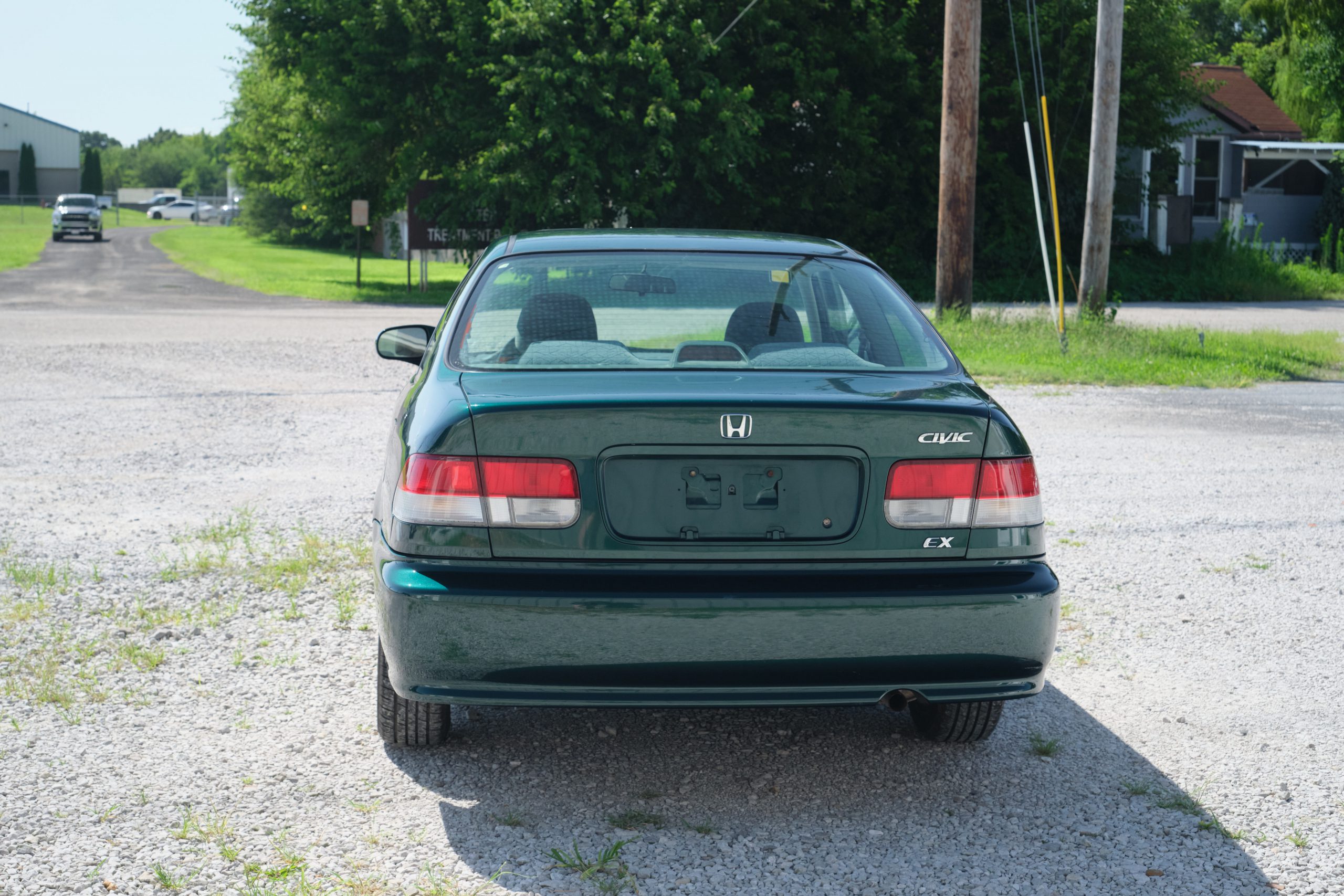
The 1999 Honda Civic EX produces 127 horsepower at 6,600 rpm and 107 lb-ft of torque at 5,500 rpm. This output is generated by the 1.6-liter D16Y8 engine, a single-overhead-cam (SOHC) powerplant featuring Honda’s signature VTEC technology, which balances daily fuel efficiency with increased high-end performance.
As we look back from the perspective of 2026, the 1999 Honda Civic EX remains a hallmark of the "Golden Era" of Honda engineering. While 127 horsepower might seem modest by modern standards where even entry-level hatchbacks often exceed 180 hp, the Civic EX was a leader in its class for the late 1990s. Its performance was defined not just by raw numbers, but by the efficiency of its power delivery and the lightweight chassis it propelled. Understanding the horsepower of the 1999 EX requires a look at the specific D16Y8 engine, the mechanics of SOHC VTEC, and how that power translates to the road.
The Heart of the EX: The D16Y8 Engine
The 1999 Honda Civic EX was equipped exclusively with the D16Y8 engine. This engine was the pinnacle of the "D-series" family available in the United States for the sixth-generation Civic. Unlike the lower-tier DX and LX trims, which utilized the D16Y7 engine, the EX’s Y8 variant was designed specifically to provide a more spirited driving experience.
Technical Specifications of the D16Y8
The D16Y8 is an inline 4-cylinder engine with a displacement of 1,590cc. It features an aluminum alloy block and cylinder head, which contributed to the vehicle’s low curb weight (approximately 2,500 to 2,600 pounds depending on body style).
Key internal specs that contribute to its 127 hp rating include:
- Compression Ratio: 9.6:1 (higher than the 9.4:1 found in the DX/LX trims).
- Bore and Stroke: 75.0 mm x 90.0 mm.
- Valvetrain: SOHC (Single Overhead Cam) with 4 valves per cylinder.
- Fuel System: Multi-point fuel injection (PGM-FI).
The higher compression ratio and the specific design of the intake manifold on the D16Y8 are primary reasons for its 21-horsepower advantage over the non-VTEC models of the same year. The EX intake manifold features shorter, wider runners compared to the LX/DX, allowing for better airflow at higher engine speeds.
Understanding SOHC VTEC in the 1999 EX
The "VTEC" badge on the 1999 Civic EX refers to Variable Valve Timing and Lift Electronic Control. However, it is important to distinguish this from the "Big VTEC" found in the Civic Si of the same year.
The EX utilizes SOHC VTEC, which only operates on the intake valves. At lower engine speeds (below approximately 5,400 rpm), the engine operates on a cam profile optimized for fuel economy and low-end torque. When the engine crosses the VTEC engagement point—typically between 5,400 and 5,600 rpm depending on engine load and oil pressure—the ECU (Electronic Control Unit) engages a locking pin that forces the intake valves to follow a more aggressive, high-lift cam lobe.
This allows the engine to "breathe" better at high RPMs, which is why the 127 hp peak is reached so high in the rev range (6,600 rpm). This technology gave the 1999 EX a dual personality: it was a docile, fuel-efficient commuter under 5,000 rpm, but it offered a noticeable "kick" and a change in engine note as it approached its 7,200 rpm redline.
Horsepower vs. Torque: The Driving Experience
While 127 horsepower provided respectable acceleration for 1999, the 107 lb-ft of torque is where the car’s age is most apparent. Modern turbocharged engines often produce peak torque as low as 1,500 rpm; by contrast, the 1999 Civic EX doesn't reach its maximum torque until 5,500 rpm.
This means that for the driver to access the full potential of the engine, they must be willing to rev it out. In a 2026 context, this makes the car feel slower in "stop-and-go" traffic than modern subcompacts, but more engaging on winding roads or highway merging where high-RPM driving is required. The lack of low-end torque is also why the 1999 EX is highly sensitive to weight; carrying three passengers and luggage can significantly dampen the perceived horsepower.
Transmission Impact: Manual vs. Automatic Power Delivery
The real-world horsepower available at the wheels—often called Wheel Horsepower (WHP)—varies significantly between the two transmission options offered in 1999.
The 5-Speed Manual (S40 Transmission)
The manual transmission is the preferred choice for enthusiasts. It features relatively short gearing that allows the driver to keep the D16Y8 within its VTEC powerband more easily. Drivetrain loss for the manual is typically estimated at 12–15%, meaning a healthy 1999 EX would put down roughly 108–112 hp to the wheels.
The 4-Speed Automatic
The automatic transmission in the 1999 EX significantly reduces the car's performance. Not only is the drivetrain loss higher (roughly 18–22%), but the wide gear ratios often "drop" the engine out of the VTEC range during upshifts. An automatic EX might only put 95–100 hp to the wheels, and the response time of the 1990s-era torque converter makes the car feel considerably less punchy than its manual counterpart.
Comparative Performance: EX vs. Other 1999 Civic Trims
To understand the 127 hp of the EX, it must be placed in the context of the 1999 lineup. This year was part of the "facelift" for the 6th generation, which updated the styling but kept the core engine architecture.
| Trim Level | Engine Code | Horsepower | Torque | Major Difference |
|---|---|---|---|---|
| CX / DX / LX | D16Y7 | 106 hp @ 6,200 rpm | 103 lb-ft @ 4,600 rpm | No VTEC; economy-focused intake |
| HX (Coupe) | D16Y5 | 115 hp @ 6,300 rpm | 104 lb-ft @ 5,400 rpm | VTEC-E (Optimized for ultra-high MPG) |
| EX (Coupe/Sedan) | D16Y8 | 127 hp @ 6,600 rpm | 107 lb-ft @ 5,500 rpm | SOHC VTEC; Performance/Efficiency balance |
| Si (Coupe) | B16A2 | 160 hp @ 7,600 rpm | 111 lb-ft @ 7,000 rpm | DOHC VTEC; high-performance |
The EX was the "premium" trim for those who wanted amenities like a sunroof and power windows but also desired a bit more "pep" than the base models provided. It sat comfortably in the middle of the lineup, offering nearly 20% more power than the DX without the higher insurance premiums and stiffer ride of the Si.
The Impact of Age: Performance in 2026
As of 2026, a 1999 Honda Civic EX is 27 years old. It is rare to find an original D16Y8 engine that still produces its factory-rated 127 horsepower. Several factors contribute to "horsepower decay" over nearly three decades:
- Compression Loss: Over time, piston rings and valve seals wear down. A drop in cylinder compression directly correlates to a loss of horsepower. A compression test is the only way to verify if an EX is still "healthy."
- VTEC Solenoid Issues: The VTEC system relies on oil pressure. If the VTEC solenoid screen is clogged or if the engine is low on oil, VTEC may not engage at all, leaving the car stuck on the "economy" cam profile and capping power significantly.
- Exhaust Clogging: Original catalytic converters from 1999 may become partially restricted over decades of use, creating backpressure that chokes the engine’s ability to exhale.
- Sensors and Electronics: The OBD-IIb system used in the 1999 model relies on aging oxygen sensors and MAP sensors. If these are out of spec, the ECU may run the engine in a "rich" or "safe" mode that reduces output.
For owners in 2026, restoring this lost horsepower usually involves a thorough "Stage 0" refresh: replacing the timing belt, spark plugs, wires, fuel filter, and cleaning the throttle body and IACV (Idle Air Control Valve).
Modernizing the HP: Common Performance Upgrades
Because the 1999 Civic EX was a cornerstone of the tuner movement, there is an exhaustive list of ways to increase its 127 hp rating.
- Bolt-Ons (The Basics): A Cold Air Intake (CAI), a 4-2-1 header, and a high-flow exhaust system are the most common mods. On a D16Y8, these typically yield a modest gain of 5–10 hp, but they significantly improve the engine's sound and throttle response.
- Intake Manifold Swaps: While the Y8 manifold is already good, some owners port and polish it or swap to aftermarket versions like those from Skunk2 to improve high-end flow.
- Forced Induction: The D16Y8 is a popular candidate for "budget" turbo setups. On stock internals, the engine can safely handle about 6–8 psi of boost, which can push horsepower from 127 hp to approximately 180–200 hp. However, the "D-series" rods are notoriously weak, and exceeding 220 hp usually results in engine failure.
- The "Mini-Me" Swap: Interestingly, owners of the non-VTEC DX/LX models often swap the 1999 EX (D16Y8) head onto their blocks to "gain" the EX's horsepower. For an existing EX owner, the next logical step up is usually a full engine swap to a B-series (from an Si or Integra) or a K-series engine.
Weight-to-Power Ratio: Why 127 HP Worked
To truly explain the 1999 Honda Civic EX horsepower, one must look at the power-to-weight ratio. The 1999 Civic EX Sedan has a curb weight of roughly 2,522 lbs.
- 1999 Civic EX: 127 hp / 2,522 lbs = ~19.8 lbs per horsepower.
- 2024 Honda Civic Sport: 158 hp / 2,935 lbs = ~18.5 lbs per horsepower.
Despite the 25-year age gap, the power-to-weight ratio is remarkably close. This is why the 1999 EX still feels nimble and "zippy" in modern traffic. It doesn't have the mass of modern safety systems, sound deadening, and heavy infotainment screens, allowing its 127 hp to work much harder than it would in a modern vehicle.
1999 Honda Civic EX Technical Summary Table
| Category | Specification |
|---|---|
| Engine Code | D16Y8 |
| Horsepower | 127 hp @ 6,600 rpm |
| Torque | 107 lb-ft @ 5,500 rpm |
| Redline | 7,200 rpm |
| VTEC Engagement | ~5,400 - 5,600 rpm |
| Curb Weight | 2,513 (Coupe) - 2,522 (Sedan) lbs |
| 0-60 MPH (Manual) | Approx. 8.4 - 8.9 seconds |
| 0-60 MPH (Auto) | Approx. 10.2 - 11.0 seconds |
| Compression Ratio | 9.6:1 |
| Fuel Requirement | 87 Octane (Unleaded) |
Frequently Asked Questions
Is the 1999 Civic EX fast?
By 2026 standards, the 1999 Civic EX is considered slow in a straight line, with a 0-60 mph time of around 8.5 seconds for the manual version. However, due to its double-wishbone suspension and lightweight frame, it is considered "fast" in terms of handling and momentum driving. It is a car that rewards a driver who maintains speed through corners rather than one who relies on raw acceleration.
Can I run 91 or 93 octane to get more HP?
No. The D16Y8 engine in the EX was tuned for 87 octane. Unless you have modified the ignition timing or added a turbocharger, higher octane fuel will not provide any additional horsepower. The compression ratio of 9.6:1 is not high enough to require premium fuel to prevent detonation under standard conditions.
Does the 1999 Civic EX have a "VTEC Controller"?
It did not come with one from the factory, but many owners in the early 2000s added aftermarket VTEC controllers (like the Apexi VAFC). These allow the driver to change the RPM at which VTEC engages. However, engaging VTEC too early (before the engine is flowing enough air) can actually reduce horsepower and cause the engine to bog down.
Why does my EX feel like it loses power when the AC is on?
Because the engine only produces 107 lb-ft of torque, the parasitic draw of the air conditioning compressor takes a significant percentage of the engine's available power. In a small-displacement engine like the D16Y8, the AC can sap as much as 5–10 hp, which is very noticeable during acceleration.
Is the D16Y8 reliable at high RPMs?
Yes, the D16Y8 is generally very reliable, but it has one known weakness: the oiling system. At sustained high RPMs (such as track use), the oil pump can struggle to keep up, and the engine is known to "throw a rod" or spin a bearing more easily than the B-series engines. For street driving and occasional spirited runs, the 127 hp is well-supported by the engine's design.
Practical Recommendation for Owners
If you are looking to buy or maintain a 1999 Honda Civic EX in 2026, focus on mechanical restoration over performance parts. A 127 hp engine that has been neglected will likely only produce 100 hp. By replacing the oxygen sensors, cleaning the fuel injectors, and ensuring the VTEC solenoid is functioning perfectly, you will experience the car as it was meant to be. If the 127 hp is insufficient for your needs, the 6th generation Civic chassis is the most versatile platform in history for engine swaps, making a jump to 160 or even 200 hp relatively straightforward with a B16 or K20 swap.