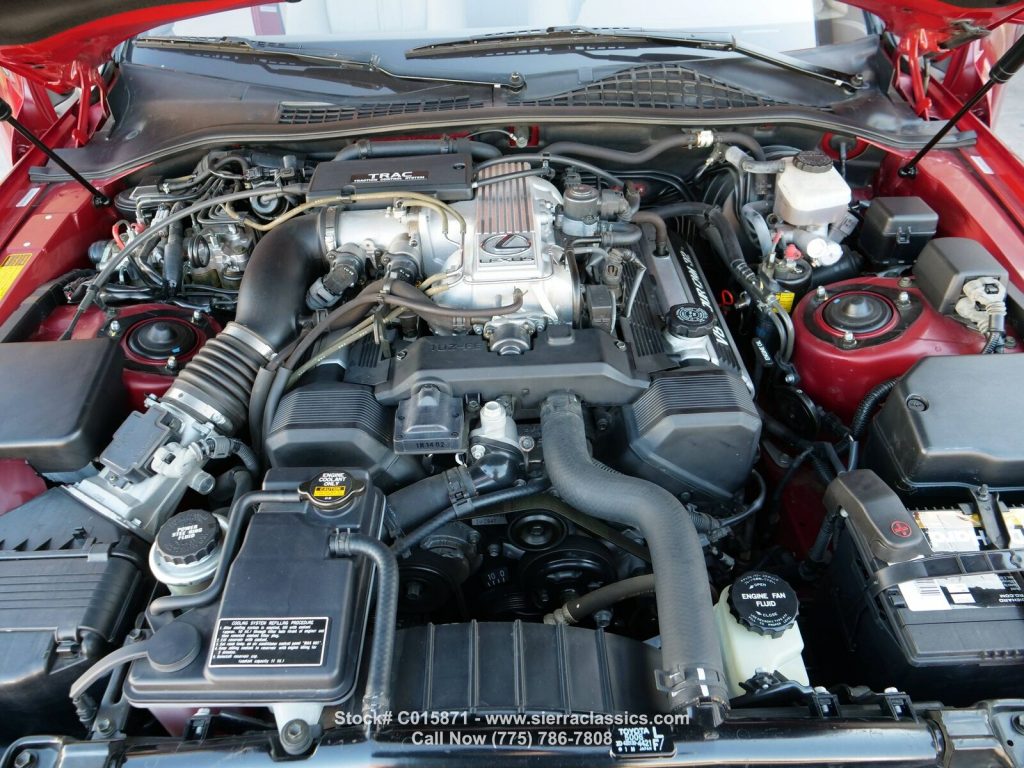
The 1992 Lexus SC400 is powered by the 1UZ-FE, a 4.0-liter, 32-valve DOHC V8 engine renowned for its extreme durability, smoothness, and over-engineered construction. Producing 250 horsepower and 260 lb-ft of torque, this powerplant is famous for its ability to exceed 300,000 miles with routine maintenance, specifically timing belt and cooling system services.
The Engineering Origin of the 1UZ-FE
To understand the 1992 Lexus SC400 motor, one must look back at the "Circle F" project—Toyota’s multi-billion dollar endeavor to create the world’s best luxury car. The 1UZ-FE was not merely a modified truck engine; it was a clean-sheet design intended to rival the best from Mercedes-Benz and BMW. When it debuted in the early 1990s, it set a new benchmark for "NVH" (Noise, Vibration, and Harshness).
The 1992 iteration represents the purest form of the early 1UZ design. Unlike later versions which adopted Variable Valve Timing with intelligence (VVT-i) in 1998, the 1992 motor features thick, forged connecting rods and a non-interference valvetrain design. This over-engineering was a result of Toyota’s desire to ensure zero failures in their nascent luxury brand. Engineers reportedly spent years refining the tolerances, leading to an engine so smooth that a famous television advertisement showed a pyramid of champagne glasses remaining undisturbed on the hood of a Lexus while the engine revved on a dynamometer.
Technical Specifications and Architecture
The 1UZ-FE is an all-aluminum 90-degree V8. The choice of aluminum for both the block and the heads was sophisticated for 1992, keeping the front-end weight of the SC400 manageable and improving the vehicle's 54/46 weight distribution.
Core Internals
The bottom end of the 1992 1UZ-FE is its most celebrated feature. It utilizes six-bolt main bearings, a feature typically reserved for high-performance racing engines or heavy-duty diesel powerplants. This provides incredible rigidity to the crankshaft, which is a forged steel unit rather than cast iron.
The pistons are made of a high-silicon aluminum alloy, designed for thermal stability. In this 1992 "early-spec" version, the connecting rods are significantly beefier than those found in the 1998–2000 models. For modern enthusiasts in 2026 looking to add forced induction (turbochargers or superchargers), the 1992 motor remains the most sought-after variant because these rods can reliably handle significantly more cylinder pressure than the later, thinner versions.
Valvetrain and Induction
The engine features dual overhead cams (DOHC) per bank, with four valves per cylinder. A notable quirk of the 1992 design is the ignition system, which uses dual distributors driven by the camshafts. While this setup seems archaic by 2026 standards, it was a robust solution for providing consistent spark at high RPMs before individual coil-on-plug systems became the industry standard.
| Feature | Specification (1992 1UZ-FE) |
|---|---|
| Displacement | 3,968 cc (4.0 Liters) |
| Bore x Stroke | 87.5 mm x 82.5 mm |
| Compression Ratio | 10.0:1 |
| Horsepower | 250 hp @ 5,600 RPM |
| Torque | 260 lb-ft @ 4,400 RPM |
| Valvetrain | DOHC, 32-Valve, Belt Driven |
| Block/Head Material | Aluminum / Aluminum |
| Fuel System | Multi-port Fuel Injection |
Essential Maintenance for the 30-Year Milestone
As we inhabit 2026, any 1992 Lexus SC400 motor has been in service for over 34 years. While the mechanical internals are nearly bulletproof, the peripheral components and rubber seals are subject to the laws of entropy. To keep a 1UZ-FE running another decade, several specific maintenance areas must be addressed.
The Timing Belt and Water Pump
The 1992 1UZ-FE is a non-interference engine. This is a critical distinction; if the timing belt snaps while the engine is running, the pistons will not strike the valves. However, a failure will still leave you stranded. The service interval is typically 90,000 miles or every 10 years. In 2026, if you do not have proof of a recent change, this should be your first priority. Replacing the water pump, idler pulleys, and tensioner at the same time is mandatory, as these components reside behind the timing cover and require the same labor to access.
The "Valley of Death" (Starter Motor)
One of the few engineering choices that mechanics loathe on the SC400 is the starter motor location. Unlike most cars where the starter is bolted to the side of the transmission, the 1UZ-FE places the starter in the center valley of the engine block, tucked underneath the intake manifold.
Replacing a starter on a 1992 SC400 is a labor-intensive "top-down" job. It requires removing the throttle body, intake plenum, and fuel rails. Because of this complexity, it is highly recommended to use only an OEM Denso starter; aftermarket units often fail prematurely, forcing you to repeat the 6-hour labor process.
Power Steering Pump Leaks
A common failure point that can kill the engine's electronics is the power steering pump. The pump is located directly above the alternator. Over time, the internal seals in the pump fail, dripping corrosive power steering fluid (Dexron III ATF) directly into the alternator's internals. This eventually causes a total charging system failure. Owners should regularly check the alternator for "wetness" and rebuild the power steering pump at the first sign of a leak.
Solving the 2026 "Electronic Plague": ECU Capacitors
As these vehicles have aged into their fourth decade, a new problem has emerged that is often misdiagnosed as a mechanical engine failure: leaking ECU capacitors.
The Engine Control Unit (ECU) in the 1992 SC400 uses electrolytic capacitors that have a finite lifespan. By 2026, most original units have begun to leak fluid onto the circuit board. This can cause a variety of symptoms, including:
- Random stalling or "hiccups" while driving.
- Poor fuel economy and "rich" exhaust smells.
- Check Engine Lights (CEL) for sensors that are actually functioning correctly.
- A "no-start" condition where the fuel pump isn't being triggered.
Restoring a 1992 motor often involves sending the ECU to a specialist for a capacitor "re-cap" using modern, high-temp components. This single step often restores the factory smoothness that many owners assume was lost to mechanical wear.
Performance Potential and Modifications
For those looking to extract more than the factory 250 horsepower, the 1992 1UZ-FE is an excellent canvas, though it requires specific approaches.
Natural Aspiration
The early 1UZ is somewhat restricted by its intake and exhaust manifolds. The factory headers are "log-style" and quite restrictive. Upgrading to aftermarket headers can unlock 15-20 horsepower. However, because the engine was designed for silence and luxury, the stock intake is already very efficient at pulling cold air; "cold air intake" kits often provide more noise than actual power gains.
Forced Induction
This is where the 1992 motor shines. Because of the thick connecting rods mentioned earlier, the 1992-1994 1UZ-FE can handle approximately 400-450 wheel horsepower on stock internals. Common modifications include:
- Supercharging: Using kits based on Eaton M90 or M112 blowers.
- Turbocharging: Single or twin-turbo setups are popular in the "drift" community, though they require custom manifold fabrication.
- Standalone ECU: Replacing the factory computer with a modern system (like Haltech or Link) is necessary to tune for boost, especially since the 1992 ECU cannot be "reflashed."
Comparison: 1UZ-FE vs. Contemporary Rivals
In 1992, the SC400 competed with the BMW 8-Series and the Infiniti M30/Q45. How does the 1UZ-FE hold up against its peers?
| Engine | Displacement | Configuration | Notable Strength | Weakness |
|---|---|---|---|---|
| Lexus 1UZ-FE | 4.0L | V8 | Unmatched longevity | Starter location |
| BMW M60B40 | 4.0L | V8 | High-revving power | Nikasil bore failure |
| Infiniti VH45DE | 4.5L | V8 | High torque output | Timing chain guides |
| Mercedes M119 | 4.2L/5.0L | V8 | Robust build | Biodegradable wiring |
The 1UZ-FE was the only engine in this group that didn't suffer from a "fatal flaw" like the BMW's cylinder bore erosion or the Mercedes' crumbling wiring harnesses. This is why more 1992 SC400s remain on the road today in 2026 than many of its more expensive European counterparts.
Troubleshooting Common 1992 SC400 Motor Issues
If your 1992 SC400 motor is behaving poorly, use this checklist to narrow down the cause:
- Rough Idle: Check the Idle Air Control Valve (IACV). These often get gummed up with carbon. Cleaning the valve with specialized cleaner can often restore a glass-smooth idle.
- Ticking Noise: The 1UZ-FE uses shim-over-bucket valve lifters. While they rarely go out of adjustment, a "ticking" sound usually indicates the need for a valve clearance check (though this is only required every 60k-100k miles).
- Misfire under load: Check the spark plug wires and the two distributor caps/rotors. Because the 1992 motor uses a traditional ignition wire setup, the wires can dry rot and "arc" against the engine block.
- Oil Leaks: The most common leak points are the valve cover gaskets and the cam seals. If oil is pooling in the spark plug holes, the inner valve cover gaskets have failed.
Frequently Asked Questions
Is the 1992 Lexus SC400 motor an interference engine?
No, the 1992 1UZ-FE is a non-interference engine. If the timing belt breaks, the valves will not hit the pistons. This changed in 1998 with the introduction of VVT-i, at which point the engine became an interference design.
How much does it cost to replace the timing belt in 2026?
Given inflation and the scarcity of skilled technicians for older platforms, a comprehensive timing belt and water pump service in 2026 typically costs between $1,200 and $1,800, including parts and labor. It is a 6-to-8-hour job for an experienced mechanic.
Can I run the 1992 SC400 on regular 87 octane fuel?
The 1992 1UZ-FE has a 10.0:1 compression ratio and was designed for premium fuel (91+ octane). While the knock sensors will retard timing to allow the engine to run on 87 octane without immediate damage, you will experience reduced fuel economy and a noticeable drop in power. To maintain the engine's longevity, premium fuel is highly recommended.
Why is my SC400 motor shaking at stoplights?
If the engine is mechanically sound, the most common cause for vibration is worn engine mounts. The 1UZ is so balanced that if the mounts are healthy, you shouldn't feel it running. By 2026, the original rubber mounts have likely collapsed or hardened.
What is the maximum mileage a 1UZ-FE can achieve?
There are numerous documented cases of 1UZ-FE engines reaching 500,000 miles, and several "million-mile" examples exist (mostly in the LS400 chassis, which shares the same motor). The key is consistent oil changes every 5,000 miles and preventing overheating.
Final Recommendation for Owners
If you are looking to purchase or restore a 1992 Lexus SC400, focus your efforts on the ECU, timing belt, and power steering system. The 1UZ-FE motor itself is essentially a "lifetime" component if it is not overheated. For those interested in performance, the 1992 model year is the "holy grail" due to its stronger internal rods, making it the perfect candidate for a high-horsepower build. Treat the cooling system with reverence—replace old plastic radiators before they crack—and this motor will likely outlast most modern vehicles produced in the 2020s.