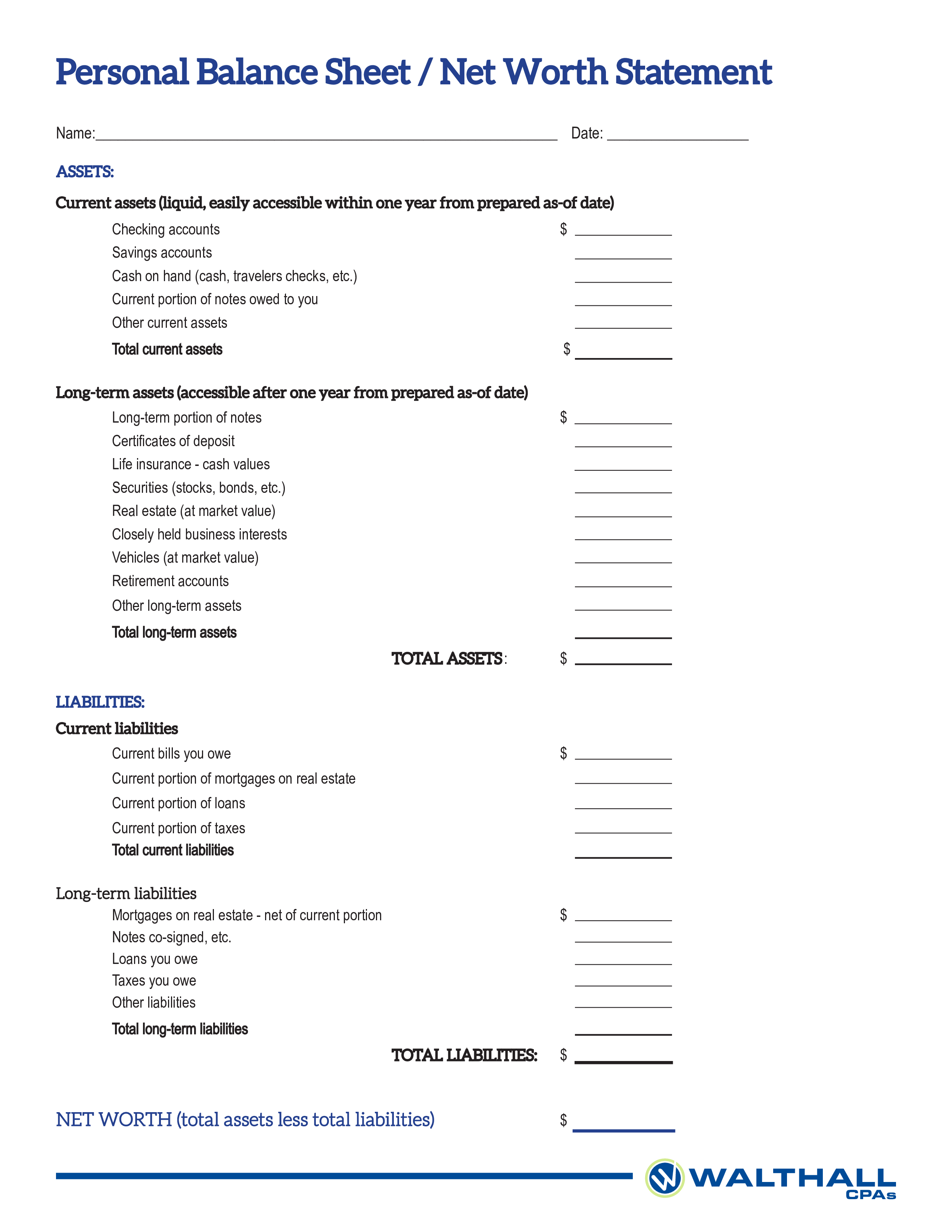
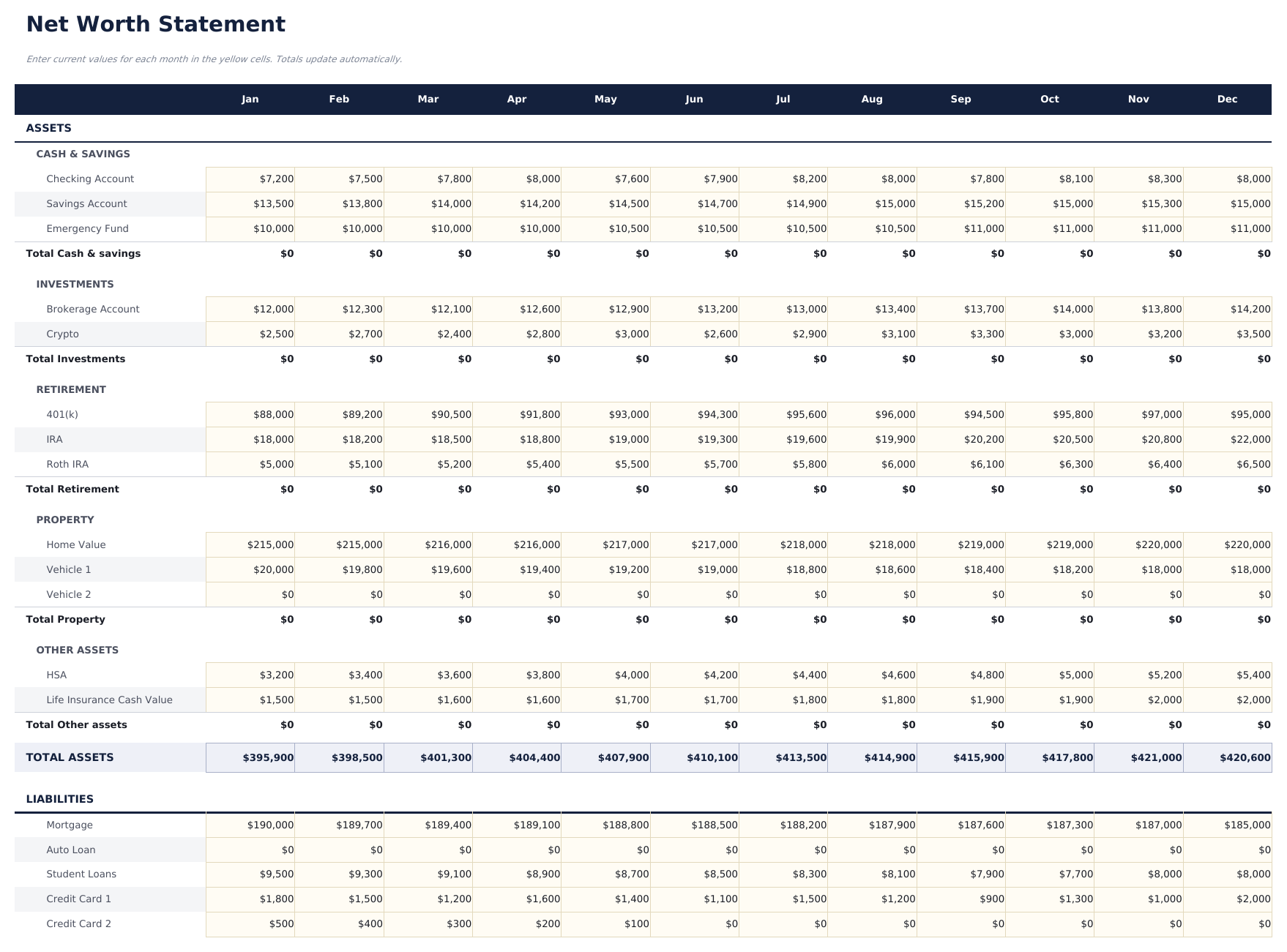
A net worth statement, also known as a personal balance sheet, provides a comprehensive overview of an individual's financial health by calculating the difference between total assets and total liabilities. It serves as a definitive "snapshot" that reveals solvency, liquidity, and progress toward long-term wealth-building goals at a specific point in time.
To understand why a net worth statement explains an individual's financial position so effectively, one must look beyond the simple final number. This document organizes a chaotic array of bank accounts, investment portfolios, real estate holdings, and various debts into a structured format. By doing so, it allows an individual to see the "big picture" of their financial life, moving the focus away from monthly cash flow and toward long-term stability and equity.
The Mathematical Foundation of Financial Position
At its core, a net worth statement is governed by a fundamental accounting equation: Assets - Liabilities = Net Worth. While the math is elementary, the implications for an individual's financial position are profound.
Understanding Assets
Assets represent everything of value that an individual owns. In a professional net worth statement, assets are typically categorized by their liquidity—how quickly they can be converted into cash without a significant loss in value.
- Liquid Assets: These are the most accessible forms of wealth. They include checking and savings accounts, money market funds, and certificates of deposit (CDs) that are nearing maturity. In 2026, many individuals also include stable digital currencies or high-yield cash management accounts within this category. High liquidity indicates a strong short-term financial position, meaning the individual can handle emergencies without selling long-term investments.
- Investment Assets: This category includes brokerage accounts, retirement accounts (such as 401(k)s and IRAs), stocks, bonds, and mutual funds. These assets are intended for long-term growth. Their value on the statement should reflect current market prices as of the statement date.
- Real Property: For most individuals, a primary residence is their largest asset. Other real estate, such as rental properties or vacation homes, also falls here. Valuation in 2026 relies on recent comparable sales or professional appraisals to ensure the financial position is accurately represented.
- Personal Property: This includes vehicles, jewelry, artwork, and high-value collectibles. It is a common mistake to overvalue these items; for an accurate financial position, these should be listed at their resale value, not their original purchase price.
Understanding Liabilities
Liabilities are the financial obligations or debts owed to other entities. They are typically split into two sub-categories to better explain the individual's debt pressure.
- Current Liabilities: Debts that are due within a year. This includes credit card balances, unpaid utility bills, or the portion of a loan due within the next 12 months.
- Long-Term Liabilities: Major obligations that will take years to satisfy, such as mortgages, student loans, or auto loans.
By subtracting these obligations from total assets, the resulting net worth figure represents the "equity" an individual truly possesses. If you were to sell everything you own today and pay off every debt you owe, the net worth is the amount of cash that would remain in your pocket.
Why the Statement is the Ultimate Diagnostic Tool
A net worth statement explains an individual’s financial position far better than a simple bank balance or a salary figure. Income is a "flow" of money, whereas net worth is a "stock" of wealth. It is entirely possible for an individual with a high salary to have a negative net worth if their lifestyle and debt accumulation outpace their earnings.
Assessment of Solvency
Solvency is the ability to meet long-term obligations. A positive net worth indicates solvency, while a negative net worth (where liabilities exceed assets) suggests technical insolvency. While a negative net worth might be expected for a recent university graduate with significant student loans but high earning potential, it is a critical warning sign for someone approaching retirement age in 2026.
Liquidity Analysis
The statement reveals if an individual is "asset rich but cash poor." For example, someone might have a net worth of $1 million, but if $950,000 of that is tied up in a primary residence and retirement accounts that cannot be accessed without penalty, their financial position is actually quite fragile in the face of an immediate job loss or medical emergency.
Tracking Wealth Momentum
By comparing net worth statements from year to year, an individual can see the trajectory of their financial health. This is known as "wealth momentum." If assets are growing while liabilities are shrinking, the financial position is strengthening. Conversely, if assets are growing but liabilities are growing faster, the individual’s position is actually deteriorating despite the appearance of accumulating "things."
Strategic Use Cases for a Net Worth Statement
Beyond personal tracking, the net worth statement is a formal document used in various professional and legal contexts.
Loan and Mortgage Applications
When applying for significant credit, lenders use the net worth statement to determine the "character" and "capacity" of the borrower. A person with a high net worth is viewed as a lower risk because they have assets that could theoretically be liquidated to repay the debt. Lenders often look at the Debt-to-Asset Ratio, calculated directly from this statement, to set interest rates and loan limits.
Estate and Tax Planning
In 2026, estate tax thresholds and gift tax exclusions remain a primary concern for high-net-worth individuals. An accurate statement is the starting point for estate planning, helping executors and attorneys understand the complexity of an estate and the potential tax liabilities that may arise upon the owner's death.
Retirement Readiness
The net worth statement is the most reliable tool for determining if an individual can afford to stop working. By isolating "investable assets" from "personal use assets" (like a home or car), a financial planner can determine if the portfolio is large enough to sustain the individual’s lifestyle through withdrawals.
How to Create an Accurate Net Worth Statement
To ensure the statement accurately explains your financial position, follow a systematic approach to data collection and valuation.
Step 1: List and Value Assets
Gather the most recent statements for all accounts. For 2026, this often involves logging into various fintech portals to get real-time valuations.
- Cash: Use the balance from the previous business day.
- Investments: Use the closing market price.
- Real Estate: Use a conservative estimate from a reputable valuation service or a recent appraisal.
- Business Interests: If you own a business, its value should be included, though this often requires a separate professional valuation.
Step 2: List All Liabilities
Include every penny owed.
- Mortgages: Get the current payoff balance, not the original loan amount.
- Credit Cards: Use the current balance, even if you plan to pay it off at the end of the month.
- Personal Loans: Include loans from family members if they are legally enforceable.
Step 3: Perform the Calculation
Total the assets and total the liabilities, then subtract the latter from the former.
| Category | Item Example | Valuation Method | Impact on Position |
|---|---|---|---|
| Liquid Asset | Savings Account | Current Balance | Provides immediate security |
| Invested Asset | 401(k) / IRA | Market Value | Long-term growth/Retirement |
| Use Asset | Primary Home | Fair Market Value | Stability/Equity growth |
| Current Liability | Credit Card Debt | Current Balance | Reduces monthly cash flow |
| Long-term Liability | Mortgage | Payoff Amount | Large equity deduction |
Common Pitfalls in Interpreting Financial Position
Even with a completed statement, misinterpretations can lead to poor financial decisions.
The "Home Equity" Trap
Many individuals include the full value of their home in their net worth but forget to deduct the mortgage. While the home is an asset, only the equity (Market Value - Mortgage Balance) contributes to the net worth. Furthermore, relying too heavily on home equity for a positive net worth can be dangerous, as real estate is an illiquid asset that can take months to sell.
Ignoring Tax Liabilities
A net worth statement often shows "pre-tax" wealth. For example, a $1,000,000 balance in a traditional 401(k) is not actually worth $1,000,000 to the individual, because a significant portion—perhaps 20% to 35%—is owed to the government in future taxes upon withdrawal. A "technical" net worth statement for an individual in 2026 should ideally account for these embedded tax liabilities to show a more realistic financial position.
Inflationary Distortions
In 2026, as in previous years, inflation can make a net worth look like it is growing when, in real terms (purchasing power), it might be stagnant. It is helpful to calculate "real" net worth by adjusting for the Consumer Price Index (CPI) when comparing statements over several years.
The Role of Net Worth in 2026 Financial Standards
The financial landscape of 2026 emphasizes transparency and digital integration. Most financial advisors now require a real-time net worth statement as part of the "Know Your Customer" (KYC) process. Furthermore, for those involved in private equity or specialized investment vehicles, maintaining a certain net worth threshold is a legal requirement to be classified as an "accredited investor" under Securities and Exchange Commission (SEC) guidelines.
While income fluctuates with career changes and economic cycles, the net worth statement provides the historical record of an individual's financial discipline. It shows the results of years of saving, the wisdom of investment choices, and the burden of past debts.
Moving Beyond the Numbers
Ultimately, a net worth statement explains an individual’s financial position by providing a "truth" that income alone cannot reveal. It is the bridge between earning money and building a legacy. Whether the goal is early retirement, funding a child's education, or achieving philanthropic objectives, the journey begins with an honest assessment of this statement.
Regularly updating this document—at least annually, though quarterly is preferred by many—ensures that an individual remains the pilot of their financial destiny. It allows for mid-course corrections before small leaks in a financial plan become catastrophic failures.
Frequently Asked Questions
How often should I update my net worth statement? Most financial experts recommend updating your statement at least once a year, typically during tax season when you already have your financial documents organized. However, if you are aggressively paying down debt or are in a period of rapid investment growth, quarterly updates can provide better motivation and more timely data for decision-making.
Can a person have a high income but a low net worth? Yes, this is a common phenomenon often referred to as being "Henry" (High Earner, Not Rich Yet). If an individual earns $500,000 a year but spends $450,000 on lifestyle expenses and carries $1 million in consumer and student debt, their net worth may be negligible or even negative, despite their high income.
Should I include my car in my net worth? Yes, a car is an asset, but it is a depreciating one. You should list it at its current "Blue Book" or resale value, not what you paid for it. If you have an auto loan, the balance of that loan must be listed under liabilities to accurately show your equity in the vehicle.
What is a "good" net worth for my age? Net worth is highly individual and depends on your career path, location, and lifestyle goals. Rather than comparing yourself to national averages, which can be skewed by outliers, it is more productive to compare your current net worth to your net worth from one or two years ago. The goal is a consistent upward trend.
Does a net worth statement include my salary? No. A net worth statement is a snapshot of what you own and owe at a specific moment. Your salary is part of your cash flow statement, which tracks money coming in and going out over a period of time. While salary helps build net worth, it is not an asset itself.
How do I handle joint assets with a spouse? If you are married, you can create a "Joint Net Worth Statement" that includes all shared assets and debts. If you prefer an individual statement, you generally list 50% of the value of joint assets and 50% of the joint liabilities, unless a legal agreement specifies a different split.
Practical Next Action
To gain immediate clarity on your financial position, set aside one hour this week to list your three largest assets and your three largest debts. Perform the subtraction to find your "Core Net Worth." This simplified exercise often provides 80% of the insight of a full statement and serves as the perfect starting point for more detailed financial planning in 2026.