A line segment of a circle is a chord when its two endpoints lie exactly on the circumference of the circle. This fundamental geometric entity serves as the basis for calculating arcs, segments, and sectors. While every diameter is a chord, not every chord qualifies as a diameter, making the chord a versatile element in both theoretical and applied mathematics.
Defining the Chord: The Geometry of Line Segments and Circles
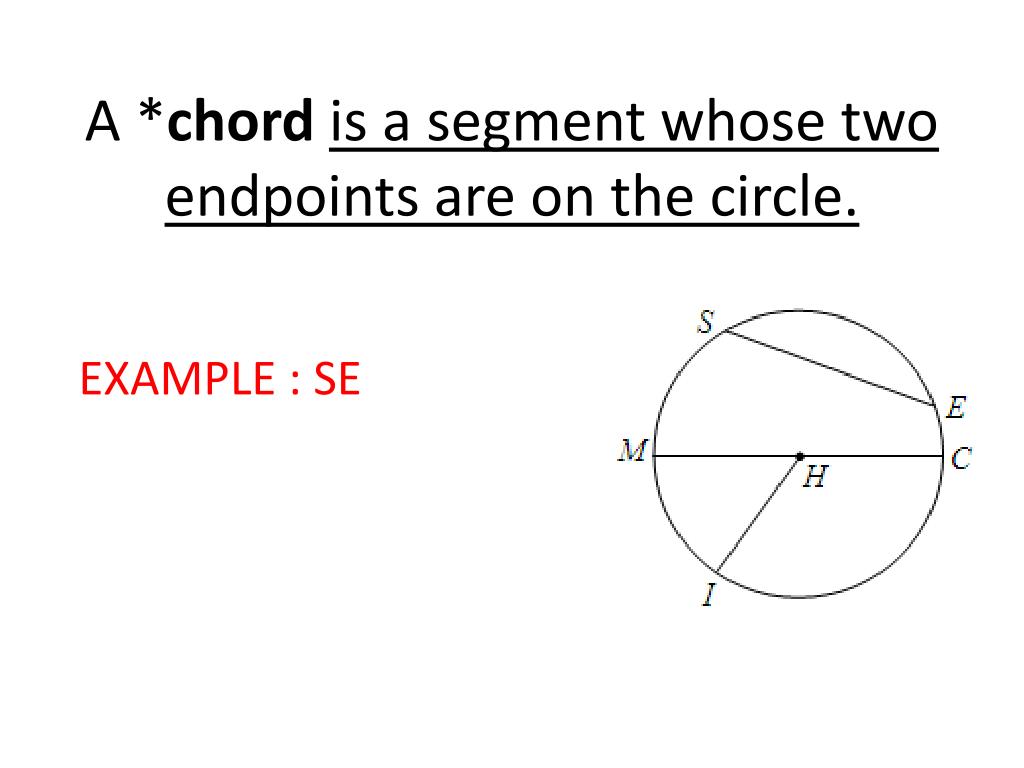
To understand why a line segment of a circle is a chord, one must first revisit the basic definitions of Euclidean geometry as they stand in 2026. A circle is defined as the set of all points in a plane that are at a fixed distance, known as the radius, from a central point. Any line segment—a finite portion of a line bounded by two distinct points—that begins and ends on this curved boundary is classified as a chord.
The term "chord" originates from the Greek word chorde, which referred to the string of a musical instrument or a bow. This etymology is visually intuitive: if you imagine a circular bow, the string connecting the two ends of the wood represents the chord. In mathematical terms, the chord "subtends" an arc, which is the portion of the circumference bounded by the chord’s endpoints.
The Fundamental Definition
In formal geometry, a chord is strictly a line segment. This is an important distinction because it separates the chord from other linear elements associated with circles, such as secants and tangents. For a segment to be a chord, it must satisfy two conditions:
- The segment must be straight (a linear path).
- Both endpoints of the segment must touch the circle's circumference.
If a segment has one endpoint at the center and one on the circumference, it is a radius. If it passes through the circle but extends infinitely in both directions, it is a secant line. The chord is the specific finite portion of a secant that exists "inside" the circle.
Chord vs. Secant vs. Tangent: Key Distinctions
It is common for students and technical professionals to conflate these terms, but their differences are critical for structural engineering, computer graphics, and navigational mathematics.
- Chord: A line segment with both endpoints on the circle. It is entirely contained within the circle (or on its boundary).
- Secant: A line that intersects a circle at two points. While a secant contains a chord, the secant itself is an infinite line, not a segment.
- Tangent: A line that touches the circle at exactly one point. A tangent never enters the interior of the circle and, therefore, cannot be a chord.
Understanding these distinctions is vital when applying the Power of a Point Theorem or calculating the stresses on circular architectural elements. In 2026, automated design software like AutoCAD and specialized geometric solvers rely on these strict definitions to execute precise renderings and structural simulations.
The Diameter: The Longest Chord in a Circle
One of the most important subsets of chords is the diameter. By definition, a diameter is a chord that passes through the center of the circle. Because it passes through the center, it represents the maximum possible distance between any two points on the circle's boundary.
The relationship between a general chord and the diameter is a primary focus in introductory geometry. Every diameter is a chord because its endpoints lie on the circle. However, a chord is only a diameter if its length is equal to twice the radius ($d = 2r$). This makes the diameter the "limiting case" for chords; as a chord moves closer to the center of the circle, its length increases until it reaches the diameter. Conversely, as a chord moves toward the edge of the circle, its length decreases toward zero.
In practical applications, identifying the diameter as a chord allows mathematicians to use chord-specific theorems to solve problems involving the widest part of a circle. For instance, Thales's Theorem states that if a triangle is inscribed in a circle where one side is a diameter, the angle opposite that side is a right angle. This is a specific application of chord properties that has been used for centuries in navigation and construction.
Mathematical Properties and Theorems of Chords
The study of chords is governed by several elegant theorems that describe their behavior relative to the circle's center, other chords, and the radii that intersect them.
The Perpendicular Bisector Theorem
One of the most useful properties of a chord involves its relationship with the circle's radius. If a radius (or diameter) is perpendicular to a chord, it bisects the chord. This means it divides the chord into two equal segments.
The proof for this relies on the properties of isosceles triangles. If you draw two radii from the center to the endpoints of a chord, you create an isosceles triangle (since all radii are equal). Dropping a perpendicular line from the apex (the center) to the base (the chord) naturally bisects the base. This property is frequently used in 2026 manufacturing processes to find the center of circular objects where the center point is not marked. By drawing two non-parallel chords and finding their perpendicular bisectors, the intersection point identifies the exact center of the circle.
Equidistant Chords and Their Properties
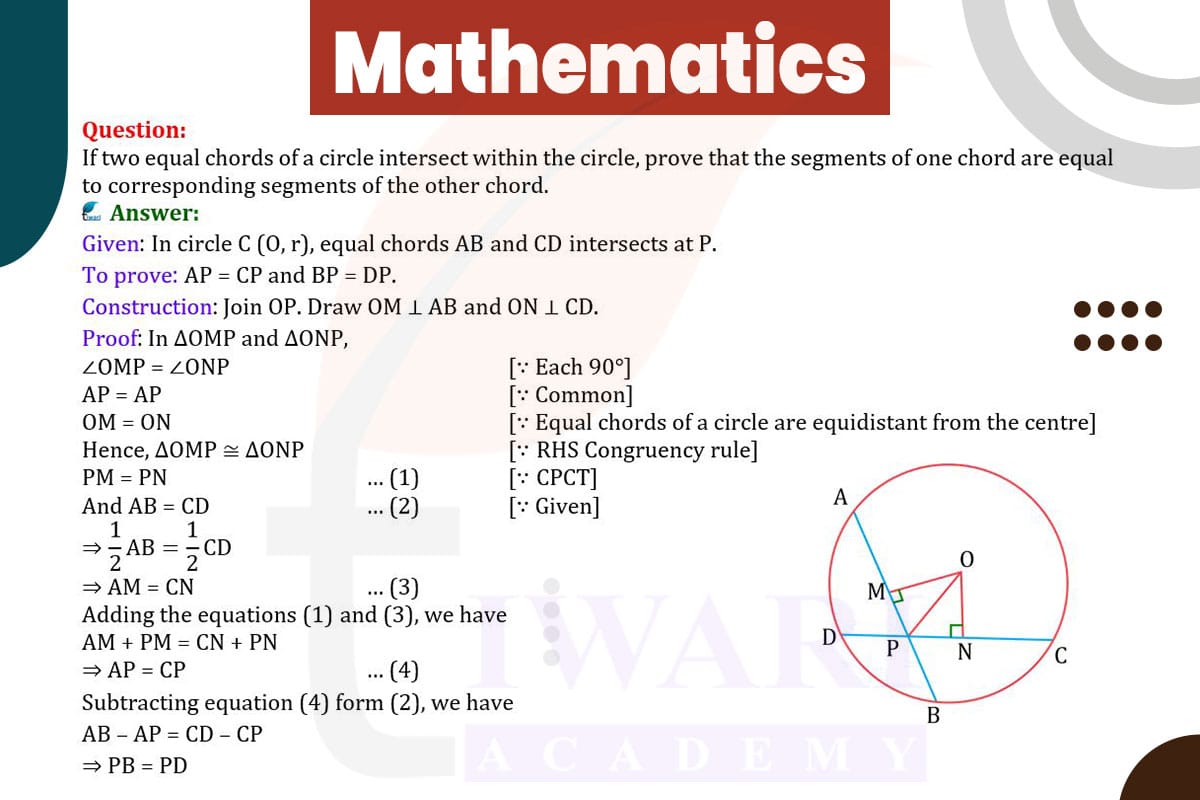
In any given circle, or in congruent circles, chords that are equal in length are equidistant from the center. This symmetry is a hallmark of Euclidean geometry. If you have two chords of 10 centimeters each in a circle with a 20-centimeter diameter, both chords will be located at the exact same distance from the center point.
The converse is also true: chords that are equidistant from the center must be equal in length. This principle is applied in the design of mechanical gears and turbines, where balanced chords ensure uniform weight distribution and rotational stability.
The Intersecting Chords Theorem
When two chords intersect inside a circle, they divide each other into segments. The Intersecting Chords Theorem states that the product of the segments of one chord is equal to the product of the segments of the other.
Mathematically, if chord $AB$ and chord $CD$ intersect at point $P$, then: $$AP \cdot PB = CP \cdot PD$$
This theorem is a result of similar triangles. The angles subtended by the same arc are equal, allowing us to establish a ratio between the sides of the triangles formed by the intersecting chords. This relationship remains a cornerstone of modern triangulation and geometric modeling in 2026.
Calculating Chord Length: Formulas and Methods
Determining the length of a chord is a common requirement in fields ranging from carpentry to aerospace engineering. Depending on the information available, there are two primary ways to calculate this.
Using the Radius and Central Angle
If you know the radius ($r$) of the circle and the central angle ($\theta$) subtended by the chord, the length ($L$) can be found using trigonometry. The formula is: $$L = 2r \sin\left(\frac{\theta}{2}\right)$$
This formula effectively treats the chord as the base of an isosceles triangle and uses the sine function to determine its length. As the angle $\theta$ increases, the chord length increases, reaching $2r$ when the angle is 180 degrees (a straight line through the center).
Using the Distance from the Center (Apothem)
In many practical scenarios, the angle is unknown, but the distance from the center to the chord ($d$) is measurable. In this case, we use the Pythagorean Theorem. Since the radius, the distance from the center, and half the chord length form a right-angled triangle, the relationship is: $$r^2 = d^2 + \left(\frac{L}{2}\right)^2$$
Solving for $L$: $$L = 2\sqrt{r^2 - d^2}$$
This calculation is essential for architects working with arched openings or curved walls, as it allows them to determine the width of a structural support based on the depth of the curve.
Comparison of Circle Segments and Lines
To visualize how a chord compares to other circular components, consider the following table:
| Feature | Chord | Diameter | Radius | Secant |
|---|---|---|---|---|
| Type of Entity | Line Segment | Line Segment | Line Segment | Infinite Line |
| Endpoints on Circle | Two | Two | One (One at center) | None (Intersects circle) |
| Passes through Center | Optional | Always | Starts at center | Optional |
| Maximum Length | Equal to Diameter | $2 \times$ Radius | $1 \times$ Radius | N/A (Infinite) |
| Key Function | Defines a Segment | Defines Semicircle | Defines Distance | Defines Intersection |
Practical Applications of Chords in 2026
The concept that a line segment of a circle is a chord is not merely an academic exercise; it has profound implications in various modern industries.
Architecture and Civil Engineering
In the design of bridges, specifically bowstring arch bridges, the "tie" that holds the arch together acts as a chord. Engineers must calculate the tension on this chord to ensure the stability of the entire structure. Similarly, in the construction of large stadiums with retractable circular roofs, chord geometry determines how the panels overlap and seal against the elements.
Astronomy and Space Exploration
In 2026, as we continue to refine satellite orbits and deep-space navigation, chord calculations are used to determine "occultation." When a celestial body passes between an observer and a star, the path the star appears to take behind the body is a chord. By measuring the time it takes for the star to disappear and reappear (the "chord" of the occultation), astronomers can calculate the precise diameter and shape of distant asteroids or planets.
Computer Graphics and Game Development
Modern rendering engines use chord properties to simplify complex curves. When a computer draws a circle, it often approximates the curve using a series of very short chords. This process, known as tessellation, relies on chord length calculations to ensure that the "jagged" edges are small enough to be invisible to the human eye, creating the illusion of a perfect curve.
Common Mistakes When Identifying and Measuring Chords
Despite the simplicity of the definition, several common errors persist in the application of chord geometry.
- Confusing Chord Length with Arc Length: The chord is the straight-line distance between two points, while the arc is the distance along the curve. The chord is always shorter than its corresponding arc (unless the distance is zero).
- Assuming All Chords are Diameters: As established, while all diameters are chords, the vast majority of chords do not pass through the center. Treating a random chord as a diameter in calculations will lead to significant errors in area and circumference.
- Ignoring the Perpendicularity Requirement: Many theorems only work if a line from the center is perpendicular to the chord. Assuming a line bisects a chord just because it comes from the center—without verifying the 90-degree angle—is a frequent mistake in geometric proofs.
Frequently Asked Questions
Is a diameter considered a chord?
Yes, a diameter is a specific type of chord. It is defined as any chord that passes through the center of the circle. In any circle, the diameter is the longest possible chord. All properties that apply to chords also apply to diameters, but diameters have additional unique properties, such as dividing the circle into two equal semicircles.
What is the difference between a chord and a secant?
A chord is a line segment, meaning it has a definite beginning and end, both of which are on the circle. A secant is a line that passes through the circle and continues infinitely in both directions. You can think of a chord as the portion of a secant that lies inside the circle.
How do you find the midpoint of a chord?
To find the midpoint of a chord, you can draw a radius from the center of the circle that is perpendicular to the chord. According to the Perpendicular Bisector Theorem, any radius that is perpendicular to a chord will bisect it, meaning the point of intersection is the chord's midpoint.
Can a chord be longer than the diameter?
No. In Euclidean geometry, no chord can be longer than the diameter of the circle. The diameter represents the maximum distance between any two points on the circle's circumference. As a chord moves further from the center, its length decreases.
What is a "Focal Chord" in a circle?
While the term focal chord is more commonly associated with parabolas and ellipses (where the chord passes through a focus), in the context of a circle, the "focus" is the center. Therefore, a focal chord of a circle is simply its diameter.
Summary and Next Actions
Understanding that a line segment of a circle is a chord provides the necessary framework for mastering circle geometry. Whether you are a student preparing for examinations or a professional applying these principles in 2026's technical landscape, the chord remains a vital geometric component.
Next Actions for Mastery:
- Practice Calculation: Use the formula $L = 2r \sin(\theta/2)$ to calculate chord lengths for various angles in a circle with a known radius.
- Verify Theorems: Draw a circle using a compass, mark a chord, and use a protractor and ruler to verify the Perpendicular Bisector Theorem.
- Explore Advanced Applications: Research the "Power of a Point" theorem to see how chord segments relate to tangents and secants in complex geometric configurations.
For those involved in technical design, ensure your software parameters correctly distinguish between chord lengths and arc lengths to maintain the structural integrity of your projects.