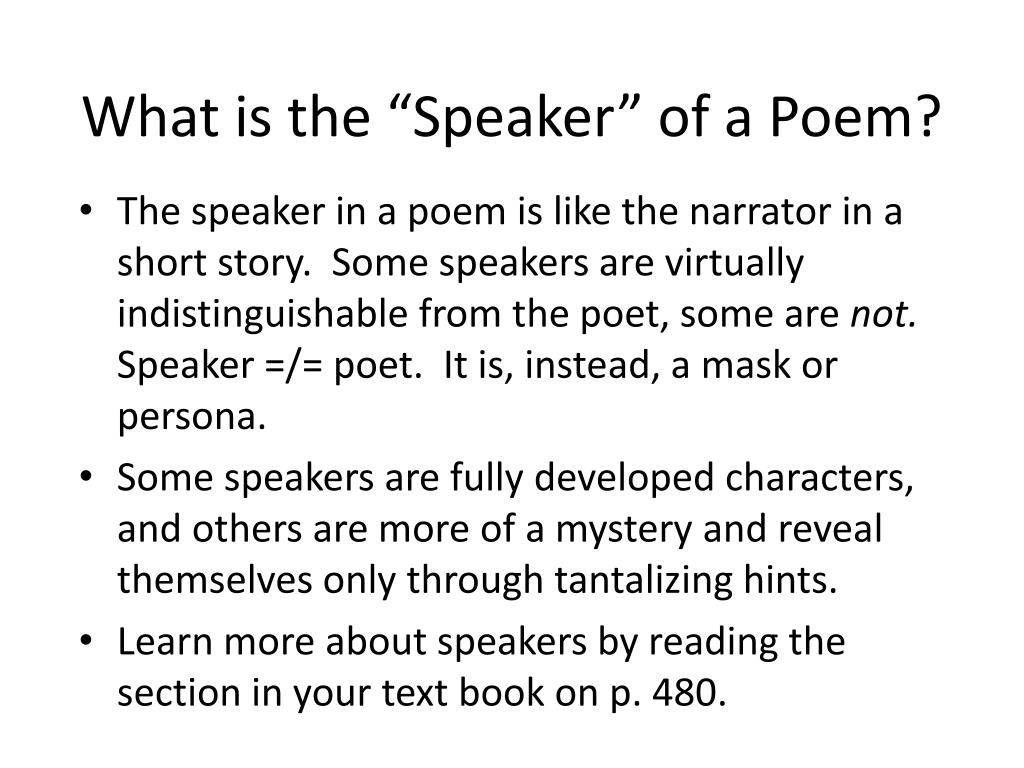
In poetry, the speaker is the persona or "voice" through which the poem is communicated. It is essential to distinguish the speaker from the poet, as the speaker functions as a specific character or perspective with unique motivations, biases, and contexts. Analyzing the speaker involves identifying their tone, perspective, and relationship to the audience.
The Vital Distinction Between Poet and Speaker
One of the most common errors in literary analysis is the "biographical fallacy"—the assumption that the "I" in a poem is the poet themselves expressing their own direct feelings and life experiences. While poets often draw from their own lives, the speaker is a literary construct. By treating the speaker as a distinct entity, readers can engage with the text more objectively, examining the rhetorical strategies and character traits the poet has deliberately assigned to that voice.
In 2026, academic standards continue to emphasize the importance of persona in literary criticism. Whether a poem is a confession, a narrative, or a political statement, the speaker serves as the medium. For instance, even in seemingly personal lyric poetry, the speaker may represent a stylized version of the self or an archetypal figure meant to evoke universal emotions rather than individual history.
Types of Speakers in Poetry
Understanding the variety of speakers is the first step in a successful analysis. The nature of the voice dictates the poem's structure, reliability, and emotional resonance.
The Persona
A persona is a mask adopted by the poet. This is most evident in dramatic monologues where the poet clearly steps into the shoes of a fictional or historical character. The goal of analyzing a persona is to determine how the character's personality influences the information they share.
The First-Person "I" (The Lyric Speaker)
This is the most common type of speaker, often found in lyric poetry. While this voice might feel intimate and autobiographical, it is still a curated persona. The analysis should focus on the speaker’s interiority—their thoughts, feelings, and sensory perceptions.
The Third-Person Objective Speaker
This speaker acts as an observer, similar to a narrator in fiction. They describe scenes, actions, or other characters without necessarily revealing their own identity or internal state. Analysis here focuses on the "camera angle" or the specific details the speaker chooses to highlight or ignore.
The Collective "We"
Rarely, a poem uses a collective speaker to represent a group, a community, or a nation. This "we" voice often appears in political or social protest poetry, where the speaker’s authority comes from their shared experience with a larger body of people.
Case Study 1: The Duke in Robert Browning’s "My Last Duchess"
Robert Browning’s "My Last Duchess" provides arguably the most famous example of a speaker for analysis. The speaker is the Duke of Ferrara, a historical figure, but Browning uses him as a vessel to explore themes of power, jealousy, and objectification.
Analyzing the Duke’s Character
When analyzing this speaker, one must look at his diction and tone. The Duke is refined, eloquent, and chillingly calm. He is showing a portrait of his deceased wife to an envoy. As he speaks, he inadvertently reveals his own monstrous nature. He complains that his wife was too friendly and "smiled" at everyone, which he viewed as a slight against his "nine-hundred-years-old name."
The Unreliable Narrator
The Duke is a classic example of an unreliable speaker. He believes he is justifying his actions (which strongly imply he had his wife murdered), but the reader perceives his vanity and cruelty. In your analysis, you would point out the gap between the Duke’s self-perception as a dignified aristocrat and the reality of his psychopathic control.
Case Study 2: J. Alfred Prufrock in T.S. Eliot’s Modernist Masterpiece
In "The Love Song of J. Alfred Prufrock," the speaker is a middle-aged, neurotic man navigating a fragmented urban landscape. Unlike the Duke, Prufrock is characterized by paralysis and indecision.
Psychological Interiority
Analysis of Prufrock requires looking at his stream of consciousness. He is a speaker who is trapped in his own head, constantly worrying about his appearance ("They will say: 'How his hair is growing thin!'") and his social standing. He is the quintessential modernist speaker—alienated, self-conscious, and unable to act.
The Addressee
The speaker invites someone along: "Let us go then, you and I." Determining who the "you" is—whether a companion or a second half of Prufrock’s own divided psyche—is a central part of the analysis. The speaker’s voice is not directed at the reader, but at an internal or intimate listener, which heightens the feeling of voyeurism and psychological depth.
Case Study 3: The Mother in Langston Hughes’ "Mother to Son"
Langston Hughes uses a distinct dialect and a powerful extended metaphor to create the speaker in "Mother to Son." The speaker is a Black mother speaking to her child about the hardships of life.
Voice and Social Context
The analysis of this speaker focuses on her ethos. Her language is colloquial and unrefined by formal standards ("Life for me ain't been no crystal stair"), yet it carries immense moral authority and wisdom. The speaker’s identity is defined by her resilience. By using this specific voice, Hughes grounds the poem in a particular cultural and historical reality, making the universal message of persistence more poignant.
The Purpose of the Voice
The speaker is not just a mother; she is an archetype of endurance. Her voice serves to inspire the son (and the reader) by contrasting her "tacks" and "splinters" with the need to "keep climbin'." The analysis should explore how her specific background and speech patterns reinforce the poem’s themes of racial and economic struggle.
A Framework for Analyzing the Speaker
To conduct a professional-level analysis of a speaker in 2026, follow this structured four-step framework. This ensures that you cover the rhetorical, psychological, and structural elements of the voice.
1. Identify the Persona and Situation
Who is speaking? Does the speaker have a name, a profession, or a specific gender? Where are they? Understanding the "dramatic situation" is the foundation of your analysis. If the speaker is anonymous, look for clues in their vocabulary and the subjects they discuss.
2. Determine the Addressee (The Silent Listener)
To whom is the speaker talking? This is known as the auditor. A speaker talking to a lover will sound very different from a speaker addressing a god, a child, or a political enemy. The relationship between the speaker and the listener defines the poem's intimacy and purpose.
3. Analyze Tone and Diction
Tone is the speaker’s attitude toward the subject matter. Is the speaker angry, nostalgic, ironic, or indifferent? Diction (word choice) provides the evidence for tone. For example, if a speaker uses medical terminology to describe a sunset, the tone is clinical and detached.
4. Evaluate Reliability and Irony
Does the speaker understand the full weight of what they are saying? Dramatic irony occurs when the reader understands something that the speaker does not. An analysis that identifies irony usually uncovers a deeper layer of meaning, showing that the poet is using the speaker to critique a certain viewpoint.
Comparison Table: Common Speaker Archetypes
The following table compares different types of speakers found in classical and contemporary poetry to help you categorize your subject.
| Speaker Type | Defining Characteristic | Example Poem | Primary Analytical Focus |
|---|---|---|---|
| The Aristocratic Controller | Highly formal, possessive, authoritative. | "My Last Duchess" | Hidden motives and moral corruption. |
| The Neurotic Intellectual | Self-doubting, fragmented, observant. | "The Love Song of J. Alfred Prufrock" | Psychological paralysis and modern alienation. |
| The Resilient Elder | Experienced, metaphorical, encouraging. | "Mother to Son" | Cultural identity and the wisdom of struggle. |
| The Nature Observer | Reflective, quiet, descriptive. | "The Road Not Taken" | The tension between external reality and internal choice. |
| The Mourner | Emotional, repetitive, focused on loss. | "The Raven" | The progression from grief to madness. |
Practical Example: Analyzing the Speaker in "The Road Not Taken"
Robert Frost’s "The Road Not Taken" is frequently misinterpreted because readers confuse the poet with the speaker. Most readers view the speaker as a wise figure who took the "road less traveled" and found success. However, a closer analysis of the speaker suggests something different.
The speaker is actually reflective and potentially self-deceiving. In the second and third stanzas, the speaker admits that the two roads were actually worn "really about the same." It is only in the final stanza that the speaker imagines telling the story "with a sigh" ages and ages hence, claiming he took the one less traveled.
When analyzing this speaker, you should point out that the speaker is someone who recognizes the human tendency to assign meaning to random choices after the fact. The "voice" here is one of retrospection and irony. The speaker is not a guide giving advice; he is a human reflecting on the narrative we construct for our own lives.
Common Pitfalls in Speaker Analysis
Even experienced critics can fall into traps when evaluating a poem’s voice. Avoiding these mistakes will strengthen your literary arguments.
- Assuming Gender: Unless the poem provides specific markers (titles, pronouns, or biological references), do not assume the speaker shares the gender of the poet or is even human.
- Ignoring the Title: Often, the title of the poem provides the most significant clue about the speaker’s identity or the irony behind their words.
- Overlooking Shifts: A speaker’s tone can change mid-poem. This "volta" or turn often signals a moment of realization or a change in the speaker's emotional state.
- Confusing Tone with Mood: Mood is the feeling the reader gets; tone is the speaker's attitude. A speaker can have a sarcastic tone that creates a humorous mood, or a detached tone that creates a chilling mood.
Frequently Asked Questions
Can the speaker of a poem be an inanimate object?
Yes. This is a literary device known as prosopopoeia. Poets often use objects (like a mirror in Sylvia Plath’s "Mirror") or animals to provide a unique, non-human perspective on human themes. In these cases, the analysis focuses on how the object's inherent qualities (reflection, permanence, instinct) shape the voice.
How do I know if a speaker is unreliable?
A speaker is considered unreliable if there is a contradiction between their words and the facts of the poem, or if their tone is inappropriately detached from a serious subject. If the speaker is overly defensive, boastful, or obviously biased, you should investigate whether the poet is using that voice ironically to reveal a flaw.
What is the difference between a speaker and a narrator?
The terms are often used interchangeably, but "speaker" is preferred in poetry while "narrator" is preferred in prose fiction. The distinction lies in the condensed, rhythmic, and often more intensely lyrical nature of the poetic voice.
Is the speaker always the one saying "I"?
Not necessarily. In a third-person poem, the "voice" that describes the action is still the speaker. Even without the word "I," the speaker’s choice of adjectives and what they choose to describe reveals a specific perspective that requires analysis.
How does the speaker’s "ethos" affect the poem?
Ethos refers to the speaker’s credibility or character. A speaker who sounds like an expert or a person of high moral standing will be perceived differently than a speaker who sounds confused or malicious. Analyzing ethos involves looking at the authority the speaker claims for themselves.
Final Recommendation for Analysis
When tasked with analyzing a speaker in poetry, your first action should be to strip away the poet’s biography. Approach the poem as a script for a character. Read the poem aloud to hear the rhythms of the speech—is it hurried and anxious, or slow and deliberate? By treating the speaker as a performance of identity, you will find it much easier to identify the nuances of tone, the presence of irony, and the underlying themes that the poet intended to convey. For a comprehensive study, always compare the speaker’s initial statements with their concluding ones to identify any transformation or deepening of their perspective.