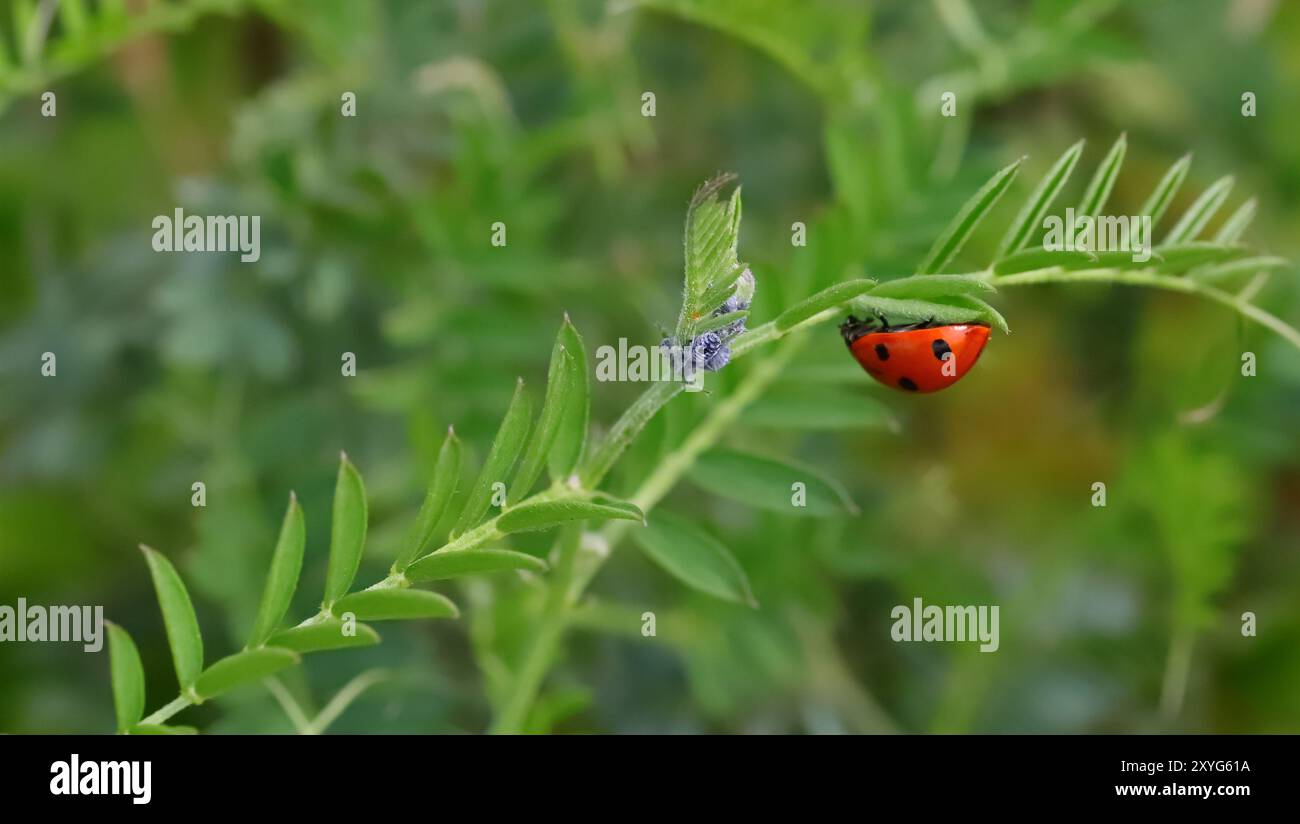
A ladybug's mouth consists of specialized biting-chewing components known as mandibulate mouthparts. Primarily designed for predation, these structures include sharp mandibles for crushing prey like aphids, sensory palps for detecting food, and a labrum and labium that act as lips to manipulate and contain their meals during consumption.
While we often view ladybugs (family Coccinellidae) as charming garden residents, a microscopic examination reveals they are highly efficient predators. Their mouthparts are precision instruments evolved over millions of years to pierce the soft bodies of insects, grind plant material, or even scrape fungal spores, depending on the specific species. To understand how these tiny beetles function as the "lions of the garden," we must examine the complex biological architecture hidden beneath their heads.
Understanding the Mandibulate Architecture
The mouth of a ladybug is not a single opening but a complex assembly of several distinct organs that work in coordination. This configuration is classified as mandibulate, or chewing mouthparts, which is the ancestral condition for insects but has been highly refined in the Coccinellidae family.
Unlike the piercing-sucking proboscis of a butterfly or the sponging mouth of a housefly, the ladybug’s mouth is built for mechanical destruction. The head of the ladybug is prognathous or hypognathous depending on the species, meaning the mouthparts either point forward or downward. In most predatory ladybugs, they are positioned to strike prey directly in front of the beetle’s path.
The architecture is divided into four primary components: the labrum, the mandibles, the maxillae, and the labium. Each serves a specific purpose in the sequence of finding, grasping, and consuming food.
The Labrum: The Protective Upper Lip
The labrum is a simple, plate-like structure that functions similarly to a human upper lip. It is attached to the clypeus (the front of the head) and hangs down over the other mouthparts. Its primary role is to provide a front boundary for the "mouth cavity," ensuring that food does not fall out forward while it is being processed by the mandibles.
On its inner surface, the labrum often contains sensory hairs (sensilla) that help the ladybug "taste" or feel the texture of the object it is about to bite. This is the first line of tactile feedback in the feeding process.
The Mandibles: The Primary Tools of Destruction
The mandibles are the most critical and visible parts of the ladybug mouth under magnification. These are two hard, heavily sclerotized (chitin-hardened) jaws that move horizontally rather than vertically.
In predatory ladybugs, such as the common Seven-spot Ladybird (Coccinella septempunctata), the mandibles are sharp and curved. They often feature two or more "teeth" at the tips. These teeth are designed to puncture the exoskeleton of an aphid or scale insect.
The mechanics of the mandible are fascinating:
- The Incisor Area: The sharp tip used for piercing and cutting.
- The Mola: The base of the mandible, which is often flattened. In herbivorous ladybugs, this area is highly developed for grinding plant fibers, whereas in predators, it is used to crush the soft tissues of prey.
The mandibles are powered by massive muscles relative to the ladybug's size, allowing them to exert significant pressure. This enables the ladybug to hold onto struggling prey that might be larger than its own head.
The Maxillae: Precision Manipulation and Sensing
Located just behind the mandibles are the maxillae. These are secondary jaws, but they are much more complex and flexible. Each maxilla consists of several parts, including the galea, the lacinia, and the maxillary palps.
The maxillary palps are the most prominent feature. They look like tiny, jointed arms or extra legs sticking out from the side of the mouth. These palps are densely covered in chemoreceptors and mechanoreceptors. As a ladybug moves through a colony of aphids, it "drums" these palps against surfaces to detect the chemical signatures of its prey.
Once the mandibles have captured a meal, the maxillae act like "forks and spoons," pushing the food further back into the mouth and manipulating it so the mandibles can get a better grip.
The Labium: The Floor of the Mouth
The labium acts as the lower lip or the floor of the mouth. Like the maxillae, the labium has its own set of palps (labial palps), though they are usually smaller. The labium keeps the food contained from the bottom and works in tandem with the labrum to create a sealed environment where the mandibles can operate efficiently.
Inside the labium is a structure called the hypopharynx, which is somewhat analogous to a tongue. It helps move the masticated food into the esophagus.
Feeding Strategies: How Ladybugs Consume Their Prey
The way a ladybug uses these parts depends heavily on its diet. Most ladybugs are carnivores, but the family includes specialists that eat fungi (the sub-family Halyziini) and others that are strictly herbivorous (the sub-family Epilachninae).
Predatory Feeding (Aphid Hunters)
When a predatory ladybug finds an aphid, the process is swift. The maxillary palps confirm the prey's identity via chemical signals. The ladybug then lunges, using its sharp mandibles to seize the aphid.
Interestingly, ladybugs do not just "eat" the aphid in one go. They often engage in extra-oral digestion. The ladybug may regurgitate digestive enzymes into the punctured body of the prey. These enzymes break down the aphid's internal organs into a liquid slurry, which the ladybug then laps up using its maxillae and labium. The solid remains are then chewed and swallowed. This combination of liquid and solid feeding allows them to extract maximum nutrition in a short amount of time.
Herbivorous Feeding (Plant Eaters)
Herbivorous ladybugs, such as the Mexican Bean Beetle (Epilachna varivestis), have mouthparts that look quite different under a microscope. Their mandibles are not sharp and pointed for piercing; instead, they are broad and multi-toothed, resembling a saw or a grater.
These beetles use a "mandibular scraping" technique. They scrape the epidermis of a leaf, removing the soft green tissue and leaving behind a "skeletonized" leaf consisting only of the veins. This requires a much more robust grinding surface (the mola) than what is found in predatory species.
Comparison of Mouthpart Components and Functions
| Component | Physical Description | Primary Function |
|---|---|---|
| Labrum | Flat, hinged plate at the top of the mouth. | Acts as an upper lip; contains food and provides sensory feedback. |
| Mandibles | Paired, hard, horizontal jaws with sharp teeth. | Piercing, crushing, and cutting prey or plant material. |
| Maxillae | Complex structures with jointed palps. | Sensing prey (chemoreception) and manipulating food into the mouth. |
| Labium | The "floor" of the mouth with smaller palps. | Prevents food from falling out the bottom; assists in swallowing. |
| Maxillary Palps | Drumstick-like appendages on the sides. | Primary sensory organ for "smelling" and "tasting" the environment. |
Larval vs. Adult Mouthparts: A Developmental Comparison
The ladybug mouth undergoes significant scrutiny not just in the adult stage, but also in the larval stage. Ladybug larvae are often called "aphid lions" because of their voracious appetites.
In the larval stage, the mouthparts are even more specialized for predation. The mandibles of a larva are often hollow or deeply grooved. This allows the larva to pierce an aphid and immediately inject digestive enzymes, then suck the liquefied contents back through the same channel. This is known as suctorial feeding.
As the ladybug pupates and emerges as an adult in 2026, its mouth anatomy shifts toward the more traditional biting-chewing structure described above. While adults still utilize some liquid feeding, they have a much greater capacity for processing solid chitin and plant matter than the larvae do.
Can Ladybugs Bite Humans? The Mechanical Reality
A common question among gardeners is whether these insects can bite humans. The answer is technically yes, though it is not a "bite" in the sense of a mosquito or a flea.
Ladybugs do not have venom, nor do they seek out human blood. However, if a ladybug lands on human skin that is salty (from sweat) or if it is feeling dehydrated, it may use its mandibles to "test" the surface. Because the mandibles are designed to puncture the relatively tough exoskeleton of other insects, they are more than capable of pinching human skin.
This "bite" usually feels like a tiny prick or a pinch. It rarely breaks the skin and does not transmit diseases. It is purely a mechanical action—the ladybug's mouthparts simply doing what they were evolved to do: investigate and process potential food sources.
The Evolutionary Advantage of Specialized Mouthparts
The success of the Coccinellidae family is largely due to the versatility of their mouthparts. By having a generalized mandibulate structure that can be "tuned" by evolution toward specific prey, ladybugs have filled numerous ecological niches.
For example, some species have evolved mouthparts specifically for eating mites, which are much smaller than aphids. These mouthparts have finer, more delicate "teeth" on the mandibles to handle microscopic prey. Others that eat scale insects have wider, flatter mandibles to pry the protective "scale" off the plant surface to reach the soft insect underneath.
This specialization is why ladybugs are among the most effective biological control agents in agriculture. Their mouths are literally "built for the job" of pest management.
Summary of Maintenance and Observation
For those interested in observing these structures, a standard 10x or 20x hand lens is often insufficient to see the fine detail of the mandibles. To truly take a "close look," one requires a digital microscope or a stereomicroscope with at least 40x to 100x magnification.
When observing a live specimen, you can often see the maxillary palps moving rapidly. This is the ladybug actively "sampling" the air and the surface it is walking on. If you provide a ladybug with a drop of honey-water or a crushed aphid, you can observe the rhythmic horizontal movement of the mandibles as they process the meal.
Frequently Asked Questions
1. Do ladybugs have teeth? Ladybugs do not have "teeth" made of bone or enamel like mammals. Instead, they have pointed protrusions on their mandibles made of hardened chitin. These serve the same functional purpose—cutting and grinding—but are part of their external skeleton.
2. How do ladybugs drink water? Ladybugs use their labium and maxillae to lap up moisture from dew drops, rain, or the juices of their prey. Their mouthparts are efficient at handling fluids through capillary action and the movement of the labium.
3. Why do some ladybug bites itch? While ladybugs don't inject venom, they do produce "reflex bleeding" from their leg joints which contains alkaloids (coccinelline) to deter predators. If this fluid gets into a small pinch from their mandibles, it can cause a minor localized irritation or an allergic reaction in sensitive individuals.
4. Do ladybugs eat their own kind with these mouthparts? Yes, ladybugs are known for cannibalism, especially in the larval stage or when food is scarce. Their mandibles are perfectly capable of piercing the soft shells of newly pupated ladybugs or the eggs of their own species.
5. Can a ladybug mouth grow back if damaged? No. Once a ladybug reaches its adult stage, it no longer molts. If the mandibles or palps are broken or damaged, they cannot be repaired or regrown. The insect must survive with the damage or face starvation.
Practical Recommendation for Gardeners
If you are using ladybugs for pest control in 2026, remember that their mouthparts require a specific environment to function optimally. Predatory ladybugs need "soft" prey. If the pests in your garden have developed a very hard waxy coating or if the environment is too dry, the ladybugs may struggle to feed. Providing a light misting of water on your plants can help ladybugs stay hydrated and ensure their mouthparts remain functional for active hunting.