Ariba Inc., founded in 1996, revolutionized corporate procurement before being acquired by SAP SE in 2012 for approximately $4.3 billion. This strategic acquisition integrated Ariba’s cloud-based B2B network into SAP’s enterprise ecosystem, resulting in SAP Ariba. As of 2026, it remains the backbone of the world's largest digital business network, facilitating trillions of dollars in global commerce annually.
The Genesis of Ariba Inc.: Solving the Paper Problem
To understand the magnitude of Ariba's journey, one must look back at the landscape of corporate purchasing in the mid-1990s. Before Ariba, procurement was a fragmented, paper-heavy, and manual process. Seven founders, including Bobby Lent, Boris Putanec, and Keith Krach, recognized that the burgeoning internet could provide a centralized platform for companies to manage their spending.
Launched in Menlo Park, California, Ariba focused on "operating resource management." The core thesis was simple: if a company could automate the way it bought office supplies, maintenance services, and raw materials, it could realize massive cost savings through volume discounts and reduced administrative overhead.
In 1999, Ariba went public during the peak of the dot-com boom. Its stock price soared, reflecting the market's belief that B2B e-commerce was the next frontier. Unlike many of its contemporaries that vanished when the bubble burst, Ariba survived by pivoting. It shifted from selling licensed software to a Cloud-based model, eventually birthing the Ariba Network—a digital marketplace where buyers and sellers could connect seamlessly.
The 2012 Acquisition: A $4.3 Billion Strategic Pivot
On May 22, 2012, SAP SE announced its intention to acquire Ariba Inc. for $45 per share in cash. This represented a 72% premium over Ariba’s stock price at the time, highlighting the immense value SAP placed on Ariba’s cloud DNA.
Why SAP Pursued Ariba
At the start of the 2010s, SAP was facing a critical juncture. While it dominated the on-premise Enterprise Resource Planning (ERP) market, it was trailing in the cloud. The acquisition of Ariba was not just about buying a procurement tool; it was about acquiring a network.
- The Network Effect: SAP realized that while they could build software, they could not easily replicate the millions of suppliers already connected to the Ariba Network.
- Cloud Transition: Ariba provided a blueprint for SAP to migrate its massive customer base from "on-premise" servers to "Software-as-a-Service" (SaaS) environments.
- Business Network Strategy: SAP aimed to move beyond "internal" business processes to "inter-enterprise" processes.
The deal closed in October 2012. At that moment, Ariba became "SAP Ariba," and the journey of integrating two vastly different corporate cultures and technology stacks began.
Integration and Evolution: The Birth of SAP Ariba
The years following the acquisition were defined by technical harmonization. Ariba’s legacy platform was built on different architectures than SAP’s core ECC and S/4HANA systems. SAP had to ensure that a purchase order generated in an SAP ERP system could flow natively into the Ariba Network without complex custom middleware.
From Ariba Network to SAP Business Network
By 2026, the branding has evolved. What was once the Ariba Network has been subsumed into the broader SAP Business Network. This evolution reflects the inclusion of other SAP assets like Fieldglass (for contingent labor) and Concur (for travel and expense). However, the Ariba procurement engine remains the "heart" of this network.
Key technical milestones in the acquisition journey included:
- The Transition to HANA: Moving Ariba’s massive database onto SAP’s in-memory computing platform (HANA) to allow for real-time spend analytics.
- Guided Buying: The introduction of a "consumer-like" shopping interface that allowed non-procurement professionals to buy goods while remaining compliant with corporate contracts.
- Ariba Pay: A partnership with financial institutions to integrate the "payment" aspect of the procurement cycle directly into the network.
Technical Capabilities and the 2026 Product Landscape
In 2026, SAP Ariba is no longer a standalone tool but a suite of integrated modules that cover the entire "Source-to-Pay" (S2P) lifecycle. The sophistication of these tools has increased significantly since the 2012 acquisition.
Strategic Sourcing and Supplier Management
Before the acquisition, sourcing was often a one-off event. Today, SAP Ariba uses Autonomous Sourcing driven by AI. The system monitors market prices, identifies supply chain risks (such as geopolitical instability or climate events), and automatically suggests alternative suppliers from the network.
Procure-to-Pay (P2P)
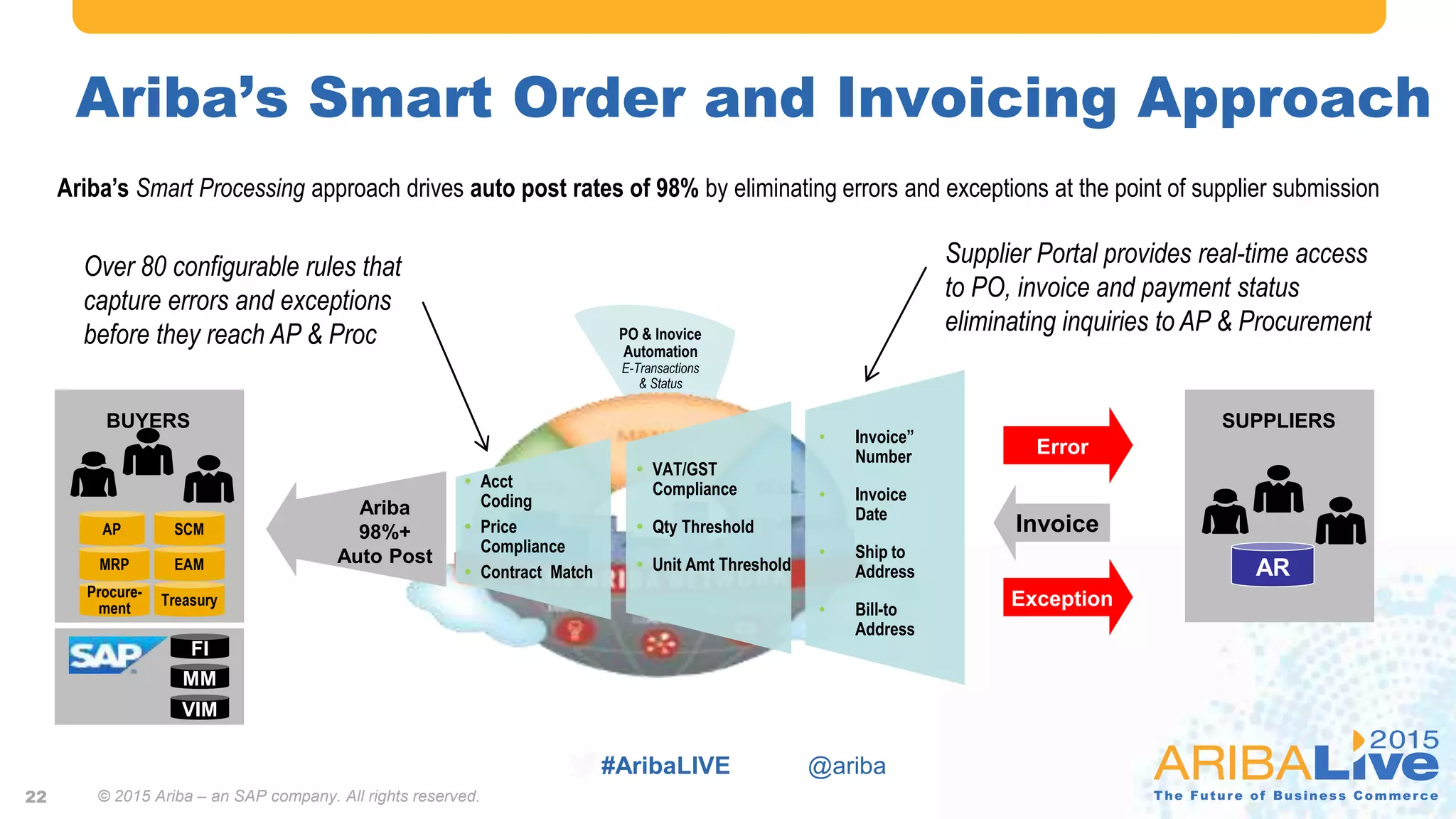
This is the operational core. It handles everything from the initial requisition to the final invoice. In 2026, the focus is on Touchless Invoicing. By utilizing machine learning, the system matches invoices to purchase orders and receipts with 99% accuracy, triggering payments without human intervention.
The Network Advantage
The scale of the network in 2026 is unparalleled. It connects over 8 million companies globally. This scale allows for "Benchmark Analytics," where a company can compare its procurement performance against industry peers anonymously to identify inefficiencies.
| Feature | Pre-Acquisition Ariba (2011) | SAP Ariba (Current 2026) |
|---|---|---|
| Deployment | Primarily Cloud/Hybrid | 100% Cloud-Native (Multi-tenant) |
| ERP Integration | Manual/Middleware heavy | Native Integration with S/4HANA |
| Intelligence | Basic Reporting | Predictive AI & Autonomous Sourcing |
| Network Scale | ~700,000 Suppliers | ~8,000,000+ Business Partners |
| Primary Focus | Cost Reduction | Resilience, ESG, and Value Creation |
| User Interface | Functional/Complex | Guided Buying (Persona-based) |
The Role of ESG and Sustainability in 2026
One of the most significant shifts in Ariba's journey post-acquisition has been the move from "cost-centric" procurement to "value-centric" procurement. In 2026, global regulations regarding carbon footprints and labor practices are stringent.
The SAP Ariba platform now includes deep Sustainability tracking. When a buyer searches for a supplier on the network, they are presented with "Sustainability Scores." This data is pulled from third-party auditors and real-time sensor data from the supply chain. This enables companies to prove their ESG (Environmental, Social, and Governance) compliance to regulators and shareholders, a capability that was merely a vision at the time of the 2012 acquisition.
Implementation: Requirements and Practical Steps
For organizations looking to join the ecosystem in 2026, the journey involves more than just a software license. The acquisition of Ariba by SAP made the platform more powerful but also more integrated into the broader SAP infrastructure.
- System Readiness: Organizations must typically be on a modern ERP platform (like SAP S/4HANA) to leverage the full "native" benefits of the Ariba integration.
- Data Cleansing: Before moving to the cloud, companies must "clean" their supplier master data. Duplicate or outdated supplier records are the leading cause of implementation delays.
- Supplier Enablement: This is the most critical step. A company must "onboard" its suppliers onto the SAP Business Network. While many suppliers are already there, smaller vendors may need assistance setting up their accounts.
- Change Management: Because SAP Ariba changes how employees buy things (moving toward "Guided Buying"), organizations must invest in training to ensure high adoption rates.
Challenges and Lessons from the Acquisition Journey
The journey has not been without hurdles. Critics of the 2012 acquisition often pointed to the "SAP-ification" of Ariba, suggesting that the platform became more complex and slower to innovate in its early years under SAP.
- Platform Fragmentation: For a period, customers struggled with two different versions of sourcing and procurement tools—the legacy SAP SRM (Supplier Relationship Management) and the new Ariba cloud tools.
- Subscription Costs: The shift to a SaaS model meant that companies moved from a capital expenditure (CapEx) to an operational expenditure (OpEx) model. For large enterprises, managing these recurring costs across thousands of users requires rigorous governance.
- The Small Supplier Barrier: Initially, some smaller suppliers found the fees associated with the Ariba Network to be a barrier to entry. SAP has since addressed this in 2026 by offering "Standard Accounts" that are free for suppliers, ensuring the network remains inclusive.
The Future of the Ariba Legacy
As we look at the state of procurement in 2026, the Ariba acquisition stands as one of the most successful "cloud-pivot" moves in software history. It allowed SAP to maintain its dominance in the enterprise space while giving Ariba the global reach and financial backing to scale its network to a level that no startup could match.
The journey from a Silicon Valley startup to a cornerstone of global trade illustrates the shift from "software as a tool" to "software as a network." In 2026, the focus has moved toward Circular Economy integration, where SAP Ariba helps companies not just buy and sell, but also track the lifecycle of products to ensure they are recycled or repurposed, meeting the global demands for a more sustainable industrial complex.
Frequently Asked Questions
What happened to Ariba Inc. after the SAP acquisition?
Ariba Inc. ceased to be a public company and became a subsidiary of SAP SE. Over time, its products were rebranded as SAP Ariba, and its technology was integrated into the SAP HANA database architecture. Many of Ariba's original leadership moved into executive roles within SAP's cloud business units.
Is the Ariba Network still the same as it was in 2012?
While the underlying principle of connecting buyers and sellers remains, the network has been significantly expanded. It is now part of the SAP Business Network, which includes more than just procurement—incorporating logistics, asset management, and contingent labor tracking.
How much did SAP pay for Ariba, and was it considered a success?
SAP paid approximately $4.3 billion. Industry analysts in 2026 generally view this as a highly successful acquisition. It provided SAP with the "Network Effect" necessary to compete with other cloud giants like Oracle and Workday, and it secured SAP's position in the "Intelligent Spend Management" category.
Can I use SAP Ariba if I don't use SAP as my ERP?
Yes. While SAP Ariba is "optimized" for SAP S/4HANA, it is designed to be ERP-agnostic. It can be integrated with Oracle, Microsoft Dynamics, and other legacy systems. However, the depth of "real-time" data synchronization is usually greatest within the SAP ecosystem.
What are the main benefits for suppliers on the network today?
In 2026, suppliers benefit from increased visibility to thousands of global buyers, faster invoice processing, and "Dynamic Discounting" options, which allow them to get paid earlier in exchange for a small discount, improving their cash flow.
Final Recommendation for Businesses
For organizations evaluating their procurement strategy in 2026, the journey of Ariba serves as a reminder that the network is as important as the software. If your goal is purely internal cost savings, basic procurement tools may suffice. However, if your goal is supply chain resilience, ESG compliance, and global scalability, leveraging the SAP Ariba ecosystem remains the industry standard. Businesses should focus on "Supplier Enablement" as their first priority; the software is only as powerful as the number of active, engaged partners you have connected to it.