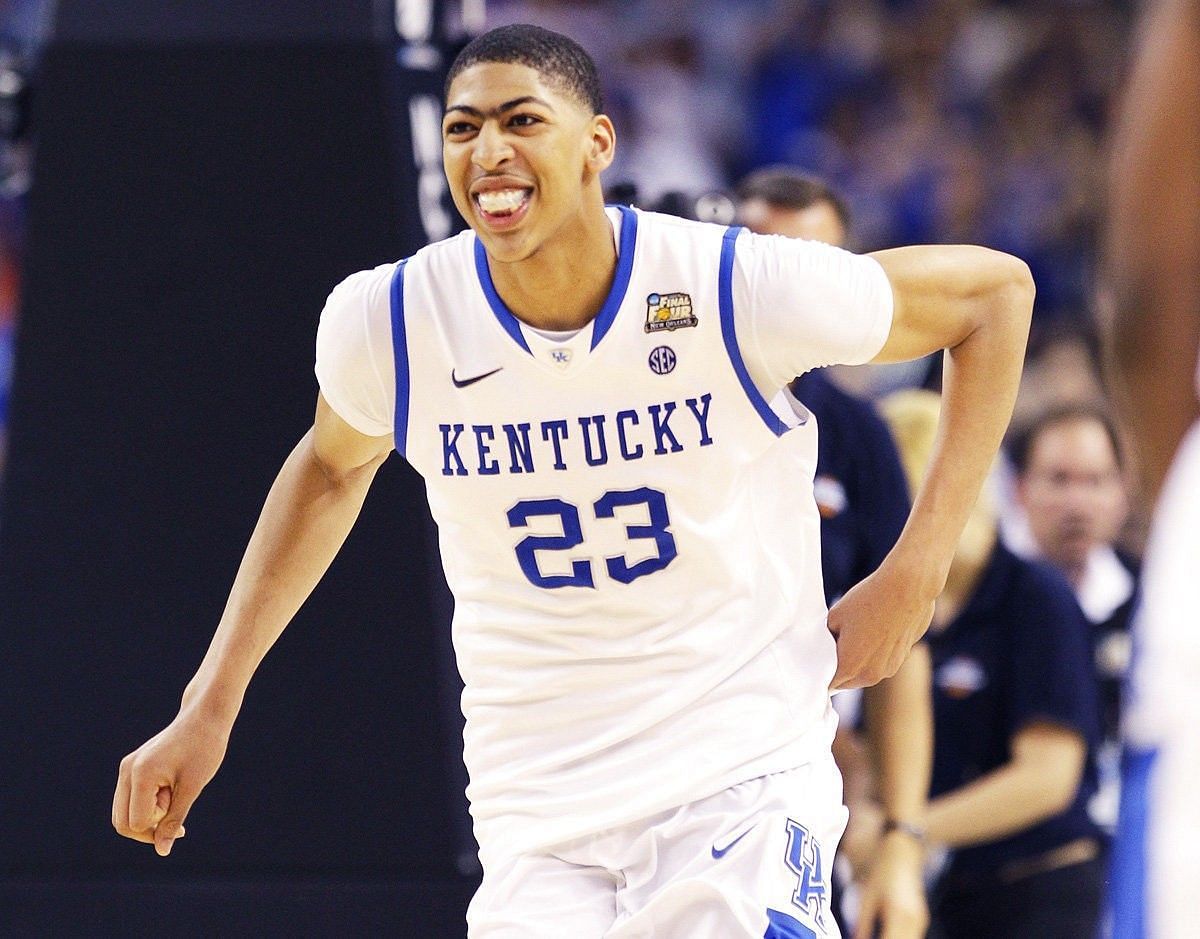
During his lone season at the University of Kentucky (2011–2012), Anthony Davis averaged 14.2 points, 10.4 rebounds, and 4.7 blocks per game. He led the Wildcats to a 38–2 record and a National Championship, sweeping every major National Player of the Year award while setting an NCAA freshman record for total blocked shots.
The 2011–2012 collegiate season is often cited as one of the most dominant individual defensive displays in the history of college basketball. Anthony Davis did not just arrive at Kentucky as a highly touted recruit; he transformed the defensive identity of the program under Coach John Calipari. As we look back from the perspective of 2026, Davis’s single year in Lexington remains the gold standard for "one-and-done" prospects who balance individual statistical brilliance with team-oriented success.
To understand the magnitude of Anthony Davis's Kentucky stats, one must look beyond the raw numbers and examine the efficiency, the defensive gravity, and the context of a roster that featured six future NBA draft picks. Davis was the fulcrum of a team that spent most of the season ranked number one in the nation, and his statistical output reflected a player who prioritized winning over personal box-score padding.
The Statistical Profile: Efficiency and Impact
Anthony Davis’s offensive game at Kentucky was characterized by extreme efficiency. While he was not a high-volume "isoball" scorer, he was an elite finisher and a constant threat in transition and on the offensive glass. His 62.3% field goal percentage was a testament to his shot selection and his ability to convert high-percentage opportunities created by Kentucky’s guard-heavy lineup.
Scoring and Offensive Role
Davis finished the season with 567 total points over 40 games. His scoring average of 14.2 points per game was second on the team behind sophomore Doron Lamb. This distribution highlights a key aspect of Davis's time at Kentucky: he was a willing participant in a balanced offensive system. He didn't demand the ball to create his own shot from the perimeter, though his background as a high school guard allowed him to handle the ball and face up when necessary.
His scoring came primarily from:
- Transition lobs: Utilizing his elite mobility to beat opposing big men down the floor.
- Put-backs: Leveraging his 7-foot-5.5-inch wingspan to secure offensive rebounds and finish immediately.
- Pick-and-roll finishing: Serving as a vertical spacer for guards Marquis Teague and Doron Lamb.
- Free Throws: Davis shot a respectable 70.9% from the charity stripe, a high mark for a player of his size and defensive specialized role.
Rebounding Prowess
Averaging a double-double for the season (14.2 PPG, 10.4 RPG), Davis was the primary force on the boards. He totaled 415 rebounds, with 294 of those coming on the defensive end. His ability to secure the defensive rebound and immediately look for a outlet pass or initiate the break himself was a hallmark of the 2012 Wildcats' fast-paced offense.
Defensive Dominance: The Shot-Blocking Record
The most jarring aspect of Anthony Davis's Kentucky stats is the shot-blocking. Davis ended the season with 186 blocks, which set a new NCAA freshman record and led the entire nation. To put this in perspective, Davis blocked more shots individually than many entire Division I teams did during that same season.
The Geometry of the Court
Davis’s defensive impact cannot be measured solely by the blocks he recorded. His "defensive gravity" forced opposing offenses to abandon the paint entirely. Scouts at the time noted that players would often drive into the lane, see Davis, and immediately pass the ball back out to the perimeter, disrupting the flow of the opposing offense.
He averaged 4.65 blocks per game, a number that remained consistent even as the competition level rose in the SEC and the NCAA Tournament. His timing and ability to block shots with either hand without fouling made him the most feared rim protector in college basketball history. He finished the season with only 80 personal fouls in 40 games, a remarkably low number (2.0 per game) for someone so active in challenging shots.
Historical Comparison: Total Blocks
| Player (Season) | School | Total Blocks | Blocks Per Game |
|---|---|---|---|
| Anthony Davis (2011-12) | Kentucky | 186 | 4.65 |
| Hassan Whiteside (2009-10) | Marshall | 182 | 5.35 |
| Jarvis Varnado (2009-10) | Miss. State | 170 | 4.72 |
| Emeka Okafor (2003-04) | UConn | 147 | 4.10 |
| Shaquille O'Neal (1991-92) | LSU | 157 | 5.23 |
While some players have had higher per-game averages in shorter seasons, Davis’s total of 186 in a 40-game championship run remains one of the most productive defensive seasons ever recorded.
The 2012 NCAA Tournament Run
The true test of a player’s statistical value is their performance under the brightest lights. During the 2012 NCAA Tournament, Davis’s scoring fluctuated, but his rebounding and defense remained elite. His performance in the National Championship game against Kansas is legendary because it proved that Davis could dominate a game without scoring a single field goal for the majority of the night.
In the championship game, Davis shot just 1-of-10 from the field, finishing with 6 points. However, he recorded:
- 16 Rebounds
- 6 Blocks
- 5 Assists
- 3 Steals
This performance encapsulated his season. Even when his offensive rhythm was off, his defensive presence ensured that Kansas could never mount a consistent comeback. He was named the NCAA Tournament Most Outstanding Player (MOP), a rare feat for a player who scored only 6 points in the final game.
Awards and Accolades
Because of his historic statistical profile, Anthony Davis achieved a "clean sweep" of every major individual award in college basketball for the 2011–2012 season. This level of consensus is rare and speaks to the gap between him and any other player in the country that year.
- Naismith College Player of the Year: Awarded to the top player in the nation.
- John R. Wooden Award: Recognized as the most outstanding player.
- AP Player of the Year: The Associated Press's top honor.
- USBWA National Player of the Year (Oscar Robertson Trophy): Voted on by the U.S. Basketball Writers Association.
- SEC Player of the Year: Dominating what was then a highly competitive conference.
- SEC Defensive Player of the Year: An obvious choice given the block records.
- NCAA Tournament Most Outstanding Player: Cementing his legacy with a ring.
Comparative Analysis: Davis vs. Other Legends
When discussing Anthony Davis's Kentucky stats, it is useful to compare his lone season to other legendary "one-and-done" freshman seasons to understand the different ways players impact the college game.
- Kevin Durant (Texas, 2006-07): Durant was a superior scorer, averaging 25.8 points per game. However, Durant’s Longhorns did not achieve the same level of team success, falling in the second round of the tournament.
- Zion Williamson (Duke, 2018-19): Zion averaged 22.6 points and 8.9 rebounds with a higher PER (Player Efficiency Rating), but he did not possess the same shot-blocking or rim-protection impact as Davis.
- Carmelo Anthony (Syracuse, 2002-03): Like Davis, Anthony led his team to a National Championship. Anthony was a much more prolific scorer (22.2 PPG), but Davis was the more transformative defensive force.
Davis occupies a unique niche: the defensive specialist who was so good at his specialty that he became the best overall player in the country.
Advanced Metrics and Beyond the Box Score
In the modern era of basketball analytics, Davis’s Kentucky season looks even more impressive. His Player Efficiency Rating (PER) was among the highest ever recorded for a freshman at the time.
His "Defensive Win Shares" were off the charts, as he anchored a defense that held opponents to just 60.6 points per game. Kentucky’s defensive strategy was essentially to funnel perimeter players toward Davis, knowing that any shot taken in the paint had a high probability of being altered or blocked. This allowed Kentucky's perimeter defenders (Michael Kidd-Gilchrist and Marquis Teague) to play more aggressively and pressure the ball, knowing they had the ultimate safety net behind them.
The Transition to the NBA
Anthony Davis’s stats at Kentucky were the primary reason he was the consensus #1 overall pick in the 2012 NBA Draft. Scouts saw a player who had the physical tools of a center but the coordination and "switchability" of a wing. His time at Kentucky served as the perfect proof of concept for the modern NBA "unicorn"—a big man who can protect the rim, switch onto guards, and finish at an elite level.
Since being drafted, Davis has translated those Kentucky traits into multiple NBA All-Star appearances, All-Defensive selections, and an NBA Championship with the Los Angeles Lakers in 2020. Even in 2026, his collegiate season is still used by analysts to describe the "perfect" developmental trajectory for a young big man.
Complete 2011-2012 Season Statistics
The following table summarizes the cumulative and per-game statistics for Anthony Davis during his tenure with the Kentucky Wildcats.
| Statistic Category | Total Season Value | Per Game Average |
|---|---|---|
| Games Played | 40 | - |
| Minutes Per Game | 1,281 | 32.0 |
| Points | 567 | 14.2 |
| Rebounds | 415 | 10.4 |
| Blocks | 186 | 4.7 |
| Steals | 54 | 1.4 |
| Assists | 50 | 1.3 |
| Field Goal % | 210-337 | 62.3% |
| Free Throw % | 146-206 | 70.9% |
| Three-Point % | 1-7 | 14.3% |
| Personal Fouls | 80 | 2.0 |
| Turnovers | 42 | 1.1 |
Frequently Asked Questions
How many blocks did Anthony Davis have at Kentucky? Anthony Davis recorded 186 blocks in his single season at Kentucky. This remains the school record for a single season and was the NCAA freshman record at the time it was set. He averaged 4.7 blocks per game over 40 contests.
Did Anthony Davis win a championship at Kentucky? Yes. Anthony Davis led the Kentucky Wildcats to the 2012 NCAA Division I Men’s Basketball Championship. They defeated the Kansas Jayhawks 67–59 in the title game held in New Orleans.
What was Anthony Davis's career high in points at Kentucky? Davis's highest-scoring game for the Wildcats was 28 points, which he achieved against Vanderbilt on February 25, 2012. Throughout the season, he scored 20 or more points on seven different occasions.
What awards did Anthony Davis win at Kentucky? Davis won nearly every major individual award available, including the Naismith Trophy, the Wooden Award, AP Player of the Year, Oscar Robertson Trophy, and the NCAA Tournament Most Outstanding Player (MOP). He was also the SEC Player of the Year and Defensive Player of the Year.
What were Anthony Davis's shooting percentages at Kentucky? Davis was highly efficient, shooting 62.3% from the field. He shot 70.9% from the free-throw line. While he rarely shot three-pointers (only 7 attempts all season), his overall true shooting percentage was among the best in the nation.
How tall was Anthony Davis when he played for Kentucky? During his 2011–2012 season, Davis was listed at 6 feet 10 inches tall with a wingspan measured at approximately 7 feet 5.5 inches. He had famously undergone a massive growth spurt in high school, growing from 6 feet to 6 feet 10 inches in a short period.
Final Recommendation for Researchers
For those analyzing collegiate impact, Anthony Davis’s 2011–2012 stats should be viewed as the definitive example of defensive efficiency. If you are looking to understand the "modern big man" evolution, studying his defensive rotations and block-to-foul ratio at Kentucky provides more insight than his raw scoring totals. For the most accurate play-by-play data, the official Kentucky Wildcats athletics archives and the NCAA's historical statistics database remain the primary verified sources for his game-by-game performances.