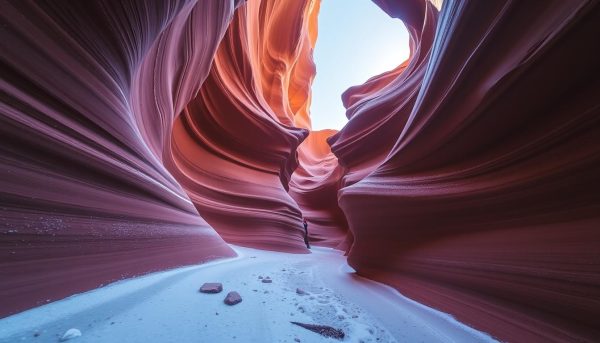
Antelope Canyon experiences significant temperature fluctuations throughout the year, driven by its high-desert location in Northern Arizona. Visitors can expect extreme seasonal shifts, ranging from sub-freezing mornings in winter to intense heat exceeding 100°F (38°C) during summer afternoons. Understanding these patterns is essential for selecting proper gear and scheduling your tour safely.
Understanding the Desert Microclimate of Antelope Canyon
Antelope Canyon is situated near Page, Arizona, on the Colorado Plateau at an elevation of approximately 4,200 feet (1,280 meters). This specific geographical setting places the slot canyons within a high-desert environment. Unlike lowland deserts that remain consistently hot, the elevation of Page results in a distinct diurnal temperature range—the difference between the daily high and the daily low.
The stone walls of the canyon—carved into Navajo Sandstone—act as thermal mass. During the day, they absorb solar radiation; at night, they radiate that stored heat back into the cooler air. However, because slot canyons are narrow and often shielded from direct sunlight at the base, they frequently maintain temperatures 5 to 10 degrees cooler than the surface level at the canyon rim. Conversely, in the winter, the deep recesses of the canyon can trap cold, stagnant air, making the floor feel significantly colder than the surrounding plateau.
Seasonal Temperature Profiles
To plan a trip effectively, one must look at the seasonal averages and the potential for extreme weather events that deviate from these norms.
Winter (December–February)
Winter in Antelope Canyon is defined by crisp, cold air. Daytime highs typically range between 35°F and 45°F (2°C–7°C). Nighttime temperatures often plummet well below freezing, occasionally reaching the teens (°F). While the sun can feel warm when hitting the canyon rims, the interior of the slot canyon—often in the shade—remains quite cold. Visitors must prepare for these temperatures by wearing thermal layers, as the lack of direct sunlight inside the narrow passages prevents the walls from heating up significantly.
Spring (March–May)
Spring is a transition period characterized by volatility. You might experience a 40-degree variance between the morning low and the afternoon high. Early spring can still bring frost, while late May can see the first signs of desert heat, with temperatures rising into the 80s°F (27°C+). This season is also marked by increased wind, which, when combined with lower temperatures, can lead to a significant wind-chill factor for those waiting in line for tours.
Summer (June–August)
Summer brings the most intense heat to the region. High temperatures frequently exceed 95°F (35°C), and it is not uncommon to see mid-day peaks topping 105°F (40°C). While the canyon depth provides a modicum of shade, the ambient temperature remains high. Furthermore, the lack of airflow in narrow sections can make the air feel stifling. Hydration and heat exhaustion awareness become critical during these months, as the journey to the canyon entrance may involve walking across exposed, sun-drenched desert sand.
Autumn (September–November)
Much like spring, autumn is a period of adjustment. September often retains the lingering heat of summer, but by late October and November, temperatures drop rapidly. The clear, dry desert air causes heat to escape quickly once the sun sets. This is arguably the most stable time for temperature-sensitive visitors, though the mornings require substantial warm clothing.
Comparison of Monthly Temperature Trends
The following table provides a generalized view of the expected temperature ranges in the Page, Arizona area to assist in travel preparation.
| Season | Average Low (°F) | Average High (°F) | Thermal Characteristics |
|---|---|---|---|
| Winter | 20° – 25° | 38° – 45° | Cold, potential ice at canyon base. |
| Spring | 35° – 45° | 60° – 75° | Highly variable, breezy, warming trend. |
| Summer | 65° – 75° | 90° – 105° | Intense heat, sun exposure concerns. |
| Autumn | 40° – 50° | 65° – 80° | Rapid cooling, comfortable mid-days. |
The Impact of Canyon Geography on Thermal Comfort
The physical structure of Antelope Canyon significantly influences how you perceive the temperature. The canyon is a series of narrow, winding corridors. In sections where the walls are nearly touching overhead, sunlight is almost entirely excluded.
This creates a "cool-well" effect. In July, while the surface temperature is 100°F, the canyon floor might stay at a more manageable 85°F. However, this is not a substitute for air conditioning. Because the canyon is a confined space, the heat remains trapped. Humidity is generally very low in this region, which aids in evaporative cooling, but the lack of wind inside the slot can negate this benefit.
Conversely, in winter, the "cool-well" becomes a disadvantage. The walls stay icy for days, and the absence of direct solar heating means the floor remains cold regardless of how bright the sky is above.
Essential Gear and Preparation Based on Temperature
Regardless of the season, the primary rule of thumb for Antelope Canyon is layering.
- Winter Requirements: If visiting from December through February, prioritize a heavy outer jacket, gloves, and a hat. The "stand and wait" nature of tour groups means you will be stationary for long periods, which allows cold to penetrate clothing quickly.
- Summer Requirements: If visiting from June through August, focus on UV protection and moisture-wicking fabrics. Loose-fitting, light-colored clothing is recommended. A wide-brimmed hat is essential for the walk to the canyon entrance, where you will have no shade.
- Footwear: Avoid open-toed shoes regardless of the heat. The terrain is deep, fine sand. In winter, this sand can be icy or damp; in summer, it acts as a heat sink. Sturdy, closed-toe hiking shoes or boots protect your feet from both debris and temperature extremes.
Hydration and Heat Mitigation
Even when the temperature feels "cool" inside the canyon, the desert air is dehydrating. You lose moisture rapidly through respiration. Carry at least one liter of water per person for a standard tour. If you are participating in a longer tour or hiking in the surrounding areas of Lake Powell and Horseshoe Bend, increase this to two liters. Dehydration exacerbates the body’s inability to regulate temperature, making you more susceptible to heat exhaustion in the summer and hypothermia-related risks in the winter.
Common Mistakes and Troubleshooting
Mistake 1: Assuming the Interior Temperature is Consistent Visitors often mistake the "slot canyon" label for a "cave" environment. Unlike a cave, which maintains a constant year-round temperature due to subterranean isolation, Antelope Canyon is an open-air feature. It tracks closely with surface weather. Do not expect 60°F year-round.
Mistake 2: Underestimating the Walk to the Entrance The temperature inside the canyon is not the only metric that matters. Before entering, you will likely traverse a segment of sandy, open ground. In the summer, this walk can be the most dangerous part of the trip due to direct solar exposure. Always check the high temperature for the day, not just the temperature you expect to feel inside the canyon.
Mistake 3: Failing to Account for Wind Chill Page is an open, high-altitude plateau. Wind speeds can be high during the spring. When checking the weather forecast, always look at the "Feels Like" temperature, especially if your tour involves waiting outside before entering the canyon.
Frequently Asked Questions
Does the temperature inside Antelope Canyon change based on time of day?
Yes, it does. In the morning, the canyon floor remains at its coldest after the overnight low. As the sun moves higher, the canyon walls slowly radiate heat. By mid-afternoon, the canyon interior reaches its peak temperature. However, the fluctuation is much narrower than on the surface, usually shifting by only 10 to 15 degrees throughout the day.
Is it colder in Lower Antelope Canyon than Upper Antelope Canyon?
Lower Antelope Canyon is generally longer and narrower in certain sections, which can lead to slightly more stagnant air. Upper Antelope Canyon is wider at the base, which allows for slightly better airflow. The differences are marginal, but Upper Antelope can feel marginally "warmer" in winter due to the potential for more direct sunlight hitting the wider floor.
Should I cancel my tour if the temperature is extreme?
Tour operators monitor weather conditions closely. In the event of extreme heat or winter storms, operators will communicate safety protocols. Generally, tours continue during high heat, but you must ensure you are physically prepared. If you have medical conditions sensitive to heat, contact your specific tour provider in advance to understand their specific cancellation policies for 2026.
How does humidity affect temperature in the canyon?
Humidity in Page, Arizona, is typically very low, often below 20%. Low humidity makes heat feel less oppressive because sweat evaporates more efficiently. However, it also means your body loses moisture faster without you realizing it. Even if the air feels "dry" and comfortable, you are still dehydrating.
Can I bring a jacket in the summer?
While it may seem counterintuitive, carrying a light, breathable long-sleeve layer is a smart move. It provides protection against direct UV radiation and can be kept in a small bag to be used if you find the shaded portions of the canyon unexpectedly chilly.
Recommendation for Visitors
To maximize your comfort, schedule your tour for the shoulder seasons (April, May, September, or October) when the diurnal temperature range is most moderate. If you must visit in mid-summer, book the earliest tour time available (typically starting at 8:00 AM) to avoid the peak heat of the afternoon. Always prioritize hydration and wear breathable clothing that covers your skin to minimize sun exposure during the transition from the parking area to the canyon entrance.