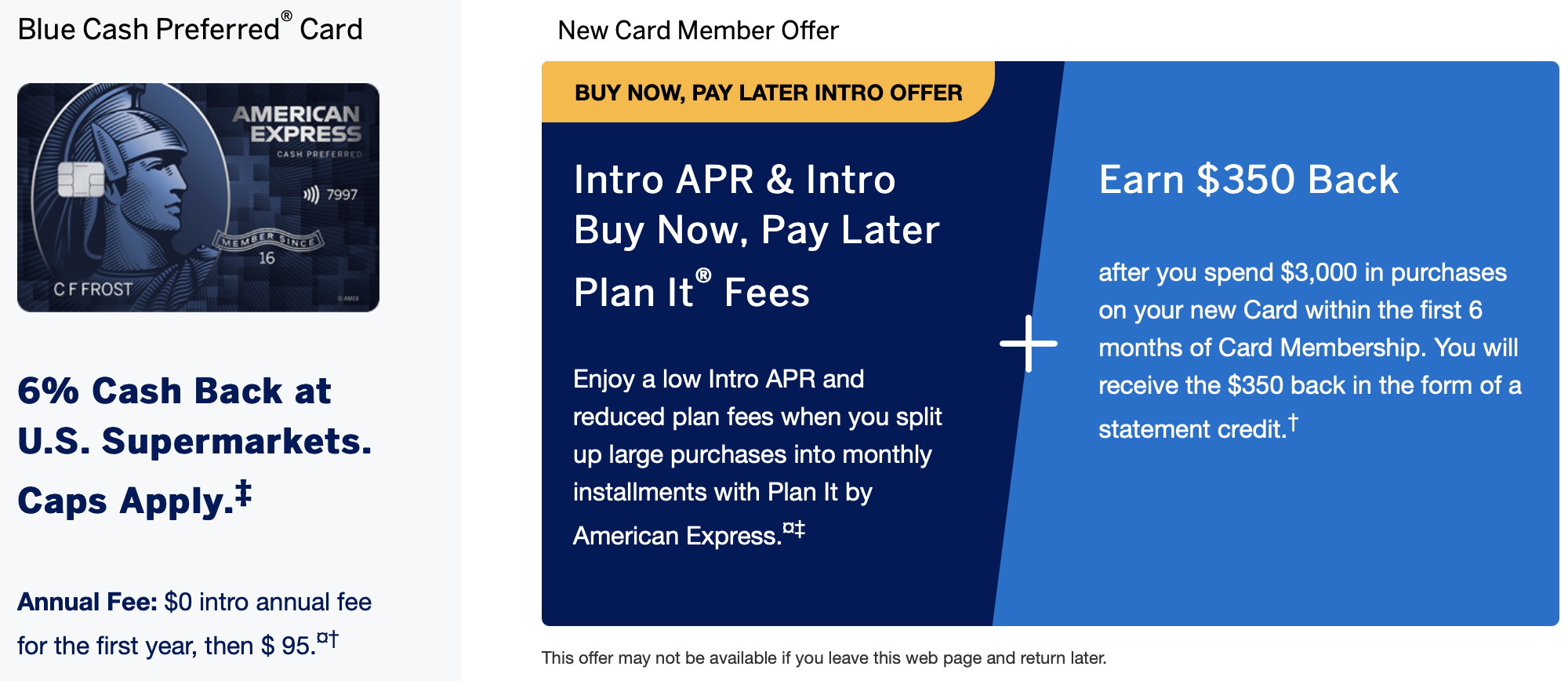
The American Express Blue Cash Preferred card allows qualifying new cardholders to perform balance transfers, typically offering a 0% introductory APR for 12 months on transfers requested within 60 days of account opening. While primarily known for its industry-leading 6% cash back on groceries, this card serves as a dual-purpose tool for debt consolidation and ongoing rewards, provided the transferred debt originates from a non-Amex financial institution.
The Role of the Blue Cash Preferred in Debt Management
As we navigate the financial landscape of 2026, the American Express Blue Cash Preferred (BCP) remains a cornerstone of the "rewards plus utility" credit card segment. Most consumers recognize the BCP for its aggressive cash-back tiers, but its utility as a balance transfer vehicle is often underutilized. A balance transfer is a financial maneuver where you move high-interest debt from one or more credit cards to a new card with a lower interest rate—ideally 0%.
The primary objective of using the BCP for this purpose is to halt the accumulation of interest, allowing 100% of your monthly payment to reduce the principal balance. However, the BCP is not a "pure" balance transfer card in the same way as the Amex EveryDay or dedicated low-interest cards. Instead, it offers a hybrid value proposition: you gain a window of interest-free debt repayment while securing a card that provides long-term value through its 6% cash-back rate on U.S. supermarkets and streaming services.
Understanding the mechanics of this card requires a look at the "Introductory Period." For 2026, American Express has maintained a competitive posture, usually granting a 12-month window of 0% APR. This period is critical because once it expires, any remaining balance will be subject to the card's standard variable APR, which can be significantly higher than the national average, depending on your creditworthiness at the time of application.
Eligibility and Credit Score Requirements
Securing an American Express Blue Cash Preferred for a balance transfer is not guaranteed. American Express is known for its selective underwriting standards. To be approved for the card and a sufficient credit limit to make a transfer meaningful, applicants generally need a "Good" to "Excellent" credit score. In 2026 terms, this typically translates to a FICO score of 690 or higher.
Underwriting Factors
Beyond the three-digit score, American Express evaluates several specific criteria:
- Debt-to-Income (DTI) Ratio: Amex prefers to see that your existing debt obligations do not consume a disproportionate amount of your gross monthly income. A DTI below 35% is generally considered favorable.
- Recent Credit Inquiries: A high number of "hard pulls" on your credit report in the last six months can signal financial distress, potentially leading to a lower starting credit limit or a denial.
- Existing Amex Relationship: If you already hold other American Express cards, the issuer will look at your payment history across those accounts. Notably, Amex often uses its internal data rather than a new hard credit pull for existing customers applying for a second card, though this is not a universal rule.
The 60-Day Window
A crucial technicality for the Blue Cash Preferred is the timing of the transfer. To qualify for the 0% introductory APR, the balance transfer request must typically be made within 60 days of account opening. If you wait until the fourth month of card ownership to request a transfer, you will likely be charged the standard variable APR, defeating the purpose of the consolidation strategy.
Fees and the Mathematics of Consolidation
While the interest rate on the BCP balance transfer is 0% during the intro period, the service is not free. American Express, like almost all major issuers, charges a balance transfer fee. As of 2026, this fee is generally the greater of $5 or 3% of the amount of each transfer.
Calculating the Break-Even Point
To determine if a balance transfer to the BCP makes sense, you must compare the transfer fee to the interest you would pay on your current card.
For example, if you are transferring $5,000 from a card with a 24% APR:
- Transfer Fee: 3% of $5,000 = $150.
- Current Interest: On a $5,000 balance at 24%, you are likely paying approximately $100 per month in interest alone.
- The Verdict: In this scenario, you "break even" in less than two months. By the third month, the $150 fee has been entirely offset by the savings in interest, and every subsequent month of the 0% period is pure profit for your balance sheet.
It is vital to remember that the balance transfer fee is added to your total balance. If you transfer $5,000 with a $150 fee, your new balance on the BCP will be $5,150. This amount must stay within your approved credit limit.
Step-by-Step Guide to Executing the Transfer
The process of moving debt to an American Express Blue Cash Preferred is streamlined but requires specific information about your existing accounts.
1. Gather Your Information
Before starting the application or the transfer request, you need the following for each account you wish to move:
- The full 16-digit credit card number of the source account.
- The exact name of the issuing bank (e.g., Chase, Citi, Wells Fargo).
- The specific amount you wish to transfer.
2. Submit the Request During Application
The most efficient way to secure the 0% rate is to include the balance transfer request during the initial online application for the BCP. There is usually a dedicated section labeled "Balance Transfers" where you can input the details mentioned above.
3. Post-Approval Processing
If you are approved, American Express does not send the funds immediately. There is a "cooling off" period, often lasting 10 to 14 days, during which the account is set up. Once this period passes, Amex sends the payment directly to your old card issuer. You must continue making payments on your old card until you see a $0 balance on that account's statement. Failure to do so could result in late fees and damage to your credit score on the very debt you are trying to manage.
4. Verification
After approximately two weeks, log in to your American Express online portal and the portal of your previous issuer to verify the transaction was successful. If there is a discrepancy, contact American Express customer service immediately.
Critical Restrictions: The "No Amex-to-Amex" Rule
Perhaps the most significant limitation of the American Express Blue Cash Preferred balance transfer is the entity restriction. You cannot transfer a balance from one American Express card to another American Express card.
This policy is standard across the industry; issuers use 0% APR offers as an acquisition tool to lure customers away from competitors. They have no incentive to lose interest income on a debt you already owe them. If you have a high balance on an Amex EveryDay card or a Gold Card, the Blue Cash Preferred cannot be used to mitigate that specific interest. In that case, you would need to look toward a competitor like Chase (Slate) or Citi (Simplicity) to move your Amex debt.
Comparing the Blue Cash Preferred to Alternatives
In 2026, consumers have several options for debt consolidation. The BCP is a "lifestyle" card with a balance transfer feature, whereas other cards are "utility" cards designed solely for debt.
| Feature | Amex Blue Cash Preferred | Amex EveryDay® Credit Card | High-Value Competitor (Typical) |
|---|---|---|---|
| Intro APR Period | 12 Months | 15 Months | 18–21 Months |
| Balance Transfer Fee | 3% (Min $5) | 3% (Min $5) | 3% to 5% |
| Annual Fee | $95 (often $0 intro year) | $0 | $0 |
| Primary Reward | 6% Groceries / Streaming | 2x Points at Supermarkets | Usually No Rewards |
| Best For | High Grocery Spenders | Frequent Amex Users | Long-term Debt Repayment |
As the table illustrates, if your primary goal is the longest possible time to pay off debt, a dedicated balance transfer card from a competitor might offer up to 21 months of 0% interest. However, if you can realistically pay off your debt within 12 months, the BCP is superior because of the $6,000 annual limit on 6% grocery rewards, which can net you up to $360 in cash back annually—far outweighing the $95 annual fee.
Strategies for Success During the 0% APR Period
A balance transfer is a tool, not a solution. To make the most of the BCP's offer in 2026, you should employ a disciplined repayment strategy.
The "Equal Payment" Method
Divide your total transferred balance (including the fee) by the number of months in the introductory period. For instance, if you owe $3,600 and have 12 months at 0%, aim to pay exactly $300 per month. This ensures the balance is zeroed out the moment the high interest kicks in.
Avoiding the "Double Debt" Trap
The biggest mistake cardholders make is continuing to charge new purchases to the card they just "cleared." If you move $5,000 from a Chase card to your Amex BCP, the Chase card now has a $5,000 open limit. If you spend on that Chase card while also carrying the debt on the Amex, you have effectively doubled your debt. It is often wise to stop using the original card entirely until the Amex balance is paid off.
Understanding Payment Allocation
If you use your Blue Cash Preferred for new purchases while carrying a transferred balance, American Express applies your "Minimum Payment" to the balance with the lowest APR (the 0% transfer). Any amount paid above the minimum is applied to the balance with the highest APR (your new purchases). This legal requirement under the CARD Act helps you avoid interest on new spending, but it can make your monthly statement complicated to read.
Limitations and Potential Pitfalls
While the BCP is a powerful financial instrument, there are specific 2026 market conditions and card-specific rules to keep in mind.
- Credit Limit Constraints: Amex may approve you for the card but grant a credit limit lower than the debt you wish to transfer. You cannot transfer a balance that exceeds your credit limit. In some cases, Amex may only allow you to transfer up to 75% or 90% of your total limit to leave room for fees and interest.
- Variable APRs: In 2026, interest rates remain subject to central bank adjustments. The "Go-To" rate on the BCP after the 12-month period is variable. If you fail to pay off the balance, you could be hit with an APR of 19.24% to 29.99% (based on current market trends), which can quickly erase any savings gained during the intro period.
- No Rewards on Transfers: You do not earn cash back on the amount you transfer. The 6% and 3% tiers apply only to new, qualifying purchases.
- The Annual Fee: Unlike many dedicated balance transfer cards, the BCP has a $95 annual fee (though often waived for the first year). You must factor this into your "cost of debt" if you plan to keep the card beyond the first 12 months.
Frequently Asked Questions
Does transferring a balance to the Amex Blue Cash Preferred hurt my credit score?
Initially, you may see a small dip in your score due to the "hard inquiry" during the application and the reduction in the average age of your accounts. However, in the medium term, a balance transfer often improves your score. By moving debt to a new card, you increase your total available credit, which lowers your overall credit utilization ratio—a key factor in FICO scoring.
Can I transfer a car loan or student loan to the Blue Cash Preferred?
Generally, no. American Express balance transfers are intended for credit card debt from other bank issuers. While some cards offer "balance transfer checks" that can be used for other types of debt, the standard electronic transfer process for the BCP is restricted to credit card accounts.
What happens if I miss a payment during the 0% APR period?
This is a critical risk. If you miss a payment or pay late, American Express reserves the right to terminate your 0% introductory APR immediately. You may also be moved to a "Penalty APR," which can be as high as 29.99%. Always set up autopay for at least the minimum amount to protect your promotional rate.
Is there a limit to how much I can transfer?
Yes. Your transfer limit is determined by your assigned credit limit. Furthermore, American Express often caps the total aggregate amount of all transfers at $7,500 or 50-75% of your credit line, whichever is lower. These specifics are provided in your cardmember agreement upon approval.
Can I earn the welcome bonus with a balance transfer?
No. Most American Express welcome offers require a certain amount of "spend" within the first few months (e.g., spend $3,000 in 6 months). Balance transfers, cash advances, and annual fees do not count toward this spending requirement. You must make new purchases to earn the welcome bonus.
Recommendation: Is the BCP Right for Your Transfer?
The American Express Blue Cash Preferred is an ideal choice for a balance transfer if you meet two specific criteria: you have a high grocery budget and you can realistically pay off your transferred debt within 12 months. If you spend $500 a month on groceries, the 6% cash back earns you $360 a year, which effectively pays for the balance transfer fee and the card's future annual fees.
However, if your debt is substantial and requires 18 to 21 months of breathing room, you should prioritize a card with a longer 0% window, even if it offers no rewards. The goal of a balance transfer is financial recovery; rewards should always be secondary to the elimination of high-interest debt. For those with a manageable balance and a need for a top-tier rewards card for the long haul, the Blue Cash Preferred remains one of the strongest options available in 2026.