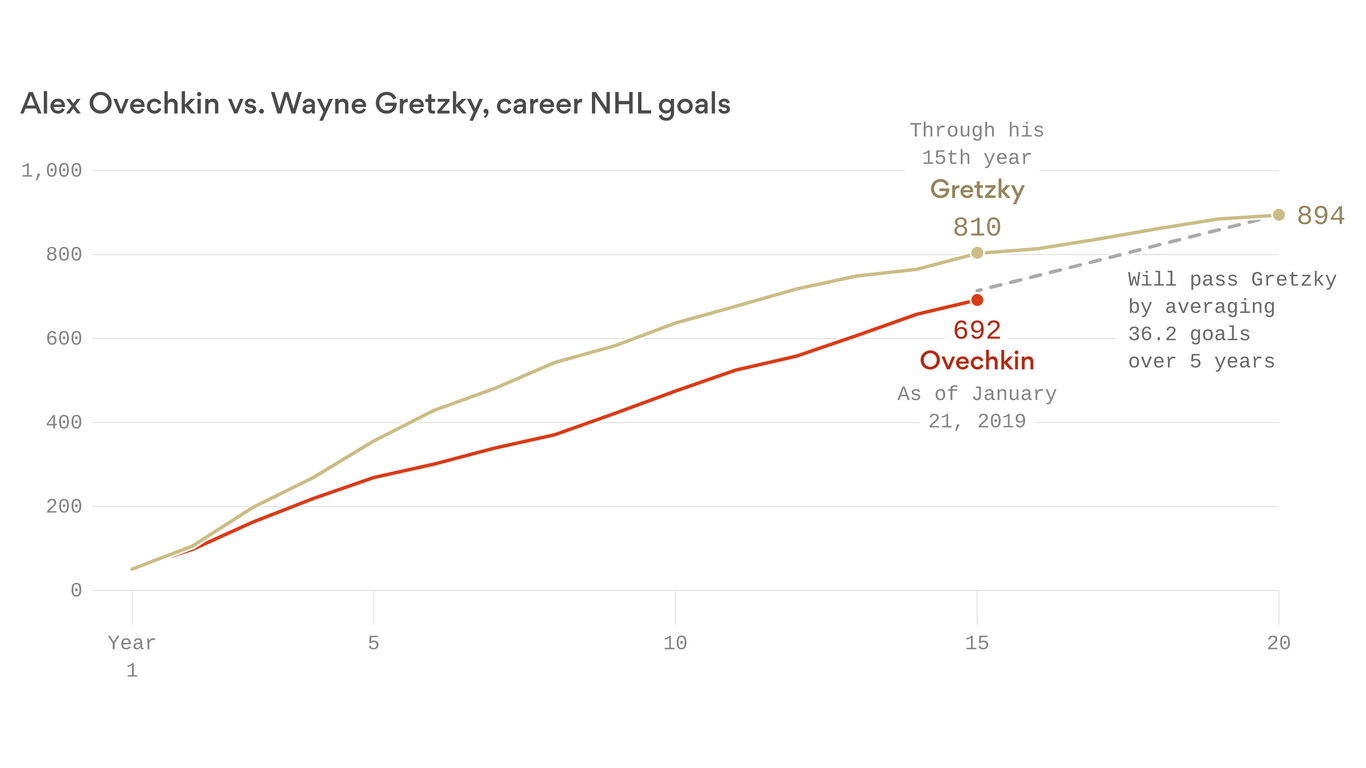
Alex Ovechkin has officially surpassed Wayne Gretzky’s long-standing record of 894 career goals, becoming the NHL’s all-time leading goal scorer. This monumental achievement, reached during the 2024-25 season and solidified by his continued performance into 2026, represents a seismic shift in professional hockey’s statistical hierarchy and the culmination of a twenty-year pursuit of excellence.
The Statistical Journey to 895 and Beyond
The pursuit of "The Great One’s" record was once considered an impossible task. When Wayne Gretzky retired in 1999, his 894 career goals sat 92 ahead of Gordie Howe and nearly 180 ahead of the next closest active player at the time. For decades, the record was viewed as a mathematical outlier, protected by the high-scoring environment of the 1980s. However, Alex Ovechkin’s career trajectory defied the standard aging curves of professional athletes.
Ovechkin’s journey to the top of the leaderboard is characterized by an unprecedented level of scoring consistency. Unlike many elite scorers who see a precipitous drop in production after age 30, Ovechkin maintained a 40-to-50-goal pace well into his late 30s. This longevity is the primary driver behind his ability to close a gap that required nearly two decades of elite health and performance. Analyzing his goal distribution reveals that while Gretzky relied on a high volume of goals during a decade of offensive dominance, Ovechkin’s tally is a product of sustained power over three different "eras" of NHL play, including the defensive-minded "dead puck" era and the modern high-tempo transition game.
To understand the magnitude of this achievement, one must look at the game-by-game pressure. As Ovechkin approached the 800-goal mark, the scrutiny intensified. Every empty-net goal, every power-play one-timer, and every "garbage" goal in the crease was cataloged by analysts worldwide. The final push from 850 to 895 was a masterclass in psychological resilience, as Ovechkin adapted his game to account for younger, faster defenders and increasingly sophisticated goaltending analytics that prioritized taking away his signature shooting lanes.
Era-Adjusted Scoring: A Technical Comparison
One of the most debated aspects of Ovechkin surpassing Gretzky involves "era-adjusted" metrics. Technical analysts and hockey historians often use these adjustments to compare players from different time periods by normalizing their statistics against the league's average scoring rate at the time. During Gretzky’s peak years in the 1980s, the average NHL game featured significantly more goals than the games played during Ovechkin’s career.
In the 1981-82 season, when Gretzky scored a record 92 goals, the league average was 4.01 goals per team per game. In contrast, during much of Ovechkin’s prime, that average fluctuated between 2.70 and 3.10. When these figures are adjusted—a process that essentially asks how many goals a player would score if the league scoring environment were constant across history—Ovechkin had actually "surpassed" Gretzky in adjusted value several seasons before he hit the raw number of 895.
Furthermore, the evolution of goaltending techniques has made scoring significantly more difficult in the 21st century. Gretzky faced goaltenders who primarily used the "stand-up" style, with smaller equipment and less emphasis on lateral coverage. Ovechkin has spent his career shooting against "butterfly" goaltenders who utilize advanced positioning, larger pads, and rigorous scouting reports. The technical proficiency required to beat a modern NHL goaltender is substantially higher, making Ovechkin’s raw total even more impressive to statistical purists.
The Mechanics of the "Great Eight": Technical Depth of the One-Timer
The most iconic element of Ovechkin’s pursuit is "The Office"—the top of the left faceoff circle. From a technical standpoint, Ovechkin’s power-play one-timer is one of the most studied mechanical movements in sports history. His ability to generate massive velocity while maintaining pinpoint accuracy from a static position has been a nightmare for defensive coordinators for 20 years.
The physics of Ovechkin's shot involves a specific weight transfer and stick flex. Using a high-flex composite stick (often customized to his specific stiffness preferences), Ovechkin utilizes the "kick point" of the shaft to create a whip-like effect. As the pass arrives, he loads his weight onto his back leg, drops his bottom hand for leverage, and strikes the ice slightly behind the puck. This "slap-shot" mechanic on a one-timer allows the stick to bow, storing kinetic energy that is released into the puck upon impact.
Opposing teams have spent two decades attempting to "shade" their defense toward Ovechkin’s side of the ice. Technically, this involves a "penalty kill" (PK) diamond formation that stretches toward the left circle. Despite this, Ovechkin’s success persisted because of the sheer speed of his release. Even when a goaltender knows the shot is coming, the velocity—often exceeding 100 mph—leaves a margin for error measured in milliseconds. His ability to change the angle of his blade at the last second, or to take the shot while his body is off-balance, is what truly separated him from other high-volume shooters like Brett Hull or Mike Bossy.
Longevity, Durability, and Physical Conditioning
Surpassing a record that stood for over a quarter-century requires more than just skill; it requires an almost supernatural level of durability. Alex Ovechkin’s career has been remarkably free of the catastrophic injuries that frequently derail the careers of power forwards. His physical style of play—heavy hitting, aggressive forechecking, and high ice time—usually leads to significant wear and tear.
Ovechkin’s training regimen and physiological makeup have been subjects of intense interest. Unlike the lean, high-cardio builds of modern "track meet" players, Ovechkin possesses a thick, sturdy frame that has allowed him to absorb the impacts of the NHL’s 82-game schedule. His ability to recover from minor ailments and his avoidance of soft-tissue injuries have enabled him to play over 95% of his possible career games. This "availability" is a statistical necessity for breaking Gretzky’s record; had Ovechkin missed even one full season due to injury, the math for reaching 895 would have become nearly impossible.
The role of sports science in the latter half of his career cannot be understated. By 2026, the Washington Capitals' medical and conditioning staff had transitioned Ovechkin into a specialized maintenance program designed to preserve his explosive power while minimizing unnecessary fatigue. This included cryogenic recovery, localized physical therapy, and a modified practice schedule that focused on high-intensity intervals rather than traditional endurance skating.
Comparative Metrics: Gretzky vs. Ovechkin
The following table breaks down the core statistical differences between the two legends at the time Ovechkin surpassed the 894 mark.
| Statistical Category | Wayne Gretzky (Final) | Alex Ovechkin (At 895) | Impact/Context |
|---|---|---|---|
| Total Games Played | 1,487 | ~1,450-1,500 | Ovechkin reached the mark in a similar games-played window. |
| Goals Per Game | 0.60 | ~0.61 | Reflects Ovechkin's remarkable consistency across eras. |
| Power Play Goals | 204 | 300+ | Ovechkin is the undisputed king of the man-advantage. |
| Game Winning Goals | 91 | 125+ | Highlights Ovechkin's "clutch" scoring capability. |
| Empty Net Goals | 56 | 60+ | A necessary component of the chase in the final stages. |
| Shots on Goal | 5,088 | 6,500+ | Ovechkin is the highest-volume shooter in NHL history. |
| Shooting Percentage | 17.6% | ~13-14% | Gretzky was more efficient; Ovechkin relies on volume. |
The Impact on the Washington Capitals and the NHL
Ovechkin’s record-breaking goal was more than just a personal milestone; it was a defining moment for the Washington Capitals franchise and the league at large. Since Ovechkin was drafted first overall in 2004, he has been the face of hockey in the mid-Atlantic United States. His pursuit of the record revitalized a market that had struggled with attendance and relevance in the late 90s.
Economically, the "Chase for 895" was a windfall for the NHL. Ticket prices for Capitals games, both home and away, saw a significant "Ovechkin Premium" as fans hoped to witness history. Television ratings for Washington games spiked during the 2023-24 and 2024-25 seasons, providing the league with a compelling narrative during the regular season. This global interest extended back to Europe and Russia, where Ovechkin remains a cultural icon, further cementing the NHL's status as the world’s premier hockey destination.
Within the Capitals organization, the pursuit shaped roster construction for several years. The team’s management prioritized keeping veteran playmakers like Nicklas Backstrom and John Carlson, whose chemistry with Ovechkin was vital for his scoring output. The "all-in" approach to helping their captain break the record occasionally came at the expense of long-term rebuilding, but the payoff—a permanent place in the history books and a 2018 Stanley Cup—has justified the strategy in the eyes of the fanbase.
Evolution of Defensive Strategies Against the Record-Breaker
To understand why Ovechkin’s achievement is so significant, one must analyze how the NHL tried to stop him. By the 2020s, defensive systems had become incredibly rigid. The "1-3-1" neutral zone trap and high-pressure "box" penalty kills were specifically designed to limit the space available to elite shooters.
Coaches began employing "shadowing" techniques that hadn't been seen since the 1980s, where a specific player was tasked with staying within stick-length of Ovechkin at all times. This tactical focus makes his ability to find "quiet ice" even more remarkable. He developed a veteran’s sense of timing, often lurking behind the play and accelerating into the zone just as the defense shifted its focus. This "stealth" scoring became more prominent in his later years as his raw skating speed naturally declined.
Frequently Asked Questions
Did Alex Ovechkin break the record faster than Wayne Gretzky?
While Ovechkin surpassed the 894-goal total, he did not do so in fewer games than Gretzky reached his own milestones. Gretzky’s early-career scoring pace remains the fastest in history. However, Ovechkin is considered the fastest to reach the record within the context of the modern, lower-scoring era.
How many of Ovechkin's goals were empty-netters?
As of his record-breaking moment, Ovechkin had scored over 60 empty-net goals. While some critics point to these as "easier" goals, they are a standard part of the game and a reflection of a coach's trust in a player to be on the ice during the final minutes of a close game. Gretzky himself had 56 empty-net goals.
What happens to the record now?
With Ovechkin now holding the record, the focus shifts to whether anyone currently in the league—such as Auston Matthews or Connor McDavid—has a realistic chance of catching him. Given the requirement for both extreme peak scoring and 20 years of health, Ovechkin’s new record is expected to stand for several decades.
Which goaltender did Ovechkin score on the most?
Throughout his career, Ovechkin found the most success against veteran goaltenders like Marc-Andre Fleury and Henrik Lundqvist, largely because he faced them dozens of times in high-stakes divisional matchups. His ability to score against the elite goaltenders of his era is a testament to his skill.
Did rule changes help Ovechkin break the record?
The NHL’s crackdown on "clutching and grabbing" after the 2004-05 lockout certainly helped offensive players, including Ovechkin. However, the introduction of the salary cap and more structured defensive coaching acted as a counterbalance, making the achievement a product of skill rather than a beneficial rule environment.
The Path Forward: Legacy and the Future of the Record
As we look at the NHL landscape in 2026, Alex Ovechkin’s name sits alone at the top of the goal-scoring list. His legacy is defined not just by the number 895, but by the way he changed the perception of what is possible in the modern game. He proved that the "untouchable" records of the high-flying 80s could be challenged through a combination of elite talent, physical durability, and a relentless competitive drive.
For fans and analysts, the next step is appreciating the twilight of a career that has spanned two decades. While the primary "chase" is over, every goal Ovechkin adds to his total now sets a higher bar for the next generation. Aspiring players looking to emulate his success should focus on the technical mechanics of his shot and the professional discipline required to maintain peak physical condition over 1,500 games.