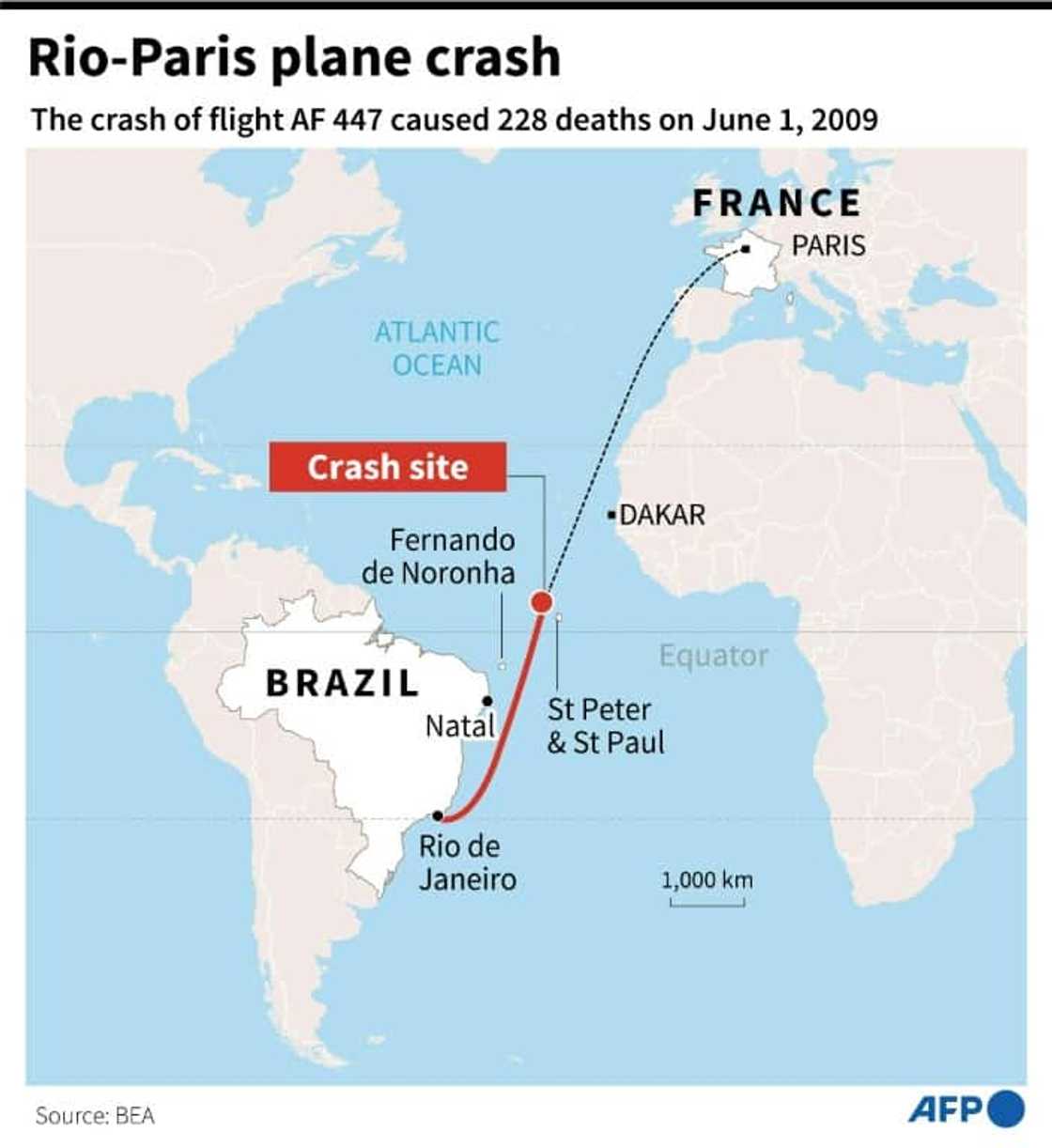
The 2009 crash of Air France Flight 447 resulted from a fatal combination of technical failure and pilot error. Ice crystals obstructed the aircraft’s pitot tubes, causing inconsistent airspeed readings and disconnecting the autopilot. The flight crew responded with incorrect control inputs, leading to an aerodynamic stall from which the aircraft never recovered.
The Final Flight: An Overview of AF447
On May 31, 2009, Air France Flight 447 (AF447) departed from Rio de Janeiro–Galeão International Airport, destined for Paris-Charles de Gaulle. The aircraft, an Airbus A330-203 registered as F-GZCP, was relatively new, having first flown in 2005. Onboard were 216 passengers and 12 crew members, representing 33 different nationalities.
The flight was expected to be a routine overnight crossing of the Atlantic Ocean. However, the route required traversing the Intertropical Convergence Zone (ITCZ), a region near the equator where the trade winds of the Northern and Southern Hemispheres meet. This zone is notorious for generating severe convective activity, including massive thunderstorms and high-altitude ice crystals.
As of 2026, the loss of AF447 remains one of the most studied events in aviation history. It fundamentally changed how the industry views "automation addiction" and high-altitude manual handling. The disaster proved that even the most advanced fly-by-wire systems cannot compensate for a loss of basic situational awareness when critical sensors fail.
The Sequence of Events: From Autopilot Disconnect to Impact
The critical phase of the flight began approximately three hours after takeoff. The aircraft was cruising at Flight Level 350 (35,000 feet) when it entered a dense area of clouds associated with the ITCZ.
The Failure of the Pitot Probes
The primary catalyst for the disaster was the icing of the aircraft's pitot probes. These small, forward-facing tubes measure the pressure of the oncoming air to determine the aircraft's speed. Because the A330 was flying through a high concentration of ice crystals, the heating elements within the Thales-brand pitot tubes were overwhelmed.
Within seconds, ice blocked the tubes, leading to a sudden drop in the airspeed displayed to the pilots. Because the flight control computers received conflicting data, they could no longer safely operate the aircraft. The system automatically disconnected the autopilot and the auto-thrust, reverting the flight control logic from "Normal Law" to "Alternate Law."
Manual Handling and the Aerodynamic Stall
In Alternate Law, many of the aircraft’s automatic protections against stalling or overstressing the airframe are disabled. The Pilot Flying (PF), Pierre-Cédric Bonin, reacted to the autopilot disconnect by pulling back on his side-stick. This "nose-up" input caused the aircraft to climb rapidly, reaching nearly 38,000 feet.
As the aircraft climbed, its speed decreased further. The stall warning—a loud, repetitive synthetic voice and "cricket" sound—began to alert the crew that the wings were no longer generating enough lift. Despite the warning, the PF continued to hold the nose up. This action is the opposite of the standard stall recovery procedure, which requires pushing the nose down to regain airspeed.
The aircraft eventually reached its peak altitude and began to fall, not in a dive, but in a flat stall. It was dropping at a rate of 10,000 feet per minute while maintaining a high nose-up attitude. Because the recorded airspeed had dropped below a certain threshold (60 knots), the stall warning actually stopped, leading the pilots to believe the situation was improving when, in fact, it was deteriorating.
Analyzing the BEA Findings: Why Did the Aircraft Fail?
The French Bureau d'Enquêtes et d'Analyses (BEA) conducted an exhaustive investigation that lasted several years. Their final report identified a complex web of causal factors that went far beyond a simple sensor malfunction.
Human Factors and CRM (Crew Resource Management)
At the time of the initial crisis, the Captain, Marc Dubois, was on a scheduled rest break. The two co-pilots, David Robert and Pierre-Cédric Bonin, were left in the cockpit. The investigation revealed a significant breakdown in Crew Resource Management (CRM).
- Lack of Leadership: When the Captain returned to the cockpit roughly 90 seconds after the initial failure, he did not immediately take control, and the two co-pilots failed to provide him with a clear summary of the situation.
- Cognitive Tunneling: The Pilot Flying appears to have been overwhelmed by the "startle factor." He focused entirely on the loss of altitude and airspeed readings without realizing his own inputs were causing the stall.
- Dual Input Issues: In the final moments, both pilots were making contradictory inputs on their side-sticks. In an Airbus, these inputs are algebraically summed unless one pilot presses a "priority" button, which did not happen until it was too late.
The Problem with Thales AA Pitot Tubes
The investigation highlighted that the Thales AA pitot tubes used on the A330 had a known history of icing incidents. Prior to the AF447 crash, there had been several reported cases of temporary airspeed loss on similar aircraft. While Air France had begun a replacement program to install more resilient Goodrich probes, the aircraft involved in the crash had not yet been upgraded.
The Technical Mystery and the Multi-Year Search
The recovery of AF447 was one of the most challenging underwater salvage operations in history. The aircraft disappeared over the "black hole" of the Atlantic, where radar coverage is non-existent.
| Search Phase | Dates | Key Outcome |
|---|---|---|
| Phase 1 | June 2009 | Discovery of floating debris and the first 50 bodies. |
| Phase 2 | Aug 2009 | Towed pinger locators failed to find the "Black Boxes." |
| Phase 3 | April 2010 | Side-scan sonar used, but the rugged terrain hid the wreckage. |
| Phase 4 | April 2011 | Success. REMUS 6000 AUVs located the main wreckage field. |
| Recovery | May 2011 | Black boxes retrieved from a depth of 3,900 meters (12,800 ft). |
The discovery of the Flight Data Recorder (FDR) and Cockpit Voice Recorder (CVR) in 2011 was a turning point. Until their recovery, the aviation community could only speculate on why a modern jet would fall out of the sky. The data revealed the shocking truth: the aircraft was fully functional aside from the brief sensor icing, and the crash was preventable.
Industry Impacts and Safety Transformations
The legacy of Air France Flight 447 is visible in nearly every aspect of modern commercial aviation safety. By 2026, the lessons learned from this tragedy have been codified into international regulations.
Mandated Equipment Upgrades
Following the BEA's recommendations, the European Union Aviation Safety Agency (EASA) and the Federal Aviation Administration (FAA) mandated the replacement of all Thales AA pitot probes with more robust models. Furthermore, new standards for underwater locator beacons (ULBs) were established, increasing their battery life from 30 days to 90 days to allow more time for search teams to locate wreckage.
Upset Prevention and Recovery Training (UPRT)
Perhaps the most significant change occurred in pilot training. The AF447 disaster exposed a "gap" in training where pilots were proficient in using automation but lacked the skills to handle high-altitude stalls manually.
As a result, UPRT (Upset Prevention and Recovery Training) is now a mandatory requirement for commercial pilots. This training includes:
- Manual Handling at High Altitude: Pilots now practice flying the aircraft without autopilot in thin air, where the "coffin corner" (the narrow margin between stall speed and overspeed) makes handling twitchy.
- Stall Recovery Logic: The industry-wide "nose-down" emphasis was reinforced. Pilots are taught that even if the aircraft is losing altitude, the priority is always to reduce the angle of attack.
- Surprise/Startle Management: Modern simulators now incorporate scenarios designed to startle pilots, helping them manage the physiological rush of a sudden emergency.
Legal Outcomes and the 2023 Trial Verdict
In 2023, a French court delivered a verdict in the long-running criminal case against Air France and Airbus. Both companies were charged with involuntary manslaughter. The court ultimately acquitted both entities, ruling that while errors were made, it could not be proven that the companies committed a "criminal fault" directly linked to the crash.
However, the court did acknowledge that Airbus had "underestimated the gravity of the pitot tube failures" and that Air France had not provided sufficient training for such an event. While the criminal trial concluded, civil litigation and settlements for the families of the victims continued for years, focusing on the corporate responsibility to act on known technical risks.
FAQs
What exactly caused the pitot tubes to fail?
The pitot tubes failed due to supercooled ice crystals in the Intertropical Convergence Zone. These crystals are so fine that they can pass through the protective grids of the sensors and accumulate inside the tube faster than the internal heating elements can melt them. This causes a blockage that prevents the sensor from measuring air pressure correctly.
Why did the pilot pull up instead of pushing down during the stall?
The investigation suggested "cognitive overload" and a lack of training. The pilot, Pierre-Cédric Bonin, likely suffered from the illusion that the aircraft was moving too fast or was concerned about losing altitude. Without reliable airspeed indicators and under extreme stress, he reverted to an instinctive but incorrect "nose-up" reaction to try and stop the aircraft's descent.
How did the stall warning "stop" during the fall?
In the Airbus A330's design at the time, if the measured airspeed fell below 60 knots (approx. 69 mph), the computer assumed the data was invalid and silenced the stall warning. As the aircraft fell vertically in a deep stall, its forward airspeed dropped below this limit. When the pilot occasionally pushed the nose down to gain speed, the warning would restart, which counter-intuitively confused the pilot into thinking his "nose-down" action was causing the problem.
Could this happen to a modern plane today?
While no system is 100% foolproof, the likelihood is significantly reduced. Modern aircraft use upgraded pitot probes and have software "synthetic airspeed" backups that calculate speed based on other factors like GPS and engine thrust. Additionally, pilots are now specifically trained to handle the exact scenario that AF447 faced.
Did the passengers know what was happening?
Data from the CVR and FDR suggests the aircraft was in a stable, albeit rapidly descending, stall for about three and a half minutes. Because the descent was "flat" and not a nose-dive, the passengers likely felt heavy turbulence and a sense of "weightlessness" or sinking, but they may not have realized the gravity of the situation until the very end, as the cabin remained pressurized and the lights stayed on until impact.
Practical Recommendation for Aviation Safety Monitoring
For those interested in current aviation safety standards, it is recommended to monitor the ICAO (International Civil Aviation Organization) and EASA annual safety reports. These documents provide updated data on how the industry is addressing "Loss of Control In-Flight" (LOC-I), which remains a leading cause of fatalities. For passengers, it is important to remember that AF447 led to the most rigorous pilot training overhaul in 50 years, making the current global aviation system significantly more resilient than it was in 2009.