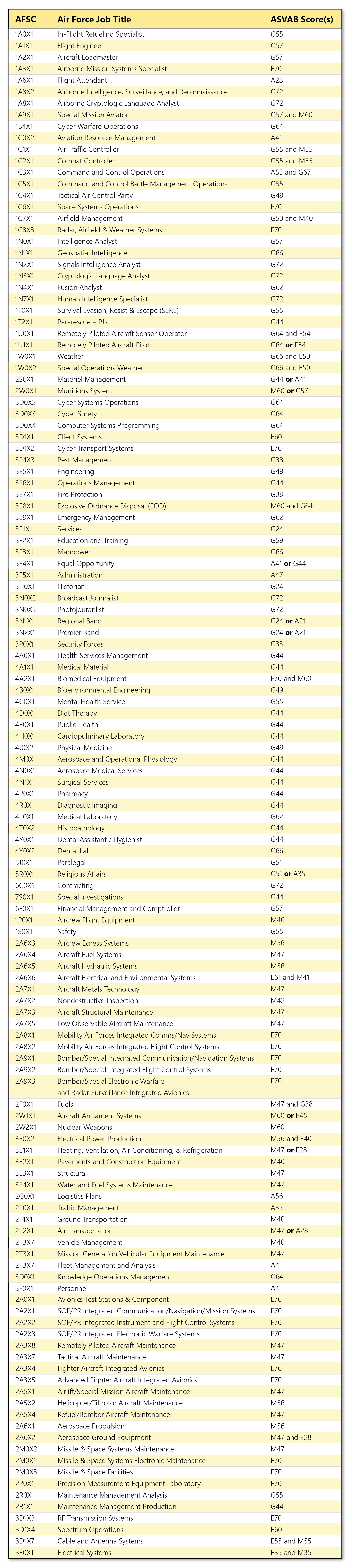
To qualify for the Air Force Security Forces (AFSC 3P0X1), applicants must achieve a minimum General (G) score of 30 on the Armed Services Vocational Aptitude Battery (ASVAB). Beyond this score, candidates must also possess a valid driver’s license, a clean criminal record, and the ability to obtain a Secret security clearance.
The Air Force Security Forces, often referred to as "Defenders," serve as the ground combat force and military police for the U.S. Air Force. As of 2026, the requirements for entering this career field remain stringent, focusing not just on cognitive ability measured by the ASVAB, but also on physical stamina, psychological resilience, and moral character. Because Security Forces personnel are responsible for protecting nuclear arsenals, multi-million dollar aircraft, and thousands of personnel, the Air Force uses the ASVAB as a baseline to ensure recruits possess the fundamental verbal and mathematical reasoning necessary for complex law enforcement and air base defense tasks.
Understanding the ASVAB Score for Security Forces
The ASVAB is not a single test but a battery of subtests designed to measure an applicant's strengths in various areas. For the Air Force, these subtests are grouped into four qualification areas: Mechanical (M), Administrative (A), General (G), and Electronic (E). These are commonly known as the "MAGE" scores.
The primary metric for Security Forces is the General (G) score. To calculate this, the Air Force combines two specific subtest scores:
- Verbal Expression (VE): This is a composite score derived from the Word Knowledge (WK) and Paragraph Comprehension (PC) subtests.
- Arithmetic Reasoning (AR): This measures your ability to solve basic mathematical word problems.
The formula is generally understood as VE + AR = General Score. To be eligible for 3P0X1, your percentile rank in this category must be at least 30. While a 30 is the baseline, many recruiters suggest aiming for a higher score to remain competitive, especially if the career field is nearing its recruitment quotas for the fiscal year.
Why the "General" Score Matters
The General score is utilized because Security Forces work requires a balance of clear communication and logical problem-solving. Whether a Defender is writing a detailed incident report, communicating over tactical radios during a base defense exercise, or calculating distances for a defensive perimeter, they rely on the literacy and numeracy skills captured by the General composite.
Detailed Breakdown of ASVAB Subtests for Defenders
To successfully hit the "G30" requirement, applicants should focus their study efforts on the three subtests that directly impact the General score. However, performing well on the entire battery is beneficial for overall military eligibility.
Word Knowledge (WK)
This subtest measures your vocabulary and ability to identify synonyms. In the context of Security Forces, this is vital for understanding legal codes, military regulations, and technical manuals. A Defender must be able to articulate observations clearly during testimonies or when briefing commanding officers.
Paragraph Comprehension (PC)
This section evaluates your ability to extract information from written passages. In the field, Defenders must interpret "Rules of Engagement" (ROE) and "Standard Operating Procedures" (SOP). Misinterpreting a single sentence in a high-pressure situation can have legal or even fatal consequences, making this subtest a critical indicator of potential success.
Arithmetic Reasoning (AR)
This subtest focuses on word problems that require mathematical logic. Security Forces use basic math for land navigation, adjusting fire on heavy weapons systems, and managing inventory of sensitive equipment. While you don't need to be a calculus expert, a solid grasp of ratios, percentages, and multi-step logic is required.
Comprehensive Requirements for AFSC 3P0X1
Meeting the ASVAB requirement is the first hurdle, but Security Forces is one of the most demanding career fields regarding non-academic prerequisites. In 2026, the Air Force continues to emphasize the "whole person" concept for its Defenders.
1. Citizenship and Security Clearance
Security Forces personnel are often granted access to restricted areas containing classified technology or nuclear assets. Therefore, you must be a U.S. citizen and be eligible for a Secret security clearance. This process involves a background investigation into your finances, criminal history, and past associations.
2. Moral and Legal Standing
Because Security Forces members carry firearms and possess law enforcement authority, their background must be exemplary.
- No History of Emotional Instability: Applicants undergo a psychological screening to ensure they can handle the stress of combat and law enforcement duties.
- The Lautenberg Amendment: Under federal law, anyone convicted of a domestic violence misdemeanor is prohibited from carrying a firearm. This is an automatic disqualifier for Security Forces.
- Drug Use: A history of significant drug use, particularly involving distribution or "hard" drugs, often results in a permanent disqualification for this AFSC.
3. Physical Standards and Vision
Defenders are expected to be among the most physically fit members of the Air Force.
- PULHES Factor: This is a military medical grading system. Security Forces typically requires high scores in physical capacity and stamina.
- Vision: You must have normal color vision. This is critical for identifying "friend or foe" targets, recognizing vehicle colors during a pursuit, and reading color-coded map overlays or signal flares.
- Driver’s License: A valid state driver’s license is mandatory, as mobile patrol is a core component of the job.
4. Strength Requirements
Recruits must be able to lift and carry heavy equipment. The Air Force uses the Strength Aptitude Test to ensure applicants can meet the "Heavy" lifting category (lifting 70–100 lbs) required for carrying body armor, weapons, and occasionally moving injured personnel.
| Requirement Category | Specific Standard for 3P0X1 |
|---|---|
| ASVAB Score | Minimum General (G) 30 |
| Citizenship | United States Citizen |
| Security Clearance | Secret |
| Driver's License | Valid State License Required |
| Lifting Category | Heavy (70-100 lbs) |
| Vision | Normal Color Vision Required |
| Moral Standard | No Domestic Violence Convictions (Lautenberg) |
The Training Pipeline: From ASVAB to "The Beret"
Passing the ASVAB and meeting the entry requirements is only the beginning. Once enlisted, a recruit goes through a rigorous training process to earn the coveted blue beret.
Basic Military Training (BMT)
All Air Force recruits attend BMT at Lackland Air Force Base in San Antonio, Texas. This 7.5-week program focuses on discipline, physical fitness, and the fundamentals of Air Force life.
The Security Forces Academy
Immediately following BMT, recruits transition to the Security Forces Academy, also located at Lackland AFB (Camp Bullis). This course lasts approximately 65 days. The curriculum covers:
- Military Law and Jurisdiction: Understanding the Uniform Code of Military Justice (UCMJ).
- Small Arms Qualification: Mastery of the M4 carbine, M18 pistol, and heavier weapon systems like the M249 and M240B.
- Combat Tactics: Small unit tactics, patrolling, and air base ground defense.
- Law Enforcement: Traffic stops, apprehension techniques, and domestic dispute response.
The academic portion of the academy reinforces the necessity of the G30 ASVAB score. Students are tested on complex legal definitions and tactical procedures that require the reading comprehension skills measured by the ASVAB.
Career Specializations and Advanced Opportunities
One of the misconceptions about Security Forces is that it is a "one-size-fits-all" job. In reality, the 3P0X1 AFSC offers numerous specialized paths. Achieving a higher ASVAB score can sometimes make it easier to transition into these highly technical sub-fields later in a career.
Military Working Dog (MWD) Handler
Handlers work with canines trained in drug detection, explosives detection, and patrol work. This is a highly competitive "shred-out" that requires significant time on station and a stellar performance record.
Combat Arms (CA)
These specialists are the Air Force’s weapons experts. They train all other Airmen on small arms and are responsible for the maintenance and repair of the unit’s armory. This role leans more into the Mechanical (M) and General (G) ASVAB categories.
Phoenix Raven
Ravens are elite Security Forces members who provide security for Air Mobility Command (AMC) aircraft in high-threat environments worldwide. They undergo specialized training in hand-to-hand combat, embassy operations, and cross-cultural awareness.
Close Precision Engagement (CPE)
Commonly known as the Air Force's countersniper program, CPE teams provide long-range observation and precision fire to protect airfields and high-value assets.
Common Obstacles and How to Overcome Them
Many potential recruits find themselves just short of the G30 requirement or facing medical hurdles. Understanding the waiver process and retesting options is vital.
Retesting for the ASVAB
If you score below a 30 in the General category, you are not permanently barred from Security Forces. You can retake the ASVAB after a 30-day waiting period. Use this time to focus specifically on the Official ASVAB Practice Tests or tutoring for Arithmetic Reasoning and Verbal Expression. A second retest is available after another 30 days, but subsequent attempts require a six-month wait.
Medical and Moral Waivers
The Air Force does offer waivers for certain past issues, such as minor legal infractions or specific medical conditions. However, waivers for Security Forces are more difficult to obtain than for other AFSCs because of the firearm requirements. If you have a "moral waiver" (for a past arrest, for example), your recruiter will need to submit a comprehensive package for review by the Air Force Recruiting Service.
Frequently Asked Questions
Can I join Security Forces with a GED?
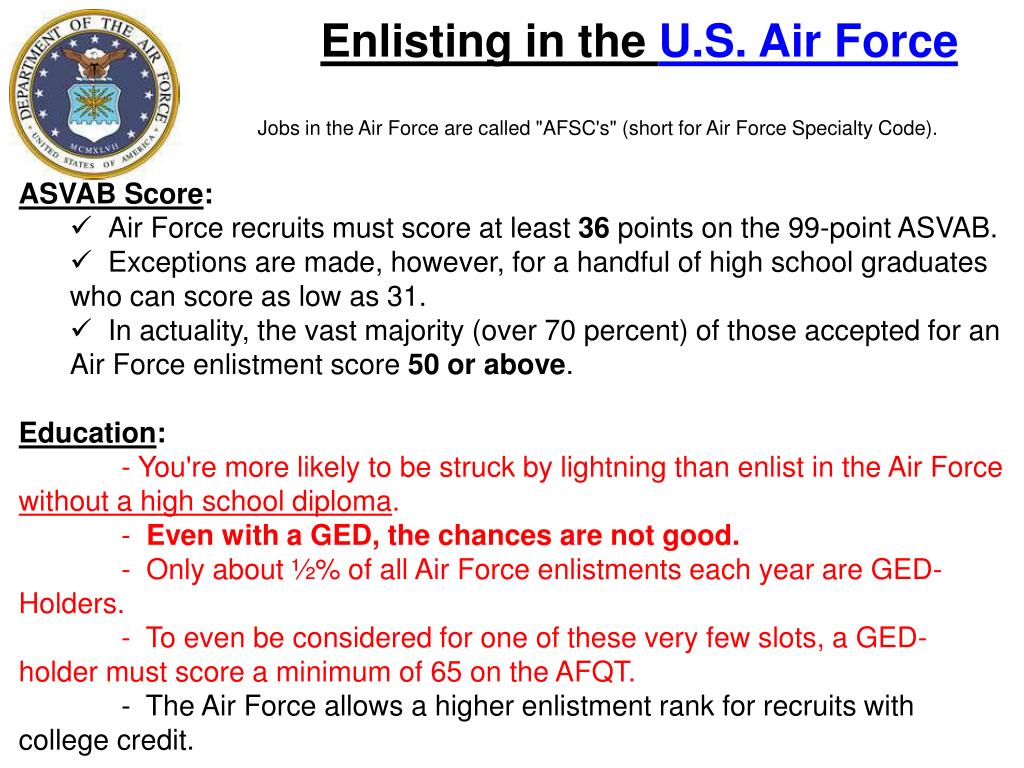
Yes, but it is more difficult. The Air Force limits the number of "Tier 2" (GED) applicants it accepts annually. Most Tier 2 applicants must score higher on the ASVAB—often a 50 or above—to be considered for enlistment, regardless of the specific AFSC requirement.
Is the G30 score the same for the Air National Guard?
Generally, yes. The Air National Guard and Air Force Reserve typically follow the same AFSC qualification standards as Active Duty. However, specific units may have additional local requirements or different openings based on their mission (e.g., a unit guarding a nuclear site vs. a transport hub).
Does my "Mechanical" score matter for Security Forces?
While the primary requirement is the General (G) score, a decent Mechanical (M) score is helpful. Security Forces members operate armored vehicles and maintain various weapon systems. Understanding basic mechanical principles will help during the "Combat Arms" and "Tactical Vehicle" portions of technical training.
What happens if I fail the Security Forces Academy?
If a recruit fails the technical training at Lackland AFB due to academic or physical reasons, they are "reclassified" based on the "Needs of the Air Force." This means they will be assigned to a different job that matches their ASVAB scores, or they may be separated from the military if no other roles are available.
Are there any height or weight requirements?
You must meet the standard Air Force height and weight (or body fat) requirements for enlistment. There is no specific "Security Forces height requirement," but you must be able to perform all physical tasks, including wearing heavy gear and entering/exiting various military vehicles.
Practical Recommendation for Aspiring Defenders
If you are aiming for a career in Air Force Security Forces in 2026, do not settle for the minimum score. While a G30 gets you through the door, the modern "Defender" is expected to be a technical expert and a tactical leader.
- Study Targeted Areas: Focus your ASVAB prep on Arithmetic Reasoning and Verbal Expression. Use high-quality study guides that offer timed practice tests.
- Physical Preparation: Start a fitness regimen that includes rucking (walking with a weighted pack), strength training, and high-intensity interval training (HIIT).
- Documentation: Gather your driving records, medical history, and legal documents early. The background check for a Secret clearance is thorough; honesty with your recruiter is the best policy.
For more information on current enlistment bonuses or to schedule an ASVAB attempt, visit the official Air Force Recruiting website.