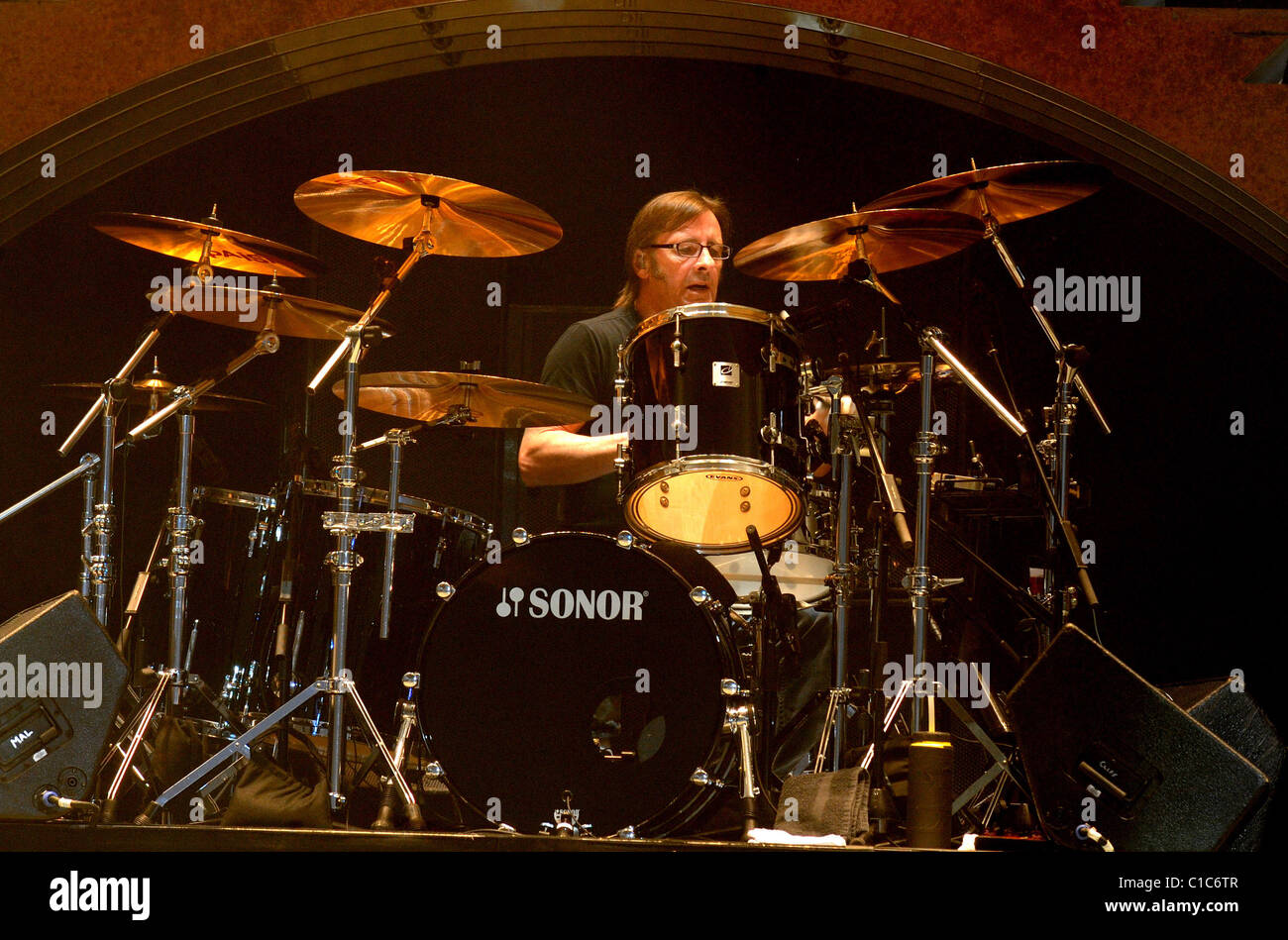
Phil Rudd is the definitive drummer for AC/DC, providing the minimalist, "behind-the-beat" groove that defined the band's hard rock sound across five decades. Known for his unwavering timing and powerful backbeat, Rudd played on the band’s most iconic albums, including Back in Black, Highway to Hell, and Power Up.
The Genesis of the Rudd Sound
Born Phillip Hugh Norman Witschke Rudzevecuis in Melbourne, Australia, Phil Rudd’s journey into the pantheon of rock history began long before the world heard the opening chords of "T.N.T." In the early 1970s, Rudd played with various Australian bands, most notably Buster Brown with future Rose Tattoo singer Angry Anderson. However, it was his 1975 audition for AC/DC—replacing Peter Clack—that would change the trajectory of rock music.
When Rudd joined AC/DC, the band was still finding its sonic identity. Angus and Malcolm Young provided the high-voltage energy, but they needed a foundation that was both immovable and possessed a certain "swing." Rudd brought a specific sensibility derived from early blues and rock and roll, prioritizing the "pocket" over technical flourish. This approach became the bedrock of the AC/DC aesthetic: a relentless 4/4 pulse that prioritizes the song over the individual performer.
During his first tenure with the band (1975–1983), Rudd contributed to a run of albums that remain the gold standard for hard rock production. From the raw energy of High Voltage to the polished, massive sound of For Those About to Rock We Salute You, his drumming provided the necessary space for the Young brothers' guitars to breathe. His ability to maintain a steady tempo without a click track—often described by bandmates as being a "human metronome"—became his professional trademark.
The Technicality of Minimalism: The "Phil Rudd Groove"
To the uninitiated, Phil Rudd’s drumming might seem simple. He rarely uses 16th-note fills, avoids double-bass pedals, and almost never utilizes the "crash" cymbal during a groove. However, within the drumming community, Rudd is revered for the extreme difficulty of his consistency and "feel."
The "Phil Rudd Groove" is characterized by a slight delay in the snare hit—often referred to as playing "on the back of the beat." While the kick drum remains locked with the bass guitar, the snare hits just a fraction of a second late, creating a sense of "heaviness" and "swagger." This prevents the high-tempo tracks from feeling rushed or frantic. Furthermore, Rudd’s hi-hat work is exceptionally controlled; he often uses the hi-hat to drive the song's energy, subtly opening and closing the plates to accentuate transitions between verses and choruses.
Another hallmark of his style is the absence of unnecessary ornamentation. In an era where 1970s prog-rock drummers were using massive kits and complex time signatures, Rudd stripped the instrument down to its core. By doing so, he created a "wall of sound" that allowed the rhythm guitar of Malcolm Young to become the lead rhythmic force. The synergy between Rudd and Malcolm Young is often cited by musicologists as one of the most important partnerships in rock history.
Equipment and Technical Specifications
Phil Rudd’s gear selection has remained remarkably consistent throughout his career, reflecting his "if it isn't broken, don't fix it" philosophy. He has been a long-time endorser of Sonor drums and Paiste cymbals. His setups are designed for maximum projection and durability, capable of cutting through the massive Marshall-stack volume produced by the rest of the band.
As of 2026, his signature sound continues to rely on large-diameter shells and heavy-weight cymbals. Below is a breakdown of the typical specifications found in his touring and studio setups:
| Component | Specification/Model | Material/Notes |
|---|---|---|
| Bass Drum | 22" x 18" Sonor Designer/SQ2 Series | Maple or Birch; known for deep "thump" |
| Snare Drum | 14" x 5" Phil Rudd Signature Brass | High-sensitivity brass with die-cast hoops |
| Rack Tom | 13" x 13" | Mounted on a separate stand for resonance |
| Floor Toms | 16" x 16" and 18" x 16" | Provides the low-end "roar" in fills |
| Hi-Hats | 14" Paiste 2002 Sound Edge | Rippled bottom hat for a sharp "chick" sound |
| Crash Cymbals | 18", 19", 20" Paiste 2002 | Large diameters for sustained wash |
| Ride Cymbal | 22" Paiste 2002 Heavy Ride | Exceptional "ping" and bell definition |
| Drumheads | Evans G2 Coated (Batter) | Durable, two-ply heads for heavy hitting |
Rudd’s signature Sonor snare drum is particularly notable in the industry. It features a chrome-over-brass shell that provides a sharp, metallic "crack" which is essential for the AC/DC snare sound. Unlike many modern drummers who use triggers or extensive digital processing, Rudd’s recorded sound is largely the result of high-volume physical striking and expert microphone placement.
The Hiatus and Triumphant Returns
Rudd’s career with AC/DC has not been without turbulence. In 1983, following the recording of Flick of the Switch, internal tensions—exacerbated by personal issues and the loss of singer Bon Scott a few years prior—led to his departure. For over a decade, AC/DC employed other talented drummers like Simon Wright and Chris Slade. While these musicians were technically proficient, fans and the band alike noted that the "swing" was missing.
The 1994 reunion of Phil Rudd with AC/DC for the album Ballbreaker was heralded as a "return to form." Malcolm Young famously stated that as soon as Rudd sat back behind the kit, the band sounded like "themselves" again. This second tenure lasted until 2014, covering the massive success of the Black Ice world tour.
However, legal challenges in New Zealand in 2014—including charges of "threatening to kill" and drug possession—led to a second forced hiatus. During this time, Rudd focused on his recovery and his solo project, releasing the album Head Job. His absence from the Rock or Bust tour led many to believe his time with the band was over.
Surprisingly, in 2020, Rudd returned for the Power Up album, a tribute to the late Malcolm Young. The album saw Rudd back in his element, proving that even in his late 60s, his timing remained impeccable. As we look at the landscape in 2026, Rudd’s legacy is solidified as the drummer who proved that "less is more" in the world of stadium rock.
The Cultural Legacy of Rudd’s Drumming
Phil Rudd’s influence extends far beyond the discography of AC/DC. He is a primary influence for thousands of drummers who prioritize "the song" over individual ego. Drummers such as Dave Grohl (Nirvana, Foo Fighters) and Christoph Schneider (Rammstein) have frequently cited Rudd as a master of the craft, specifically praising his discipline.
In a technical sense, Rudd’s drumming serves as an instructional masterclass for "playing for the room." Because AC/DC frequently performs in massive stadiums, a complex drummer's notes would become lost in the natural reverb of the venue. Rudd’s slow, deliberate strikes ensure that every beat reaches the back of the arena with clarity. This architectural understanding of sound is what makes him a "technical" drummer in a way that is often overlooked.
Frequently Asked Questions
Why did Phil Rudd leave AC/DC in 1983?
Rudd left the band following a physical altercation with rhythm guitarist Malcolm Young and a period of personal instability. The band was going through a difficult creative phase after the monumental success of Back in Black, and the interpersonal dynamics had become strained. He moved to New Zealand shortly after, where he lived a relatively quiet life running a helicopter charter business before his first return in 1994.
What makes Phil Rudd’s drumming style unique?
His uniqueness lies in his "unflappable" timing and his refusal to play fills where most drummers would. He focuses almost entirely on the kick, snare, and hi-hat. His "swing" comes from a subtle syncopation where he sits slightly behind the beat, giving the music a heavy, rolling feel rather than a stiff, robotic one.
Did Phil Rudd play on the album "Rock or Bust"?
No. While Rudd was initially involved in the early stages of the project, his legal issues in New Zealand prevented him from joining the band for the promotional cycle and the subsequent world tour. Chris Slade, who had previously played with the band during the The Razors Edge era, was brought in to fill the seat for the tour.
What kind of drumsticks does Phil Rudd use?
Rudd uses his own signature Ahead drumsticks. Unlike traditional wood sticks, Ahead sticks are made of an aerospace-grade aluminum tubing with replaceable nylon covers. This provides more power with less vibration, which is necessary for his heavy-hitting style and helps prevent the chronic fatigue associated with decades of stadium performances.
Is Phil Rudd still the drummer for AC/DC in 2026?
As of 2026, Phil Rudd remains the official drummer for AC/DC's studio recordings, as seen with the Power Up era. While his participation in extensive world tours is often subject to health and travel logistics, he is still considered an integral member of the "classic" lineup and continues to contribute to the band's ongoing legacy.
Practical Recommendations for Aspiring Drummers
For those looking to emulate Phil Rudd's style, the most important step is to master the metronome. Practice playing simple 4/4 beats at slow tempos (60-80 BPM) and focus on making the snare hit feel "heavy" without actually rushing the tempo.
- Simplify Your Kit: Remove your extra toms and cymbals. Focus on getting a variety of sounds out of just a kick, snare, and hi-hat.
- Listen to the Bass: Rudd’s kick drum is often perfectly aligned with the bass guitar. Spend time practicing with a bassist to ensure your "bottom end" is unified.
- Physicality Matters: Rudd hits the drums hard, but with a controlled "whip" motion. Study his technique on concert films like Live at Donington to see how he generates power through his wrists rather than just his arms.
- The "One" is Sacred: Always ensure the first beat of every measure is clear and definitive. This is the "anchor" that allows the Young brothers' syncopated guitar riffs to work.
Phil Rudd’s career serves as a reminder that in music, the most important thing is the groove. While flashier drummers may capture the headlines, it is the drummers like Rudd who build the foundations that last for decades.