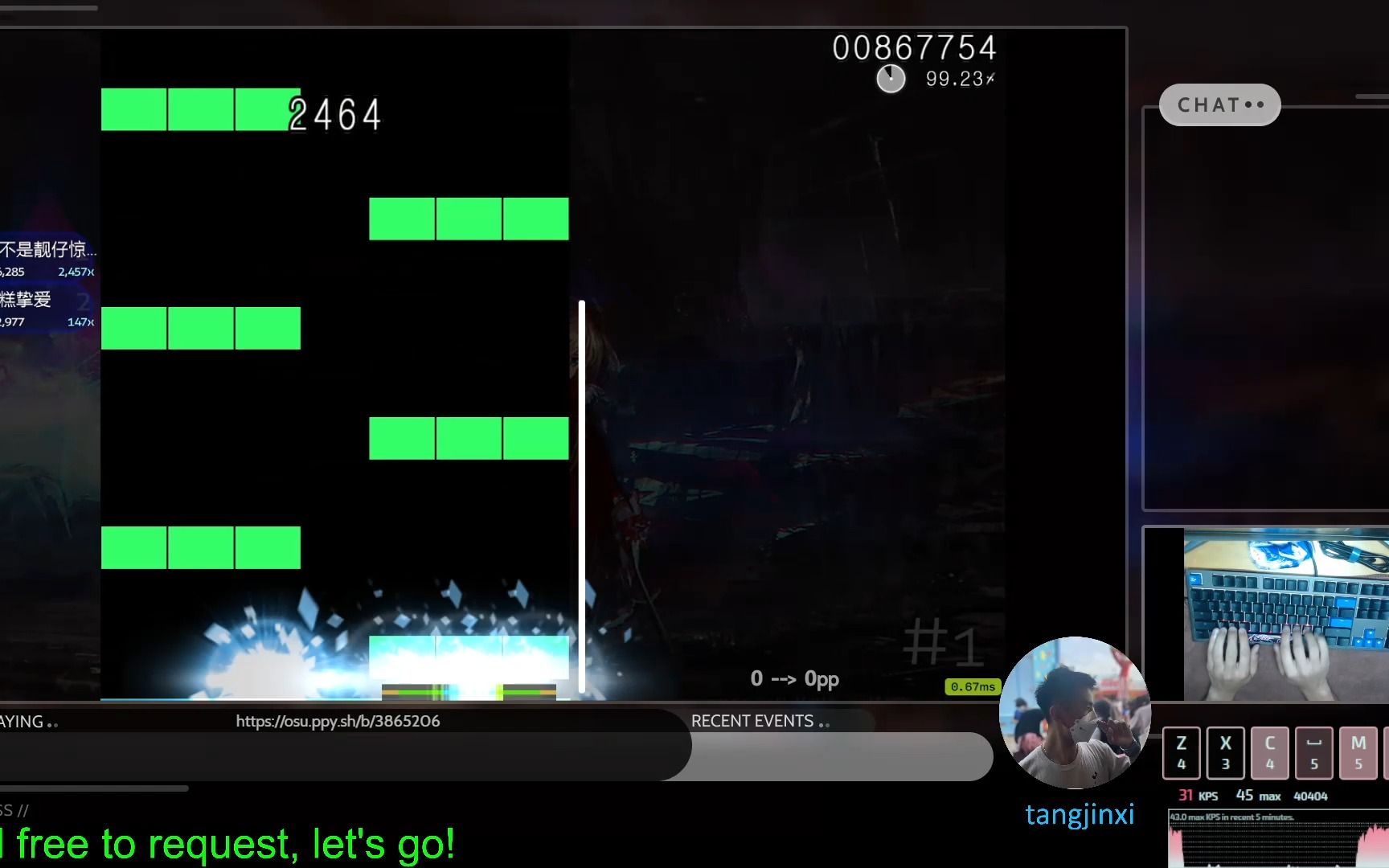
In osu!mania, 7K gameplay refers to the seven-key mode where players must process notes across seven vertical columns, typically utilizing a "spacebar-centered" layout. Mastering this mode requires a synergy of physical layout optimization, visual reading proficiency, pattern recognition, finger independence, rhythmic accuracy, Long Note (LN) management, and physical stamina. These elements distinguish 7K from the more common 4K mode by introducing a central pivot point and significantly higher cognitive load.
osu!mania 7K is often considered the definitive "Vertical Scrolling Rhythm Game" (VSRG) experience. While 4K focuses heavily on speed and raw density, 7K introduces a level of complexity that requires a fundamental shift in how a player interacts with their keyboard and the screen. By 2026, the 7K scene has evolved with highly specialized skins, advanced mechanical hardware, and maps that push the boundaries of human multitasking. To reach a high level of proficiency, a player must methodically develop each of the following seven elements.
1. Peripheral Reading and Visual Processing
Reading in 7K is fundamentally different from 4K because the human eye cannot focus on all seven columns simultaneously with high precision. Instead, players must rely on their peripheral vision to "anchor" the outer columns while the central vision focuses on the middle lanes.
The Focus Point
Advanced players rarely look at the "judgment line" at the bottom of the screen. Instead, they position their gaze roughly one-third to one-half of the way up the track. This allows the brain to process upcoming patterns before they reach the hit zone. In 7K, if you focus too intently on a single column, you will likely "misread" the outer lanes (the pinky and ring finger columns), leading to "ghost notes" where you press a key that has no note or miss a note entirely.
Scroll Speed (Fixed vs. Variable)
By 2026, the use of Fixed Scroll Speed (C-speed) is the industry standard for competitive play. A consistent scroll speed ensures that the visual distance between notes represents a consistent time interval, regardless of the song's BPM changes. Finding the "sweet spot" for scroll speed—where notes are far enough apart to be distinct but slow enough to be reacted to—is the first step in mastering visual processing.
2. Layout Optimization and Hardware Ergonomics
The physical interface is the bridge between the player's intent and the game's execution. Because 7K uses seven fingers (usually three on each hand plus one thumb), the choice of keybinds and hardware is critical.
The "Symmetric" Layout
The most common 7K layout is S D F [Space] J K L. This layout uses the left pinky/ring/middle fingers, the right middle/ring/pinky fingers, and one thumb for the spacebar. Some players prefer A S D [Space] J K L or even shifted versions to better fit their hand size. The thumb acts as a unique pivot point; because it is stronger and has a different range of motion than the fingers, it is often assigned to the most complex or frequent notes in the middle column.
Hardware Considerations
In 2026, high-polling-rate keyboards (8000Hz) and Rapid Trigger technology have become essential for top-tier 7K play.
- Actuation Point: A shallow actuation point allows for faster response times.
- Keycap Profile: Flat profiles (like XDA or DS) are often preferred over sculpted ones (like OEM or Cherry) to prevent fingers from "tripping" when moving across the seven keys.
- Anti-Ghosting: Ensuring the keyboard has N-Key Rollover (NKRO) is mandatory; otherwise, pressing four or more keys simultaneously (a common occurrence in 7K) will result in inputs not being registered.
3. Pattern Recognition and Muscle Memory
7K gameplay is a language made of recurring patterns. Instead of seeing individual notes, an experienced player sees "words" or "sentences."
Common 7K Patterns
| Pattern Type | Description | Difficulty Focus |
|---|---|---|
| Stairs/Scales | Notes appearing in sequential order (1-2-3-4-5-6-7). | Flow and timing. |
| Chords | Multiple notes hit at the exact same time (Double, Triple, Quad). | Hand balance. |
| Jacks | Repeated hits on the same column in rapid succession. | Finger speed and tension. |
| Brackets | Patterns that require hitting outer and inner keys simultaneously. | Hand coordination. |
| Rolls | Rapid alternating patterns, often circular or wave-like. | Internal rhythm. |
Mastering these requires thousands of repetitions until the brain no longer thinks "press key 1, then key 2," but instead executes a "stair" as a single fluid motion.
4. Finger Independence and Dexterity
The greatest hurdle for 7K players is the "weak finger" syndrome. In 4K, the index and middle fingers do most of the work. In 7K, the ring fingers and pinkies are forced into active roles.
The Ring Finger Struggle
Naturally, the ring finger and middle finger share a tendon, making it difficult to move one without the other. 7K maps often exploit this by placing "trills" (alternating notes) between the ring and middle columns. Developing independence requires specific practice maps (often called "Technical" or "LN" maps) that force these fingers to work in isolation.
The Thumb Pivot
The thumb is the "7th element." It is used for the middle column (Column 4). Because the thumb moves on a different axis than the fingers, many beginners struggle to integrate it into their rhythmic flow. Learning to treat the thumb as an equal partner to the fingers is essential for handling "handstreams"—dense patterns where all seven columns are active simultaneously.
5. Rhythmic Accuracy and Timing (OD and UR)
osu!mania is a game of precision. Scoring is determined by how closely your hit matches the map's internal clock.
Overall Difficulty (OD)
OD determines the "hit window"—the amount of time (in milliseconds) you have to hit a note to receive a "300g" (MAX) or a "300." At higher OD levels, the window for a perfect hit can be as small as ±16ms.
Unstable Rate (UR)
UR measures the consistency of your hits. A low UR means you are hitting notes at the same relative time, even if you are slightly off-beat. Improving accuracy in 7K involves "playing with your ears, not just your eyes." Players must internalize the song's pulse (the metronome) to ensure that their physical inputs align with the auditory cues, especially during complex polyrhythmic sections where the visual density can be distracting.
6. Long Note (LN) Manipulation
Long Notes, or "sliders," are notes that must be held for a specific duration and released at a specific time. In 7K, LNs add a layer of "holding" difficulty on top of "hitting" difficulty.
The Release Window
Unlike many other rhythm games, osu!mania requires a precise release. Releasing an LN too early or too late will result in a loss of accuracy or a "miss." This creates a cognitive "split" where one finger must stay held down while other fingers continue to tap "rice" (single) notes.
Noodle Maps and Inverse
"Noodle" maps are 7K charts comprised almost entirely of LNs. These maps test your ability to maintain finger tension without locking up. "Inverse" patterns occur when most columns are held down, and the "notes" are actually brief moments where you must release and re-press the keys. This is widely considered one of the most technical aspects of 7K gameplay.
7. Stamina and Tension Management
Stamina in 7K isn't just about how fast you can vibrate your fingers; it’s about how long you can maintain high-intensity play without your muscles "locking."
The "Death Grip"
When players encounter a section that is too fast or complex, they often tense their forearms and grip the keys harder. This "tension" is the enemy of stamina. It slows down your reaction time and leads to rapid fatigue. Learning to "play light"—using the minimum amount of force necessary to actuate the key—is the secret to clearing 10-minute "marathon" maps.
Ergonomic Health
By 2026, the community has placed a much higher emphasis on hand health. Proper wrist posture (keeping wrists straight or slightly elevated) and regular stretching are vital. Because 7K involves seven fingers, the risk of Repetitive Strain Injury (RSI) is higher than in 4K. Taking breaks and practicing "mindful relaxation" during slow sections of a song can significantly extend a player's session capacity.
Comparison: 7K vs. 4K Elements
| Feature | 4K Focus | 7K Focus |
|---|---|---|
| Primary Challenge | Raw Speed & Density | Reading & Hand Coordination |
| Key Usage | 4 fingers (Index/Middle) | 7 fingers (Thumb/Index/Middle/Ring/Pinky) |
| Mental Load | High (focused) | Extremely High (spread) |
| Pattern Complexity | Linear / Symmetrical | Multi-layered / Asymmetrical |
| Center Pivot | None | Middle Column (Spacebar) |
Frequently Asked Questions
Why is 7K considered harder than 4K?
7K is considered harder primarily due to the cognitive load. Processing seven columns instead of four requires more peripheral vision usage and greater finger independence. Additionally, the inclusion of the thumb and the outer ring/pinky fingers introduces physical limitations that most people do not have to overcome in 4K or daily typing.
Should I use a skin with bars or circles for 7K?
This is a matter of preference, but in 2026, most top-tier 7K players use Bar skins. Bars provide a clearer horizontal line, which makes it easier to judge the "height" of notes relative to one another, helping with timing and reading dense chords. Circle skins are often preferred by players transitioning from "standard" osu! mode or those who find bars too visually "cluttered."
How do I stop my ring finger from moving with my middle finger?
This is a biological hurdle called "tendon coupling." You can improve this through isolation exercises. Play 7K maps that are slightly below your skill level but feature many trills or chords involving the middle and ring fingers. Focus on keeping the unused fingers relaxed. Over time, your neural pathways will adapt to move these fingers more independently.
What is "Ghosting" in 7K?
Ghosting occurs when a player's keyboard cannot register multiple simultaneous keypresses. Since 7K frequently requires hitting 3, 4, or even 7 notes at once, a keyboard without N-Key Rollover (NKRO) will "drop" inputs, leading to misses that aren't the player's fault. Always ensure your hardware supports NKRO for 7K play.
How long does it take to become "good" at 7K?
"Good" is subjective, but reaching an intermediate level (4-5 star maps) typically takes 6 to 12 months of consistent practice. Because 7K requires building new muscle memory for the ring fingers and thumb, the initial learning curve is much steeper than 4K.
Next Steps for Improvement
To advance in 7K, you should begin by standardizing your setup. Ensure your scroll speed is fixed and your keybinds are comfortable. Once your hardware is ready, focus on "Dan" courses—community-created skill ladders that test your proficiency across different patterns like stamina, LNs, and tech.
The most effective way to improve is "pattern-specific" practice. If you struggle with stairs, play maps categorized as "Bracket" or "Stream" heavy. If your accuracy is low, play lower-difficulty maps and focus entirely on achieving a high "MAX" count. Consistency is the final element; even 30 minutes of focused 7K practice a day is better than a five-hour session once a week.