Choosing the right Honda Civic for your lifestyle involves evaluating how your daily driving habits, passenger requirements, cargo capacity needs, and aesthetic preferences align with the various trims, body styles, and powertrain configurations available in the model lineup.
Selecting a vehicle is a significant investment that requires balancing immediate driving enjoyment with long-term utility. Because the Honda Civic has evolved across multiple generations—spanning efficient sedans, versatile hatchbacks, and performance-focused variants—shoppers face a diverse array of choices. Whether you are a daily commuter navigating heavy urban traffic, a weekend road-tripper needing extra cargo space, or an enthusiast seeking track-ready dynamics, narrowing down the ideal Civic requires a structured approach. Analyzing your lifestyle needs ensures you invest in a configuration that delivers optimal value, fuel economy, comfort, and driving satisfaction.
1. Evaluate Your Daily Commute and Fuel Economy Needs
The foundation of choosing any vehicle lies in understanding your daily mileage, traffic conditions, and routine driving environment. If your lifestyle involves long highway commutes or heavy stop-and-go city driving, fuel economy and powertrain responsiveness become primary decision factors.
For standard commuting duties, the traditional naturally aspirated engines or turbocharged inline-four options found in standard trims like the LX, Sport, EX, and Touring provide a balanced mix of efficiency and power. However, if your lifestyle prioritizes cutting fuel expenses and reducing emissions, exploring powertrain efficiency is critical.
- City Commuting: If you spend most of your time idling in urban congestion, look for trims equipped with continuously variable transmissions (CVTs) designed for seamless power delivery and optimized low-end efficiency.
- Highway Cruising: Long-distance drivers benefit from the stable ride quality, sound insulation, and advanced driver-assistance systems found in higher-tier trims, which reduce driver fatigue over extended mileage.
- Powertrain Innovations: Keep in mind how newer hybrid options fit into modern driving requirements. Hybrid variants deliver exceptional low-end torque and impressive EPA fuel economy ratings, making them ideal for high-mileage drivers looking to minimize refueling stops.
Balancing fuel economy with your driving environment prevents you from overspending on performance you rarely use or under-buying on comfort features necessary for long hours behind the wheel.
2. Determine Your Passenger and Seating Requirements
How you use your cabin space on a daily basis dictates whether a sedan or a hatchback best suits your household. While both body styles share the same fundamental platform and wheelbase, subtle differences in roofline and rear configuration impact passenger comfort and loading convenience.
If you regularly transport adults in the rear seats, pay close attention to rear legroom and headroom specifications.
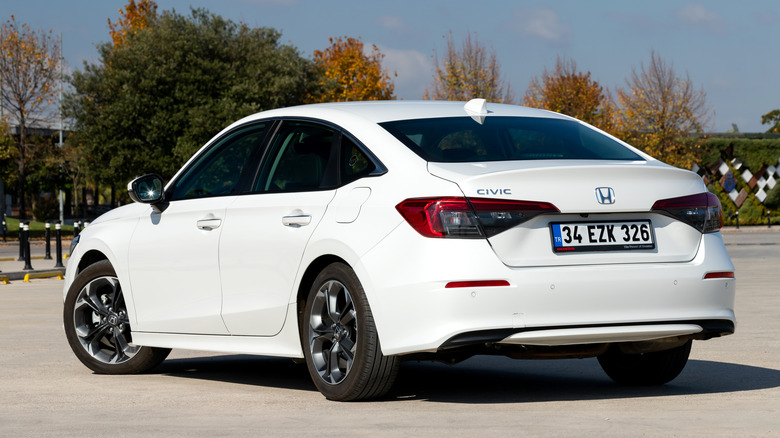
- Sedan Configuration: The traditional sedan offers a sleek profile with generous rear legroom, though its sloping C-pillar can slightly restrict headroom for exceptionally tall passengers compared to boxier alternatives. It remains the gold standard for traditional family carpooling and professional transport.
- Hatchback Configuration: The hatchback provides a more versatile cabin footprint. While rear legroom remains virtually identical to the sedan, the extended roofline often yields slightly more vertical clearance for rear passengers, alongside vastly superior cargo loading flexibility.
Consider whether you frequently install child safety seats, travel with pets, or carpool with colleagues. Testing the rear doors, opening angles, and anchor point accessibility during a physical test drive ensures your chosen Civic accommodates your passengers comfortably.
3. Assess Cargo Capacity and Utility Needs
Lifestyle needs extend far beyond passenger seating; how you haul gear, groceries, sports equipment, or luggage plays a monumental role in selecting the correct Civic body style.
The Honda Civic Sedan features a traditional trunk with a respectable volume, typically ranging around 14.8 cubic feet depending on the specific trim level. This enclosed space keeps valuables out of sight and works exceptionally well for standard groceries, golf bags, and standard luggage.
Conversely, the Civic Hatchback completely transforms cargo utility by replacing the traditional trunk lid with a wide-opening liftgate.
| Feature / Metric | Civic Sedan | Civic Hatchback |
|---|---|---|
| Primary Utility | Secure trunk storage | Versatile open cargo |
| Cargo Volume | ~14.8 cubic feet | ~24.5 cubic feet |
| Loading Aperture | Standard trunk opening | Wide liftgate opening |
| Best Suited For | Commuters, traditional luggage transport | Cyclists, campers, bulk shoppers |
As illustrated in the comparison above, the hatchback configuration nearly doubles accessible cargo utility when the rear 60/40 split-folding seats are stowed flat. If your lifestyle involves cycling, camping, DIY home improvement projects, or transporting bulky boxes, the hatchback is almost always the superior choice.
4. Match Performance Levels to Your Driving Passion
While many drivers view a car purely as an A-to-B appliance, the Honda Civic lineup famously spans everything from mild commuter efficiency to track-capable performance. Aligning your driving aspirations with the correct trim prevents buyer's remorse.
- Base and Mid-Tier Trims (LX, Sport, EX): Powered by dependable engines focused on reliability and smooth daily driveability, these models are tuned for comfort, predictable handling, and effortless maneuverability in tight parking spaces.
- Performance Trims (Si): If you enjoy spirited driving on winding back roads, the Civic Si offers a turbocharged engine paired exclusively with a short-throw manual transmission, a helical limited-slip differential, and retuned suspension geometry for sharper cornering dynamics.
- Track-Focused Flagships (Type R): For enthusiasts whose lifestyle revolves around high-performance driving events and track days, the Civic Type R delivers high-output turbocharged power, aggressive aerodynamics, adaptive damping systems, and race-bred braking components.
Be realistic about your driving habits. Purchasing a track-focused vehicle for bumper-to-bumper urban commuting can result in a stiffer ride quality and higher operational costs that outweigh daily enjoyment.
5. Factor in Technology, Safety Features, and Long-Term Value
Modern vehicles are rolling technology suites, and choosing the right Civic requires evaluating which infotainment, connectivity, and safety packages match your day-to-day expectations.
Honda Sensing—a suite of advanced driver-assistance systems—comes standard across modern Civic models. However, higher trims introduce enhanced amenities such as wireless Apple CarPlay and Android Auto integration, premium Bose audio systems, larger touchscreen displays, and integrated navigation.
- Infotainment Preferences: If you rely heavily on smartphone mirroring, streaming audio, and digital instrument clusters, investing in a mid-to-high trim ensures a responsive, modern interface.
- Safety Technology: Review features like blind-spot monitoring, rear cross-traffic alert, and low-speed braking control. These features offer significant peace of mind in high-density traffic environments.
- Resale Value and Depreciation: The Honda Civic consistently maintains exceptional residual value compared to many competitors in its class. Choosing a popular trim level with well-regarded features ensures stronger resale performance if you decide to upgrade in the future.
Frequently Asked Questions
Is the Honda Civic Hatchback better than the sedan for families?
The hatchback is often better for families who require versatile cargo space for strollers, bicycles, and bulk groceries, thanks to its wide-opening liftgate and flexible rear storage. However, both body styles offer identical passenger legroom and top-tier safety ratings, making the choice dependent entirely on your cargo habits rather than passenger capacity.
Which Civic trim offers the best balance of fuel economy and features?
Mid-tier trims like the Sport or EX typically strike the ideal balance between everyday comfort features—such as heated seats and upgraded touchscreens—and exceptional fuel economy, without forcing buyers to pay for high-performance track hardware they do not need.
Are newer Civic models difficult to maintain?
No. Honda vehicles are widely recognized for their mechanical reliability, widespread parts availability, and straightforward maintenance schedules. Routine services like oil changes, brake inspections, and tire rotations follow standard automotive intervals and can be serviced easily at most certified service centers.
How does the Civic Si differ from the standard Civic?
The Civic Si is built specifically for driving enthusiasts. It features a high-output turbocharged engine, a manual-only transmission, sport-tuned suspension, larger brakes, and aggressive styling enhancements, whereas standard Civics prioritize smooth commuting comfort and automatic transmission convenience.
What should I check during a test drive before buying a Civic?
Pay close attention to outward visibility, seating comfort over rough pavement, infotainment responsiveness, cabin noise levels at highway speeds, and how easily your daily gear fits into the trunk or cargo area.
Conclusion and Next Actions
Choosing the best Civic for your lifestyle comes down to an honest assessment of your daily commute, passenger requirements, cargo habits, and performance desires. By breaking down your priorities across fuel efficiency, body style utility, and trim-level features, you can narrow your options with confidence. Your next step should be visiting a local dealership to test drive both a sedan and a hatchback variant, loading your personal gear into the trunk, and experiencing how each configuration fits your everyday routine.