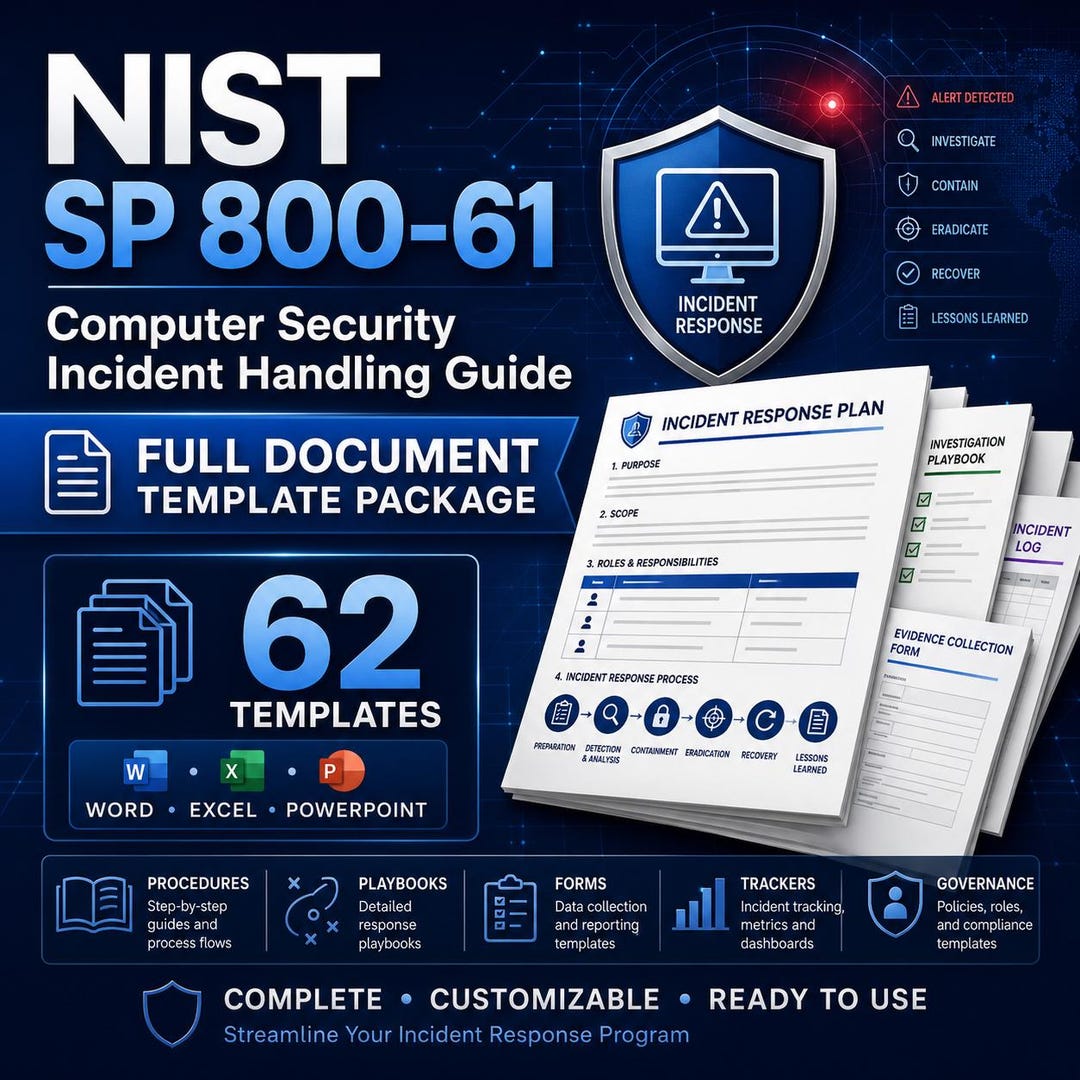
Adopting the National Institute of Standards and Technology (NIST) Special Publication 800-61 provides organizations with a standardized, structured framework to detect, analyze, contain, eradicate, and recover from cybersecurity incidents while improving overall operational resilience.
In an era where cyber threats grow increasingly sophisticated and prevalent, organizations of all sizes face the daunting task of defending their digital assets. Having robust perimeter defenses and endpoint security is no longer sufficient; security teams must anticipate breaches and prepare for them methodically. Without a standardized framework, incident response efforts often descend into chaos, characterized by ad-hoc decision-making, poor communication, and extended downtime.
The National Institute of Standards and Technology (NIST) addressed this critical operational gap by publishing NIST SP 800-61, titled Computer Security Incident Handling Guide. This foundational document offers a structured, repeatable methodology that security operations center (SOC) teams, IT leaders, and risk managers rely on to manage security incidents effectively. Exploring why organizations choose to build their cybersecurity programs around this standard reveals multiple operational, strategic, and compliance-driven incentives.
Understanding NIST SP 800-61: What Is It?
Before examining the core reasons for its adoption, it is essential to understand what NIST SP 800-61 is and what it aims to achieve. Published by the National Institute of Standards and Technology, NIST SP 800-61 serves as a comprehensive guide for establishing a computer security incident response capability and handling incidents efficiently.
The framework breaks down incident response into four main phases:
- Preparation: Establishing and training an incident response team (IRT) and acquiring necessary tools and resources to prevent incidents.
- Detection and Analysis: Monitoring for anomalous activity, determining whether an incident has occurred, and assessing its scope and severity.
- Containment, Eradication, and Recovery: Isolating affected systems to prevent further damage, eliminating malicious artifacts, and restoring systems back to normal operations securely.
- Post-Incident Activity (Lessons Learned): Conducting post-mortem reviews to capture insights, update defenses, and improve future response capabilities.
By implementing this cyclical model, organizations move away from reactive panic and toward proactive, disciplined resilience. Let us explore the five key reasons why adopting NIST SP 800-61 transforms an organization's security posture.
1. Establishing a Proven, Standardized Methodology
The primary driver for adopting NIST SP 800-61 is the elimination of guesswork during a crisis. When a cyberattack strikes—whether it is a ransomware deployment, a data exfiltration event, or a distributed denial-of-service (DDoS) attack—every second counts. Ad-hoc incident response often leads to critical mistakes, such as destroying digital forensics evidence, failing to notify necessary stakeholders, or letting attackers move laterally across the network unchecked.
NIST SP 800-61 provides a time-tested, universally recognized blueprint. Because the framework is developed through rigorous public-private sector collaboration led by a respected standards body, it reflects industry best practices.
- Predictable Workflows: Security analysts know precisely what steps to take next, reducing cognitive load during high-stress situations.
- Role Clarity: The publication outlines clear responsibilities for team members, management, legal counsel, and public relations.
- Scalability: The framework adapts seamlessly whether an organization is a small business with a outsourced IT provider or a multinational enterprise with a dedicated 24/7 SOC.
By standardizing these workflows, organizations ensure that response quality does not depend solely on the intuition of a single heroic sysadmin. Instead, institutional knowledge is codified into repeatable operational procedures.
2. Minimizing Dwell Time and Mitigating Business Impact
In cybersecurity, the financial and operational cost of an incident is directly correlated with dwell time—the duration that an attacker remains undetected inside a network. The longer a threat actor resides within an infrastructure, the more data they can steal, encrypt, or corrupt.
NIST SP 800-61 emphasizes rapid detection, structured analysis, and efficient containment. The structured approach to the Detection and Analysis phase helps analysts quickly triage alerts, separate true positives from noise, and identify the root cause.
Furthermore, the framework’s emphasis on systematic containment prevents minor security events from escalating into enterprise-wide catastrophes. For example, by following NIST guidelines on network segmentation and isolation during an outbreak, an organization can quarantine compromised endpoints before malware spreads to mission-critical databases. This reduction in downtime directly translates to saved revenue, preserved customer trust, and minimized regulatory fallout.
3. Facilitating Regulatory Compliance and Legal Alignment
Modern organizations operate under a complex web of data protection laws, industry regulations, and contractual obligations. Frameworks such as the Health Insurance Portability and Accountability Act (HIPAA), the Payment Card Industry Data Security Standard (PCI DSS), and regional privacy regulations like the European Union's General Data Protection Regulation (GDPR) mandate that organizations maintain documented incident response plans.
Adopting NIST SP 800-61 provides an immediate audit-ready baseline. Because NIST publications are widely recognized by regulatory bodies, auditors, and legal insurers, demonstrating alignment with NIST SP 800-61 proves that an organization exercises a legally defensible standard of care.
- Audit Readiness: Compliance officers can point directly to NIST-aligned policies and tabletop exercise logs during audits.
- Evidence Preservation: The framework provides guidelines on handling digital evidence in a manner that preserves its integrity, which is vital if law enforcement or legal counsel becomes involved.
- Streamlined Reporting: NIST guidelines assist in defining criteria for when and how external stakeholders, customers, and regulatory authorities must be notified of a data breach.
4. Driving Continuous Improvement Through "Lessons Learned"
Many organizations treat incident response as a linear process that ends once systems are restored to production. However, attackers continuously evolve their techniques, meaning an organization that fails to learn from past breaches remains vulnerable to repeat attacks.
NIST SP 800-61 places significant emphasis on the fourth phase: Post-Incident Activity, commonly referred to as "Lessons Learned." The framework requires organizations to hold formal post-mortem meetings after every significant incident to answer critical questions:
- Exactly how did the attacker breach the perimeter?
- Which detection mechanisms failed or succeeded, and why?
- How effective was the communication during the response?
- What architectural or procedural changes can prevent recurrence?
| Incident Response Phase | Core Objective | Primary Deliverable |
|---|---|---|
| 1. Preparation | Build capability and posture | IR plan, tools, and team training |
| 2. Detection & Analysis | Identify and scope the threat | Incident alerts, triage reports |
| 3. Contain & Eradicate | Stop damage and remove threat | Isolated hosts, patched vulnerabilities |
| 4. Post-Incident | Institutionalize improvements | Lessons learned report, updated controls |
This feedback loop ensures that every security incident—even a painful breach—yields actionable intelligence that hardens the organization against future threats.
5. Improving Cross-Departmental Communication and Collaboration
A major vulnerability during cyber incidents is organizational silos. Technical security teams often speak a technical language that executives, legal counsel, and public relations teams cannot easily translate into business risk. Conversely, leadership may demand immediate answers that technical teams cannot yet verify.
NIST SP 800-61 provides a common vocabulary and operational framework that bridges the gap between technical responders and business decision-makers. By establishing clear escalation paths and reporting structures beforehand, the framework ensures that:
- Executive Leadership receives accurate, timely updates regarding business risk, financial exposure, and regulatory reporting deadlines without getting bogged down in technical jargon.
- Legal and PR Teams obtain the verified facts necessary to draft public statements, notify affected customers, and manage litigation risk appropriately.
- Technical Responders receive the executive backing, budget, and authorization needed to make tough operational decisions, such as temporarily shutting down customer-facing web applications to stop an active breach.
This cohesive, enterprise-wide alignment transforms cybersecurity from a purely IT-centric burden into an integrated, organization-wide strategic priority.
Frequently Asked Questions
Is NIST SP 800-61 mandatory for private companies?
No. NIST SP 800-61 is a federal guideline published by the National Institute of Standards and Technology. While mandatory primarily for U.S. federal civilian agencies, many private-sector companies adopt it voluntarily as a recognized gold standard for cybersecurity best practices.
How does NIST SP 800-61 differ from NIST SP 800-53?
NIST SP 800-53 is a massive catalog of security and privacy controls for information systems and organizations. NIST SP 800-61 focuses specifically and operationally on how to build an incident response capability and handle security breaches when they occur.
Can small businesses implement NIST SP 800-61 effectively?
Yes. The framework is scalable. Small businesses do not need a massive 24/7 SOC to adopt NIST principles; they can scale the four-phase methodology to fit their existing IT staff or managed service providers (MSPs).
Does NIST SP 800-61 cover ransomware attacks specifically?
While written as a general computer security incident handling guide, the principles of preparation, detection, containment, eradication, and recovery apply directly to modern ransomware incidents, data extortion, and advanced persistent threats.
Next Steps for Adoption
Implementing NIST SP 800-61 begins with an honest assessment of your current incident response maturity. Organizations should start by reviewing the publication's guidelines on the Preparation phase: establishing an incident response policy, forming a cross-functional incident response team, and acquiring essential logging and monitoring tools. Following this, conduct regular tabletop exercises to simulate attacks and test how well your staff executes the four-phase methodology before a real-world crisis strikes.