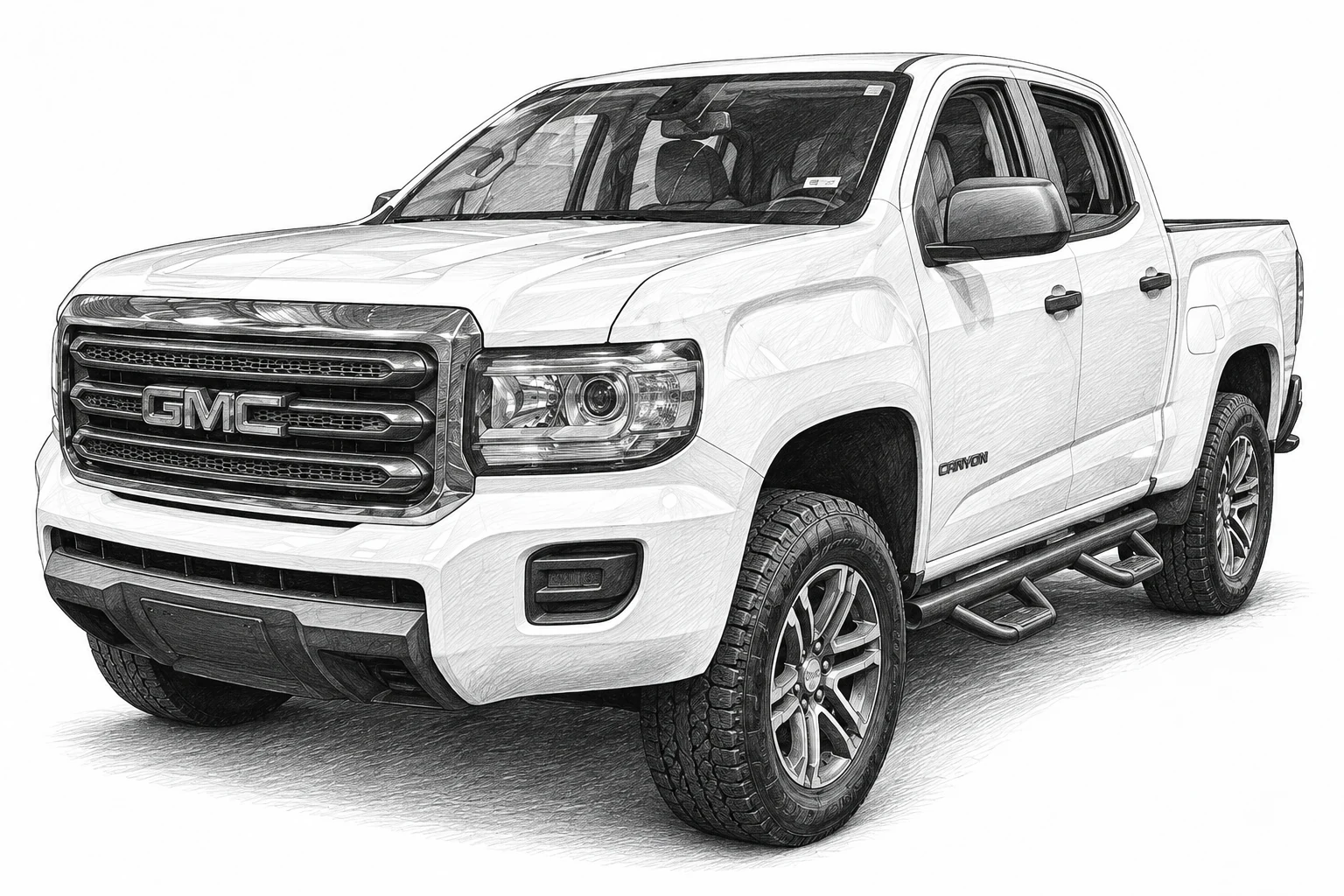
The 2017 GMC Canyon delivers a maximum towing capacity ranging between 3,500 pounds and 7,700 pounds, depending on the engine, drivetrain, and installed trailering equipment. Base 2.5L four-cylinder models max out at 3,500 pounds, 3.6L V6 models pull up to 7,000 pounds when properly equipped with the factory trailering package, and 2.8L Duramax Turbo-Diesel models achieve the class-leading peak of 7,700 pounds.
Overview of 2017 GMC Canyon Towing Capabilities by Engine
The 2017 GMC Canyon midsize pickup truck was engineered to bridge the gap between light-duty commuter comfort and heavy-duty utility. A primary factor in determining the exact towing limit of any 2017 Canyon is its powertrain configuration. General Motors offered three distinct engines for this model year: a base inline four-cylinder gas engine, an updated direct-injected V6 gas engine with an eight-speed automatic transmission, and a high-torque four-cylinder turbo-diesel.
Understanding the specific limits of each engine variant is crucial to avoiding drivetrain stress, premature component failure, or dangerous handling characteristics while pulling a load.
2.5L 4-Cylinder Gas Engine Specifications & Limits
The standard engine for base and SLE trim configurations is the 2.5-liter DOHC four-cylinder gas engine. Designed primarily for light commuting, city transit, and modest utility tasks, this engine yields 200 horsepower at 6,300 rpm and 191 lb-ft of torque at 4,400 rpm.
- Maximum Towing Capacity: 3,500 lbs (1,588 kg)
- Standard Transmission: 6-speed manual (available on select 2WD extended cab trims) or 6-speed automatic
- Gross Combined Weight Rating (GCWR): Approximately 8,500 lbs
Because this engine generates its peak torque higher in the rev range, towing near the 3,500-pound ceiling requires patient acceleration and conservative speed management. It is best suited for small pop-up campers, light utility trailers, personal watercraft (such as single jet skis), or small aluminum fishing boats. It does not support the factory heavy-duty Z82 Trailering Package.
3.6L V6 Gas Engine Specifications & Limits
For the 2017 model year, General Motors introduced an updated 3.6-liter V6 engine (engine code LGZ) featuring Active Fuel Management (cylinder deactivation) and direct injection, paired with an all-new 8-speed automatic transmission. This combination produces 308 horsepower at 6,800 rpm and 275 lb-ft of torque at 4,000 rpm.
- Standard Towing Capacity (Bumper/Standard Hitch): 3,500 lbs (1,588 kg)
- Maximum Towing Capacity (With Z82 Trailering Package): 7,000 lbs (3,175 kg)
- Gross Combined Weight Rating (GCWR): 12,000 lbs
Without the factory-installed Z82 Trailering Package, the V6 model is restricted to a standard 3,500-pound maximum towing limit due to cooling and receiver limitations. However, when equipped with the Z82 package—which adds a class IV hitch receiver and upgraded electrical harness—the V6 Canyon transforms into a capable midsize tow vehicle. The additional gears in the 8-speed transmission keep the V6 in its optimal powerband during highway merges and steep grade climbs.
2.8L Duramax Turbo-Diesel Engine Specifications & Limits
The standout powertrain option for long-distance hauling and maximum capacity is the 2.8-liter Duramax inline-four turbo-diesel engine (LWN). While generating 181 horsepower at 3,400 rpm, its primary advantage is its low-end torque output: a robust 369 lb-ft of torque at just 2,000 rpm.
- Maximum Towing Capacity (2WD): 7,700 lbs (3,493 kg)
- Maximum Towing Capacity (4WD): 7,600 lbs (3,447 kg)
- Transmission: 6-speed automatic (6L50)
- Gross Combined Weight Rating (GCWR): 12,700 lbs
The diesel variant achieves the highest tow rating in the 2017 GMC Canyon lineup. The slight 100-pound drop in towing capacity for 4WD models (7,600 lbs vs. 7,700 lbs) is due to the added weight of the transfer case and front axle assembly, which increases the truck's curb weight and slightly reduces the net available towing margin under the GCWR.
2017 GMC Canyon Towing Capacity Quick Reference
The following table provides a comprehensive specification breakdown across all engine, transmission, and drivetrain combinations available for the 2017 GMC Canyon.
| Engine | Transmission | Drivetrain | Max Tow Capacity (lbs) | Max Payload (lbs)* | GCWR (lbs) | GVWR (lbs) |
|---|---|---|---|---|---|---|
| 2.5L I4 Gas | 6-Speed Manual / Auto | 2WD | 3,500 | ~1,605 | 8,500 | 5,400 – 5,500 |
| 2.5L I4 Gas | 6-Speed Auto | 4WD | 3,500 | ~1,520 | 8,500 | 5,600 |
| 3.6L V6 Gas (Standard) | 8-Speed Auto | 2WD / 4WD | 3,500 | ~1,500 – 1,590 | 8,500 | 5,700 – 6,000 |
| 3.6L V6 Gas (With Z82) | 8-Speed Auto | 2WD | 7,000 | ~1,590 | 12,000 | 5,800 – 6,000 |
| 3.6L V6 Gas (With Z82) | 8-Speed Auto | 4WD | 7,000 | ~1,530 | 12,000 | 6,000 |
| 2.8L Diesel (With Z82) | 6-Speed Auto | 2WD | 7,700 | ~1,505 | 12,700 | 6,000 |
| 2.8L Diesel (With Z82) | 6-Speed Auto | 4WD | 7,600 | ~1,420 | 12,700 | 6,200 |
*Note: Payload capacity varies based on cab style (Extended Cab vs. Crew Cab), bed length (Short Bed vs. Long Bed), trim level, and installed optional accessories. Always refer to the tire and loading information placard located on the driver-side B-pillar of the vehicle.
Factory Trailering Package (Z82) and Key Towing Features
Achieving maximum towing limits on the 3.6L V6 and 2.8L Duramax models requires specific factory hardware. GMC packages these features into option codes designed to regulate thermals, control electrical trailer functions, and maintain vehicle stability.
What the Z82 Trailering Package Includes
The Z82 Trailering Package comes standard on all 2.8L Duramax Diesel models and is an optional upgrade on 3.6L V6 models. It consists of:
- Class IV Hitch Receiver: A 2-inch frame-mounted box receiver engineered to handle heavy tongue weights up to 770 lbs.
- 7-Pin and 4-Pin Connector Wiring Harness: Dual sealed electrical connectors mounted near the bumper to supply power to trailer lights, turn signals, reverse lights, and electric brakes.
Integrated Trailer Brake Controller (ITBC)
For models equipped with the Z82 package, GMC offered an integrated trailer brake controller located on the dash to the left of the steering wheel.
- Standard on Diesel Models: The ITBC is integrated into the vehicle's anti-lock braking (ABS) system, allowing the driver to manually adjust brake gain and output to the trailer's electric brakes.
- Available on V6 Models: Optional on V6 trims equipped with the trailering package.
Tow/Haul Mode
Activated via a button on the center console stack, Tow/Haul mode alters the automatic transmission’s shift schedule. It delays upshifts to keep the engine within its optimal powerband during acceleration and provides earlier downshifts to assist with engine braking when descending steep grades. This reduces brake fade and fluid heating.
StabiliTrak with Trailer Sway Control
All 2017 GMC Canyon models feature GMC’s StabiliTrak electronic stability control system with integrated Trailer Sway Control. If the system senses high-speed instability or trailer oscillation, it automatically applies selective wheel braking and reduces engine power to help bring the truck and trailer back into alignment.
Payload Capacity vs. Towing Capacity: Understanding Weight Limits
One of the most frequent mistakes vehicle owners make is confusing towing capacity with payload capacity. Exceeding your truck's payload limit can compromise braking, suspension geometry, and frame integrity even if your trailer weight falls below the maximum tow rating.
Critical Weight Terminology Explained
- Gross Vehicle Weight Rating (GVWR): The maximum allowable total weight of the truck itself, including fuel, driver, passengers, cargo in the truck bed, and the tongue weight of the trailer.
- Gross Combined Weight Rating (GCWR): The maximum allowable combined weight of the fully loaded truck and the fully loaded trailer together.
- Payload Capacity: The maximum weight of cargo, occupants, and tongue weight that the truck's chassis can support.
- Tongue Weight: The downward force exerted by the trailer coupler onto the hitch ball. Safe trailering typically requires tongue weight to equal 10% to 15% of the total loaded trailer weight.
Calculating Real-World Towing Limits
To illustrate how payload restricts real-world towing, consider a 2017 GMC Canyon V6 4WD Crew Cab with a maximum tow rating of 7,000 lbs and a payload rating of 1,500 lbs.
- Calculate Trailer Tongue Weight: If towing a 6,000 lb travel trailer, a 12% tongue weight equals 720 lbs.
- Subtract Tongue Weight from Payload: $$\text{Remaining Payload} = 1,500 \text{ lbs} - 720 \text{ lbs} = 780 \text{ lbs}$$
- Account for Passengers and Gear: If four adults inside the cabin weigh a combined 650 lbs and you carry 200 lbs of gear in the bed ($650 + 200 = 850\text{ lbs}$), your total payload demand is: $$720 \text{ lbs (Tongue)} + 850 \text{ lbs (Occupants + Cargo)} = 1,570 \text{ lbs}$$
In this scenario, the truck is 70 lbs over its maximum GVWR/payload limit, even though the trailer weight (6,000 lbs) is well below the 7,000-lb towing threshold. Drivers must account for occupants, cargo, and aftermarket accessories when calculating realistic towing capacity.
Real-World Towing Configurations: What Can You Tow?
To translate these weight numbers into practical applications, the following examples illustrate typical recreational and work loads appropriate for each engine option.
2017 GMC CANYON TOWING MATCH-UP
- 2.5L I4 Engine: Up to 3,500 lbs
- Single Jet Skis / Small Pop-Up Camper
- 16-ft Utility Trailer w/ Riding Mower
- 3.6L V6 Engine (w/ Z82): Up to 7,000 lbs
- 20-24 ft Travel Trailer / Ski Boat
- Dual-Axle Car Hauler w/ Compact Sedan
- 2.8L Diesel Engine: Up to 7,700 lbs
- 24-28 ft Lightweight Camper
- Heavy Livestock / Enclosed Cargo
What a 3,500-lb Capacity Can Tow (2.5L I4 & Base V6)
- Teardrop trailers and small pop-up campers (1,500 – 2,800 lbs dry weight)
- Single-axle utility trailers carrying lawn equipment or ATVs
- Personal watercraft (PWC) or small aluminum fishing boats on single-axle trailers
- Small open-bed motorcycle trailers
What a 7,000-lb Capacity Can Tow (3.6L V6 with Z82 Package)
- Medium-sized travel trailers up to 24 feet (typically 4,000 – 5,500 lbs dry weight)
- Midsize fiberglass ski boats, bowriders, or pontoon boats on dual-axle trailers
- Open tandem-axle car haulers carrying a lightweight vehicle
- Enclosed cargo trailers (6x12 or 7x14 dual-axle configurations)
What a 7,700-lb Capacity Can Tow (2.8L Duramax Diesel)
- Larger ultra-lite travel trailers up to 26–28 feet (5,000 – 6,200 lbs dry weight)
- Tandem-axle horse or livestock trailers loaded with animals
- Heavy-duty equipment trailers transporting compact tractors or skid steers
- Deep-V hull offshore fishing boats within reasonable length limits
2.8L Duramax Diesel vs. 3.6L V6 Gas for Towing
When selecting between a pre-owned 2017 Canyon V6 gas or Duramax diesel for trailering duties, peak towing horsepower and torque figures tell only part of the story. The driving characteristics of each powertrain differ significantly under heavy loads.
Low-End Torque vs. Peak Horsepower
The 3.6L V6 Gas engine produces 308 horsepower, making it responsive during unloaded driving and quick-passing maneuvers. However, its 275 lb-ft of torque peaks high in the engine cycle at 4,000 rpm. When towing uphill, the 8-speed transmission will drop several gears, running the engine at elevated RPMs to maintain speed.
Conversely, the 2.8L Duramax Diesel reaches its full 369 lb-ft of torque at just 2,000 rpm. This low-end torque curve allows the vehicle to launch heavy trailers effortlessly from a complete stop and hold top gear longer on highway inclines without aggressive downshifting.
Diesel Exhaust Brake System
A major advantage of the 2.8L Duramax is the standard smart exhaust braking system. Activated via a switch on the dash, the variable-geometry turbocharger (VGT) restricts exhaust gas flow when lifting off the throttle. This creates engine backpressure that slows the vehicle down long steep grades, reducing heat buildup in the mechanical brakes and enhancing control during heavy-duty towing.
Fuel Economy Under Load
While towing heavy loads, gasoline engines experience a sharp drop in fuel economy as they dump extra fuel to maintain higher RPMs and keep cylinder temperatures down. Owners routinely report V6 towing fuel consumption dropping into the 9–12 mpg range. The 2.8L Duramax diesel remains substantially more fuel-efficient under load, frequently averaging 14–18 mpg while towing comparable trailers.
Towing Safety Requirements and Maintenance
To safely tow maximum loads with a 2017 GMC Canyon, drivers must adhere to weight distribution guidelines and preventative maintenance procedures.
Weight Distribution Hitch Requirements
General Motors specifies that for any trailer weight exceeding 5,000 lbs, a Weight Distribution Hitch (WDH) with sway control should be used.
A weight distribution hitch uses spring bars to leverage a portion of the tongue weight off the truck's rear axle and transfer it forward onto the front axle and backward onto the trailer's axles. This levels the stance of the truck, ensuring:
The front tires maintain steering traction and braking control.
Headlight alignment stays level rather than aiming upward into oncoming traffic.
Rear suspension sag is reduced, avoiding premature bottoming out against bump stops.
WITHOUT WEIGHT DISTRIBUTION (Sagging Rear End)
WITH WEIGHT DISTRIBUTION (Level Ride Height)
Essential Pre-Tow Safety Checklist
- Tire Pressure Verification: Inspect both the truck's tire pressures (listed on the driver door jamb placard) and the trailer tire pressures (listed on the trailer specification plate). Trailer tires should generally be inflated to their maximum cold PSI rating for optimal load-carrying efficiency.
- Hitch Ball and Coupler Sizing: Ensure the ball size matches the trailer coupler (commonly 2-inch or 2-5/16-inch). Confirm the locking latch is pinned securely.
- Safety Chains: Cross the safety chains under the trailer tongue in an "X" pattern before connecting them to the hitch receiver frame hooks. This forms a cradle that catches the trailer tongue should the hitch ball disengage.
- Emergency Breakaway Cable: Attach the breakaway cable to a secure frame point on the truck (not to the safety chains or removable hitch drawbar). This activates the trailer's internal electric brakes if it completely detaches from the tow vehicle.
- Lighting Check: Test running lights, brake lights, left/right hazard signals, and reverse lights with an assistant before departure.
Severe Duty Maintenance Intervals
Towing puts stress on engine cooling, transmission fluid, differential gear oil, and brake components. General Motors recommends following the Severe Maintenance Schedule found in the owner's manual if you tow frequently:
- Automatic Transmission Fluid: Service fluid and filter changes every 45,000 miles (instead of the standard 90,000-mile interval).
- Rear Differential Fluid: Replace synthetic gear oil every 45,000 miles to clear metal wear particles from heavy torque transfer.
- Engine Oil & Filter: Change engine oil when prompted by the Oil Life System, or at a maximum threshold of 5,000 miles when frequently towing heavy loads in elevated ambient temperatures.
- Brake Rotors and Pads: Inspect front and rear brake pads for friction material thickness at every oil change interval.
Frequently Asked Questions
Can a 2017 GMC Canyon tow a 30-foot travel trailer?
Generally, no. A 30-foot travel trailer typically exceeds both the weight and aerodynamic footprint capabilities of a midsize truck. Even lightweight 30-foot trailers usually have a dry weight above 6,000 lbs, which easily exceeds 7,000 to 7,700 lbs once loaded with water, propane, and gear. Additionally, the long profile of a 30-foot trailer can easily push a midsize chassis around in high crosswinds. Midsize trucks are better suited to trailers under 24 to 26 feet.
How do I know if my 2017 GMC Canyon has the Z82 Trailering Package?
Look at the option code label located inside the glove box (RPO code sticker). If the code Z82 is listed, the truck was built from the factory with the heavy-duty trailering package. Visually, a Z82-equipped Canyon features a factory-installed 2-inch frame-mounted square hitch receiver and standard 7-pin/4-pin wiring connectors near the rear bumper.
What is the maximum tongue weight for the 2017 GMC Canyon?
The maximum allowable tongue weight on the 2017 GMC Canyon is 770 lbs when equipped with a weight-distributing hitch setup on the 2.8L Duramax Diesel model, and 700 lbs on the 3.6L V6 model. Using a conventional weight-carrying hitch without distribution spring bars typically limits maximum tongue weight to 500 lbs.
Can I install an aftermarket hitch to tow 7,000 lbs on a V6 Canyon that didn't come with the factory tow package?
While installing a high-quality aftermarket Class IV hitch receiver physically allows you to hook up heavy loads, it does not officially raise your truck’s certified tow rating to 7,000 lbs. Models without the factory Z82 trailering package lack specific electrical components and wiring harnesses calibrated for heavy trailer towing. The official manufacturer limit for non-Z82 models remains capped at 3,500 lbs.
Is the 2017 GMC Canyon capable of flat-towing behind an RV?
Yes, but only specific configurations. Only 2017 GMC Canyon 4WD models equipped with a two-speed transfer case (AutoTrac) featuring a true "Neutral" position can be flat-towed (dinghy towed) behind a motorhome with all four wheels on the ground. 2WD models cannot be flat-towed without removing the driveshaft, as doing so will ruin the transmission output bearings.
Summary & Practical Recommendations
When evaluating the 2017 GMC Canyon tow capacity, selecting the right vehicle setup comes down to your primary hauling needs:
- Select the 2.5L I4 Engine if you only plan to tow light utility trailers, jet skis, or pop-up campers up to 3,500 lbs.
- Choose the 3.6L V6 with Z82 Package for versatile everyday driving combined with standard recreational towing up to 7,000 lbs.
- Choose the 2.8L Duramax Turbo-Diesel if you tow frequently, travel long distances through mountain passes, or need the absolute maximum 7,700-lb towing performance with lower fuel consumption and engine braking control.
Prior to towing, always weigh your loaded vehicle and trailer at a certified vehicle scale (such as a CAT Scale) to confirm your gross combined weight, rear axle weight, and trailer tongue weight remain safely below the manufacturer's specified limits.