The 2011 RAM 1500 features two primary fuel tank options: a standard 26-gallon (98-liter) tank and an optional 32-gallon (121-liter) extended-range tank. The larger capacity was typically available on Quad Cab and Crew Cab models with specific bed configurations or higher trim packages like the Laramie or Outdoorsman.
Understanding the fuel capacity of the 2011 RAM 1500 is essential for owners and used-car buyers who need to calculate operational costs, towing range, and maintenance requirements. As of 2026, many of these fourth-generation trucks are still active on the road, serving as reliable workhorses and recreational vehicles. Because the fuel tank size directly dictates how far you can travel between fill-ups—especially when hauling heavy loads—identifying which tank your specific VIN is equipped with is a critical first step for any trip planning.
The Dual-Tank Strategy of the 2011 RAM 1500
In 2011, Chrysler (then under the Fiat-Chrysler era) designed the RAM 1500 to be highly customizable. This modularity extended to the fuel system. Depending on the cab style, bed length, and intended use, the truck was fitted with one of two high-density polyethylene (HDPE) tanks.
The 26-gallon tank was the baseline for the majority of the lineup. It provided a balance between weight savings and range. For most daily drivers and light-duty users, 26 gallons was sufficient to cover roughly 350 to 450 miles of highway driving, depending on the engine.
The 32-gallon tank was marketed toward those who used their trucks for "heavy-duty" light-duty tasks. This included the Outdoorsman trim, which was specifically branded for hunters, fishermen, and campers who might find themselves far from a gas station. It was also a popular add-on for the Laramie and Sport trims. The extra six gallons of fuel might seem modest, but it translates to nearly 100 extra miles of highway cruising or an extra hour or two of range when towing a trailer.
2011 RAM 1500 Fuel Capacity by Configuration
While the engine choice (V6 vs. V8) impacted fuel economy, the physical dimensions of the truck often dictated which fuel tank could fit under the chassis. Generally, shorter wheelbases were limited to the smaller tank, while longer configurations had the structural "real estate" to accommodate the 32-gallon unit.
| Trim Level | Standard Tank Capacity | Optional Tank Capacity | Common Cab/Bed Pairing |
|---|---|---|---|
| ST (Work Truck) | 26 Gallons | 32 Gallons | Regular Cab / 8' Bed |
| SLT | 26 Gallons | 32 Gallons | Quad Cab / 6'4" Bed |
| Outdoorsman | 32 Gallons | N/A | Crew Cab / 5'7" Bed |
| Sport | 26 Gallons | 32 Gallons | Quad or Crew Cab |
| Laramie | 26 Gallons | 32 Gallons | Crew Cab / 5'7" Bed |
| Big Horn / Lone Star | 26 Gallons | 32 Gallons | Quad or Crew Cab |
Note: In 2011, the "Lone Star" edition was a regional package specific to Texas, mirror-imaging the "Big Horn" specs found in other states.
Engine Options and Their Impact on Range
The 2011 RAM 1500 was offered with three distinct engines, each with different fuel consumption rates and fuel type requirements. The fuel capacity is only half of the equation; the "burn rate" of these engines determines your actual range.
3.7L Magnum V6
This was the base engine, primarily found in the ST regular cab models. It produced 215 horsepower and was paired with a 4-speed automatic transmission. While it had the lowest power, it didn't always offer the best fuel economy because it had to work harder to move the truck's mass.
- EPA Estimated MPG: 14 City / 20 Highway.
- Estimated Range (26-gal): 364 miles highway.
- Fuel Requirement: 87 Octane Regular Unleaded.
4.7L PowerTech V8
The mid-range V8 offered a significant step up in power (310 hp) and was notable for its Flex-Fuel (E85) capability. If you are using E85, your fuel economy will drop by approximately 25-30%, making the 32-gallon tank almost a necessity for practical use.
- EPA Estimated MPG (Gasoline): 14 City / 19 Highway.
- Estimated Range (32-gal): 608 miles highway (theoretical max).
- Fuel Requirement: 87 Octane or E85 Ethanol.
5.7L HEMI V8 with MDS
The 5.7L HEMI was the flagship engine, delivering 390 horsepower. It featured Multi-Displacement System (MDS) technology, which deactivated four cylinders during light cruising to save fuel.
- EPA Estimated MPG: 14 City / 20 Highway (2WD) or 13 City / 19 Highway (4WD).
- Estimated Range (32-gal): Approx. 640 miles (2WD highway).
- Fuel Requirement: 89 Octane recommended for optimum performance, 87 Octane acceptable.
For official historical fuel economy ratings, you can reference the U.S. Department of Energy’s Fuel Economy database.
The Physics of Fuel: Weight and Payload Considerations
When discussing fuel capacity, many owners overlook the impact of weight. Gasoline weighs approximately 6.1 pounds per gallon. This weight must be subtracted from the truck’s total payload capacity.
For a 2011 RAM 1500 with a 26-gallon tank, a full load of fuel adds roughly 158.6 pounds. For a truck with a 32-gallon tank, a full load adds roughly 195.2 pounds.
While a 37-pound difference between the two tanks seems negligible, it is part of the "gross vehicle weight rating" (GVWR). If you are already at the limit of your payload with passengers, gear, and tongue weight from a trailer, that extra fuel weight is a factor to consider. Furthermore, the 32-gallon tank itself is physically larger and heavier than the 26-gallon version, even when empty.
How to Verify Your Tank Size
If you are a second or third owner of a 2011 RAM 1500, you might not know which tank is installed. There are three reliable ways to verify this:
- The VIN Decoder: You can enter your Vehicle Identification Number (VIN) into a Mopar equipment listing tool. This will generate the "Build Sheet" for your truck, which lists every factory-installed component, including the fuel tank size.
- The "Low Fuel" Test: When your low-fuel light illuminates, the 2011 RAM typically has a "reserve" of about 3 to 4 gallons. If you fill up immediately after the light comes on and the pump stops at 22 or 23 gallons, you almost certainly have the 26-gallon tank. If the pump goes to 28 or 29 gallons, you have the 32-gallon tank.
- Physical Inspection: Under the driver’s side of the truck, the fuel tank is visible. The 32-gallon tank is notably longer, extending further toward the rear of the cab/bed junction than the 26-gallon unit.
Technical Maintenance of the 2011 RAM Fuel System
By 2026, the fuel system in a 2011 RAM 1500 may require attention due to age-related wear. Whether you have the 26 or 32-gallon tank, the internal components are largely similar.
The Fuel Pump Module
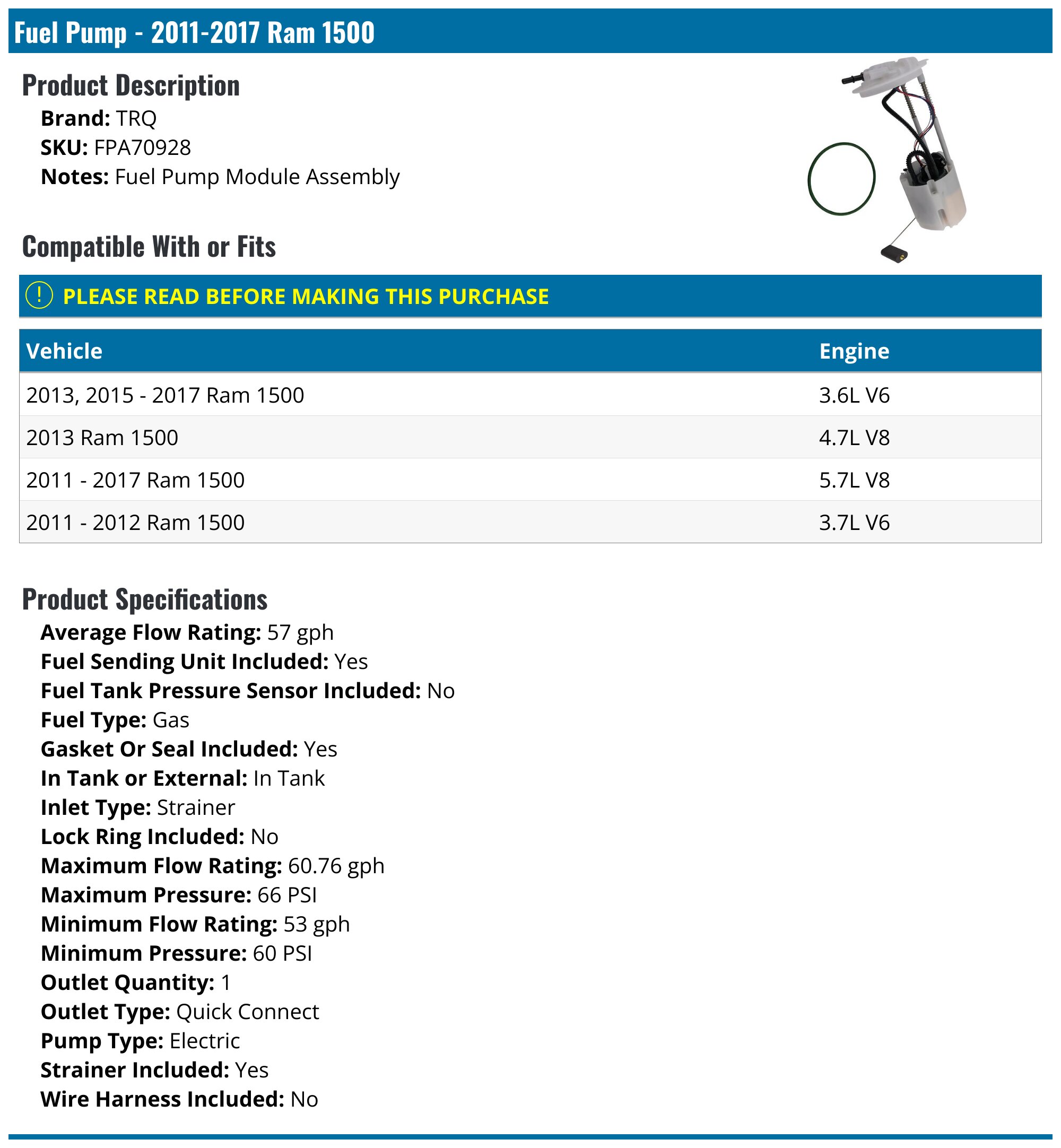
The fuel pump in the 2011 RAM 1500 is a modular design located inside the tank. It includes the pump, the fuel pressure regulator, and the fuel level sending unit. One common issue with aging RAMs is the failure of the fuel level sensor, which causes the gas gauge to read "Empty" even when the tank is full. Replacing this usually requires dropping the entire tank or lifting the truck bed.
Evaporative Emission (EVAP) System
The 2011 models are known for occasional EVAP system codes (such as P0456 or P0440). These are often caused by a cracked charcoal canister or a worn-out gas cap seal. Because the fuel tank is a sealed system designed to trap vapors, a leak anywhere in the 26 or 32-gallon system will trigger a Check Engine Light, preventing the vehicle from passing emissions inspections.
Fuel Tank Straps and Corrosion
For owners in the "rust belt," the metal straps that hold the plastic fuel tank in place can corrode over time. While the tank itself is plastic and will not rust, the security of the tank depends on these steel straps. During routine maintenance, it is vital to inspect these for structural integrity.
Upgrading Your Capacity: Can You Swap Tanks?
A common question among 2011 RAM 1500 owners is whether the 26-gallon tank can be swapped for the 32-gallon version.
Technically, the answer is yes, but with caveats. The mounting locations on the frame are generally the same for both tanks across the 1500 series. However, you will need the larger tank, the corresponding longer fuel straps, and potentially a recalibration of the truck's computer (the Power Control Module) so that the "Distance to Empty" reading on the dashboard remains accurate.
It is also important to note that certain Regular Cab, short-bed configurations may not have enough physical clearance for the 32-gallon tank due to the proximity of the rear axle and suspension components. Before attempting a swap, consult a factory service manual or a dedicated RAM enthusiast forum to confirm clearance for your specific wheelbase.
Driving Range and Modern Fuel Standards
In 2026, fuel formulations have evolved slightly from 2011 standards. Most modern "Top Tier" detergents are beneficial for the 5.7L HEMI’s fuel injectors. However, owners should remain cautious of high-ethanol blends (E15) unless their 2011 RAM is specifically designated as a Flex-Fuel Vehicle (FFV). While the 4.7L V8 often carried this designation, the 5.7L HEMI was not designed for high ethanol concentrations, and using them can lead to degraded fuel lines and poor combustion performance over time.
For more information on vehicle safety and fuel-related recalls for the 2011 model year, check the National Highway Traffic Safety Administration (NHTSA) website.
Frequently Asked Questions
How many miles can a 2011 RAM 1500 go on a full tank?
On average, a 2011 RAM 1500 with the 5.7L HEMI and a 26-gallon tank can travel approximately 350–400 miles on the highway. With the 32-gallon tank, that range extends to 480–550 miles. City driving and towing significantly reduce these numbers, often cutting the range by 30% to 50%.
Why does my 2011 RAM 1500 take forever to fill up?
This is a common "spit-back" issue often related to the fuel tank's inlet check valve or a clogged EVAP canister. If the air in the tank cannot escape as fuel enters, the gas station pump's automatic shut-off will trigger prematurely. This is a known issue on many fourth-generation RAMs and usually requires inspecting the vent lines.
Is the fuel tank on the 2011 RAM 1500 plastic or metal?
The tanks are made of high-density polyethylene (HDPE) plastic. This is standard for most modern trucks as it reduces weight and eliminates the risk of internal tank rust, which was a common problem in older steel-tank vehicles.
What is the fuel reserve on a 2011 RAM 1500?
When the "Low Fuel" warning light appears on the Electronic Vehicle Information Center (EVIC), there is typically a reserve of roughly 10% to 15% of the total capacity. For a 26-gallon tank, this is about 3 gallons; for a 32-gallon tank, it is approximately 4 to 4.5 gallons.
Can I use Premium fuel to get better range?
Using 91 or 93 octane fuel in a truck tuned for 87 or 89 (like the 2011 RAM engines) generally does not provide a noticeable increase in fuel economy or range. The HEMI engine is optimized for 89 octane; while premium won't hurt it, the cost-to-benefit ratio is usually poor.
Practical Recommendation for Owners
If you are planning to use your 2011 RAM 1500 for long-distance travel or as a dedicated towing rig, verify your tank size immediately using your VIN. If you find you have the 26-gallon tank and require more range, consider carrying high-quality portable fuel cans or exploring the possibility of a tank swap if your chassis allows it.
Furthermore, because these vehicles are now well into their second decade of service, prioritize a fuel system inspection. Replacing a 15-year-old fuel cap and checking the EVAP hoses for cracks can prevent annoying Check Engine Lights and ensure your fuel system remains pressurized and efficient for the years ahead.