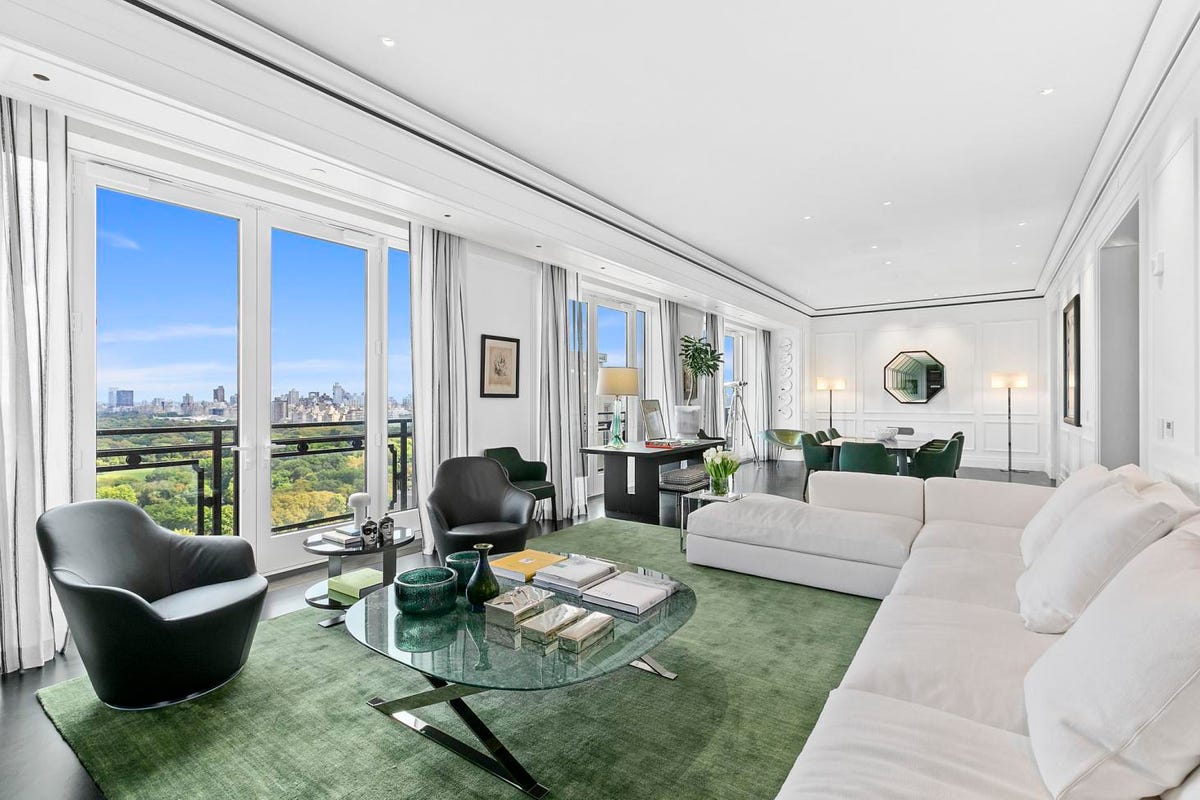
Ken Griffin’s record-breaking purchase of a penthouse at 220 Central Park South for approximately $238 million stands as a watershed moment in global real estate, offering profound insight into the mechanics of ultra-prime asset accumulation, privacy architecture, and the macroeconomic hedging strategies deployed by the world’s wealthiest individuals.
The Magnitude of the 220 Central Park South Transaction
When hedge fund manager Ken Griffin, founder and chief executive officer of Citadel, closed on his sprawling multi-floor penthouse at 220 Central Park South in January 2019, he did not merely buy a condominium; he established an entirely new ceiling for American residential real estate. At roughly $238 million, the transaction shattered previous records for the most expensive home ever sold in the United States.
To understand this transaction is to understand the apex of modern vertical luxury. Designed by Robert A.M. Stern Architects and developed by Vornado Realty Trust, 220 Central Park South was conceived precisely to capture this tier of ultra-high-net-worth capital. The building’s architecture merges classical limestone detailing with contemporary engineering, offering panoramic, unobstructed views of Central Park from heights that guarantee absolute privacy and light. Griffin’s acquisition involved combining multiple units across several floors into a massive, customized compound, a structural undertaking that required meticulous engineering foresight, bespoke architectural planning, and a staggering capital outlay.
Yet, focusing solely on the purchase price misses the broader economic and strategic implications of the deal. High-end real estate at this scale operates less like conventional housing and more like fine art, venture capital, or private equity. It represents a specialized asset class where liquidity, security, physical preservation of capital, and lifestyle consolidation intersect.
1 Core Insight: The Ultra-Prime Real Estate as a Sovereign-Grade Liquidity and Wealth Preservation Vehicle
The primary insight driving Ken Griffin’s 220 Central Park South deal is the strategic deployment of trophy real estate as a sovereign-grade wealth preservation vehicle that hedges against systemic financial volatility.
For multi-billionaires whose fortunes are largely tied to liquid, highly volatile financial instruments—such as hedge fund equities, global derivatives, and private equity stakes—holding vast amounts of cash or public securities carries distinct systemic risks. Global inflationary pressures, geopolitical instability, shifting tax regimes, and regulatory changes constantly threaten liquid capital reserves. Real estate, particularly irreplaceable physical assets located in top-tier global gateway cities like New York City, functions as a hard-asset anchor.
| Asset Class | Primary Function | Risk/Return Profile |
|---|---|---|
| Liquid Public Equities | Capital growth & liquidity | High volatility, high liquidity |
| Private Equity/Hedge Funds | Alpha generation & yield | Illiquid, high regulatory scrutiny |
| Ultra-Prime Real Estate | Capital preservation & privacy | Low volatility, high capital base |
By acquiring a unique, irreplaceable property overlooking Central Park, Griffin converted highly liquid, market-sensitive capital into an indestructible physical monument. Central Park South real estate does not correlate with broader suburban housing markets or even general metropolitan commercial property trends. It belongs to an insulated micro-economy governed by global wealth concentration. Even during economic downturns, the supply of unimpeded, sky-high park-view frontage is strictly finite. Consequently, trophy properties absorb immense amounts of capital with a high historical degree of capital retention, serving as a reliable fortress for generational wealth.
Architectural Complexity and Customization at 220 Central Park South
Executing a transaction of this magnitude involves far more than signing a standard contract of sale. The 220 Central Park South deal highlights the immense logistical and legal complexity required to assemble multi-unit compounds in supertall luxury towers.
Structural Engineering and Unit Combination
Griffin’s acquisition was not a pre-built penthouse; it was a complex assembly of raw or semi-finished spaces that required extensive architectural intervention. Combining floor plates vertically and horizontally in a limestone-clad supertall requires:
- Advanced acoustic engineering to isolate sound between massive structural slabs.
- Customized HVAC and mechanical integration to support sprawling square footage.
- Specialized interior load distribution to accommodate heavy stone finishes, art collections, and custom staircases.
Privacy, Discretion, and Legal Architecture
At the level of a $238 million transaction, anonymity and privacy are paramount. Ultra-high-net-worth buyers utilize layered legal structures—such as specialized domestic trusts, anonymous LLCs, and family office entities—to shield their personal identities from public registries while remaining fully compliant with federal and state disclosure mandates, including FinCEN (Financial Crimes Enforcement Network) geographic targeting orders aimed at high-end real estate transactions.
Comparative Context: How the 220 Central Park South Deal Reshaped the Market
To appreciate the significance of Griffin's purchase, it is helpful to place it within the historical context of New York City luxury real estate records. Prior to 2019, ultra-luxury records hovered around the $100 million mark, largely set by transactions like the penthouse at One57 purchased by billionaire Michael Dell.
| Property / Building | Location | Approximate Purchase Price | Year Closed | Key Strategic Characteristic |
|---|---|---|---|---|
| 220 Central Park South | Central Park South, Manhattan | ~$238 Million | 2019 | Multi-unit penthouse assembly by Ken Griffin; set new US record. |
| One57 | Billionaires' Row, Manhattan | ~$100.5 Million | 2014 | First residential sale in NYC to breach the nine-figure threshold. |
| 220 Central Park South (Secondary) | Central Park South, Manhattan | ~$190 Million | 2019 | Daniel Och’s penthouse purchase, underscoring building clustering. |
| The Woolworth Building | Tribeca, Manhattan | ~$110 Million | 2017 | Conversion of historic industrial crown into residential duplex. |
This comparison illustrates that Griffin’s purchase did not just break the record; it doubled it, recalibrating pricing expectations across Billionaires’ Row and fundamentally altering how developers price top-floor inventory.
Economic and Tax Implications of Ultra-Prime Asset Holdings
Acquiring a $238 million residential asset also brings complex tax and operational considerations that shed light on how modern ultra-prime wealth is managed.
Property Taxes and Municipal Contributions
Properties of this scale generate substantial ongoing revenue for municipal governments through real estate and mansion taxes. New York State imposes a real estate transfer tax alongside a progressive "mansion tax" on residential properties valued over $1 million, with additional surcharges for properties exceeding $25 million. For a transaction valued at nearly $238 million, the immediate tax contribution to state and local coffers runs into the millions of dollars, alongside continuous annual property tax assessments that fund municipal infrastructure.
Maintenance, Carrying Costs, and Operational Overhead
Owning a super-prime penthouse incurs millions in annual carrying costs. Monthly common charges and reserve fund contributions for properties of this size often exceed tens of thousands of dollars before factoring in private staff, bespoke security details, insurance premiums, and specialized interior upkeep. These ongoing expenses reinforce the reality that ultra-prime real estate is an exclusive domain restricted to individuals with immense, diversified cash-flow streams.
Common Misconceptions About Billionaire Real Estate Purchases
Public commentary surrounding transactions like Ken Griffin’s often relies on superficial assumptions. Addressing these misconceptions clarifies the true economic mechanics at play:
- Misconception 1: These properties are used as primary year-round residences. In reality, ultra-prime penthouses are frequently part of a global portfolio of homes. Owners like Griffin maintain primary corporate residencies elsewhere (such as Chicago or Miami, reflecting Citadel's corporate relocation history) and utilize New York properties as pied-à-terre sanctuaries.
- Misconception 2: Such purchases are speculative flips. Trophy real estate at the $200M+ level is rarely acquired for short-term capital appreciation. The transaction costs, illiquidity, and customization expenses make flipping economically unviable. These are long-term capital preservation vehicles.
- Misconception 3: Purchases are made purely for ostentatious display. While architectural visibility exists, the primary drivers are structural privacy, security infrastructure, elite concierge services, and proximity to financial hubs.
Frequently Asked Questions About Ken Griffin’s 220 Central Park South Deal
What was the exact purchase price of Ken Griffin’s 220 Central Park South penthouse?
The transaction closed at approximately $238 million, making it the most expensive home ever sold in the United States at the time of purchase in January 2019.
Why is 220 Central Park South considered superior to other Billionaires’ Row towers?
The building, designed by Robert A.M. Stern Architects, stands out due to its classic limestone construction, intimate unit count compared to ultra-tall slender glass towers, unobstructed and permanently protected park views, and extreme privacy measures.
How does purchasing multi-million dollar real estate protect wealth against inflation?
Physical real estate acts as a hard asset whose intrinsic value is tied to land scarcity and construction costs. Unlike fiat currency or debt instruments, prime real estate historically retains purchasing power during inflationary cycles.
What are the ongoing carrying costs for a property of this magnitude?
Carrying costs include substantial monthly common charges, multi-million-dollar annual property taxes, specialized insurance policies, private security, and bespoke maintenance for custom architectural finishes.
Did Ken Griffin make similar high-end real estate purchases outside of New York?
Yes, Griffin has made numerous high-profile real estate acquisitions globally, including record-setting purchases in Palm Beach, Florida, London, and Chicago, reflecting a consistent strategy of acquiring trophy assets in prime global markets.
Conclusion and Strategic Takeaway
Ken Griffin’s acquisition at 220 Central Park South transcends a simple luxury purchase; it is a masterclass in modern wealth preservation, utilizing irreplaceable physical assets to anchor multi-billion-dollar fortunes against global economic volatility. By recognizing trophy real estate as a sovereign-grade liquidity and risk-management tool, observers can better understand the rational economic forces shaping the upper echelons of the global property market.