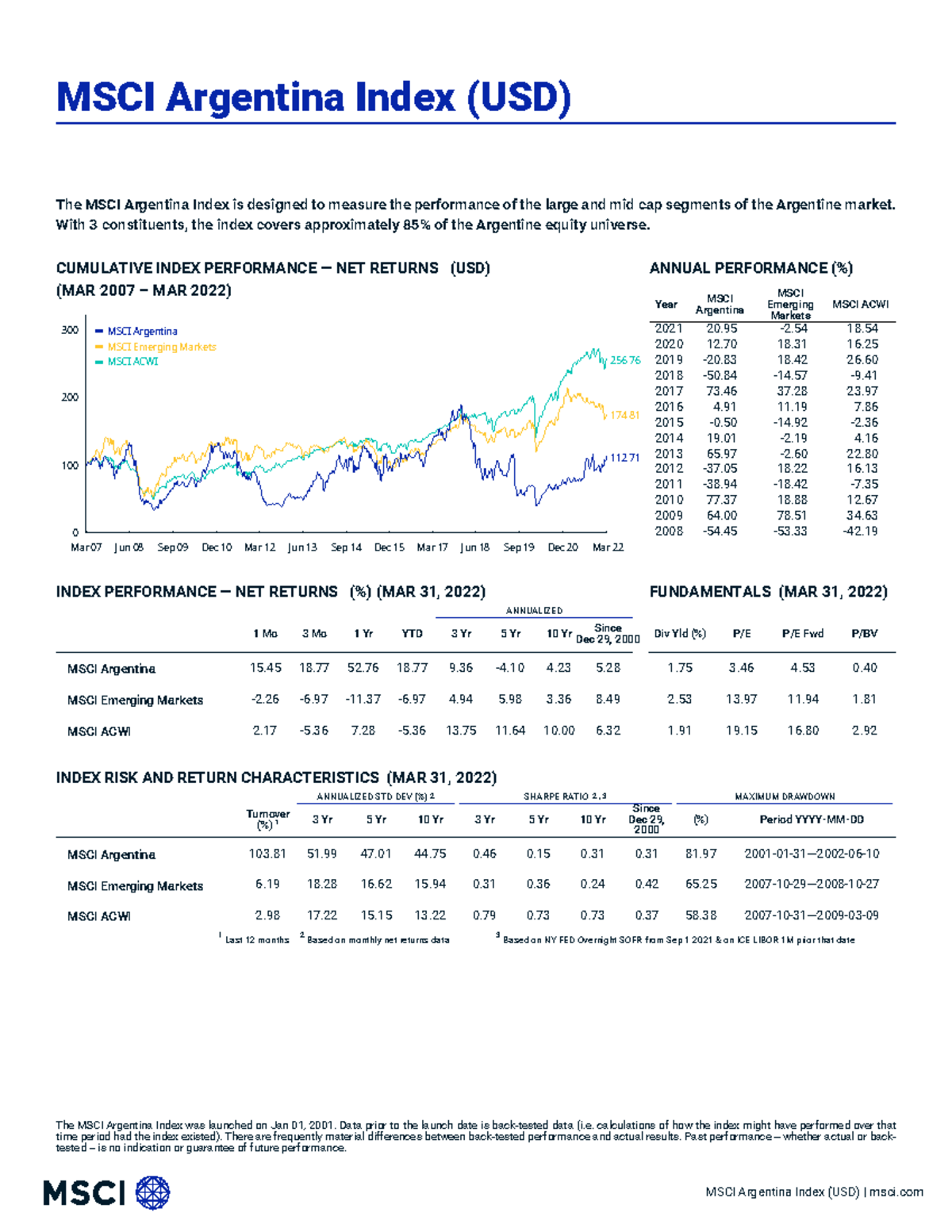
The MSCI Argentina Index is a market capitalization-weighted index designed to measure the performance of the equity market in Argentina. As of 2026, the index continues to serve as a critical benchmark for institutional investors, though it remains categorized as a Standalone Market due to persistent capital flow restrictions and market accessibility challenges that prevent its return to Emerging or Frontier Market status.
Understanding the MSCI Argentina Index Framework
The MSCI Argentina Index is part of the broader family of indices managed by MSCI Inc. (formerly Morgan Stanley Capital International). These indices are the gold standard for global portfolio managers, providing a standardized way to compare the performance of equity markets across different countries. For Argentina, the index represents a filtered selection of the country's most liquid and significant companies, primarily those with listings available to international investors via American Depositary Receipts (ADRs).
As we navigate 2026, the index is not just a reflection of stock prices; it is a barometer of international confidence in Argentina’s macroeconomic stability. Because MSCI indices are used to benchmark trillions of dollars in assets, a country’s classification—whether it be Developed, Emerging, Frontier, or Standalone—dictates the volume of "passive" capital (from ETFs and index funds) that flows into its domestic assets.
The Significance of Market Classification
Market classification is the most impactful aspect of the MSCI ecosystem. When a country is part of the Emerging Markets (EM) index, it is included in portfolios of funds tracking the MSCI EM Index, which includes giants like China, India, and Brazil. When a country is downgraded, it loses access to these massive pools of institutional capital.
In the case of Argentina, the journey has been volatile:
- 2018: Argentina was upgraded from Frontier to Emerging Market status.
- 2021: Due to the "prolonged severity" of capital controls (the cepo), MSCI took the rare step of downgrading Argentina directly from Emerging to Standalone Market, skipping the Frontier category entirely.
- 2026 Status: As of the current period in 2026, Argentina remains a Standalone Market. This status means the country is not part of any major multi-country index (like the MSCI Frontier Markets Index), making it a "specialist" play rather than a standard component of global portfolios.
Historical Context: The Path to Standalone Status
To understand the Argentina MSCI Index in 2026, one must examine the regulatory environment that shaped its current exclusion from the primary indices. The primary culprit has been the restriction on the inflow and outflow of capital. MSCI’s methodology emphasizes "Market Accessibility." Investors must be able to move money in and out of a country at the official exchange rate without significant delays or penalties.
Throughout the early 2020s, Argentina maintained multiple exchange rates and heavy restrictions on the repatriation of dividends. Even as the government in 2026 continues to work toward normalizing these conditions, MSCI requires a sustained period of stability and "proven" accessibility before considering a reclassification. This lag between policy change and index reclassification is a standard part of the MSCI review cycle, which typically occurs semi-annually in May and November.
Composition and Sector Weightings of the Index
The MSCI Argentina Index is relatively concentrated compared to its neighbors in the region. Because the index requires constituents to meet specific size and liquidity thresholds, only a handful of Argentinian "blue-chip" companies qualify.
Key Index Constituents
The index is dominated by companies that have a dual listing on the New York Stock Exchange (NYSE) or NASDAQ. These ADRs provide the liquidity necessary for MSCI inclusion. Major players typically include:
- YPF S.A. (Energy): The state-controlled energy giant is a cornerstone of the index. Its performance is closely tied to the development of the Vaca Muerta shale formation, one of the largest non-conventional oil and gas reserves in the world.
- Grupo Financiero Galicia (Financials): As one of the largest private banks in Argentina, Galicia serves as a proxy for the country’s internal consumption and credit cycles.
- Banco Macro (Financials): Another heavy hitter in the banking sector, Macro’s inclusion highlights the concentration of the index in the financial industry.
- Pampa Energía (Utilities/Energy): A diversified energy company involved in electricity generation, transmission, and gas production.
- Telecom Argentina (Communication Services): A major provider of fixed and mobile telecommunications.
Sector Concentration
Historically, the MSCI Argentina Index has shown a high concentration in Financials and Energy. In 2026, this concentration remains a risk factor. While the energy sector offers growth potential through exports, the financial sector is highly sensitive to local inflation and interest rate policies. This lack of diversification into technology or manufacturing (within the domestic index) distinguishes it from broader indices like the MSCI Brazil.
Technical Methodology: Size and Liquidity Requirements
MSCI uses a rigorous framework called the Global Investable Market Index (GIMI) methodology. For a stock to be included in the Argentina index, it must meet three primary criteria:
- Full Market Capitalization: The total value of all outstanding shares must meet a global minimum threshold.
- Free Float-Adjusted Market Capitalization: This refers to the value of shares available for purchase by international public investors (excluding government holdings or founder-locked shares). This is known as the Foreign Inclusion Factor (FIF).
- Liquidity: The stock must be traded frequently enough that a large institutional investor can enter or exit a position without causing a massive price swing. MSCI uses the Annualized Traded Value Ratio (ATVR) to measure this.
For Argentina, many domestic listings on the Bolsas y Mercados Argentinos (BYMA) fail the liquidity test. Consequently, the MSCI Argentina Index often feels more like an "ADR Index" than a true representation of the local Buenos Aires exchange.
Comparing Market Tiers
The following table outlines the criteria MSCI uses to distinguish between the tiers of market classification, illustrating why Argentina is currently classified as Standalone.
| Feature | Emerging Markets (EM) | Frontier Markets (FM) | Standalone Markets |
|---|---|---|---|
| Market Accessibility | Very High; few or no capital controls. | Moderate; some restrictions permitted. | Low; significant capital controls. |
| Size Requirement | Large (e.g., USD 2B+ full cap). | Modest (e.g., USD 1B+ full cap). | Varies by individual country. |
| Liquidity | High; consistent daily volumes. | Moderate; intermittent liquidity. | Low to Moderate. |
| Investor Rights | Strong protection; transparent. | Improving but variable. | Often limited or restricted. |
| Global Index Status | Included in MSCI EM Index. | Included in MSCI FM Index. | Excluded from global benchmarks. |
The Role of ADRs and the Global X MSCI Argentina ETF (ARGT)
For many investors, the "Argentina MSCI Index" is synonymous with the Global X MSCI Argentina ETF (ARGT). However, it is vital to distinguish between the two. While the official MSCI Argentina Index focuses on companies strictly tied to the country's domestic classification, the ARGT ETF often includes companies like MercadoLibre (MELI) and Globant (GLOB).
These companies are technologically "Argentinian" in origin and leadership, but because they are headquartered or incorporated outside of Argentina (e.g., Uruguay or Luxembourg) and listed in the US, MSCI classifies them under different regional indices. Therefore, the ARGT ETF may show strong performance due to MercadoLibre’s e-commerce dominance across Latin America, even if the official MSCI Argentina Index remains stagnant due to local economic headwinds.
Investment Outlook for 2026: Risks and Opportunities
Investing in an index categorized as Standalone requires a high tolerance for volatility. In 2026, the primary narrative surrounding the Argentina MSCI Index is the reversion to the mean and the potential for a "reclassification play."
Opportunities: The Reclassification Trade
If the Argentinian government successfully dismantles the capital control framework and stabilizes the exchange rate, MSCI will likely begin a "consultation" process to move the country back to Frontier Market status. Historically, such an announcement triggers a massive influx of "front-running" capital as investors anticipate the inclusion of Argentinian stocks in the MSCI Frontier Markets Index.
Risks: Political and Currency Volatility
The greatest risk remains currency devaluation. Since the MSCI Argentina Index is calculated in US Dollars, any significant drop in the value of the Peso (ARS) can wipe out gains made in local stock prices. Furthermore, as a Standalone Market, the index suffers from low "depth," meaning a few large trades can cause disproportionate price movements.
Prerequisites for a Classification Upgrade
For Argentina to move from Standalone back to the Frontier or Emerging tiers, MSCI’s Index Policy Committee will look for several verified milestones:
- Elimination of the "Cepo": The removal of limits on purchasing foreign currency and transferring it abroad.
- Liquidity in the FX Market: A single, transparent exchange rate rather than a "blue" or "parallel" market system.
- Consistency: MSCI typically requires at least 12 months of consistent market behavior before finalizing a classification change.
- Market Presence: At least two to three companies must meet the minimum size and liquidity requirements for Frontier status, or three for Emerging status.
Frequently Asked Questions
Is MercadoLibre part of the MSCI Argentina Index?
Technically, no. MSCI classifies MercadoLibre as a US-listed company with primary operations across Latin America, and it is often included in broader regional indices rather than the specific MSCI Argentina Index. However, it is a major component of ETFs that track Argentinian companies, such as the Global X MSCI Argentina ETF.
Why did Argentina move directly to Standalone in 2021?
MSCI determined that the capital controls implemented in Argentina were so severe that they blocked the basic "investability" of the market. Rather than keeping it in the Frontier category, where it would still receive passive inflows, MSCI moved it to Standalone to protect international investors from being "trapped" in the market.
How often does MSCI review Argentina's status?
MSCI conducts a Market Classification Review every year in June. Additionally, they perform quarterly and semi-annual index reviews (February, May, August, and November) to update the constituents and their weightings based on market capitalization changes.
Can individual investors buy the MSCI Argentina Index?
An individual cannot "buy" an index directly, but they can invest in products that track it. The most common way is through Exchange Traded Funds (ETFs) or by purchasing the underlying ADRs of the companies that make up the index, such as YPF or Grupo Financiero Galicia.
What is the difference between the MSCI Argentina Index and the Merval?
The Merval (S&P/BYMA Argentina Index) is the local benchmark of the Buenos Aires Stock Exchange and is priced in Argentinian Pesos. The MSCI Argentina Index is an international benchmark, primarily focused on ADRs, and is calculated in US Dollars. Their performances can diverge significantly due to exchange rate fluctuations.
Strategic Recommendation for 2026
For investors monitoring the Argentina MSCI Index in 2026, the key is to watch the Market Accessibility reports issued by MSCI. While the "Standalone" label often scares off conservative capital, it creates an environment where valuations can become decoupled from fundamentals.
The most prudent approach is to treat the index as a high-beta, tactical allocation. Investors should focus on the energy sector’s growth (Vaca Muerta) as a fundamental driver, while staying alert for regulatory changes regarding capital repatriation. Once a formal consultation for reclassification to Frontier Market status is announced by MSCI, the "liquidity event" could provide a significant tailwind for the index's constituents. Until then, the index remains a specialist tool for those navigating the complexities of the Southern Cone's most volatile economy.