American Mahjong is a four-player tabletop game that requires a combination of skill, strategy, and luck. To play correctly, players must follow the rules established by the National Mah Jongg League (NMJL), which include mastering the complex "Charleston" passing phase and matching tiles to a specific annual scorecard.
American Mahjong (often spelled Mah Jongg) is a fascinating evolution of the traditional Chinese game. While it shares the same foundational tiles, the American variant introduced unique mechanics in the early 20th century, most notably the use of Jokers and a changing array of winning hands. In 2026, the game remains a staple of social clubs and competitive tournaments across North America. Whether you are a novice looking for a printable American Mahjong rules PDF or an experienced player refining your strategy for the 2026 card, understanding the nuances of the game is essential for a fluid and enjoyable experience.
Essential Components of American Mahjong
Before diving into the mechanics, players must ensure they have the correct equipment. Unlike other variants that use 136 or 144 tiles, a standard American Mahjong set consists of 152 tiles.
The Tile Set Breakdown
The tiles are divided into several categories, and recognizing them instantly is the first step toward mastery:
- The Three Suits: Each suit runs from 1 to 9, with four of each tile.
- Dots (Circles): Represented by stylized round patterns.
- Bams (Bamboos): Represented by sticks of bamboo. Note that the "One Bam" is almost always depicted as a bird (often a sparrow or owl).
- Cracks (Characters): Represented by Chinese characters and a red character below.
- Honors: These are non-suited tiles.
- Winds: North, East, West, and South (4 of each).
- Dragons: Red, Green, and White (4 of each). In American play, the White Dragon is also called the "Soap" and is frequently used as a zero when matching number sequences.
- Specialty Tiles:
- Flowers: There are 8 Flower tiles in a set.
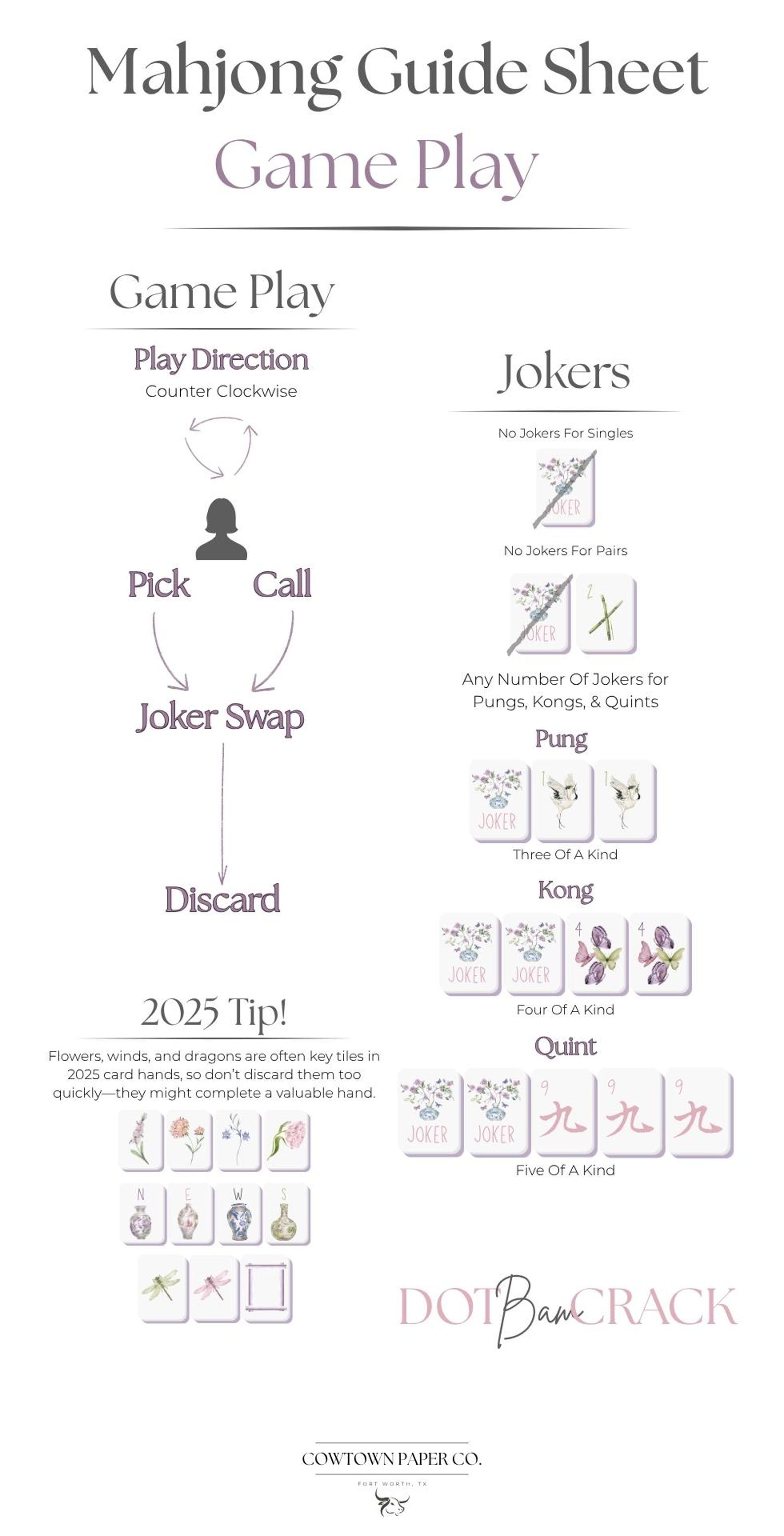
- Jokers: There are 8 Joker tiles, which act as wild cards for any tile in a "grouping" (Pung, Kong, Quint, or Sextette) but cannot be used for single tiles or pairs.
The Racks and Pushers
In American Mahjong, each player uses a rack to hold their tiles upright and hidden from opponents. Most modern racks come with an attached "pusher" or "swing arm," which is used to move the built wall of tiles into the center of the table during the game.
The National Mah Jongg League (NMJL) Card
The defining characteristic of the American game is the Official Standard Hands and Rules card, published annually by the National Mah Jongg League. In 2026, players must use the 2026 card to determine which combinations of tiles constitute a winning hand. This card is protected by copyright, which is why a "rules PDF" usually focuses on the mechanics of play rather than reproducing the specific hands on the card itself.
The Setup and The Deal
To begin a session, four players sit around a square table. Positions are often determined by a roll of the dice, with the highest roller becoming "East."
- Shuffling the Tiles: All 152 tiles are placed face down on the table and thoroughly mixed (often called "the washing of the tiles").
- Building the Walls: Each player builds a double-stacked row of tiles in front of their rack. Each wall should be 19 tiles long (38 tiles total per player).
- Breaking the Wall: East rolls the dice to determine where the wall will be opened. East then takes the first four tiles (two stacks of two). Players take turns clockwise, taking four tiles at a time until everyone has 12 tiles.
- Final Tiles: East takes two tiles (the 1st and 3rd from the top), and the other three players each take one tile. East begins the game with 14 tiles, while everyone else has 13.
The Charleston: A Unique American Tradition
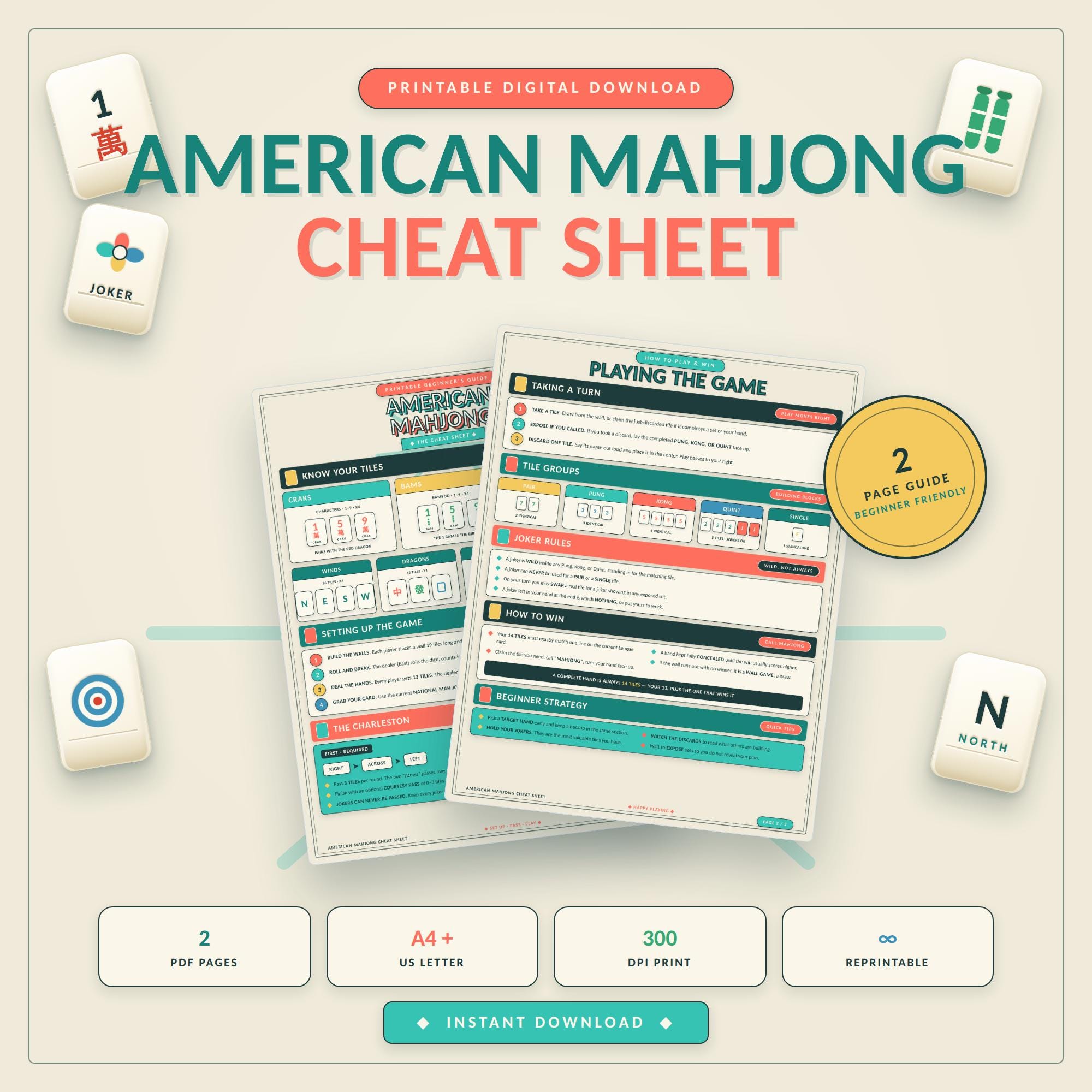
Before the actual play begins, players participate in a mandatory tile-exchange phase known as the Charleston. This is designed to help players get closer to one of the hands on the NMJL card.
The First Cycle (Mandatory)
- Right: Each player passes 3 unwanted tiles to the player on their right.
- Across: Each player passes 3 tiles to the player across from them.
- Left: Each player passes 3 tiles to the player on their left. This is the "Blind Pass" phase; a player may take up to 3 tiles passed to them and, without looking at them, pass them along to the next player if they don't want to break up their own potential hand.
The Second Cycle (Optional)
If all four players agree, a second Charleston is performed in the following order:
- Left: Pass 3 tiles to the left.
- Across: Pass 3 tiles across.
- Right: Pass 3 tiles to the right.
The Courtesy Pass
After the Charleston cycles are complete, the players sitting across from each other may agree to an optional "Courtesy Pass." They can exchange 0, 1, 2, or 3 tiles. The player who requests the fewer number of tiles dictates the limit.
Mechanics of Play: Drawing and Discarding
The objective is to be the first person to declare "Mahjong" by completing a hand that matches one of the patterns on the 2026 NMJL card.
Normal Play
East begins by discarding one tile, naming it clearly (e.g., "Three Dot"). The player to the right then draws a tile from the wall and discards one. Play continues counter-clockwise.
Calling a Tile
A player can "call" a discarded tile if it completes a grouping in their hand (a Pung, Kong, Quint, or Sextette).
- Pung: Three of the same tile.
- Kong: Four of the same tile.
- Quint: Five of the same tile (requires at least one Joker).
- Sextette: Six of the same tile (requires at least one Joker).
Note: You cannot call a tile for a "Pair" or a "Single" unless it is the very last tile you need to declare Mahjong.
When a tile is called, the player must display the completed grouping face-up on top of their rack. This is called "exposing" a hand. While exposing tiles helps you progress, it also gives opponents clues about which hand you are attempting to build.
The Role of Jokers
Jokers are essential for high-scoring hands. However, they come with specific rules:
- Exchange Rule: If a player has an exposed grouping (like a Kong of 8-Bams) that contains a Joker, and you have the actual tile (the 8-Bam) in your hand, you may exchange your tile for that Joker during your turn. You must have drawn a tile or called a tile first before making the exchange.
- Dead Hands: If a player uses a Joker in a grouping that is supposed to be a "Pair" (according to the card), their hand is declared "Dead," and they are disqualified from that round.
Understanding the NMJL Card Shorthand
To use a rules PDF effectively, you must understand the shorthand used on the NMJL card. The card is categorized by sections like "Consecutive Runs," "Odds," "Evens," and "Winds-Dragons."
| Abbreviation/Color | Meaning | Example/Notes |
|---|---|---|
| N, E, W, S | Winds | North, East, West, South |
| D | Dragon | Can be Red, Green, or White (Soap) |
| F | Flower | Any Flower tile in the set |
| 0 (Zero) | White Dragon | Used as a zero in 2026 number sequences |
| Red Text | Suit #1 | Represents any one suit (e.g., all Dots) |
| Blue Text | Suit #2 | Represents a different suit |
| Green Text | Suit #3 | Represents a third suit |
| (X) | Exposure | Usually indicates a specific grouping size |
If a hand is printed in only one color on the card, it must be completed using only one suit. If it is in two colors, it must use two suits.
Strategic Depth and The "Dead Hand"
American Mahjong is as much about defense as it is about offense. As the game progresses, you must watch the discards. If you see that all four "Five Cracks" have been discarded or exposed, and your intended hand requires a pair of Five Cracks, your hand is impossible to complete.
Declaring a Hand Dead
A player's hand can be called "Dead" by another player if:
- Impossibility: It is mathematically impossible for them to win based on visible tiles.
- Wrong Exposure: They expose a grouping that does not fit any hand on the card.
- Illegal Move: They have the wrong number of tiles after a draw/discard or they made an illegal Joker exchange.
A player with a Dead hand stops playing but must remain at the table. Depending on the rules, they may still have to pay the winner at the end of the round.
Why You Need a Rules PDF
While the NMJL card provides the "what" (the hands), a comprehensive American Mahjong rules PDF provides the "how." It serves as a neutral arbiter for table disputes and a study guide for:
- Error Correction: What happens if someone calls a tile out of turn?
- Scoring: Determining how much is owed (doubling for a "no-joker" hand, etc.).
- Tournament Standards: Ensuring your home game follows the same rigor as professional play.
For those looking for a formal source, the National Mah Jongg League offers an official rulebook, though many clubs create simplified PDF cheat sheets for their members to summarize the Charleston and Joker rules.
Frequently Asked Questions
1. Can I play American Mahjong with a Chinese Mahjong set?
Yes, provided the set includes at least 152 tiles. Most Chinese sets contain 144 tiles and lack the 8 Jokers necessary for the American game. You can purchase "Joker stickers" to convert standard tiles if needed.
2. Is the 2026 card different from the 2025 card?
Yes. Every year, the NMJL changes the required hands to keep the game fresh and challenging. While the basic categories (Odds, Evens, Consecutive Runs) remain, the specific combinations and tile requirements are altered.
3. What happens if two people call the same discarded tile?
If one person calls the tile for Mahjong (to win the game), they take priority. If neither is calling for Mahjong, the player whose turn would have come next in the clockwise rotation takes priority.
4. Can I use a Joker to complete a "Pair" or "Single" tile?
No. This is one of the most common mistakes for beginners. Jokers can only be used in groupings of three (Pungs) or more. If a hand on the card requires "11 22 33," those are pairs, and you cannot use a Joker for any of those tiles.
5. What is the "White Dragon" or "Soap" used for?
In American Mahjong, the White Dragon (usually a blank tile or a tile with a blue frame) acts as the number 0. This is particularly relevant in "Year" hands (e.g., 2026) or specific consecutive runs that involve a zero.
Conclusion and Next Steps
Mastering American Mahjong is a journey of pattern recognition and tactical flexibility. By 2026, the game has evolved into a sophisticated pastime that rewards those who take the time to study the annual card and the underlying mechanics of the Charleston.
If you are just starting, your next step should be to obtain a physical 2026 NMJL card and download a standardized rules PDF to keep at your table. Practice by "playing" solo—dealing yourself a hand and seeing how many turns it takes to match a pattern on the card. Once you are comfortable with the flow of the Charleston, join a local club or an online platform to experience the social and competitive thrill that has made American Mahjong a beloved tradition for over a century.