The U.S. Bank Altitude rewards card suite is a tiered collection of credit cards designed to reward specific consumer behaviors, ranging from daily dining and commuting to premium global travel. As of 2026, the ecosystem consists of three primary pillars: the Altitude Go, the Altitude Connect, and the flagship Altitude Reserve. Each card utilizes a proprietary points system that offers maximum flexibility through "Real-Time Rewards," allowing cardholders to instantly redeem points for purchases via text message.
While the term "Altitude" is also utilized by Westpac in the Australian market for its own rewards program, this overview focuses on the U.S. Bank Altitude suite available in the United States, which has become a dominant force in the rewards landscape due to its unique "mobile wallet" earning potential and straightforward redemption paths.
Understanding the Altitude Rewards Ecosystem
The Altitude suite is structured to compete with major players like Chase Sapphire, American Express Gold/Platinum, and Capital One Venture. However, U.S. Bank distinguishes itself by targeting niche spending categories that other issuers often overlook or cap.
The core philosophy of the Altitude program is simplicity combined with high-velocity earning. Unlike programs that require complex transfer partner knowledge to achieve high value, Altitude points (especially with the Reserve variant) provide a fixed, elevated value when used for travel. This makes the cards particularly attractive to "efficient travelers"—those who want premium rewards without the "homework" of searching for award flight availability.
The Evolution of Altitude Points
In the 2026 financial landscape, points earned within the Altitude ecosystem are generally valued at 1 cent per point for most redemptions (cash back, gift cards, or statement credits). However, the Altitude Reserve elevates this value by 50% for travel redemptions, making points worth 1.5 cents each. It is important to note that while points are earned within the same "Altitude" branding, they are technically siloed by account unless you hold multiple cards and utilize the internal transfer features, which have seen various updates to improve user experience over the last several years.
The Altitude Reserve: The Premium Powerhouse
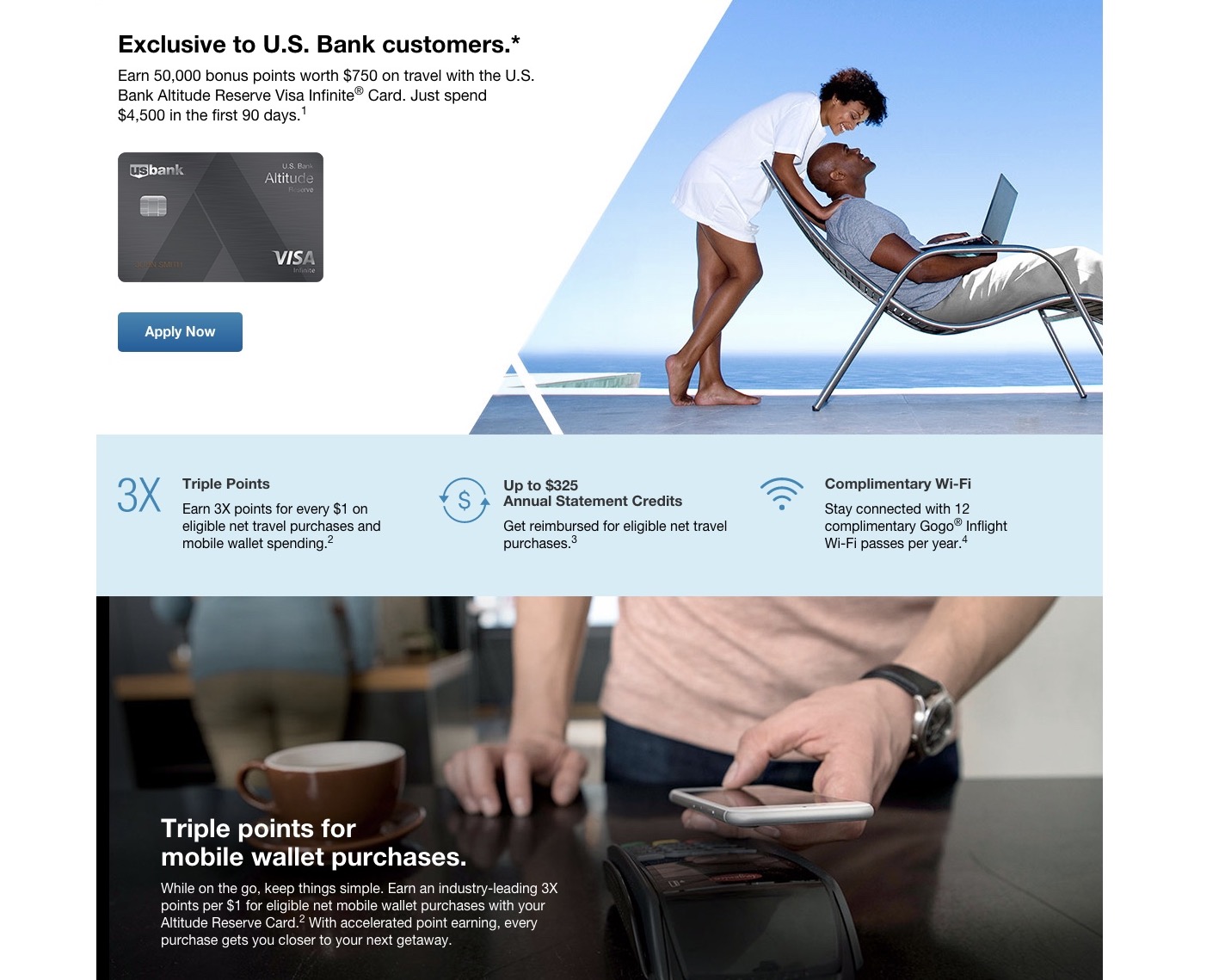
The U.S. Bank Altitude® Reserve Visa Infinite® Card remains one of the most coveted premium credit cards in 2026, primarily because of its industry-leading rewards for mobile wallet transactions. This card is designed for the modern consumer who utilizes Apple Pay, Google Pay, or Samsung Pay for nearly all in-person transactions.
Rewards Structure and Mobile Wallet Dominance
The Altitude Reserve offers a straightforward but powerful earning structure:
- 5x points on prepaid hotels and car rentals booked directly through the Altitude Rewards Center.
- 3x points on eligible travel purchases.
- 3x points on all mobile wallet spending.
- 1x point on all other purchases.
The 3x mobile wallet category is the "killer feature" of this card. In 2026, as contactless payment adoption has reached near-ubiquity in retail, grocery stores, and even many service providers, the Altitude Reserve effectively acts as a 4.5% cash-back card for almost all in-person spending (when points are redeemed for travel at 1.5 cents each).
Premium Benefits and Credits
To offset its $400 annual fee, the Reserve provides a suite of high-value offsets:
- $325 Annual Credits: This is an automatic reimbursement for eligible travel and dining purchases. Because this credit is broad and applies to both travel and restaurants, most users find the "effective" annual fee to be only $75.
- Priority Pass Select: Cardholders receive a limited number of complimentary visits to airport lounges and participating airport restaurants annually.
- Global Entry or TSA PreCheck® Credit: Up to $120 reimbursement every four years.
- Visa Infinite Protections: Includes primary rental car insurance, trip cancellation/interruption insurance, and purchase security.
The Altitude Connect: The Mid-Tier Commuter Specialist
As of 2026, the U.S. Bank Altitude® Connect Visa Signature® Card occupies a unique space as a no-annual-fee card (following the structural shift in late 2024) that offers premium-level rewards for travelers and commuters.
Earning Categories
The Connect card is optimized for "the journey," whether that involves a daily commute or a cross-country road trip:
- 5x points on prepaid hotels and car rentals booked in the Altitude Rewards Center.
- 4x points on travel, gas stations, and EV charging stations.
- 2x points at grocery stores, dining, and streaming services.
- 1x point on all other eligible purchases.
The 4x rate on gas and EV charging is among the highest in the industry for a card without an annual fee. This makes it an essential "sock drawer" card for those who do not want to pay for a premium travel card but want to maximize their fuel or charging expenses.
Key Features and Limitations
Unlike the Reserve, the Connect card does not offer the 1.5-cent travel redemption boost. Points are worth a flat 1 cent each. However, it still provides a TSA PreCheck®/Global Entry credit every four years—a rarity for a no-annual-fee card—and does not charge foreign transaction fees, making it an excellent secondary card for international travel.
The Altitude Go: The Lifestyle and Dining Entry Point
The U.S. Bank Altitude® Go Visa Signature® Card is the entry-level offering, focusing on everyday lifestyle expenses. It carries no annual fee and is frequently cited as one of the best cards for young professionals or students building their credit rewards.
High-Yield Dining Rewards
The Go card’s primary draw is its 4x points on dining, which includes takeout and delivery services. In 2026, this remains one of the highest "no-fee" dining multipliers available.
- 2x points at grocery stores, gas stations, EV charging stations, and on streaming services.
- 1x point on all other purchases.
The Streaming Credit
A unique feature of the Altitude Go is the $15 annual streaming credit. After 11 consecutive months of eligible streaming service purchases (such as Netflix, Hulu, or Spotify), the cardholder receives a $15 credit. While modest, it effectively pays the user to hold the card, as there is no annual fee.
Comparing the Altitude Suite: 2026 Specifications
| Feature | Altitude Reserve | Altitude Connect | Altitude Go |
|---|---|---|---|
| Annual Fee | $400 | $0 | $0 |
| Top Reward Rate | 5x (Travel Portal) | 5x (Travel Portal) | 4x (Dining) |
| Mobile Wallet Rate | 3x (High Value) | 1x | 1x |
| Gas/EV Charging | 3x (via Mobile Wallet) | 4x | 2x |
| Point Value (Travel) | 1.5 cents | 1.0 cent | 1.0 cent |
| Travel Credits | $325 (Travel/Dining) | None | $15 (Streaming) |
| Lounge Access | Priority Pass Select | 4 Annual Visits (Select) | None |
| Foreign Fees | None | None | None |
Maximizing Value with Real-Time Rewards
One of the most innovative aspects of the Altitude rewards card overview is the Real-Time Rewards system. This feature bypasses the traditional travel portal requirements that many other banks enforce.
How Real-Time Rewards Work
- Enrolling: Users opt-in via the U.S. Bank mobile app or website and set categories for redemption (e.g., Travel, Groceries, Dining).
- Transaction Trigger: When you make a purchase in an enrolled category that meets a minimum dollar threshold (usually $10 for most categories, but higher for travel), U.S. Bank sends a text message.
- Instant Redemption: The text asks if you would like to use your points to cover the purchase. By replying "REDEEM," the points are deducted from your balance, and a statement credit is issued to your account within 24–72 hours.
For Altitude Reserve holders, this is the mechanism that unlocks the 1.5-cent-per-point valuation. When a "Travel" purchase triggers the text, the points are redeemed at the elevated rate. This allows users to book flights directly with airlines or hotels (earning loyalty points and elite status) while still using their bank points for a 50% bonus value—a feat nearly impossible with Chase or Amex without using their restrictive portals.
Strategic Application and Eligibility
U.S. Bank is known for having stricter approval standards compared to other major issuers. They value "relationship banking," meaning your chances of approval for an Altitude card—especially the Reserve—increase significantly if you have an existing checking, savings, or brokerage account with them.
The "U.S. Bank Relationship" Rule
Historically, the Altitude Reserve required a prior relationship of at least 30 to 60 days before application. While these rules have softened by 2026 to allow broader access, having a U.S. Bank Smartly® Checking account often provides the necessary "foot in the door." Furthermore, U.S. Bank is sensitive to "credit seeking behavior" (opening many cards in a short period). Applicants are generally advised to have fewer than two new accounts in the last 12 months (the "0/6 or 1/12" rule) for the best chance at a high-limit Altitude Reserve.
Common Mistakes to Avoid
- Ignoring Mobile Wallets: If you carry the Altitude Reserve but forget to use Apple/Google Pay, you are losing a massive portion of the card's value.
- Redeeming Reserve Points for Cash: Redeeming Reserve points for a check or statement credit only nets 1 cent per point. Always aim for the 1.5-cent travel redemption via Real-Time Rewards or the travel portal.
- Low Purchase Thresholds: Real-Time Rewards often have a minimum purchase amount (e.g., $10). Small coffee purchases may not trigger the redemption text.
Frequently Asked Questions
Can I transfer points between different Altitude cards?
Yes, U.S. Bank typically allows for the movement of points between Altitude accounts through their rewards center. However, moving points from an Altitude Go to an Altitude Reserve does not always mean those points automatically gain the 1.5-cent value. In most 2026 configurations, points retain the value of the card they were earned on, though some specific "combined" accounts may allow for unified valuation. Always check your specific account terms for the current "Points Transfer" policy.
What counts as "Travel" for the 3x or 4x multipliers?
U.S. Bank uses a broad definition of travel. This includes airlines, hotels, car rental agencies, cruise lines, passenger trains, and even some local transit like buses and taxis. It specifically excludes real estate agents, tourist attractions, and some discount travel sites that do not use the correct Merchant Category Code (MCC).
Is the Altitude Reserve still worth it in 2026?
For most users, the answer is yes, provided they spend at least $325 a year on dining or travel. The "net" annual fee of $75 is easily recovered by the 3x mobile wallet earning. If you spend more than $2,500 annually via mobile wallet (which is less than $210 per month), you have already broken even compared to a standard 2% cash-back card.
Does the Altitude Connect still have a $95 annual fee?
No. Following the update in late 2024, the Altitude Connect transitioned to a $0 annual fee card. This change also involved some minor adjustments to its lounge access perks (limiting them to four visits per year) and the removal of the streaming credit, which was consolidated into the Altitude Go card.
How do I trigger the 1.5-cent redemption on the Reserve?
To get the 1.5-cent value, you must redeem your points for travel. This can be done by booking through the U.S. Bank travel portal or by using Real-Time Rewards for a direct travel purchase (like an airline ticket bought directly on Delta.com). When the text message arrives, it will show you the "discounted" point cost reflecting the 1.5-cent value.
Next Steps for Prospective Cardholders
If you are considering an Altitude rewards card, the first step is to analyze your spending via your bank statements from the last three months.
- The "Mobile Wallet" Test: Look at how many of your transactions were made in person at retailers that accept contactless payments. If this number is high, the Altitude Reserve is likely your best option.
- The "Commuter" Test: If you spend heavily on gas or EV charging but rarely travel or use mobile wallets, the Altitude Connect offers the highest return for zero annual cost.
- The "Dining" Test: For those who want a simple, no-fuss card for restaurants and streaming, the Altitude Go is a top-tier choice.
Before applying, ensure your credit score is in the "Excellent" range (720+) for the Reserve or "Good to Excellent" (680+) for the Go and Connect. If you do not have a relationship with U.S. Bank, consider opening a basic savings account a month before applying to build the necessary internal profile.