Choosing the right Alberta auto insurance company involves navigating a private, highly regulated market where over 30 providers compete for your business. In 2026, the selection process requires balancing the province’s mandatory "Grid" pricing system with optional coverages and various service models, ranging from traditional brokers to direct-to-consumer digital platforms.
Alberta’s automobile insurance landscape is distinct within Canada. Unlike provinces with government-run monopolies, such as British Columbia or Saskatchewan, Alberta utilizes a private-delivery system. This means that while the government sets the rules, private companies compete to offer the best rates, service levels, and specialized endorsements. As we move through 2026, understanding the regulatory framework and the specific strengths of major insurers is essential for any driver looking to optimize their premiums and protection.
The Regulatory Framework: AIRB and the Grid System
The Alberta Automobile Insurance Rate Board (AIRB) serves as the primary regulator for the industry. Their mandate is to ensure that insurance remains accessible and that rate increases are justified by actuarial data. One of the most critical components of the Alberta market is the Grid System.
The Grid was established to set a maximum premium for basic coverage (Third Party Liability and Accident Benefits). Every driver in Alberta is assigned a "step" on the Grid based on their years of licensed driving and their history of at-fault accidents and convictions. If an insurance company’s internal rating system produces a premium higher than the Grid maximum for a specific driver, the company must charge the Grid rate instead. In 2026, this remains a vital safety net for high-risk drivers or those new to the province, ensuring they are not priced out of the market.
Furthermore, the Direct Compensation for Property Damage (DCPD) model, which was fully integrated several years ago, continues to streamline the claims process. Under DCPD, your own insurance company pays for repairs to your vehicle when you are not at fault in a collision. This removes the need to subrogate or chase the other driver's insurance, leading to faster repairs and more predictable claims handling across all Alberta auto insurance companies.
Profile of Major Alberta Auto Insurance Companies
The Alberta market is diverse, featuring national giants, regional specialists, and member-based organizations. Each caters to different demographic profiles and risk appetites.
Intact Insurance
As the largest provider of property and casualty insurance in Canada, Intact holds a significant share of the Alberta market. They are known for a robust digital infrastructure, including a sophisticated mobile app that allows for real-time claims tracking and document management. Intact typically operates through a vast network of independent brokers, though they have expanded their direct-to-consumer presence. Their "my Drive" program, a usage-based insurance (UBI) initiative, is a major draw for drivers in 2026 who want to lower their premiums by demonstrating safe driving habits via telematics.
Alberta Motor Association (AMA)
AMA is a unique entity in the province, operating as a member-based organization. For many Albertans, AMA is the go-to for auto insurance because of the integration with their roadside assistance and registry services. AMA Insurance is often praised for its customer service and local claims adjusters who understand the specific geographic challenges of Alberta, such as severe hailstorms and icy rural roads. Membership is required to access their insurance products, but the bundled value often outweighs the annual membership fee.
Wawanesa Mutual Insurance
Wawanesa is one of the oldest insurers in Western Canada and operates on a mutual model, meaning it is owned by its policyholders rather than shareholders. In 2026, Wawanesa remains a favorite among traditionalists who prefer working through independent brokers. They are often noted for their competitive rates for "standard" risks—drivers with clean records and established insurance histories. Their claims philosophy tends to be straightforward, focusing on reliability rather than high-tech bells and whistles.
TD Insurance
TD Insurance is the leading direct writer in Alberta, meaning they sell policies directly to the public without the use of independent brokers. They are particularly popular among university alumni, professional associations, and employer groups, as they offer significant group discounts. For many young professionals in 2026, TD’s seamless online quoting tool and integration with TD banking apps make it a highly convenient option.
Aviva Canada
Aviva is a global player with a strong foothold in Alberta. They have historically been innovators in the space, being one of the first to offer specialized coverage for ride-sharing drivers (such as those for Uber or Lyft). In 2026, Aviva focuses heavily on sustainability and electric vehicle (EV) specific policies, offering incentives or specialized endorsements for owners of low-emission vehicles.
Comparing Service Models: Brokers vs. Direct Writers
When searching for "alberta auto insurance companies," one of the first decisions you must make is whether to use an insurance broker or a direct writer.
Working with an Independent Broker
A broker acts as an intermediary between you and multiple insurance companies (like Intact, Wawanesa, or Economical).
- Pros: They shop around on your behalf to find the best rate across several providers. They provide personalized advice and can help you navigate complex claims as an advocate.
- Cons: You may pay a small commission (hidden in the premium), and the process might be slightly slower than a direct online quote.
Buying Directly from an Insurer
Direct writers (like TD Insurance, Allstate, or Sonnet) sell their own products directly to the consumer.
- Pros: Often faster and more convenient for tech-savvy users. They may offer lower rates because they don't pay broker commissions.
- Cons: You are limited to that specific company's products. If their rates go up, you have to do the legwork to find a new provider yourself.
Understanding Mandatory and Optional Coverages in Alberta
Regardless of which company you choose, the structure of an Alberta auto policy is standardized into "Sections."
| Coverage Type | Mandatory/Optional | Description |
|---|---|---|
| Section A: Third Party Liability | Mandatory | Protects you if you are responsible for a collision that causes injury, death, or property damage to others. The legal minimum is $200,000, though most Albertans carry $1,000,000 to $2,000,000. |
| Section B: Accident Benefits | Mandatory | Provides medical payments, disability income, and death benefits regardless of who was at fault. Includes coverage for physiotherapy and chiropractic care. |
| Section C: Loss or Damage | Optional | Covers damage to your own vehicle. This is divided into Collision (impact with another vehicle or object) and Comprehensive (hail, fire, theft, vandalism). |
| Section D: Uninsured Motorist | Mandatory | Protects you if you are involved in an accident with an unidentified driver (hit-and-run) or an uninsured vehicle. |
| SEF 13D: Limited Glass | Optional | A popular Alberta endorsement that excludes stone chips and cracks from your comprehensive coverage in exchange for a lower premium. |
| SEF 44: Family Protection | Optional | Highly recommended; protects you and your family if you are hit by a driver who does not have enough insurance to pay your claim. |
Factors Influencing Alberta Auto Insurance Premiums in 2026
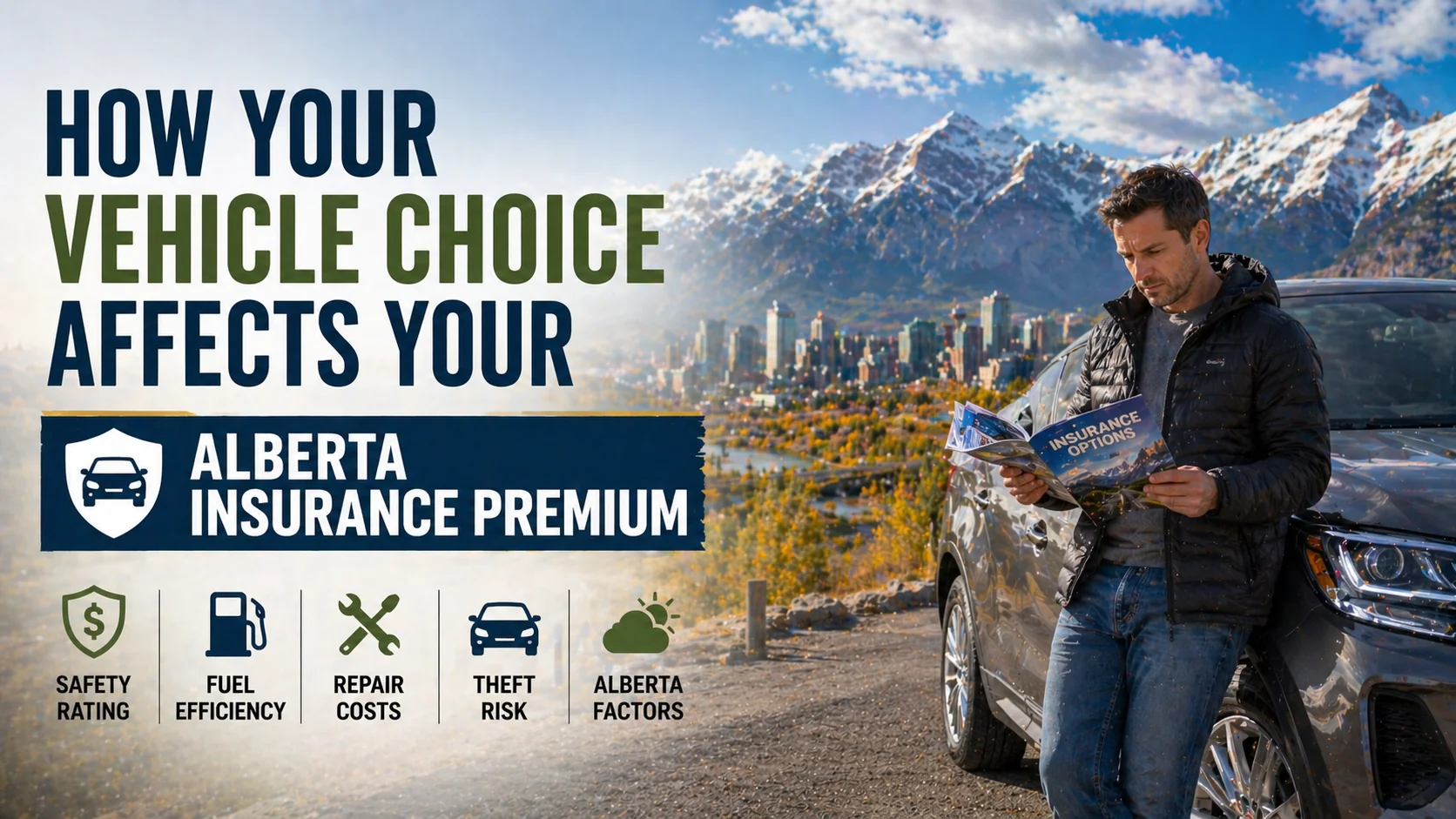
The cost of insurance in Alberta is influenced by a combination of individual factors and macroeconomic trends. In 2026, several key drivers are impacting the rates offered by companies:
- Vehicle Technology: Modern vehicles are equipped with Advanced Driver Assistance Systems (ADAS). While these reduce accidents, the sensors and cameras make repairs significantly more expensive, which has pressured premiums upward.
- Weather Events: Alberta is the "hail capital" of Canada. Insurers like AMA and Intact have had to adjust their comprehensive coverage rates to account for the increasing frequency and severity of localized hailstorms in the Calgary-Edmonton corridor.
- The "Good Driver" Advantage: Legislation in recent years has focused on protecting "good drivers" from massive rate hikes. Companies in 2026 are increasingly competing for these low-risk clients by offering high-discounts for clean abstracts (records).
- Usage-Based Insurance (UBI): More Albertans are opting for telematics. By allowing an app to track your braking, acceleration, and speed, you can often secure a discount of 10% to 25% off your premium.
How to Choose the Best Company for Your Needs
Selecting from the many Alberta auto insurance companies requires a systematic approach. Follow these steps to ensure you are getting the best value:
- Step 1: Check Your Grid Step. Use the AIRB Grid Calculator to find your maximum premium. This provides a baseline; if a company quotes you higher than this for basic coverage, they are not complying with provincial regulations.
- Step 2: Determine Your Coverage Needs. Do you need full glass coverage? (Likely not, given Alberta's gravel-heavy roads). Do you require a high liability limit because you commute long distances?
- Step 3: Gather Multiple Quotes. Use a mix of direct writers (like TD) and a broker who can access companies like Wawanesa or Travelers.
- Step 4: Check Financial Stability and Claims Reputation. Consult the Insurance Bureau of Canada (IBC) for consumer resources and check the J.D. Power customer satisfaction rankings for Canadian insurers.
- Step 5: Review Endorsements. Ensure you are comparing "apples to apples." One company might be cheaper but may have excluded the SEF 44 Family Protection endorsement, which is crucial for long-term safety.
Common Pitfalls to Avoid
When interacting with Alberta auto insurance companies, avoid these common mistakes:
- Under-insuring for Liability: In 2026, a $200,000 limit is dangerously low. Legal settlements for bodily injury frequently exceed this amount.
- Ignoring the "Limited Glass" Endorsement: Alberta roads are notorious for windshield damage. Carrying a $0 or $100 deductible on glass is often more expensive than simply paying for a new windshield out of pocket once every few years.
- Failing to Update Your Commute: If you have shifted to a permanent work-from-home model, ensure your insurer knows. "Pleasure use" is significantly cheaper than "Commute use."
Frequently Asked Questions
What is the average cost of auto insurance in Alberta in 2026?
While it varies wildly by age and location, the average Alberta driver pays between $1,400 and $2,100 annually for full coverage. Drivers in urban centers like Calgary or Edmonton typically see higher premiums than those in rural areas due to higher theft and collision rates.
Can an insurance company refuse to sell me a policy in Alberta?
Alberta follows an "all-comers" rule for mandatory coverage. This means a private insurer cannot refuse to provide you with Third Party Liability and Accident Benefits, regardless of your risk profile. However, they can refuse to provide optional coverages like Collision or Comprehensive if you have a history of frequent claims or non-payment of premiums.
How does the Grid system affect my rates if I have a clean record?
If you have a clean record and many years of driving experience, you will likely be at the bottom of the Grid (e.g., Step -15). In this case, your insurance company’s internal rates will almost certainly be lower than the Grid maximum. The Grid exists primarily to protect those at the higher end of the scale from astronomical costs.
Does Alberta use a "No-Fault" insurance system?
Alberta uses a hybrid system. While it has Direct Compensation for Property Damage (DCPD), which feels like no-fault because you deal with your own insurer for vehicle damage, it is still a Tort system for bodily injury. This means you still have the right to sue an at-fault driver for pain and suffering, subject to certain legislative caps on minor injuries.
Are electric vehicles more expensive to insure in Alberta?
Generally, yes. In 2026, EVs often command a 10-15% higher premium than comparable internal combustion engine vehicles. This is due to the high cost of battery replacement and the specialized labor required for repairs following a collision.
Final Recommendation
For most Alberta drivers in 2026, the best approach is to start with a local independent broker to scan the broader market, particularly if you have a complex history or multiple vehicles. However, if you are a "good driver" with a clean record and a modern vehicle, checking with a direct writer like TD Insurance or using a usage-based app from a company like Intact may yield the lowest possible rates. Always ensure you carry at least $2,000,000 in Third Party Liability and never skip the SEF 44 Family Protection endorsement.