An Agile plan is a dynamic framework that balances strategic direction with the ability to adapt to changing requirements. Unlike rigid traditional models, it organizes work into iterative cycles, ensuring that teams deliver high-value features incrementally while maintaining a structured path toward the project’s long-term vision and business objectives.
In the current landscape of 2026, project management has evolved beyond simple task tracking. Organizations now face hyper-accelerated market shifts, making the "Agile plan" more critical than ever. The primary challenge for modern leaders is not just "being agile" but creating a structured approach that prevents flexibility from turning into chaos. A well-constructed Agile plan provides the necessary guardrails for innovation, ensuring that every pivot is backed by data and aligned with stakeholder expectations.
The Architecture of an Agile Plan: The Planning Onion
To understand how structure coexists with flexibility, we must examine the "Agile Planning Onion." This concept illustrates that planning occurs at multiple levels, each with a different time horizon and level of detail. By layering these plans, an organization remains grounded in its long-term goals while remaining nimble in daily execution.
1. The Vision and Strategy Level
At the outermost layer, the vision defines the "why" of the project. In 2026, high-level strategy is often informed by real-time market analytics and AI-driven predictive modeling. This stage is not about specific features but about the desired outcome. A structured Agile plan begins here, establishing the North Star that guides every subsequent decision.
2. The Product Roadmap
The roadmap translates the vision into a chronological (but flexible) sequence of milestones. It focuses on themes and outcomes rather than specific tickets. For a structured approach, the roadmap should be reviewed quarterly. It provides stakeholders with a high-level view of where the product is headed without over-committing to granular details that may change.
3. Release Planning
Release planning bridges the gap between the roadmap and the actual iterations. It identifies a set of features or "user stories" that will be delivered in a specific timeframe, often spanning several months. This level of the plan introduces the concept of Minimum Viable Product (MVP) and ensures that each release provides tangible value to the end user.
4. Iteration or Sprint Planning
This is where the plan becomes highly granular. Sprints—typically lasting one to four weeks—are the heartbeat of Agile. During sprint planning, the team commits to a specific set of tasks from the product backlog. The structure here is rigid for the duration of the sprint: once the work is set, the team focuses exclusively on delivery, shielding themselves from outside distractions.
5. Daily Planning
The innermost layer is the daily stand-up. This 15-minute sync ensures the plan is adjusted in real-time based on the previous day’s progress and any immediate blockers. It is the most flexible part of the structure, allowing for micro-adjustments that prevent small issues from snowballing into project-wide delays.
Core Components of the Agile Planning Process
A structured Agile plan relies on several key artifacts and rituals. These are not merely administrative tasks; they are the mechanisms that allow for controlled flexibility.
The Product Backlog: The Living Document
The product backlog is an ordered list of everything that might be needed in the product. It is never "finished." A structured approach requires regular Backlog Refinement (or "grooming"). In this process, the Product Owner and the team review items to ensure they are:
- Detailed appropriately: Items near the top of the list have more detail than those at the bottom.
- Estimated: The team provides a rough idea of the effort required (often using story points).
- Emergent: The backlog grows and changes as new information becomes available.
- Prioritized: Items are ranked based on business value, risk, and dependencies.
User Stories and Acceptance Criteria
Instead of technical specifications, Agile plans use user stories to describe functionality from the perspective of the end user. The structure comes from the Acceptance Criteria—the specific conditions that a software product must meet to be accepted by a user or customer. Without clear criteria, flexibility leads to "scope creep," where the project expands indefinitely without reaching completion.
Velocity and Capacity Planning
Structure in Agile is maintained through data. Velocity is a metric that tracks the amount of work a team completes during a sprint. By calculating the average velocity over several cycles, project managers can forecast future completion dates with remarkable accuracy. Capacity planning involves looking at the team's availability (holidays, meetings, other commitments) to ensure the sprint plan is realistic.
Comparing Traditional and Agile Planning Frameworks
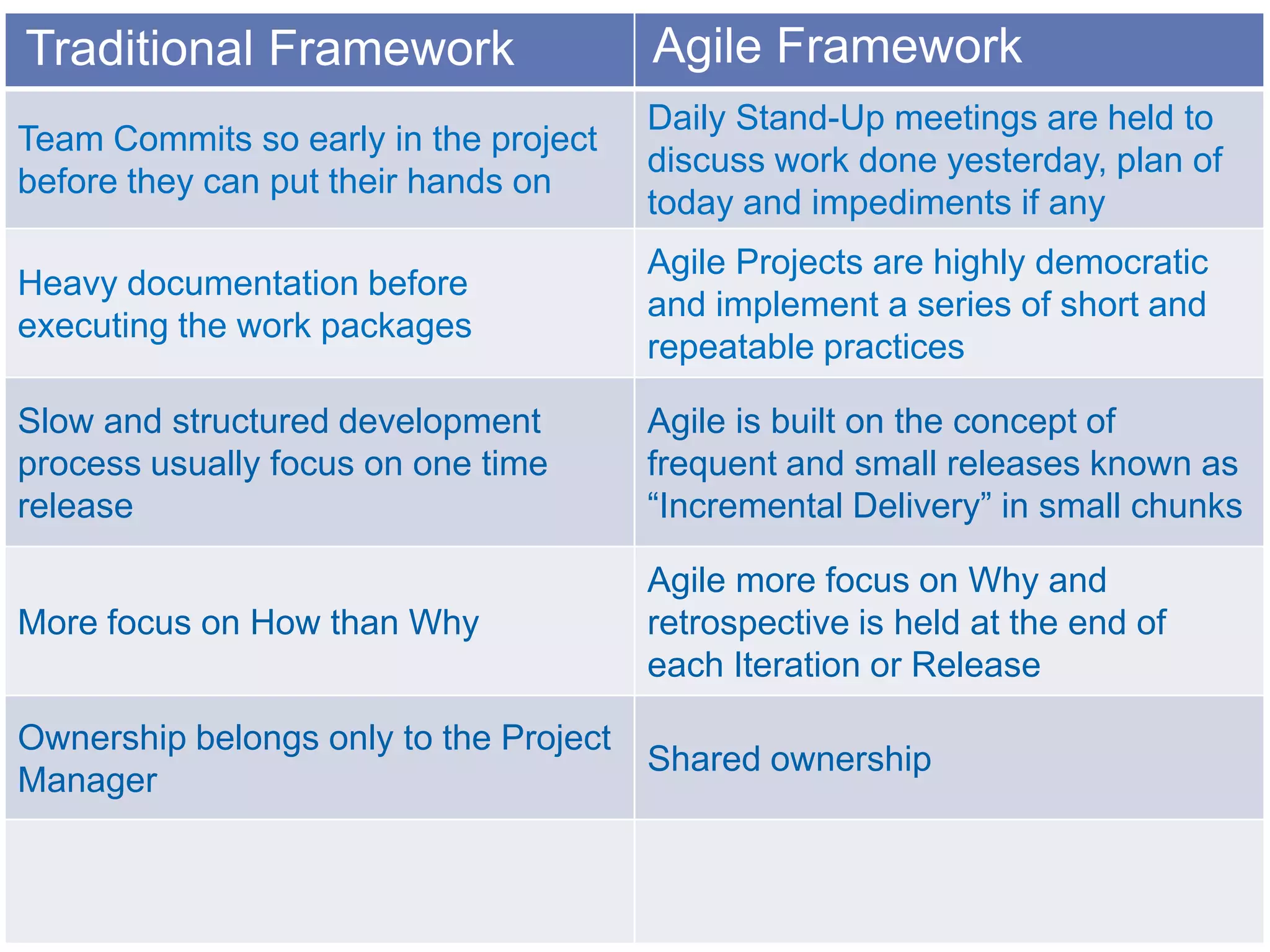
To appreciate the structured flexibility of Agile, it is helpful to compare it against the traditional Waterfall methodology. While Waterfall emphasizes exhaustive upfront planning, Agile emphasizes continuous discovery.
| Feature | Traditional (Waterfall) Plan | Agile (Structured/Flexible) Plan |
|---|---|---|
| Primary Goal | Following a predefined sequence | Delivering maximum value iteratively |
| Requirements | Fixed at the start of the project | Evolving based on feedback |
| Delivery | Single "Big Bang" at the end | Frequent, incremental releases |
| Change Management | Formal, often discouraged | Built-in via backlog refinement |
| Risk Mitigation | Identification at the start | Constant assessment at each iteration |
| Stakeholder Input | High at start/end; low during | Continuous throughout the lifecycle |
| Success Metric | Adherence to timeline and budget | User satisfaction and product quality |
Implementing the Agile Plan: A Step-by-Step Guide
Transitioning to a structured Agile approach requires more than just changing terminology. It requires a shift in mindset and the disciplined application of specific steps.
Step 1: Define the Product Vision
Start by articulating what success looks like. Use tools like the "Elevator Pitch" or "Product Vision Board" to ensure every team member understands the core purpose of the project. In 2026, this vision should also include ethical AI considerations and data privacy standards as foundational pillars.
Step 2: Build and Prioritize the Backlog
Gather requirements from all stakeholders and translate them into user stories. Use a prioritization framework such as MoSCoW (Must have, Should have, Could have, Won't have) or the Kano Model to rank these stories. The goal is to identify the "Must haves" that constitute the MVP.
Step 3: Estimate Effort with Story Points
Avoid estimating in hours, which are often inaccurate. Instead, use story points to measure relative complexity. Techniques like Planning Poker help build team consensus and highlight different perspectives on the difficulty of a task. This estimation provides the data needed for long-term forecasting.
Step 4: Establish the Sprint Cadence
Decide on a sprint length (e.g., two weeks) and stick to it. Consistency creates a "rhythm" for the team, making it easier to measure velocity and plan future work. Each sprint should end with a Sprint Review (to demo work to stakeholders) and a Sprint Retrospective (to improve team processes).
Step 5: Monitor Progress with Visual Tools
Use Kanban boards or Scrum boards to visualize the flow of work. In 2026, these are often augmented by automated dashboards that track lead time and cycle time. Visualizing the plan makes it transparent, allowing anyone to see the project's status at a glance.
Managing Risks and Uncertainty in Agile Planning
One of the greatest misconceptions about Agile is that it lacks a plan for risk. In reality, the iterative nature of Agile is a risk-mitigation strategy in itself. By delivering small increments of work, teams can fail fast and pivot before significant resources are wasted.
Technical Debt and the "Definition of Done"
A common risk in flexible project management is the accumulation of technical debt—taking shortcuts to meet a deadline. A structured Agile plan prevents this through a rigorous Definition of Done (DoD). The DoD is a checklist of quality standards (e.g., code reviews, automated testing, documentation) that every user story must meet before it is considered complete.
Addressing Dependency Management
In large organizations, teams often depend on one another. A structured Agile plan accounts for these dependencies during release planning. Modern project management offices (PMOs) in 2026 use integrated roadmapping tools to identify "red lines" or blockers across different teams, ensuring that flexibility in one department doesn't cause a bottleneck in another.
The Role of AI in Agile Planning (2026 Perspective)
As of 2026, Artificial Intelligence has become an indispensable assistant in Agile project management. AI agents now handle much of the administrative burden of planning, allowing human leaders to focus on strategy and team dynamics.
- Predictive Backlog Grooming: AI tools analyze historical data to suggest story point estimates and identify high-risk items in the backlog before they reach a sprint.
- Automated Resource Allocation: Algorithms can suggest the best team composition based on individual skills and past performance on similar tasks.
- Sentiment Analysis in Retrospectives: Natural Language Processing (NLP) tools can analyze team communication to identify burnout or morale issues, allowing Scrum Masters to intervene early.
- Dynamic Roadmapping: Roadmaps now update automatically based on real-time market data and internal velocity, providing a "living" forecast that is more accurate than any static document.
Common Pitfalls to Avoid
Even with a structured approach, Agile planning can fail if certain traps are not avoided:
- The "Water-Agile-Fall" Hybrid: This occurs when organizations try to wrap a rigid Waterfall budget and timeline around an Agile development team. It creates a "pressure cooker" environment where flexibility is promised but not permitted.
- Ignoring the Retrospective: The retrospective is the most important part of the Agile structure. Skipping it means the team stops learning and improving, leading to stagnant processes and repeated mistakes.
- Product Owner Absence: A successful Agile plan requires a dedicated Product Owner who is empowered to make decisions. Without this role, the team lacks direction and the backlog becomes a disorganized wish list.
- Over-Planning the Future: Trying to plan Sprint 10 while still in Sprint 1 is a waste of effort. The details of future work will likely change based on the outcomes of earlier sprints.
Expert Guidance for Long-Term Success
To truly master an Agile plan, organizations must foster a culture of trust. A structured approach to flexible project management is only effective if team members feel safe reporting failures and suggesting changes. Leaders should move away from "command and control" styles and toward "servant leadership," where their primary role is to remove obstacles and support the team's autonomy.
The Agile Alliance provides extensive resources on the foundational principles that support this culture. Furthermore, for those looking to formalize their approach, the Project Management Institute (PMI) offers guidance on integrating Agile practices into broader organizational frameworks. Consistent education and certification (such as those from Scrum.org) ensure that the entire team speaks the same language and adheres to the same structured standards.
Frequently Asked Questions
How does an Agile plan handle fixed-price contracts? In a fixed-price environment, the Agile plan focuses on "fixed time and budget" while keeping the "scope" flexible. The team commits to delivering the highest priority items within the constraints. This is managed through a transparent, prioritized backlog where the client understands that lower-priority items may be traded off for higher-value ones as the project progresses.
What is the difference between a Product Roadmap and a Release Plan? A Product Roadmap is a high-level strategic document that outlines the long-term direction and major milestones (usually 6-12 months). A Release Plan is more tactical, detailing the specific features and user stories that will be delivered in the next major deployment (usually 2-4 months). The roadmap explains "where we are going," while the release plan explains "what we are delivering next."
Can Agile planning work for non-software projects? Yes. The principles of iterative delivery, feedback loops, and prioritized backlogs are increasingly applied in marketing, human resources, and hardware engineering. The key is to find the "increment"—the smallest piece of valuable work that can be completed and reviewed—regardless of the industry.
How often should an Agile plan be updated? The plan is updated at various frequencies depending on the level. The daily plan is updated every 24 hours. The iteration plan is updated at the start of every sprint (every 1-4 weeks). The release plan and roadmap are typically reviewed monthly or quarterly, depending on the volatility of the market and the project's complexity.
What is the "Definition of Ready" in Agile planning? While the "Definition of Done" ensures quality at the end of a task, the "Definition of Ready" ensures that a user story is sufficiently understood and detailed before it is allowed into a sprint. This prevents the team from starting work on vague tasks that could lead to delays or misunderstandings.
Summary Recommendation
To successfully implement an Agile plan, start by establishing a clear Product Vision and a prioritized Backlog. Adopt a consistent sprint cadence and use velocity data to inform your forecasts. Remember that structure is not the enemy of flexibility; rather, it is the framework that makes sustainable flexibility possible. Regularly engage stakeholders through demos and use retrospectives to refine your process continuously.