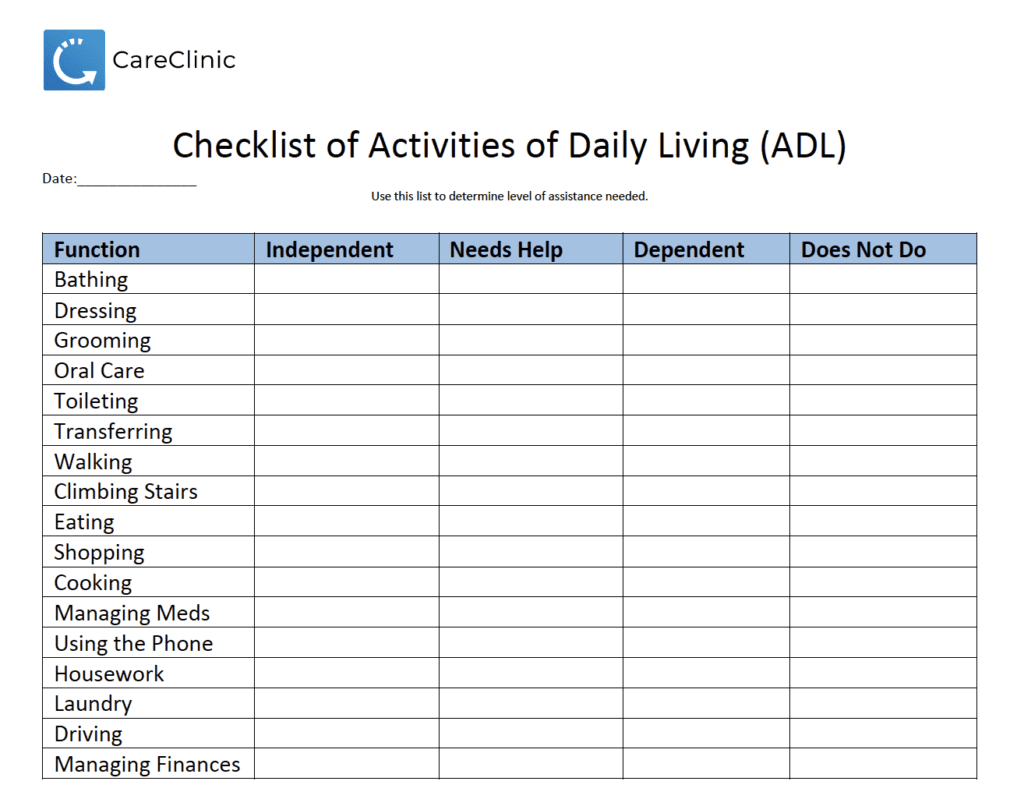
An Activities of Daily Living (ADL) questionnaire is a standardized assessment tool used by healthcare professionals, insurance providers, and caregivers to evaluate an individual's functional status and ability to perform essential self-care tasks independently. These documents, often provided in PDF format for ease of printing and clinical distribution, categorize tasks into basic ADLs, such as bathing and dressing, and instrumental ADLs, which involve more complex cognitive-motor skills like managing finances or preparing meals.
The Purpose of ADL Questionnaires in Clinical Practice
The primary utility of an Activities of Daily Living questionnaire is to quantify the level of support an individual requires to maintain safety and health. By using a standardized PDF form, practitioners ensure that evaluations remain consistent across different patient encounters and healthcare settings.
Clinicians typically use these assessments to determine eligibility for services, track changes in physical or cognitive health over time, and facilitate discharge planning from hospitals or rehabilitation centers. Because the questionnaire is often stored as a PDF, it allows for seamless integration into electronic health record (EHR) systems, where it can be digitized, annotated, or archived for historical tracking.
Basic ADLs (BADLs) vs. Instrumental ADLs (IADLs)
To understand what you will encounter on an ADL assessment form, it is necessary to distinguish between the two primary domains of daily living. These domains provide the backbone of almost every validated ADL questionnaire.
Basic Activities of Daily Living (BADLs)
Basic ADLs are the fundamental skills required to manage one’s own physical needs. They are usually the first to be assessed when determining if a patient can live at home safely without assistance. The standard items in this category include:
- Hygiene and Grooming: The ability to bathe, brush teeth, and maintain personal cleanliness.
- Dressing: The physical capability to select, retrieve, and put on clothing, including the management of fasteners.
- Toileting: The capacity to reach the toilet and perform necessary cleanup.
- Transferring: The ability to move from a bed to a chair or navigate from one room to another.
- Feeding: The ability to move food from a plate to the mouth, though this often excludes the act of meal preparation.
Instrumental Activities of Daily Living (IADLs)
Instrumental ADLs are more complex and require a higher degree of cognitive function and executive control. These tasks are essential for independent living in a community setting but are not necessarily required for basic biological survival. Examples include:
- Meal Preparation: Planning, cooking, and serving meals.
- Financial Management: Balancing checkbooks, paying bills, and managing assets.
- Transportation: Driving, using public transit, or arranging alternative travel.
- Communication: Using a telephone or digital device to reach out for assistance or social interaction.
- Housekeeping: Managing the cleanliness and maintenance of a living environment.
Accessing Validated Questionnaires
When looking for an ADL questionnaire PDF, you should prioritize versions that have been validated by medical research organizations. Common, widely used instruments include the Katz Index of Independence in Activities of Daily Living and the Lawton-Brody IADL Scale.
These forms are widely available through:
- Professional Health Associations: Organizations such as the American Occupational Therapy Association (AOTA) or geriatric care societies often provide professional-grade assessment templates.
- Government Health Agencies: Many national and state departments of health provide public-domain versions of these forms for use in long-term care planning.
- Educational Institutions: Universities with nursing or gerontology programs often host high-quality, research-validated PDF versions of these questionnaires on their public portals.
How to Evaluate and Score the Questionnaire
Most ADL questionnaires use a point-based system or a level-of-assistance scale. Understanding how to interpret these scores is critical to getting an accurate picture of a person’s needs.
Common Scoring Methodologies
- Binary Scoring: The assessor marks "Independent" or "Dependent" for each task. This is the most common format for basic screening.
- Level of Assistance Scale: This approach is more granular, offering categories such as "Independent," "Requires Supervision," "Requires Physical Assistance," or "Totally Dependent."
- Weighted Scoring: Some advanced forms assign higher points to tasks that involve greater safety risks (e.g., toileting and transferring) compared to others.
When using a PDF version, check if the document contains a scoring key at the bottom or an attached instructions page. A scoring key is essential because it translates raw data points into actionable insights, such as "low dependency," "moderate dependency," or "high dependency," which are often required for insurance and government aid applications.
Comparison of Assessment Tools
The table below outlines common ADL assessment tools often found in PDF formats and their specific focus areas.
| Assessment Tool | Primary Focus | Ideal For |
|---|---|---|
| Katz Index | Basic ADLs | Evaluating elderly patients for physical decline. |
| Lawton-Brody Scale | IADLs | Assessing cognitive and community-living capacity. |
| Barthel Index | Mobility & Self-care | Tracking recovery progress in stroke patients. |
| Functional Independence Measure (FIM) | Comprehensive | High-level clinical and rehabilitation monitoring. |
Prerequisites and Best Practices for Implementation
Before administering or completing an ADL questionnaire, certain conditions must be met to ensure the results are reliable.
- Contextual Awareness: The person being assessed should be evaluated in their natural environment, such as their home or their usual living space, rather than a sterile clinical setting, if possible.
- Observer Neutrality: If the form is being completed by a caregiver, they should be instructed to report on observations rather than their subjective feelings about the patient's condition.
- Frequency of Re-evaluation: An ADL questionnaire is not a one-time task. Health status can fluctuate, particularly following an acute injury, illness, or surgery. Standard clinical guidelines suggest re-evaluating every six months or whenever there is a significant change in the individual's baseline health.
Common Mistakes to Avoid
When printing or filling out these PDF forms, several common errors can undermine the effectiveness of the assessment:
- Assuming Capacity Based on Past Performance: A patient might have been able to dress themselves last month, but an assessment must focus strictly on their current capability.
- Ignoring Environmental Barriers: A person might be "independent" in a bedroom with handrails but "dependent" in a bedroom that lacks them. The questionnaire should ideally account for the environment or assume a standardized environment.
- Failing to Verify Cognitive Factors: An individual might be physically capable of performing a task (e.g., cooking) but cognitively unable to do so safely (e.g., turning off the stove). Failing to distinguish between physical and cognitive limitations is a common failure in generic ADL forms.
Legal and Insurance Considerations
In 2026, many insurance carriers and long-term care insurance providers require an official ADL assessment to trigger benefits. When using an ADL questionnaire PDF for insurance purposes, ensure that it contains the necessary fields for the assessor’s credentials, the date of the assessment, and the signature of a licensed professional.
Generic questionnaires found online may not be accepted by insurance companies for the purposes of policy claims. Always check with the specific provider to see if they supply their own proprietary form, as insurance-specific versions often include additional sections related to policy definitions of "benefit triggers" and "eligibility for coverage."
Safety and Professional Limitations
It is crucial to recognize that an ADL questionnaire is a screening tool, not a diagnostic medical test. While it can identify functional gaps, it cannot determine the underlying medical cause of a decline. If a questionnaire reveals that an individual has a sudden loss of ability in multiple ADLs, this is a "red flag" that should trigger an immediate consultation with a primary care physician or a geriatric specialist.
Furthermore, these forms are not intended to replace professional judgment. A patient may score as "independent" on a paper form while still exhibiting high-risk behaviors that require oversight. Always supplement the findings of a questionnaire with direct physical observation and consultation with the individual's care team.
Frequently Asked Questions
Can I complete an ADL questionnaire by myself? Yes, self-assessment versions exist, but they are often less reliable than objective assessments conducted by a third-party caregiver or healthcare provider. Self-reports can be subject to bias, as patients may overstate their abilities to maintain a sense of independence or understate them to obtain needed support.
Are these PDF questionnaires legally binding? Usually, no. However, when submitted to insurance companies or government agencies as part of a formal application for aid, the information provided becomes part of a legal record. Providing false information on these forms can lead to the denial of benefits or legal repercussions.
What should I do if the score indicates a need for help? If an assessment highlights significant functional deficits, your next step should be to contact the individual's primary healthcare provider to discuss the findings. They can provide a referral to an occupational therapist or a case manager who can help develop a formal plan of care.
Why are there different versions of ADL questionnaires? Different versions are designed for different clinical goals. For instance, the Katz index is focused on basic survival tasks for the elderly, while the FIM is designed for complex, inpatient rehabilitation environments. Choosing the right tool depends on whether you are conducting a simple home health screening or a complex medical outcome study.
How do I ensure the PDF I found is legitimate? Look for the source of the document. If it is hosted on a government URL (ending in .gov) or the website of a reputable medical institution or university, it is likely a standard, accepted instrument. Avoid downloading PDFs from random file-hosting sites or forums that do not provide clear authorship or references to clinical literature.
Does an ADL questionnaire cover mental health? While ADL forms often touch upon cognitive elements (like the ability to manage finances), they are primarily focused on physical function. Mental health assessments, such as those for depression or anxiety, usually require separate, dedicated clinical tools.
Next Steps for Implementation
If you are currently evaluating an individual's need for assistance, start by selecting a widely recognized, validated questionnaire like the Katz Index or the Lawton-Brody scale. Print the document and perform the assessment in the subject's normal living environment.
Once completed, summarize the areas of difficulty—not just the numerical score. The "Why" behind the inability to perform a task is often more valuable for future care planning than the score itself. If you find consistent patterns of dependency, schedule a follow-up appointment with a healthcare professional to review your findings and discuss long-term support resources, such as home health assistance or occupational therapy.