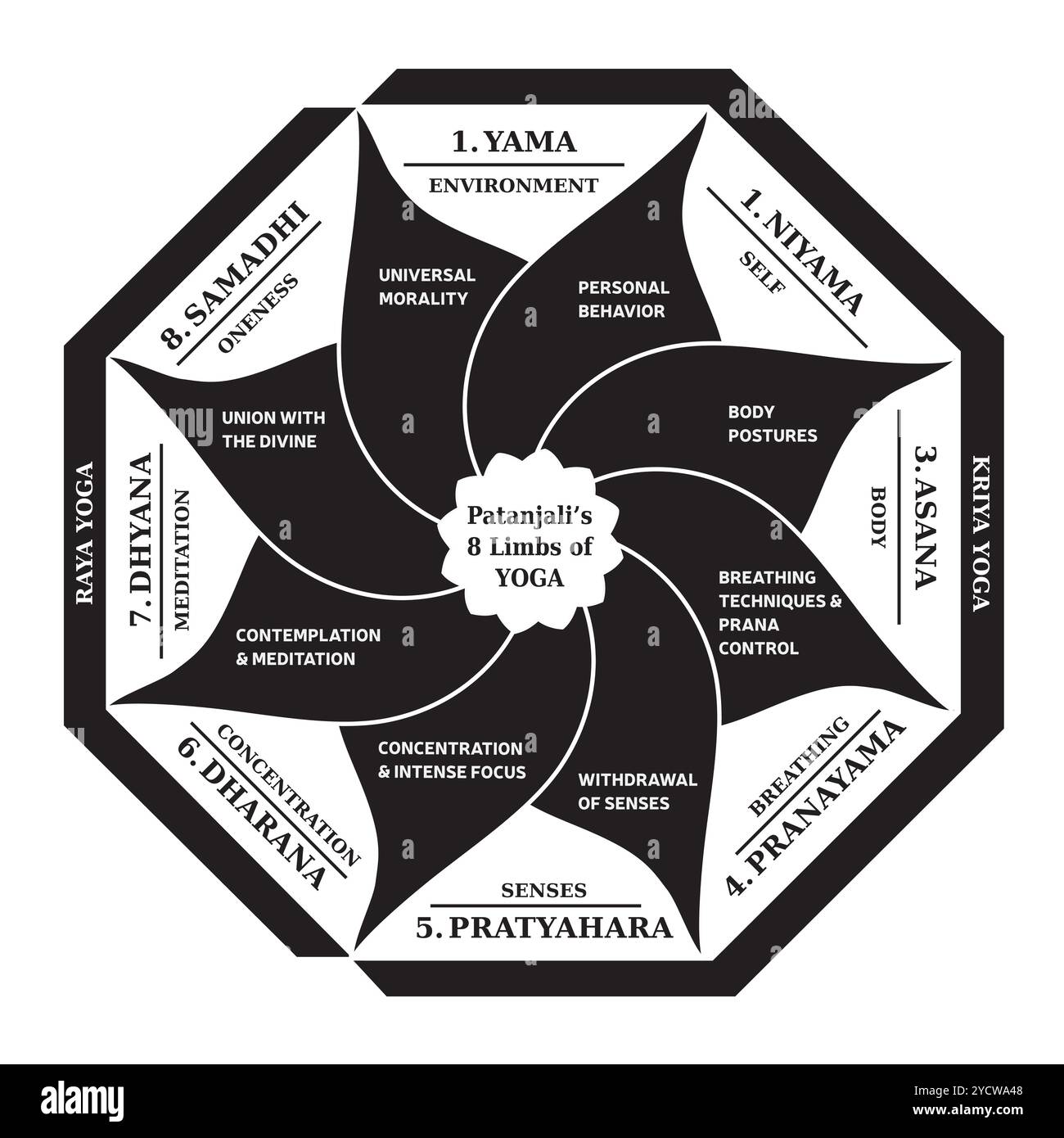
The Eight Limbs of Yoga, or Ashtanga, constitute a holistic roadmap for ethical living, mental discipline, and spiritual realization. Codified by the sage Patanjali in the Yoga Sutras approximately 2,000 years ago, this framework guides practitioners from external behavioral restraints to the deepest states of internal meditative absorption and self-realization.
While modern yoga is frequently associated exclusively with physical postures (asana), the 8-limb system clarifies that physical practice is only one stage of a much larger journey. In 2026, as mental health and holistic wellness have become central to global healthcare, understanding the 8 limbs is essential for anyone seeking a stable, integrated life. This guide serves as a foundational text for those seeking an "8 limbs of yoga pdf" or study resource to deepen their practice.
The Origins and Purpose of the Eight Limbs
The system of the eight limbs was first detailed in the Yoga Sutras of Patanjali. This text is one of the most important pillars of classical yoga philosophy. Patanjali did not "invent" yoga; rather, he systematized existing practices and oral traditions into 196 succinct aphorisms (sutras).
The Sanskrit term Ashtanga literally translates to "eight limbs" (ashta = eight, anga = limb). It is important to distinguish this from the modern "Ashtanga Vinyasa Yoga" brand; the latter is a specific style of physical yoga, whereas the former refers to the philosophical framework. The purpose of these limbs is to provide a path to Kaivalya—liberation or independence of the soul from the fluctuations of the mind.
The Sequential Nature of the Path
Patanjali organized the limbs in a logical progression. The first five limbs are considered Bahiranga (external) practices, focusing on our relationship with the world and our physical bodies. The final three limbs are Antaranga (internal) practices, dealing with the refinement of the mind and consciousness.
1. The Yamas: Universal Morality and Social Ethics
The first limb, Yama, consists of five ethical restraints. These are not meant as "commandments" but as a means to harmonize our relationship with the external world. By practicing the Yamas, we reduce external friction and mental agitation.
Ahimsa (Non-violence)
Ahimsa is the foundation of all yoga. It implies non-harming in thought, word, and deed. In 2026, this extends to digital interactions, environmental consciousness, and, most importantly, the way we speak to ourselves. Practicing Ahimsa means cultivating compassion and letting go of the judgment that creates internal and external conflict.
Satya (Truthfulness)
Satya involves being truthful in our communication and honest with ourselves. However, Patanjali suggests that Satya must be tempered by Ahimsa; if a truth causes unnecessary harm, one must consider the most compassionate way to proceed. It is about aligning our actions with our deepest integrity.
Asteya (Non-stealing)
While it literally means not taking what isn't ours, Asteya also refers to not "stealing" time from others, not taking credit for others' work, and not consuming more than our fair share of resources. It is the antidote to the "scarcity mindset."
Brahmacharya (Right Use of Energy)
Traditionally interpreted as celibacy, modern practitioners often view Brahmacharya as the moderation of all sensual pleasures. It is about directing our vital energy toward higher purposes rather than dissipating it through overindulgence or obsession with sensory gratification.
Aparigraha (Non-greed or Non-attachment)
Aparigraha is the practice of letting go. It encourages us to take only what we need and to avoid the accumulation of unnecessary possessions or emotional baggage. It challenges the "more is better" philosophy prevalent in modern consumer culture.
2. The Niyamas: Personal Observances and Self-Discipline
If the Yamas are about how we treat others, the Niyamas are about how we treat ourselves. These five practices build the internal character necessary for deep meditation.
Saucha (Purity)
Saucha involves both physical cleanliness and mental clarity. It refers to keeping our bodies healthy, our environments organized, and our minds clear of toxic thoughts. In 2026, "digital saucha"—the intentional curation of the information we consume—has become a critical aspect of this practice.
Santosha (Contentment)
Santosha is the practice of being at peace with what we have and where we are. It is not a passive state but a radical acceptance that our happiness is not dependent on external circumstances. It is the practice of finding gratitude in the present moment.
Tapas (Discipline or Heat)
Tapas refers to the "burning" desire to achieve a goal. It is the self-discipline required to maintain a consistent practice. It is the "heat" generated by effort that purifies the body and mind, helping us break through old habits and patterns.
Svadhyaya (Self-Study)
Svadhyaya is the study of sacred texts and, more importantly, the study of the self. Through reflection, journaling, and observation, we learn about our triggers, motivations, and the nature of our ego.
Ishvara Pranidhana (Surrender to a Higher Power)
This Niyama involves surrendering the fruits of our labor to something larger than ourselves. Whether one defines this as God, the Universe, or the Collective Consciousness, it is the practice of letting go of the ego’s need for control.
3. Asana: The Physical Posture
The third limb, Asana, is the most recognized in the West. In Patanjali’s time, Asana referred almost exclusively to a steady, comfortable seat for meditation. The Yoga Sutras state that a posture should be sthira (steady) and sukha (comfortable).
The evolution of Hatha Yoga later expanded Asana into the complex physical practices we see today. However, the ultimate goal remains the same: to create a body that is strong, flexible, and free of pain so that it does not distract the mind during meditation. According to the National Center for Complementary and Integrative Health, the physical practice of yoga (Asana) is highly effective for stress management and physical rehabilitation, which serves as a gateway to the deeper limbs.
4. Pranayama: Control of the Breath
Pranayama is the regulation of the breath to control the "Prana," or life-force energy. By manipulating the rhythm of inhalation, exhalation, and retention, we can directly influence the autonomic nervous system.
Pranayama acts as a bridge between the body and the mind. Scientific studies have shown that specific breathing techniques can lower cortisol levels and improve heart rate variability (HRV). For a practitioner using an "8 limbs of yoga pdf" as a study guide, Pranayama is often the first step in learning how to quiet the "monkey mind" before attempting seated meditation.
5. Pratyahara: Withdrawal of the Senses
The fifth limb, Pratyahara, marks the transition from external to internal yoga. It involves turning our attention away from the external world and sensory inputs.
In the hyper-connected world of 2026, Pratyahara is arguably the most difficult limb to master. It is not about "turning off" the senses, but rather about changing our relationship with sensory stimuli so they no longer disturb our inner peace. By practicing Pratyahara, we stop reacting to every sound, smell, or notification, allowing the mind to turn inward.
6. Dharana: Concentration
Once the senses are quieted, we can practice Dharana, which is the act of focusing the mind on a single point. This point could be the breath, a mantra, a candle flame, or a visualization.
Dharana is the "effortful" stage of meditation. The mind will inevitably wander; the practice of Dharana is the act of repeatedly and gently bringing it back to the object of focus. This limb strengthens the "mental muscle" required for the deeper states of consciousness that follow.
7. Dhyana: Meditation
While Dharana is the act of concentrating, Dhyana is the state of being concentrated. It is an uninterrupted flow of awareness toward the object of meditation.
In Dhyana, the distinction between the observer and the object begins to blur. It is often described as "effortless focus." If Dharana is like individual drops of water falling, Dhyana is like a steady stream of oil flowing without interruption. This state leads to profound mental clarity and emotional stability.
8. Samadhi: Absorption and Liberation
The final limb is Samadhi, a state of profound bliss and absorption. In Samadhi, the practitioner’s consciousness merges with the object of meditation and the Universe as a whole. The ego—the sense of "I"—dissolves.
Samadhi is not a permanent state for most, but rather a peak experience that provides a glimpse into the true nature of reality. It is the ultimate goal of the 8-limbed path: a state of total freedom, peace, and enlightenment.
Comparative Overview of the 8 Limbs
The following table provides a quick-reference summary of the limbs, which is often a central feature of any high-quality "8 limbs of yoga pdf" or study guide.
| Limb Number | Sanskrit Name | English Meaning | Primary Focus | Practical 2026 Application |
|---|---|---|---|---|
| 1 | Yama | Restraints | Social Ethics | Digital integrity and ethical consumption. |
| 2 | Niyama | Observances | Self-Discipline | Personal hygiene and mental "unplugging." |
| 3 | Asana | Posture | Physical Health | Counteracting sedentary "tech-neck" and desk fatigue. |
| 4 | Pranayama | Breath Control | Energy Regulation | Using breath to manage workplace anxiety. |
| 5 | Pratyahara | Sense Withdrawal | Internalization | Taking "silent breaks" from social media and noise. |
| 6 | Dharana | Concentration | Mental Focus | Deep work and single-tasking without distraction. |
| 7 | Dhyana | Meditation | Flow State | Achieving sustained focus in creative or spiritual tasks. |
| 8 | Samadhi | Absorption | Spiritual Unity | Experiencing connection beyond the individual ego. |
Why Practitioners Search for an 8 Limbs of Yoga PDF
Students of yoga often seek a PDF version of this information for several practical reasons:
- Sequencing and Study: The 8 limbs are complex. Having a downloadable document allows students to print a "cheat sheet" to place near their yoga mat or in their journals for daily reflection.
- Teacher Training: Most 200-hour and 500-hour Yoga Teacher Training (YTT) programs require a deep dive into the Yoga Sutras. A structured PDF serves as a vital study aid for exams and teaching preparation.
- Off-the-Mat Practice: Since most of the limbs (Yamas, Niyamas, etc.) are practiced away from a yoga studio, a portable guide helps practitioners remember to apply these principles during their workday or in their relationships.
When looking for a reliable "8 limbs of yoga pdf," ensure the source is an established yoga institute or a recognized scholar of Sanskrit. Reputable organizations like the Himalayan Institute or the International Association of Yoga Therapists (IAYT) often provide academic-grade resources.
Integrating the 8 Limbs into Daily Life
The transition from theory to practice is where the real benefit of the 8 limbs lies. In 2026, we see a shift away from "performative yoga" toward "integrated yoga."
Start with the Yamas and Niyamas
It is a common mistake to think one must master Asana before moving on. In reality, the Yamas and Niyamas can be practiced by anyone, regardless of physical ability. Choosing to speak kindly (Ahimsa) or being content with your current progress (Santosha) is practicing yoga in its truest sense.
Consistency Over Intensity
Patanjali emphasizes Abhyasa (consistent practice over a long period) and Vairagya (non-attachment to the results). Whether you have five minutes for Pranayama or an hour for Asana, the regularity of the practice is what transforms the nervous system.
Avoiding "Spiritual Bypassing"
A comprehensive PDF guide should also note the importance of staying grounded. The 8 limbs are not a way to escape reality but a way to engage with it more clearly. Using meditation to ignore real-world problems is known as spiritual bypassing. The limbs are designed to give you the strength to face those problems with a calm and steady mind.
Common Obstacles (The Kleshas)
Patanjali also identified the "Kleshas," or mental colorings, that prevent us from progressing through the 8 limbs. These include ignorance (Avidya), egoism (Asmita), attachment (Raga), aversion (Dvesha), and fear of death (Abhinivesha). Recognizing these obstacles is a key part of Svadhyaya (self-study).
Frequently Asked Questions
Do I have to practice the 8 limbs in order?
While Patanjali presented them in a logical sequence from external to internal, they are often practiced simultaneously. For example, your physical practice (Asana) is enhanced by your breath (Pranayama) and your ethical intention (Yama). Think of them as limbs of a tree that grow together, rather than steps on a ladder.
Is the 8-limbed path a religion?
No. While it has roots in Indian philosophy and shares some terminology with Hinduism and Buddhism, the 8 limbs are a philosophical and psychological framework. People of all faiths (or no faith) practice the 8 limbs to improve their mental clarity and ethical conduct.
Why is Samadhi so difficult to reach?
Samadhi is considered a state of grace that comes after years of dedicated practice. In modern terms, it can be compared to the ultimate "flow state," where the self disappears into the task or moment. While full Samadhi is rare, the preceding limbs provide significant benefits to mental and physical health long before that stage is reached.
Can I find a free 8 limbs of yoga pdf online?
Yes, many yoga schools and educational websites offer free summaries. When downloading, prioritize versions that include the original Sanskrit terms alongside English translations to ensure you are getting the most accurate representation of the Yoga Sutras.
Next Actions for Your Practice
To move beyond the theoretical understanding of the 8 limbs, consider selecting one Yama or Niyama to focus on each week. Keep a journal of how practicing Satya (truthfulness) or Aparigraha (non-attachment) changes your interactions with others. If you are looking for a physical resource, you can create your own "8 limbs of yoga pdf" by summarizing these sections into a personal manifesto that resonates with your 2026 lifestyle goals.
For those serious about the philosophical study, reading a direct translation of the Yoga Sutras with commentary—such as those by Swami Satchidananda or B.K.S. Iyengar—is the next logical step in the journey toward mastery.