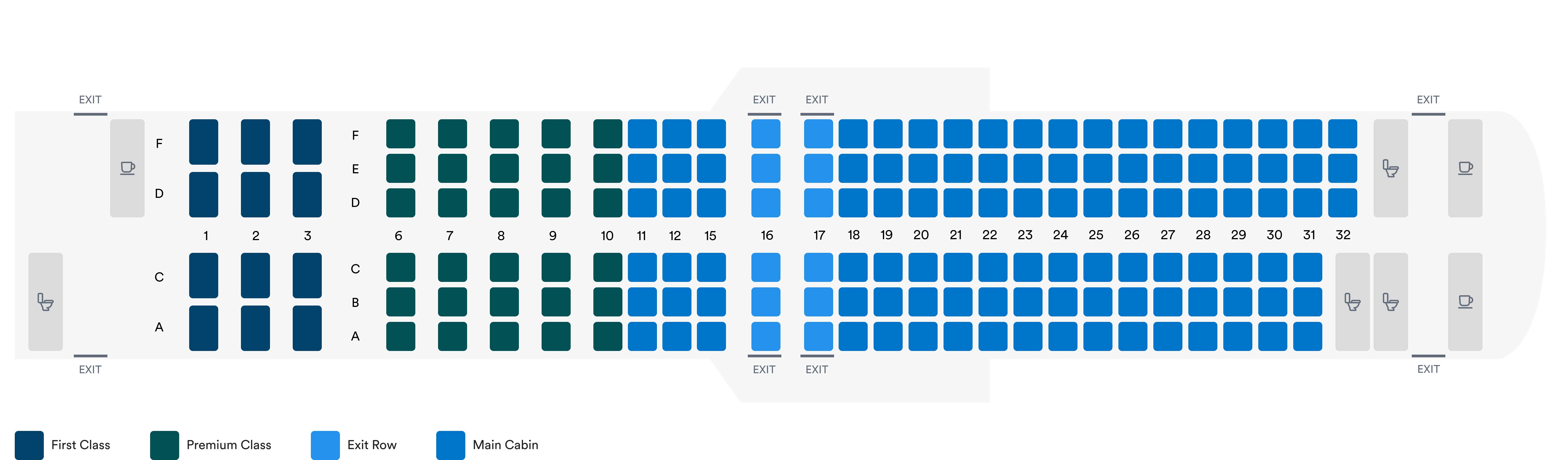
The Alaska Airlines Boeing 737-800 seat map typically features a 159-seat configuration divided into three distinct sections: 12 First Class seats, 30 Premium Class seats, and 117 Main Cabin seats. To maximize comfort, passengers should prioritize Row 17 for extra legroom with full recline or Row 6 for the best Premium Class bulkhead experience.
The Boeing 737-800 remains a cornerstone of the Alaska Airlines fleet in 2026. While newer MAX models have entered service, the -800 series has undergone significant interior retrofitting to ensure a consistent passenger experience. Understanding the nuances of the seat map is essential for any traveler looking to balance cost, comfort, and productivity. This guide analyzes the seven most critical details of the Alaska Airlines 737-800 layout, providing technical insights into seat dimensions, amenities, and strategic selection.
1. The Tri-Class Configuration and Total Capacity
In 2026, the standardized layout for the Alaska Airlines 737-800 focuses on a high-efficiency, three-cabin model. The aircraft is designed to accommodate 159 passengers, a number that strikes a balance between airline profitability and passenger personal space.
The division of the cabin is as follows:
- First Class (Rows 1–3): 12 seats in a 2-2 configuration.
- Premium Class (Rows 6–10): 30 seats in a 3-3 configuration.
- Main Cabin (Rows 11–31): 117 seats in a 3-3 configuration.
This configuration is the result of Alaska’s commitment to a unified fleet experience. The 737-800 utilizes Recaro slimline seats, which are engineered to maximize knee room. By using a thinner backrest, the airline can maintain a standard pitch while providing the feeling of more space. However, travelers should note that "pitch" (the distance from one point on a seat to the same point on the seat in front) is not the same as "legroom" (the actual space available for your limbs). On the -800, the slimline design effectively adds about an inch of perceived legroom compared to older, thicker seat models.
2. First Class Nuances: Rows 1 Through 3
The First Class cabin on the 737-800 offers a 40-inch pitch and a seat width of approximately 21 inches. While these dimensions are generous compared to the back of the plane, not all First Class seats are created equal.
Row 1 is the bulkhead row. While it offers the advantage of no one reclining into your space, it has two significant drawbacks. First, there is no floor storage during takeoff and landing; all personal items must go into the overhead bins. Second, the bulkhead wall can actually restrict full leg extension for taller passengers compared to the space under the seat in front of Rows 2 and 3.
Rows 2 and 3 are often preferred by frequent flyers. Row 3, however, is located directly in front of the Premium Class section, separated only by a soft curtain divider. This proximity can sometimes lead to increased noise or light bleed from the main cabin. In terms of hardware, these seats feature custom-designed footrests and a "tablet groove" in the tray table, reflecting Alaska’s "Bring Your Own Device" (BYOD) entertainment philosophy.
3. Premium Class Value Proposition (Rows 6–10)
Premium Class is not a separate "cabin" in terms of physical walls, but it offers a significantly upgraded experience within the economy section. On the 737-800, Premium Class spans Rows 6 through 10.
The primary technical draw here is the 35-inch pitch. This represents a 4-to-5-inch increase over the standard Main Cabin seating. For a business traveler in 2026, this extra space is the difference between being able to fully open a 14-inch laptop and having the screen tilted at an awkward angle.
Row 6 is the bulkhead row for the economy cabin. Like Row 1, it lacks under-seat storage but offers the most "open" feel in the aircraft. One detail often overlooked is that the tray tables in Row 6 are tucked into the armrests, which makes the armrests immovable and slightly reduces the effective seat width. If you prefer a wider-feeling seat, Rows 7 through 10 are better options as they feature standard moveable armrests.
4. Main Cabin Dynamics and Row 11
The Main Cabin (Rows 11–31) features a 31-to-32-inch pitch and a 17-inch seat width. While these are industry-standard dimensions, the 737-800 seat map contains specific "trap" seats and "gem" seats that travelers should recognize.
Row 11 is the first row of the standard Main Cabin, located immediately behind Premium Class. There is no physical barrier between Row 10 and Row 11, meaning that if the passenger in 10 reclines, they are utilizing the space you paid less for.
Conversely, the very last row (Row 31) is generally considered the least desirable. On many Alaska 737-800 configurations, Row 31 has restricted recline due to the rear galley wall and is located directly adjacent to the lavatories. This leads to high foot traffic and potential odor issues. Furthermore, the 737-800 engine noise is more pronounced in the rear of the cabin, making Row 31 the loudest section of the aircraft.
5. Strategic Exit Row Seating: Rows 16 and 17
For those who want Premium Class legroom without the Premium Class price tag, the exit rows are the target. On the Alaska 737-800, these are Rows 16 and 17.
There is a major technical difference between these two rows:
- Row 16: These seats have extra legroom but do not recline. This is a safety requirement to ensure the exit path to the overwing doors remains clear at all times.
- Row 17: These seats offer the same extra legroom (roughly 38–39 inches of pitch) and they do recline.
Because Row 17 reclines into the space of Row 18 (a standard Main Cabin row), it is widely considered the best value on the entire plane. However, passengers in exit rows must meet FAA requirements, including being at least 15 years old and having the physical capability to assist in an emergency. The FAA provides specific guidelines on exit row eligibility that Alaska Airlines strictly enforces during the boarding process.
6. Connectivity and Power Specifications
By 2026, Alaska Airlines has finalized the transition to high-speed satellite Wi-Fi across its 737-800 fleet. The seat map is designed to support a "connected office" environment.
Every seat on the 737-800—from First Class to the last row of the Main Cabin—is equipped with:
- AC Power Outlets: Located between seats (one per person in First, two outlets for every three seats in Economy).
- USB-C Charging Ports: Most retrofitted -800s now feature USB-C ports integrated into the seatback or the power brick, providing faster charging for modern smartphones and tablets.
The placement of these outlets is a key detail. In the Main Cabin, the power outlets are located beneath the seat cushion. This can be difficult to reach mid-flight. Expert travelers often plug in their chargers before the person in front of them reclines, as the recline mechanism can sometimes block easy access to the outlet.
7. The Boeing Sky Interior and Storage
While the 737-800 is an older airframe than the MAX, many of Alaska's units have been updated with the "Boeing Sky Interior." This detail is reflected in the seat map through the availability of "Space Bins."
These larger overhead bins allow bags to be loaded on their sides rather than flat. Technically, this increases the overhead capacity by nearly 50%, which is crucial for a 159-passenger aircraft where nearly everyone brings a carry-on. If you are seated in the back of the plane (Rows 25–31), you may find that bin space fills up faster because flight attendants often store emergency equipment in the rear overhead compartments.
The lighting in the Sky Interior also changes throughout the flight (e.g., warm amber for boarding, cool blue for cruising), which helps reduce jet lag—a subtle but important detail for those on long-haul transcontinental routes like Seattle to New York.
Alaska Airlines 737-800 Seating Comparison Table
| Feature | First Class | Premium Class | Main Cabin |
|---|---|---|---|
| Seat Pitch | 40 inches | 35 inches | 31–32 inches |
| Seat Width | 21 inches | 17 inches | 17 inches |
| Configuration | 2-2 | 3-3 | 3-3 |
| Recline | Maximum | Increased | Standard |
| Power Outlets | 1 per seat | Shared (2 per 3) | Shared (2 per 3) |
| In-Flight Food | Included Meal | Included Snacks | For Purchase |
| Beverages | Full Bar | Beer/Wine/Cocktails | Soft Drinks/Coffee |
| Boarding Group | Group A | Group B | Groups C–E |
Frequently Asked Questions
Which seats on the Alaska 737-800 have no windows?
On the Boeing 737-800, there is occasionally a "missing window" or a misaligned window due to the placement of air conditioning risers within the fuselage. This typically occurs around Row 11 or 12. If a window view is paramount, it is advisable to check the specific aircraft tail number on tracking sites, though Row 9 and Row 15 are generally safe bets for clear, unobstructed views.
Is the Wi-Fi on the 737-800 fast enough for video calls?
While Alaska's satellite-based Wi-Fi in 2026 is significantly faster than legacy systems, the airline generally discourages or blocks Voice over IP (VoIP) services like Zoom or FaceTime to maintain a quiet cabin environment. The bandwidth is typically sufficient for streaming HD video via Netflix or YouTube, but latency can still be an issue for high-intensity gaming or professional video conferencing.
How does Premium Class boarding work on the 737-800?
Premium Class passengers are assigned to Group B. This allows you to board immediately after First Class and Million Miler/MVP Gold 75k members. This is a critical detail for the 737-800 because it ensures you have first access to the overhead "Space Bins" in the front of the economy cabin before the Main Cabin groups (C, D, and E) begin boarding.
Are there any seats with restricted width?
Yes, any seat in a bulkhead row (Rows 1 and 6) or the exit rows (Rows 16 and 17) may have slightly restricted width. This is because the tray tables or safety equipment are often housed inside the armrests, making them immovable and thicker than standard armrests. For passengers who value every fraction of an inch in seat width, a standard aisle seat in Row 7 or 8 is often a better choice.
Does Alaska Airlines offer seatback screens on the 737-800?
No. Alaska Airlines intentionally removed seatback screens years ago in favor of a personal device entertainment system. The 737-800 seat map features "tablet holders" integrated into the seatbacks of the Recaro seats. Passengers are expected to use their own smartphones, tablets, or laptops to connect to the "Alaska Beyond Entertainment" portal, which offers hundreds of free movies and TV shows.
Strategic Recommendation
For the best overall experience on the Alaska Airlines 737-800, aim for Seat 17C or 17D. These aisle seats in the second exit row provide the maximum possible legroom in the economy cabin, allow for full recline, and offer quick access to the aisle for deplaning. If you are traveling for business and need to work, the $30–$80 upgrade to Premium Class (Rows 6–10) is objectively worth the cost for the guaranteed 35-inch pitch and early boarding, ensuring your laptop and carry-on are always within reach. Avoid Row 31 at all costs due to the proximity to the lavatories and the lack of seat recline.