The fastest official 3x3 Rubik's Cube single solve is 3.13 seconds, a record set by Max Park at the Pride in Long Beach 2023 competition. As of 2026, this achievement remains the benchmark for human speed, supported by the World Cube Association (WCA). Speedcubers reach these velocities through a combination of the CFOP method, advanced magnetic hardware, and frame-perfect fingertricks.
The Evolution of the 3x3 World Record
The journey to a sub-4-second solve has been decades in the making. When the first Rubik's Cube World Championship was held in 1982, Minh Thai won with a time of 22.95 seconds. At that time, the cubes were friction-heavy, non-adjustable, and prone to "locking up." The transition from over 20 seconds to nearly 3 seconds is not merely a testament to human dexterity but also to the massive leaps in mathematical optimization and mechanical engineering.
Following the 1980s, speedcubing entered a dormant phase before exploding in the early 2000s with the formation of the World Cube Association (WCA). Legends like Feliks Zemdegs pushed the boundaries of what was thought possible, breaking dozens of world records and proving that "sub-10" and "sub-5" were achievable milestones. Max Park’s 3.13-second solve in 2023 shattered the previous 3.47-second record held by Yusheng Du, a record that many thought would stand for much longer.
In 2026, the competitive landscape is tighter than ever. While the single-solve record captures headlines, the "Average of 5" record is often considered a better measure of a cuber’s true skill. This involves performing five solves, removing the fastest and slowest, and averaging the remaining three. Records in this category have dipped consistently into the low 4-second range, with prodigies like Yiheng Wang setting unprecedented standards for consistency.
The Four Pillars of the Fastest Solves
To understand how a human can solve a 3x3 in under four seconds, we must look at the four critical components that make such speed possible: the method, the hardware, the technical execution, and the cognitive processing.
1. The Dominant Solving Methods
The vast majority of world-class speedcubers use the CFOP method, also known as the Fridrich Method. It is an acronym for Cross, F2L (First Two Layers), OLL (Orientation of the Last Layer), and PLL (Permutation of the Last Layer).
- The Cross: The solver builds a cross on one face (usually white or yellow). Elite cubers do this in under 8 moves and generally in less than 0.5 seconds. They plan the entire cross during the 15-second inspection period.
- F2L (First Two Layers): This is the most critical phase for speed. Instead of solving the corners and then the edges, cubers pair them up and insert them into "slots" simultaneously. There are 41 basic cases, but pros use hundreds of variations to avoid rotating the cube, a technique known as "rotationless F2L."
- OLL (Orientation of the Last Layer): This step involves making the entire top face one color. There are 57 standard algorithms for this.
- PLL (Permutation of the Last Layer): The final step involves moving the pieces on the top layer to their correct positions. There are 21 standard algorithms.
While CFOP is the most popular, the Roux method is a powerful alternative. Roux uses fewer moves on average (roughly 45-50 compared to CFOP’s 55-60) and focuses on "block building" and "Last Six Edges" (LSE). Because Roux relies heavily on M (middle) slice moves, it can be incredibly fast for cubers with high M-move proficiency.
2. High-Performance Hardware
In 2026, the technology inside a Rubik's Cube is closer to a high-performance vehicle than a toy. "Speedcubes" differ from the original 1980s models in several key ways:
- Magnetic Positioning: Modern cubes use neodymium magnets in the pieces to "snap" the layers into alignment. This prevents overshooting and allows for much higher turning speeds.
- MagLev Technology: Many flagship cubes replace traditional metal springs with opposing magnets. This reduces friction and noise, making the cube feel effortless to turn.
- Ball-Core Systems: By placing magnets in the core and the base of the pieces, manufacturers create "omnidirectional" attraction, providing stability that was impossible ten years ago.
- Corner Cutting: A high-end speedcube can execute a turn even if the layers are misaligned by up to 45 degrees. The internal geometry is rounded to allow pieces to slide past each other without catching.
Brands like GAN, MoYu, and QiYi dominate the market. Solvers often customize their cubes with different lubricant viscosities to achieve a specific "feel"—either "crunchy" and fast or "gummy" and controllable.
3. Technical Execution: Fingertricks and TPS
"Turns Per Second" (TPS) is a vital metric in speedcubing. To achieve a 3.13-second solve, a cuber must maintain a TPS of roughly 10 to 12. This means their fingers are moving faster than the human eye can easily track.
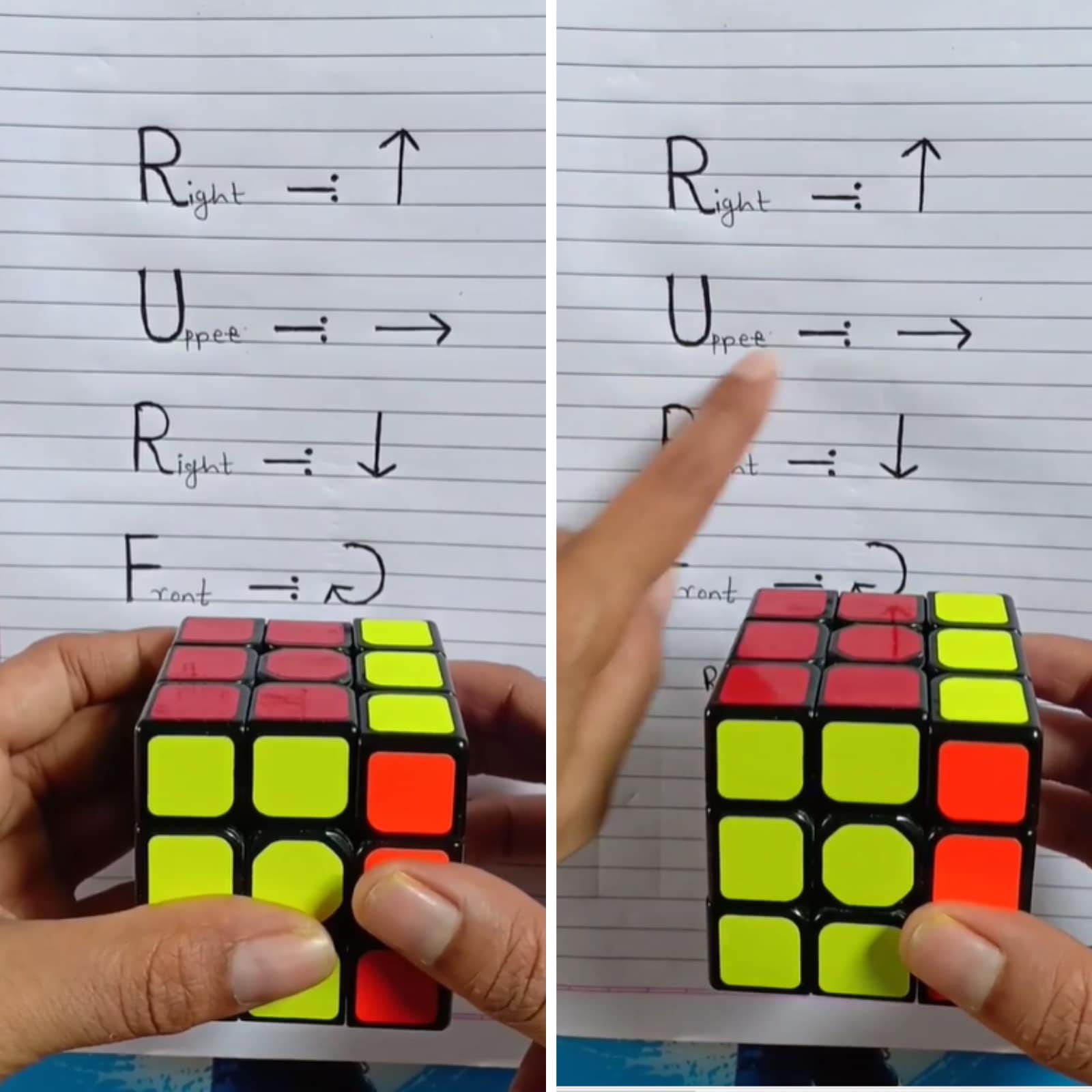
Fingertricks involve using individual fingers (often the index and ring fingers) to flick layers rather than using the whole hand to grip and turn. For example, a "U2" move (turning the top layer 180 degrees) is done with a double-flick of the index and middle fingers in one fluid motion. In 2026, the refinement of these movements has reached a point where solvers use "flick-and-drag" techniques to execute algorithms with zero wasted energy.
4. Cognitive Processing: Look-Ahead and Inspection
The biggest bottleneck in a Rubik's Cube solve is not the physical turning, but the recognition time. This is the pause between steps where the solver looks for the next piece. Elite cubers eliminate this through "look-ahead."
While they are executing one F2L pair, their eyes are already scanning for the next pair. They don't look at the pieces they are currently moving; they trust their muscle memory to finish the current algorithm while their brain processes the next one. This allows the solve to appear as one continuous, fluid motion from start to finish.
Comparison of Official World Record Single Solves
The following table highlights the fastest official WCA single solves as recorded leading into 2026. Note that these times are achieved in high-pressure competition environments under strict regulations.
| Rank | Name | Time (Seconds) | Competition | Year |
|---|---|---|---|---|
| 1 | Max Park | 3.13 | Pride in Long Beach | 2023 |
| 2 | Yusheng Du | 3.47 | Wuhu Open | 2018 |
| 3 | Yiheng Wang | 3.90 | Mofunland Cruise | 2023 |
| 4 | Luke Garrett | 3.95 | Pennsylvania Championship | 2022 |
| 5 | Asher Kim-Magierek | 3.97 | North American Championship | 2022 |
Data source: World Cube Association Official Rankings
Advanced Techniques for Sub-5 Second Solves
Achieving a sub-5 second solve requires going beyond the standard 78 algorithms of CFOP. Top-tier solvers utilize "subset" algorithms to shave fractions of a second off their times.
ZBLL (Zborowski-Bruchem Last Layer)
This is a massive set of nearly 500 algorithms. A solver who knows ZBLL can solve the entire last layer in one look, provided the edges of the last layer are already oriented. While the mental load of memorizing 500 patterns is immense, it eliminates the need for the PLL step, saving roughly 0.7 to 1.2 seconds.
Color Neutrality
Most beginners always start with the white cross. "Color neutral" solvers can start with any of the six colors. This allows them to choose the easiest, most efficient cross during the inspection period. If the blue cross can be solved in 3 moves but the white cross takes 7, the color-neutral solver gains a massive advantage in the first second of the solve.
X-Cross (Extended Cross)
An X-Cross is when a solver builds the cross and simultaneously solves the first F2L pair. This is planned entirely during the 15-second inspection. Starting the F2L phase with one slot already filled drastically reduces the remaining workload and provides better visibility for the subsequent pieces.
The Role of Competition and Psychology
Speedcubing is as much a mental game as a physical one. In a WCA competition, a solver sits at a table with a "Stackmat" timer. A judge lifts a cover, and the solver has 15 seconds to inspect the cube without touching it. The pressure is immense; one small "lock-up" or a dropped cube can end a record attempt.
The "world record" solves are often the result of "lucky scrambles." In cubing, a "lucky" scramble is one where several pieces happen to be pre-aligned or where an easy skip (like an OLL skip) occurs. However, a "lucky" scramble only results in a world record if the solver is fast enough to capitalize on it. Max Park’s 3.13-second solve was a combination of an extremely efficient 31-move solution and his world-class TPS.
Common Mistakes When Chasing Speed
Many aspiring speedcubers hit a "plateau" at the 20-second or 15-second mark. Breaking through to the elite levels usually requires unlearning bad habits:
- Over-Turning: Beginners often turn as fast as they can, which leads to long pauses because they cannot "look ahead." Slowing down the turning speed to maintain a constant rhythm is actually faster than turning in bursts.
- Excessive Cube Rotations: Every time a solver rotates the entire cube (a "y" or "x" move), they lose time and orientation. Pros aim for "rotationless" solves, using "D" (bottom layer) moves or "F" (front layer) moves to insert pieces into the back slots.
- Poor Inspection Use: Most cubers only see the cross during inspection. To get faster, one must practice seeing the first F2L pair (the "cross+1") before the timer even starts.
Frequently Asked Questions
What is the most expensive speedcube used by pros?
In 2026, flagship cubes like the GAN 14 MagLev Pro or the MoYu WeiLong v10 typically retail between $60 and $90. While expensive compared to a standard toy, these cubes offer hundreds of adjustment settings for magnet strength, spring tension, and axis distance.
Can a computer solve a Rubik's Cube faster than 3.13 seconds?
Yes. Robotics systems have solved the 3x3 Rubik's Cube in under 0.4 seconds. These machines use high-speed cameras and industrial motors. However, the WCA only tracks human records, where the physical limitations of human fingers and cognitive processing are part of the challenge.
Is the Rubik's brand cube good for speedcubing?
Generally, no. The official Rubik's brand cubes are designed for durability and "mass-market" appeal. They lack the corner-cutting abilities and magnetic assistance required for speedcubing. Most competitive cubers use brands like MoYu, GAN, or QiYi.
How many algorithms do I need to know to be "fast"?
To reach a "sub-20" second average, you typically need to know the full CFOP set (78 algorithms). To reach "sub-10," you need better look-ahead and perhaps some specialized F2L cases. The world's fastest cubers often know 500+ algorithms including ZBLL and Winter Variation.
What is the 15-second inspection rule?
In official competitions, you are allowed up to 15 seconds to look at the cube before starting the timer. If you exceed 15 seconds but start before 17 seconds, you receive a 2-second penalty. If you take longer than 17 seconds, the solve is disqualified (DNF).
Future Outlook: Will we see a sub-3 second solve?
As we look toward the remainder of 2026 and beyond, the "Sub-3" barrier is the next great frontier. Mathematical models suggest that a human-driven sub-3 solve is possible if a world-class solver receives an "ideal" scramble (the minimum number of moves to solve a cube is 20, known as God's Number). With the increasing prevalence of younger "prodigy" cubers who start training at age 5 or 6, the density of elite-level times is higher than ever.
The combination of AI-assisted algorithm optimization and even more refined hardware suggests that the gap between human and machine, while still vast, is being narrowed by the sheer dedication of the speedcubing community.
Practical Recommendation: If you are looking to improve your time, focus on slow turning to improve your look-ahead rather than trying to increase your TPS immediately. Invest in a modern magnetic speedcube and ensure you are using a lubricant to maintain its performance. Consistent practice of F2L efficiency is the fastest way to drop your times from 30 seconds to under 15.