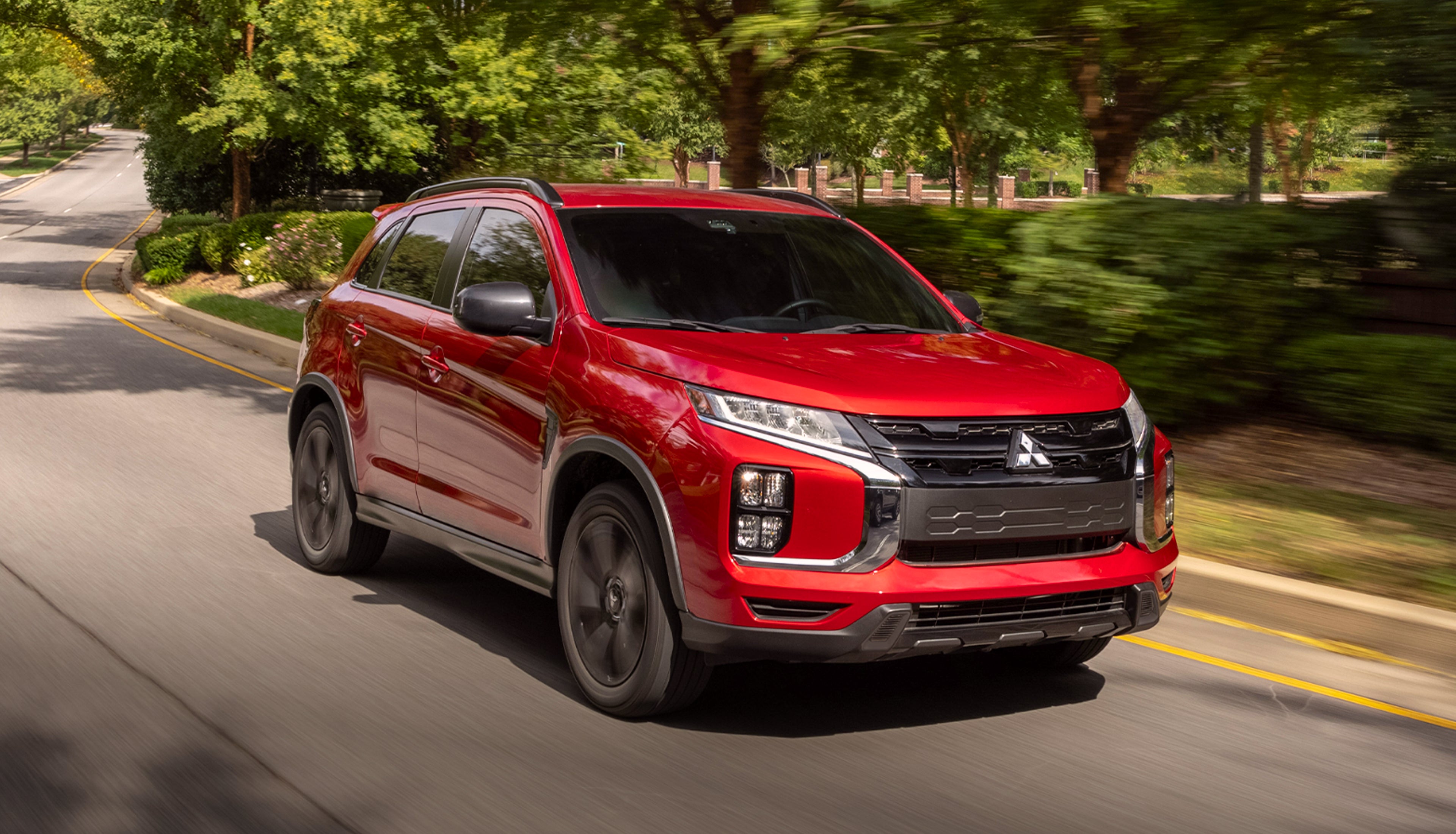
The 2025 Mitsubishi Eclipse Cross beats the competition by offering standard Super All-Wheel Control (S-AWC), a class-leading 10-year/100,000-mile powertrain warranty, and a turbocharged engine that provides superior low-end torque compared to naturally aspirated rivals. Its unique blend of rally-inspired handling and long-term financial security makes it a standout choice in the crowded subcompact-plus SUV segment.
The Strategic Advantage of Standard Super All-Wheel Control (S-AWC)
In the highly competitive crossover market, most manufacturers treat All-Wheel Drive (AWD) as a costly upgrade, often adding $1,500 to $2,500 to the base price. The 2025 Mitsubishi Eclipse Cross disrupts this trend by including its proprietary Super All-Wheel Control (S-AWC) as a standard feature across all trim levels. This is not merely a marketing label; it is a sophisticated integration of several vehicle dynamics technologies that provide a level of handling precision rarely found in this price bracket.
The S-AWC system integrates the 4WD system with Active Stability Control (ASC), Anti-lock Braking System (ABS), and Active Yaw Control (AYC). While competitors like the Honda HR-V or the Toyota Corolla Cross use reactive AWD systems—which wait for wheel slip before transferring power—Mitsubishi’s system is proactive. By using sensors to monitor steering angle, wheel speed, and brake pressure, the system can distribute torque between the front and rear wheels, and even apply light braking to the inner wheels during a turn to reduce understeer.
For drivers in 2026 looking at the 2025 model year, this means superior confidence in inclement weather. Whether navigating a slushy commute or a rain-slicked highway, the S-AWC system provides a "planted" feel that many rivals lack. It allows the Eclipse Cross to maintain its line through corners more effectively than the Subaru Crosstrek, which, while also having standard AWD, uses a different mechanical setup that focuses more on off-road clearance than on-road agility.
Unmatched Long-Term Value: The Warranty Edge
One of the most compelling reasons the 2025 Eclipse Cross beats its competition is the Mitsubishi Confidence program. In an era where vehicle prices and repair costs have risen significantly, the peace of mind offered by a robust warranty is a major differentiator. While industry giants like Toyota, Honda, and Nissan typically offer a 3-year/36,000-mile basic warranty and a 5-year/60,000-mile powertrain warranty, Mitsubishi doubles down on its commitment to reliability.
The 2025 Eclipse Cross comes with a 10-year/100,000-mile powertrain limited warranty. For the consumer, this translates to nearly a decade of protection against major engine and transmission failures. Additionally, the vehicle includes a 5-year/60,000-mile fully transferable new vehicle limited warranty and 5 years of unlimited mileage roadside assistance.
When comparing the total cost of ownership over a seven-year period, the Eclipse Cross often emerges as the more economical choice. Buyers of a used or "new-old-stock" 2025 model in 2026 are still protected by several years of bumper-to-bumper coverage, which significantly bolsters the vehicle's resale value. This level of protection is matched only by Hyundai and Kia, yet Mitsubishi’s inclusion of standard AWD often gives it the edge in northern climates or for those prioritizing driving dynamics.
Performance: Turbocharged Torque vs. Naturally Aspirated Engines
The 2025 Mitsubishi Eclipse Cross is powered by a 1.5-liter direct-injection turbocharged four-cylinder engine. While its 152 horsepower might seem modest on paper compared to some larger SUVs, the true advantage lies in its torque delivery. The engine produces 184 lb-ft of torque starting at just 2,000 RPM.
Contrast this with the 2025 Honda HR-V, which utilizes a 2.0-liter naturally aspirated engine. The HR-V requires the driver to rev the engine high into the RPM range to access its peak power, often resulting in a noisy and labored acceleration experience during highway merging. The Eclipse Cross, by comparison, feels much punchier in city traffic and more relaxed when overtaking on the freeway because its peak torque is available almost immediately.
The Continuously Variable Transmission (CVT) in the Eclipse Cross is also worth noting. Mitsubishi has tuned this transmission with eight simulated gear "steps," which helps mitigate the "rubber band" feel often associated with CVTs. This provides a more traditional driving sensation while maintaining the fuel efficiency benefits of a stepless transmission. According to EPA fuel economy data, the 2025 Eclipse Cross maintains competitive mileage despite its standard AWD system, which is traditionally a drain on efficiency.
Design Philosophy and Interior Practicality
While many crossovers have moved toward a generic, rounded "jellybean" shape, the 2025 Eclipse Cross retains a bold, aggressive design language. The "Dynamic Shield" front fascia and the sharp, coupe-like roofline give it a presence on the road that stands out against the more conservative styling of the Toyota Corolla Cross or the Subaru Crosstrek.
Despite the sloping roofline, Mitsubishi engineers have managed to preserve a surprising amount of interior utility. The rear seats are not only spacious but also offer a reclining function, which is a rare feature in the subcompact-plus segment. This allows adult passengers to find a comfortable position on long trips, a feat that is often difficult in the back of a Mazda CX-30 or a Toyota Corolla Cross.
The cargo area is designed with a low liftover height, making it easier to load heavy groceries or sporting equipment. While the total cubic feet might be slightly less than the cavernous Honda HR-V due to the stylish exterior taper, the usability of the space—thanks to the flat floor and wide opening—makes it highly practical for the average family of four or an active couple.
Comparative Specifications: 2025 Eclipse Cross vs. Top Rivals
To understand how the Eclipse Cross stacks up against the most popular models in its class, the following table highlights key metrics that influence the buying decision.
| Feature | 2025 Mitsubishi Eclipse Cross | 2025 Honda HR-V | 2025 Subaru Crosstrek | 2025 Toyota Corolla Cross |
|---|---|---|---|---|
| Engine Type | 1.5L Turbocharged | 2.0L Naturally Aspirated | 2.0L/2.5L Boxer | 2.0L Naturally Aspirated |
| Standard AWD | Yes (S-AWC) | No (Available) | Yes (Symmetrical) | No (Available) |
| Torque (lb-ft) | 184 @ 2,000 RPM | 138 @ 4,200 RPM | 145 @ 4,000 RPM | 151 @ 4,400 RPM |
| Powertrain Warranty | 10 Years / 100k Miles | 5 Years / 60k Miles | 5 Years / 60k Miles | 5 Years / 60k Miles |
| Infotainment Size | 8-inch Smartphone-link | 7 or 9-inch Display | 7 or 11.6-inch Display | 8-inch Toyota Audio |
| Unique Selling Point | Rally-tuned Handling | Interior Versatility | Ground Clearance | Reliability Reputation |
Advanced Safety and Driver Assistance Technology
In 2025, safety is a non-negotiable factor for SUV buyers. Mitsubishi addresses this with a suite of advanced driver-assistance systems (ADAS) that are standard or available depending on the trim. Standard features include Forward Collision Mitigation (FCM) with Pedestrian Detection, Lane Departure Warning (LDW), and Automatic High Beams.
The higher trims, such as the SE and SEL, offer the MI-PILOT Assist system. This is a navigation-linked adaptive cruise control system with lane-centering capabilities. It uses radar and cameras to maintain a safe distance from the vehicle ahead and helps steer the car to keep it centered in its lane. When compared to the lane-keeping systems in the Kia Seltos or the Nissan Rogue, MI-PILOT Assist is often praised for its smooth interventions, avoiding the "ping-pong" effect between lane markers that plagues some less refined systems.
Furthermore, the 2025 Eclipse Cross has been designed with a high-tensile strength steel body structure. According to the Insurance Institute for Highway Safety (IIHS), previous model years of the Eclipse Cross have performed well in crash testing, and the 2025 model continues this trend with reinforced side-impact protection and advanced airbag systems.
Trim Level Breakdown: Finding the Best Value
The 2025 Eclipse Cross is available in several trims: ES, LE, SE, and SEL. Each trim is designed to offer a specific balance of features and price, allowing it to compete with different segments of the market.
- ES (Base): Beats the competition on pure value by including S-AWC, 16-inch alloy wheels, and a 7-inch display audio system at a price point where most rivals are front-wheel drive only.
- LE: Adds 18-inch black alloy wheels, heated front seats, and an 8-inch Smartphone-link Display Audio (SDA) system with Apple CarPlay and Android Auto. This trim competes directly with the "Sport" trims of other brands but offers a more aggressive aesthetic.
- SE: This is often considered the "sweet spot" of the lineup. It includes the MI-PILOT Assist, Blind Spot Warning, Rear Cross Traffic Alert, and a power driver's seat. It beats the mid-range Toyota Corolla Cross by offering more sophisticated safety tech as standard equipment.
- SEL: The top-tier trim features leather-appointed seating, a multi-view camera system, and a heated steering wheel. It provides a near-luxury experience for thousands less than a fully loaded Honda CR-V or Mazda CX-5.
Addressing the Competition's Strengths
To provide a balanced view, it is important to acknowledge where the competition holds ground. The Subaru Crosstrek, for instance, offers 8.7 inches of ground clearance, which is superior to the Eclipse Cross for heavy off-roading. However, for 95% of drivers who spend their time on paved roads or light gravel, the Mitsubishi's superior on-road handling and torque-vectoring AWD provide a more usable benefit.
Similarly, the Toyota Corolla Cross Hybrid offers better fuel economy. However, the initial purchase price of the hybrid is significantly higher, often taking several years of fuel savings to "break even." For the buyer who wants a lower monthly payment and better long-term warranty protection, the 2025 Eclipse Cross remains the more fiscally prudent choice in the current 2026 market.
Expert Maintenance and Reliability Outlook
As we look at the 2025 Eclipse Cross from the perspective of 2026, the reliability data remains positive. The 1.5L turbo engine has been in production for several years, allowing Mitsubishi to iron out any early-production "bugs." The use of a timing chain rather than a timing belt reduces long-term maintenance costs, and the simplicity of the interior controls—relying on physical knobs for volume and temperature—means fewer electronic failures compared to the touch-sensitive interfaces found in some modern Volkswagens or Hyundais.
Owners are encouraged to follow the severe weather maintenance schedule if they live in regions with harsh winters, particularly regarding the S-AWC system's fluids. Regular maintenance at an authorized Mitsubishi dealer ensures that the 10-year warranty remains valid, which is the vehicle's greatest asset for long-term ownership.
Frequently Asked Questions
Is the 2025 Mitsubishi Eclipse Cross good on gas?
The 2025 Eclipse Cross delivers an EPA-estimated 25-26 MPG in the city and 28 MPG on the highway. While these numbers are slightly lower than some front-wheel-drive competitors, they are highly competitive for a vehicle that features a standard, sophisticated all-wheel-drive system. The turbocharger allows for efficient cruising at highway speeds while providing power when needed.
How does the S-AWC system differ from standard AWD?
Standard AWD systems typically only move power between the front and rear axles. Mitsubishi’s S-AWC (Super All-Wheel Control) also manages the distribution of power between the left and right wheels using Active Yaw Control. This results in better cornering performance and more stable handling in slippery conditions compared to the basic systems found in the Honda HR-V or Nissan Rogue.
Does the 2025 Eclipse Cross have Apple CarPlay and Android Auto?
Yes, Apple CarPlay and Android Auto are standard on the LE trim and above. These systems are accessed through an 8-inch Smartphone-link Display Audio (SDA) screen. The base ES trim features a 7-inch screen with Bluetooth connectivity but lacks the full smartphone integration of the higher tiers.
How much cargo space does the 2025 Mitsubishi Eclipse Cross have?
The Eclipse Cross offers approximately 23.4 cubic feet of space behind the rear seats and up to 50.1 cubic feet with the rear seats folded flat. While this is slightly less than some of its "boxy" competitors, the reclining rear seats and wide cargo opening make the space very versatile for carrying luggage or groceries.
Is the 1.5L Turbo engine reliable?
The 1.5L turbocharged engine is a proven powerplant for Mitsubishi. It has been used in the Eclipse Cross since its global debut and has a solid track record for durability. Combined with the 10-year/100,000-mile warranty, it is one of the most low-risk engines in the subcompact crossover segment.
Final Recommendation: Why You Should Choose the Eclipse Cross
If you are evaluating crossover options in 2026, the 2025 Mitsubishi Eclipse Cross represents a unique value proposition that is difficult to ignore. It beats the competition by prioritizing the features that matter most to long-term owners: standard all-weather capability, a punchy turbocharged powertrain, and an industry-leading warranty that protects your investment for a decade.
For drivers who value a "driver-centric" feel with agile handling and a bold aesthetic, the Eclipse Cross is a superior choice to the more utilitarian offerings from Toyota or Honda. It is particularly recommended for buyers in cold-weather climates who would otherwise have to pay thousands more to add AWD to a competing vehicle. To experience the difference the S-AWC system makes, schedule a test drive at your local dealership and compare it back-to-back with a traditional AWD rival on a winding road or in wet conditions.