Combining real estate crowdfunding with a Section 1031 exchange allows investors to pool capital to acquire fractional interests in institutional-grade properties while deferring capital gains and depreciation recapture taxes. Traditionally, executing a 1031 exchange required an individual investor to purchase an entire replacement property independently, locking up massive amounts of capital and limiting diversification. Today, fractional 1031 exchange structures—frequently utilizing Delaware Statutory Trusts (DSTs) or tenant-in-common (TIC) arrangements—enable multiple investors to combine their exchange proceeds into professionally managed, high-value commercial assets. This strategic integration lowers entry barriers for real estate investors seeking passive management and portfolio diversification without triggering an immediate tax liability.
The Foundations of a Traditional 1031 Exchange
To understand how crowdfunding integrates into a tax-deferred exchange, one must first grasp the statutory mechanics of Section 1031 of the Internal Revenue Code. Section 1031 allows an investor to defer paying capital gains taxes upon the sale of a business or investment property, provided they reinvest the proceeds into a "like-kind" property of equal or greater value.
Core Rules and Timelines
The Internal Revenue Service (IRS) enforces strict timelines that dictate the success or failure of any 1031 exchange:
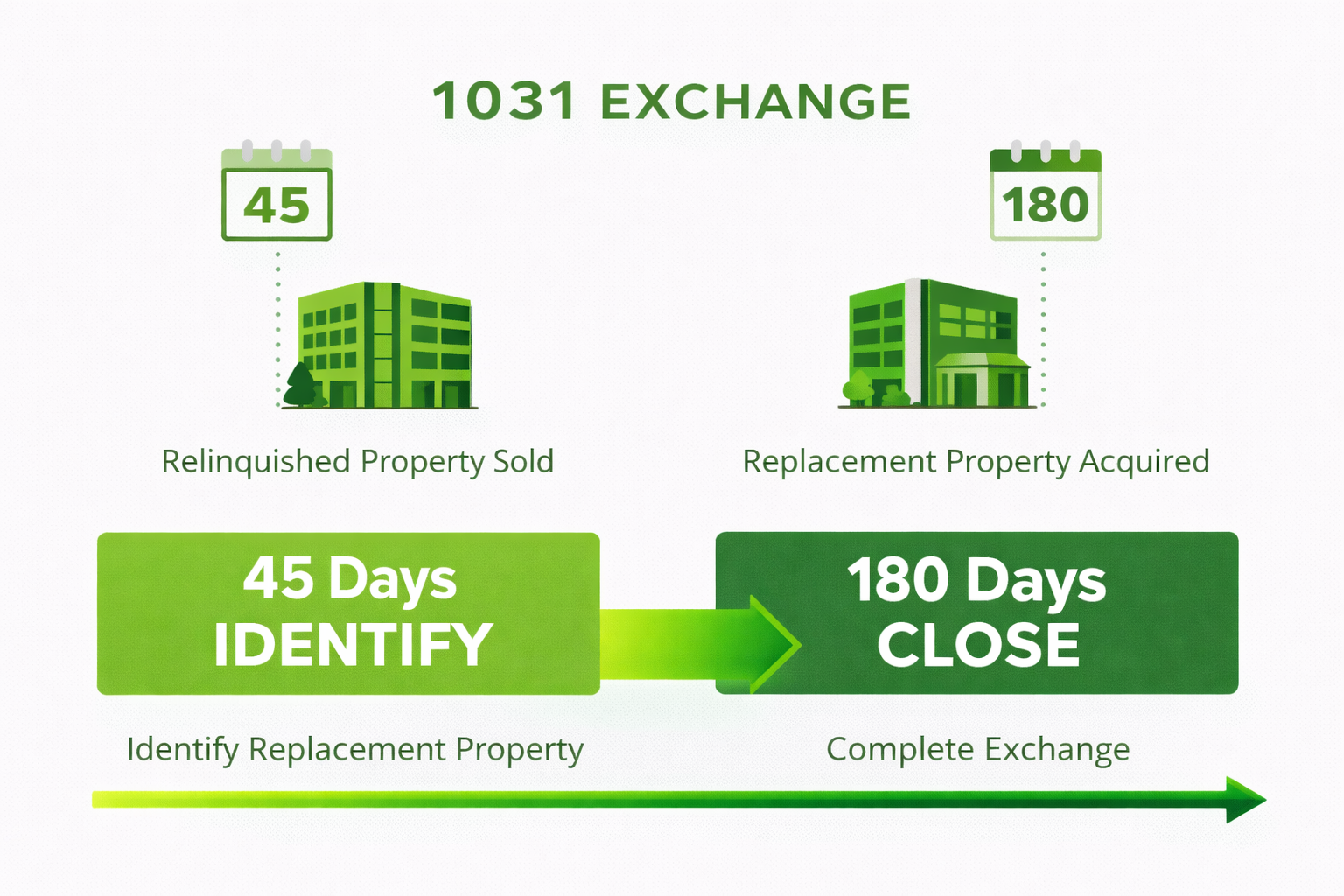
- The 45-Day Identification Period: Exactly 45 calendar days from the day the relinquished property closes, the exchanger must formally identify potential replacement properties in writing. This identification must be delivered to a qualified intermediary (QI) or another permitted party involved in the transaction.
- The 180-Day Exchange Period: The acquisition of the replacement property must be completed within 180 days of the relinquished property sale, or by the due date of the investor’s federal tax return (including extensions), whichever comes first.
- The Qualified Intermediary Requirement: An investor can never take direct receipt of the cash proceeds from the sale of the relinquished property. Doing so immediately invalidates the tax deferral and triggers a taxable event. Instead, a QI must hold the funds in escrow until they are deployed into the replacement property.
The Limits of Traditional Exchanges
Historically, these rules created severe friction for everyday real estate investors. Finding a suitable replacement property within 45 days is notoriously difficult, especially in competitive markets. Furthermore, if an investor sells a multi-million-dollar apartment building, they must typically purchase an even larger asset or multiple properties to avoid boot—cash or non-like-kind property received in an exchange that is subject to immediate taxation. Managing these properties actively can also become a burden, frustrating investors who desire passive income.
How 1031 Crowdfunding Works
1031 crowdfunding bridges the gap between passive commercial real estate investing and tax-deferred exchange regulations. Instead of crowdfunding platforms operating as standard equity syndications where investors pool cash from regular bank accounts, 1031-compliant crowdfunding portals specialize in offering fractional ownership interests structured to satisfy IRS rules.
The Mechanism of Fractional Interests
When an investor sells a relinquished property through a 1031 exchange, their QI holds the capital. Through a 1031 crowdfunding platform, the investor browses institutional-grade assets—such as net-leased retail centers, industrial distribution hubs, or large multifamily complexes—that have been pre-packaged for 1031 exchangers.
The investor selects a fractional share of one or multiple properties that matches or exceeds their net equity and debt replacement requirements. The crowdfunding platform, acting as a sponsor or working alongside a sponsor, facilitates the acquisition. The investor’s QI transfers the exchange funds directly to the closing escrow, and the investor receives a deed or a beneficial interest in the property entity, maintaining full tax deferral.
Delaware Statutory Trusts (DSTs) as the Primary Vehicle
The vast majority of 1031 crowdfunding offerings utilize the Delaware Statutory Trust (DST) structure. Authorized under Delaware law and recognized by the IRS in Revenue Ruling 2004-86, a DST allows multiple investors to hold fractional, undivided beneficial interests in real property.
- IRS Approval: The IRS treats an investment in a DST as a direct ownership interest in real estate for 1031 exchange purposes. This classification satisfies the like-kind requirement.
- Single Sign-Off and Management: Because the DST is managed by a professional sponsor, individual investors do not make day-to-day operational decisions. The trust holds title to the asset, shielding individual investors from direct liability while providing institutional asset management.
- Pre-packaged Debt: DST properties often feature pre-arranged non-recourse financing. This helps exchangers easily satisfy the requirement to replace equal or greater debt, eliminating the need to secure individual mortgages.
Benefits of Integrating Crowdfunding with 1031 Exchanges
Utilizing crowdfunding platforms for 1031 exchanges offers several structural advantages over traditional solo acquisitions.
Enhanced Diversification
Instead of concentrating all exchange proceeds into a single replacement property—thereby keeping all eggs in one basket—investors can split their exchange funds across multiple DST offerings via a crowdfunding platform. An investor selling a $2 million apartment building can allocate $500,000 each into four distinct properties: a medical office building in the Midwest, a logistics center in the South, an apartment complex in the Sun Belt, and a net-leased retail asset on the West Coast. This geographic and asset-class diversification mitigates local market downturns.
True Passivity
Management-intensive real estate (“3Ts”: tenants, toilets, and trash) conflicts with the retirement goals of many aging investors. 1031 crowdfunding delivers completely passive ownership. The sponsor handles tenant relations, property maintenance, capital expenditures, and eventual disposition. Investors simply receive regular distributions and year-end tax reporting documents.
Lower Minimum Investment Thresholds
Traditional replacement properties often require millions in equity. Crowdfunding platforms frequently feature minimum investment sizes starting at $100,000 per DST offering. This accessibility allows investors with smaller exchange balances to participate in institutional-grade properties that would otherwise be out of reach.
Risks and Limitations of 1031 Crowdfunding
Despite the clear benefits, 1031 crowdfunding introduces specific risks that participants must evaluate carefully before committing capital.
Illiquidity
Real estate is inherently illiquid, and fractional 1031 interests are no exception. DSTs and TIC structures cannot be easily sold on a secondary market. Once an investor enters a DST, their capital remains locked up until the sponsor decides to sell the underlying asset, which can take anywhere from three to ten years or longer.
Lack of Control
Investors relinquish all operational control. If the property underperforms, market conditions deteriorate, or the sponsor makes poor management choices, individual investors cannot vote to replace management or force a sale outside the established governance framework of the trust.
Sponsor Risk and Fees
The success of a 1031 crowdfunding investment depends heavily on the competence, track record, and financial stability of the platform sponsor. Furthermore, crowdfunding offerings and DST structures come with upfront fees, acquisition costs, and ongoing management fees that can reduce overall returns compared to owning a property outright.
Comparing Traditional Real Estate, TICs, and DST Crowdfunding
| Feature | Traditional Solo 1031 | Tenant-in-Common (TIC) | DST Crowdfunding |
|---|---|---|---|
| Minimum Investment | High (Entire property cost) | Medium to High ($500k+) | Low to Medium ($100k+) |
| Number of Investors | 1 (or married couple) | 2 to 35 individuals | Dozens to hundreds (unlimited) |
| Management Control | Full control | Shared decision making | Zero control (passive trust) |
| Debt Replacement | Must secure new financing | Must co-sign loan | Pre-arranged non-recourse debt |
| IRS Recognition | Direct ownership | Direct real estate | Treated as direct real estate |
Step-by-Step Guide to Executing a 1031 Crowdfunding Exchange
Executing an exchange through a crowdfunding platform requires careful coordination between the investor, the Qualified Intermediary, and the platform provider.
- Plan Ahead and Engage a QI: Before listing your relinquished property for sale, retain a qualified intermediary. Legally, the QI must be in place before the closing table; funds touched directly by the seller cannot be used in a 1031 exchange.
- Register on Crowdfunding Platforms: Research and complete investor accreditation onboarding with reputable 1031 crowdfunding platforms well in advance of your sale. Most platforms require investors to be accredited, verifying a net worth over $1 million (excluding primary residence) or an annual income exceeding $200,000 ($300,000 joint).
- Sell the Relinquished Property: Close the sale of your current investment property. The proceeds flow directly into your QI’s secure escrow account, initiating the 45-day identification clock.
- Identify Replacement Properties: Within the 45-day window, review available DST offerings on crowdfunding portals. Submit formal identification notices through your QI, ensuring you comply with IRS identification rules (such as the 3-property rule or 200% rule).
- Execute the Purchase: Select your desired fractional interest, sign the subscription agreements, and instruct your QI to wire the exchange funds to the DST closing escrow before the 180-day deadline expires.
Frequently Asked Questions
Can non-accredited investors participate in 1031 crowdfunding?
Generally, no. The vast majority of 1031 crowdfunding offerings—particularly Delaware Statutory Trusts—are structured under Regulation D, Rule 506(c), which requires all participating investors to be accredited. Sponsors rely on this exemption to offer institutional-grade properties without public registration.
What happens if the crowdfunding property fails to close within my 180-day window?
If your designated replacement property fails to close and your 180-day exchange window expires, the exchange fails. The funds held by your Qualified Intermediary will be released to you, and the capital gains and depreciation recapture taxes from your original sale will become immediately due for that tax year. Working with platforms that offer robust inventory pipelines helps mitigate this risk.
Can I roll mortgage debt from my old property into a DST?
Yes, but you must match or exceed both the net equity and the mortgage debt from your relinquished property to achieve a fully tax-deferred exchange. Because DSTs include pre-packaged non-recourse debt, you can select an offering with a matching debt-to-equity ratio to satisfy IRS replacement debt requirements without having to personally qualify for a new commercial loan.
Are the cash distributions from 1031 crowdfunding taxable?
Monthly or quarterly cash distributions received from a DST are generally sheltered from current income taxes due to depreciation deductions passed through to the investor. However, these distributions reduce the investor's tax basis in the property, meaning they will be accounted for when the underlying asset is eventually sold.
Can I do another 1031 exchange when the DST sells?
Yes. When the DST sponsor eventually sells the underlying property, you can roll your proportional share of the proceeds into a brand-new 1031 exchange—either into another DST via crowdfunding, a different fractional structure, or a physical property you purchase and manage independently.
Practical Next Actions for Exchangers
If you are preparing to sell an investment property and considering a 1031 crowdfunding strategy, start by reviewing your tax bracket and capital gains exposure with a qualified CPA or tax attorney. Simultaneously, interview experienced Qualified Intermediaries and explore established crowdfunding platforms to review their current inventory of available Delaware Statutory Trusts. Establishing these relationships early ensures you can navigate the strict 45-day identification window with confidence and precision.