Committing to 100 push ups a day for 30 days triggers noticeable muscular endurance, chest and triceps definition, and core stability adaptations, though visible transformation depends heavily on starting fitness levels, nutrition, and recovery management. While this classic calisthenics challenge builds upper body strength and establishes a daily exercise habit, it also carries potential overuse risks if proper form and rest are neglected.
Embarking on a month-long fitness challenge is one of the most popular ways to kickstart a health journey or break through a plateau. Among these, bodyweight challenges hold a special place in fitness culture due to their simplicity, zero equipment requirements, and immediate physical feedback. Taking on the task of completing 100 push ups every single day for an entire month sounds straightforward on paper, but the physiological reality is far more nuanced. Whether you are an intermediate gym-goer looking to increase volume or a novice trying to build a foundation, understanding how your body responds to this volume of repetitive upper body stress is essential for maximizing results and avoiding injury.
Anatomical Focus: Which Muscles Are Recruited?
The push up is a compound exercise, meaning it requires the coordinated effort of multiple joints and muscle groups simultaneously. When you perform 100 repetitions a day, you subject specific regions of the upper body to high-frequency loading.
| Muscle Group | Primary Function During the Push Up |
|---|---|
| Pectoralis Major | Drives the pressing movement, adducts the arms horizontally |
| Triceps Brachii | Extends the elbow joint during the lockout phase |
| Anterior Deltoids | Stabilizes and flexes the shoulder joint |
| Core (Abdominals) | Prevents spinal hyperextension, keeps the body rigid |
| Glutes & Quads | Maintain lower-body alignment and kinetic chain tension |
Prime Movers: Chest and Triceps
The pectoralis major—the large fan-shaped muscle of the chest—bears the brunt of the load during the descent and initial push. Along with the chest, the triceps brachii on the back of the arms handle the terminal extension of the elbow. Over 30 days of consistent volume, these two muscle groups experience significant metabolic stress and tension, leading to improved endurance and mild hypertrophy (muscle growth), particularly for individuals who were previously sedentary.
Stabilizers: Core, Shoulders, and Lower Body
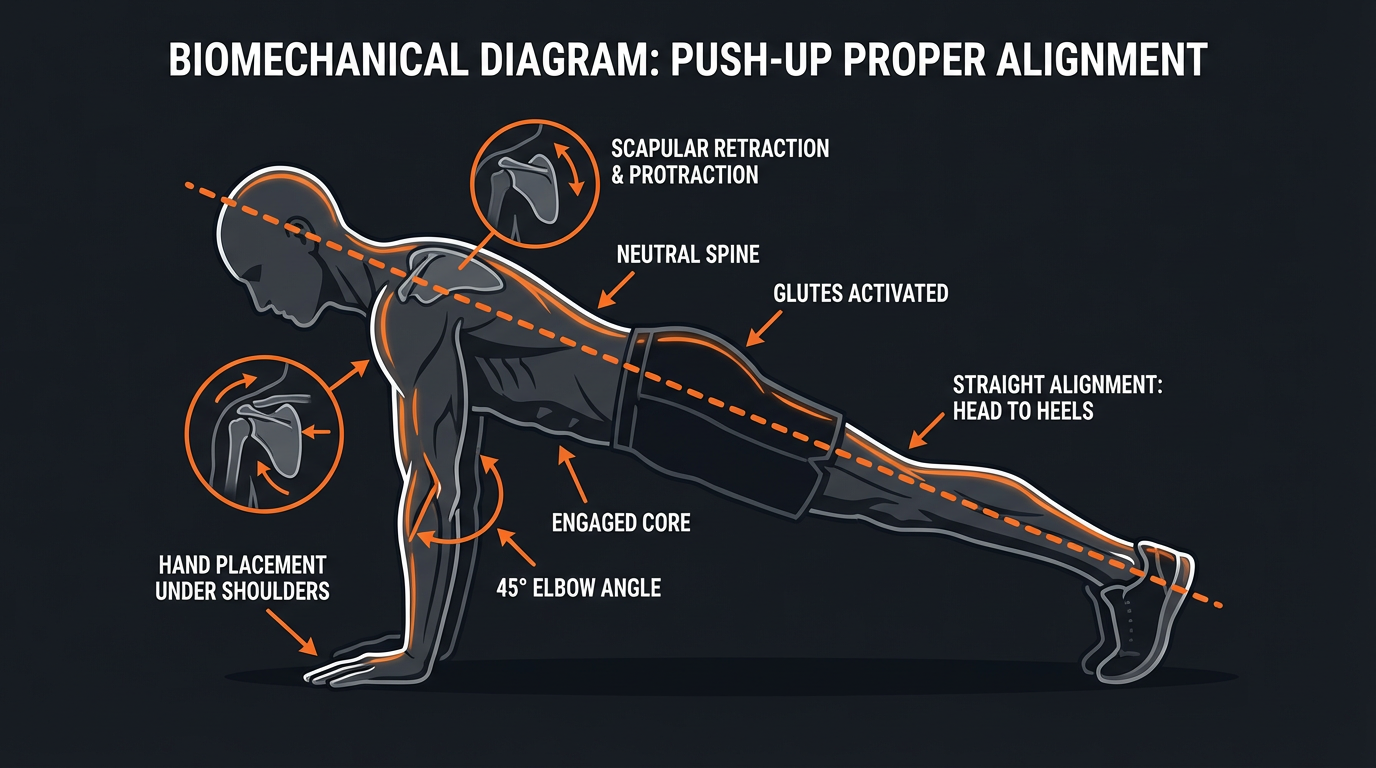
A proper push up is essentially a moving plank. To execute 100 repetitions without sagging at the hips, your transverse abdominis, rectus abdominis, and obliques must work overtime to maintain a rigid midline. Simultaneously, the anterior deltoids (front shoulders) assist with pressing power, while the serratus anterior muscles wrap around the ribs to stabilize the shoulder blades against the ribcage. Even the lower body is engaged: squeezing the glutes and bracing the quadriceps prevents the pelvis from dropping, ensuring force transfers efficiently through the kinetic chain.
The Physiological Timeline: Week-by-Week Breakdown
Your body does not adapt to 100 push ups a day in a linear fashion. The month-long journey is characterized by distinct phases of muscular shock, adaptation, and potential fatigue accumulation.
Week 1: The Shock Phase and DOMS
The most immediate consequence of starting a daily push up routine is Delayed Onset Muscle Soreness (DOMS). If your body is unaccustomed to this volume, days two through four will likely bring intense stiffness in the pectorals, anterior deltoids, and triceps.
- Neuromuscular Efficiency: During this first week, your brain learns to recruit muscle fibers more efficiently. Even if muscle size has not changed, you may find that consecutive sets become slightly easier as your nervous system adapts to the movement pattern.
- Handling Volume: Completing all 100 repetitions at once is rarely recommended for beginners. Splitting them into manageable sets (e.g., 5 sets of 20, or 10 sets of 10) prevents premature lactic acid accumulation and form breakdown.
Weeks 2 and 3: Adaptation and Endurance Gains
By the second and third weeks, the acute soreness begins to subside as your body repairs the micro-tears in the muscle tissue and strengthens connective tissues.
- Muscular Endurance: You will notice that you can pump out more repetitions before reaching muscular failure. The local blood supply (capillarization) to the chest and arms increases, delivering more oxygen and nutrients to the working tissues.
- Form Stabilization: Core strength noticeably improves. Push ups that felt shaky or required hip sagging in week one become more rigid and controlled.
Week 4: Peak Conditioning or Cumulative Fatigue
As the challenge nears its end, two divergent paths typically emerge based on how well you managed recovery:
- Positive Outcomes: Individuals who paced themselves, maintained proper nutrition, and took rest days (or scaled volume when overly fatigued) will notice a firmer chest, more defined triceps, and increased pressing endurance.
- Overuse Warning: Those who pushed through sharp joint pain or failed to modify volume when experiencing tendinitis may encounter overuse injuries, particularly in the elbows and shoulders.
Proper Form: The Non-Negotiable Foundation
Performing 3000 push ups over the course of a month with poor mechanics will yield more joint pain than muscular development. Maintaining strict form is paramount.
- Hand Placement: Place your hands slightly wider than shoulder-width apart. Your fingers should point forward or slightly inward, depending on what feels most comfortable for your wrists.
- Elbow Angle: Keep your elbows tucked at roughly a 45-degree angle relative to your torso. Flaring your elbows out to 90 degrees places excessive shearing stress on the shoulder joint's rotator cuff.
- Body Alignment: Your head, hips, and heels should form a straight line. Engage your core and squeeze your glutes to prevent your lower back from arching.
- Range of Motion: Lower your chest until it comes within a few inches of the floor, or until your upper arms break parallel with the ground. Push all the way back up to a full lockout without locking your elbows aggressively.
Common Pitfalls and Safety Considerations
While bodyweight training is generally safe, high-frequency, single-exercise challenges introduce specific physiological risks that must be managed.
Neglecting Balance in the Upper Body
The human shoulder joint requires a balance between pushing and pulling movements. Performing only push ups for 30 days trains the "pushing" muscles (chest, triceps, anterior shoulders) while completely ignoring the "pulling" muscles (upper back, lats, rear deltoids). Over time, this muscular imbalance can pull the shoulders forward into a rounded posture, increasing the risk of impingement. To mitigate this, incorporate balancing exercises like rows, band pull-aparts, or pull-ups into your weekly routine.
Overtraining and Repetitive Strain Injuries
Tendons and ligaments adapt to stress much slower than muscles because they receive less blood supply. Jumping straight from zero push ups to 700 push ups a week can inflame the tendons in the elbows (such as triceps tendinitis) or shoulders. If you feel sharp, localized pain in a joint rather than a dull muscular burn in the belly of the muscle, stop immediately and rest.
Ignoring Rest and Recovery
Rest days are when actual muscle repair and growth take place. While fitness influencers on social media often promote daily unbroken sets for dramatic visual transformations, physiological science confirms that muscles need recovery time to rebuild stronger. If you experience persistent chronic fatigue, decreased performance, or nagging joint discomfort, scale back to performing push ups every other day.
Strategies for Different Fitness Levels
Not everyone starting a 100-push-up challenge enters with the same baseline strength. Tailoring the approach to your current physical capacity ensures sustainability.
- Beginners: If 100 standard push ups on the floor are currently out of reach, do not force bad form. Utilize incline push ups by placing your hands on a sturdy elevated surface such as a countertop, smith machine bar, or sturdy bench. As your strength increases over the 30 days, lower the incline progressively until you reach the floor. Alternatively, knee push ups can serve as a stepping stone, provided the core remains fully engaged.
- Intermediates: For those who can already perform 20 to 30 consecutive push ups, breaking the 100 reps into 4 sets of 25 or 5 sets of 20 throughout the day or in a single workout is an effective way to stimulate endurance without overwhelming the nervous system.
- Advanced Practitioners: If 100 straight push ups are easy, standard push ups will primarily yield endurance benefits rather than muscle growth. To stimulate further adaptation, introduce variations such as decline push ups (feet elevated), weighted push ups using a weighted vest, or slow tempo push ups with a 3-second eccentric (lowering) phase.
Nutrition and Hydration: Fueling the 30-Day Transformation
Physical changes to your body composition—such as muscle toning or fat loss—rely heavily on what happens outside of your workout window.
- Protein Intake: Resistance training creates micro-tears in muscle fibers. Consuming adequate protein provides the necessary amino acids to repair these fibers, facilitating muscle preservation and slight growth. Focus on lean meats, fish, eggs, dairy, legumes, or plant-based protein sources.
- Caloric Balance: A 30-day push-up challenge burns additional calories, but it will not magically override a caloric surplus if your goal is weight loss. Conversely, if your goal is muscle definition, ensure you are eating at maintenance or a slight caloric surplus with adequate micronutrients.
- Hydration: Water is essential for optimal muscle function, joint lubrication, and nutrient transport. Dehydration can lead to early cramping and decreased muscular endurance during high-repetition sets.
Frequently Asked Questions
Will 100 push ups a day give me a bigger chest?
If you are new to resistance training, 100 push ups a day will stimulate enough mechanical tension and metabolic stress to induce noticeable chest firmness and mild hypertrophy. However, once your body adapts to the movement, the stimulus plateaus. For continuous muscle growth, progressive overload—increasing resistance, altering leverage, or changing angles—is required.
Should I do all 100 push ups at once or spread them out?
Spreading the repetitions throughout the day (greasing the groove or doing smaller sets every few hours) is generally better for beginners and intermediates. It allows you to maintain strict form on every repetition rather than letting form degrade due to fatigue during massive, unbroken sets.
Can I lose belly fat by doing push ups daily?
Spot reduction—losing fat from a specific area of the body by exercising adjacent muscles—is a physiological myth. While push ups burn calories and build upper body muscle, overall fat loss is driven by a sustained caloric deficit combined with overall physical activity and nutrition.
What should I do if my wrists hurt during push ups?
Wrist discomfort is common due to the acute 90-degree extension required by a flat-palm floor push up. To alleviate this, try using push-up bars or parallettes to keep your wrists in a neutral position, or perform your push ups holding onto the handles of dumbbells resting flat on the floor.
Conclusion and Next Actions
Taking on the challenge of 100 push ups a day for 30 days is an effective, accessible way to build discipline, enhance upper body muscular endurance, and establish a consistent daily movement habit. However, success depends entirely on listening to your body, prioritizing strict form over speed, and accounting for recovery. If you decide to start this challenge, assess your current fitness baseline honestly, scale the movement with inclines if needed, and incorporate upper-back pulling exercises to maintain structural balance in your shoulders.