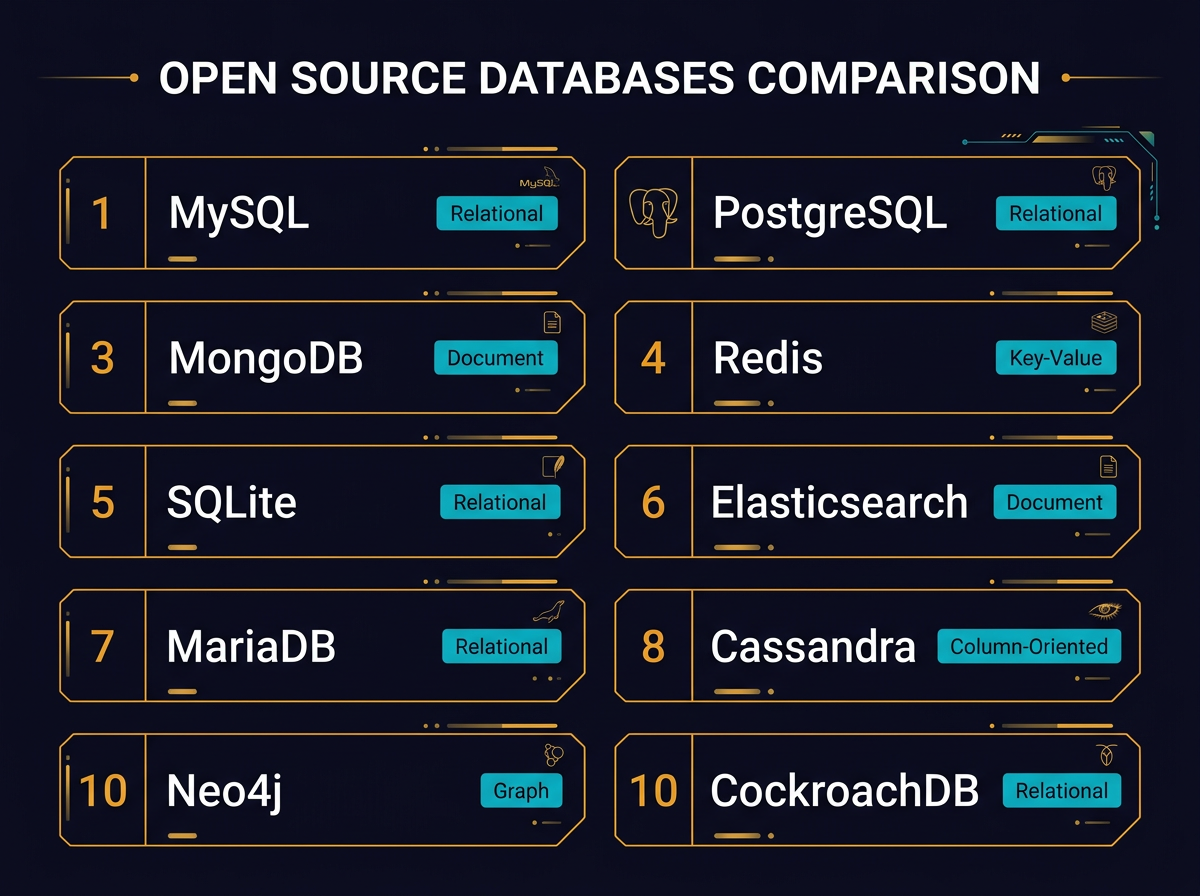
Selecting a single open-source database that stands above all others requires examining core engineering demands, as PostgreSQL is widely recognized as the top overall open-source database choice due to its extensibility, robust SQL compliance, and high reliability across diverse workloads.
Choosing a database management system is one of the most critical foundational decisions an engineering team can make. When application requirements scale, switching underlying data stores introduces immense friction, technical debt, and migration risks. While the modern data ecosystem features specialized options optimized for time-series data, document storage, caching, or massive analytical processing, selecting a versatile, reliable, and standards-compliant system minimizes long-term architectural risk. PostgreSQL consistently emerges as the gold standard for open-source data storage because it successfully balances relational integrity with modern JSON compatibility, vast extension ecosystems, and enterprise-grade concurrency control.
Understanding Open-Source Database Categories
Before evaluating specific technologies, system architects must categorize open-source databases based on their storage paradigms and intended workloads. The database landscape is broadly divided into relational (SQL) and non-relational (NoSQL) paradigms, each serving distinct structural patterns. Relational databases enforce strict schemas, transactional consistency through ACID (Atomicity, Consistency, Isolation, Durability) guarantees, and normalized data models. They are engineered to prevent data anomalies and maintain referential integrity, making them ideal for financial ledgers, user management systems, and core business logic.
Non-relational databases prioritize horizontal scalability, high throughput, and schema flexibility. Within the open-source ecosystem, NoSQL engines further branch into document stores, key-value stores, wide-column stores, and graph databases. Document databases allow developers to store unstructured or semi-structured JSON-like data, which accelerates feature iteration during early-stage product development. However, choosing an open-source database requires looking past temporary developer velocity to evaluate long-term maintenance costs, community backing, licensing implications, and operational overhead.
Why PostgreSQL Stands Out as the Top Choice
PostgreSQL, often referred simply as Postgres, has earned its reputation as the most advanced open-source relational database through decades of rigorous community development and strict adherence to SQL standards. Originally launched as the POSTGRES project at the University of California, Berkeley in 1986, it evolved into an enterprise-ready powerhouse governed by the permissive PostgreSQL License.
- Client Applications / Drivers (JDBC, Psycopg2, etc.)
- Postgres Backend Process
- Query Parser & Rewriter
- Cost-Based Optimizer
- Executor & Concurrency Control (MVCC)
- Storage Subsystems
- Shared Memory
- Shared Buffers
- WAL Buffers
- Storage Subsystem
- Heap Files & Indexes (B-Tree)
- Write-Ahead Log (WAL)
- Shared Memory
What separates PostgreSQL from other open-source alternatives is its hybrid capability. While it functions as a rock-solid relational database, it natively supports JSONB data types, allowing developers to store and query unstructured JSON documents with indexing capabilities akin to dedicated document stores. Furthermore, its extensibility model via extensions like PostGIS for spatial data, TimescaleDB for time-series analytics, and pgvector for vector embeddings used in artificial intelligence applications makes it an adaptable core infrastructure component.
Key Architectural Advantages of PostgreSQL
Evaluating a database requires analyzing how it handles concurrency, data integrity, and complex queries under heavy load. PostgreSQL excels in these areas through several core architectural features:
- Multi-Version Concurrency Control (MVCC): PostgreSQL manages concurrent data access without aggressive locking. By maintaining multiple physical versions of a single logical row, readers do not block writers, and writers do not block readers, maximizing throughput in high-concurrency web applications.
- Advanced Indexing: Beyond standard B-tree indexes, Postgres provides GiST (Generalized Search Tree), SP-GiST, GIN (Generalized Inverted Index) for full-text search and array types, BRIN (Block Range Index) for massive sequential tables, and Bloom filters.
- Extensibility and Custom Types: Developers can write custom functions, operators, and data types using procedural languages like PL/pgSQL, Python, C, or JavaScript (via V8), tailoring the database engine directly to business logic requirements.
- Robust Compliance: PostgreSQL boasts exceptional compliance with ANSI-SQL standards, supporting complex queries, common table expressions (CTEs), window functions, recursive queries, and foreign data wrappers (FDWs) that let you query external data sources directly from SQL.
Comparing Top Open-Source Database Alternatives
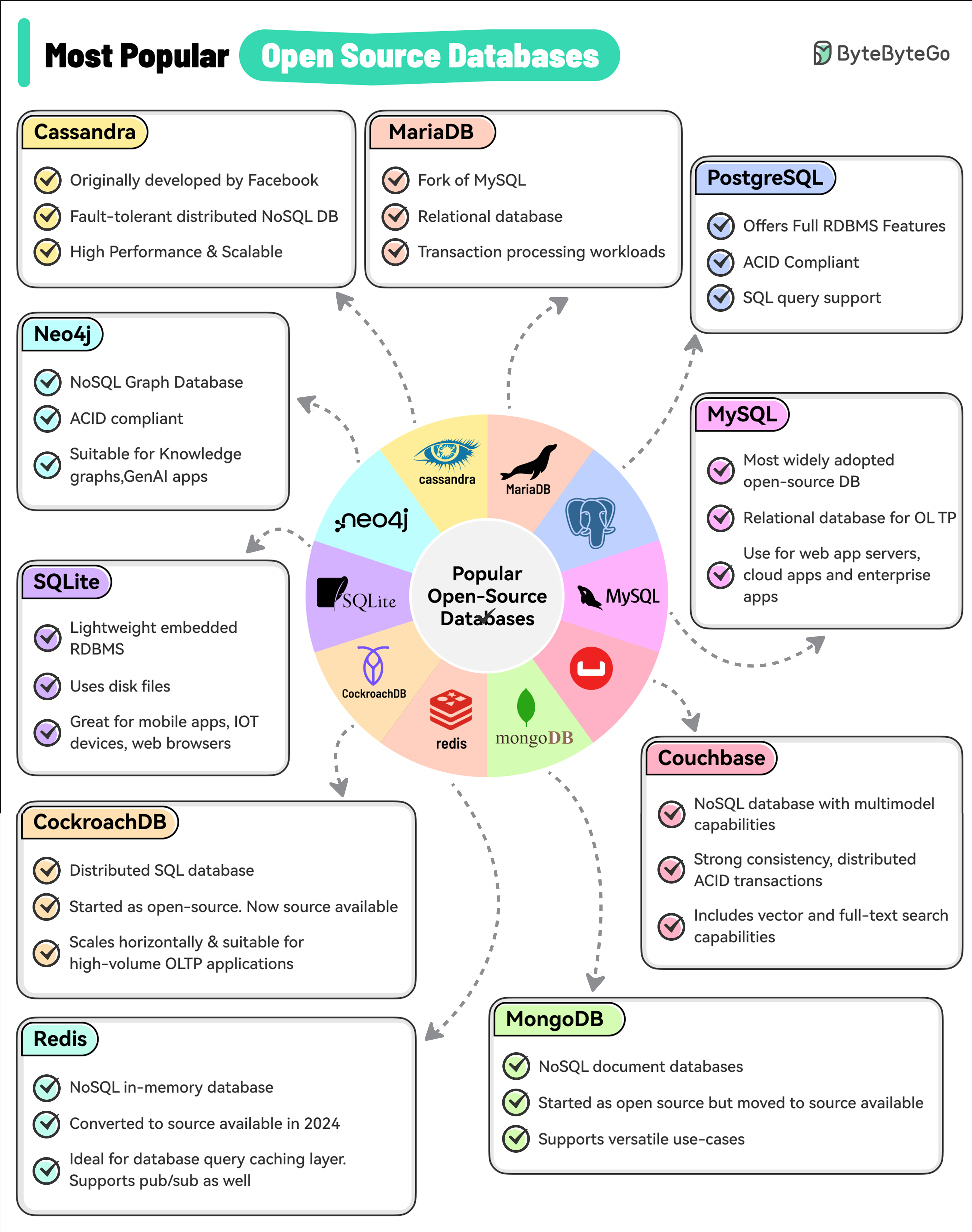
To understand why PostgreSQL earns the top spot, it must be compared against other prominent open-source database engines. Each alternative excels in specific niches but often introduces trade-offs in flexibility, consistency, or operational complexity.
| Database Engine | Primary Paradigm | Best Use Case | License | Core Trade-Off |
|---|---|---|---|---|
| PostgreSQL | Relational / Hybrid JSON | General-purpose, OLTP, GIS, AI vector search | PostgreSQL License | Higher memory tuning complexity at extreme scale |
| MySQL | Relational | Web applications, Read-heavy CMS workloads | GNU GPL v2 | Historically weaker native extension ecosystem and complex subquery optimization |
| MongoDB | Document Store | Rapid prototyping, flexible schemas, content management | SSPL (Source-Available) | Not traditional open-source; weaker multi-document ACID guarantees historically |
| Redis | In-Memory Key-Value | Caching, session management, real-time leaderboards | RSALv2 / SSPL | Data limited by RAM capacity; persistence requires careful tuning |
| Apache Cassandra | Wide-Column NoSQL | Massive write-heavy distributed time-series or logs | Apache 2.0 | Eventual consistency model; complex operational topology |
As illustrated above, while databases like Redis and Cassandra excel in ultra-specific performance niches, they lack the general-purpose utility required for standard application backends. MySQL remains a formidable competitor, particularly in WordPress and LAMP-stack environments, but PostgreSQL offers superior analytical capability, stricter standards compliance, and an unmatched extensibility framework.
Operational Considerations and Performance Tuning
Deploying an open-source database in a production environment requires careful attention to configuration parameters, hardware provisioning, and maintenance routines. Out-of-the-box configurations for PostgreSQL are deliberately conservative to ensure successful boot sequences on minimal hardware, meaning default settings will underperform on modern cloud instances or dedicated bare-metal servers.
Memory allocation represents the single most important tuning vector. Administrators must correctly size the shared_buffers parameter—typically set to roughly 25% to 40% of total available system RAM—to ensure that frequently accessed table data and indexes remain cached in memory. Additionally, work_mem and maintenance_work_mem control the memory allocated for internal sort operations, hash joins, and index creation. Inadequate tuning of these parameters leads to excessive disk spilling, severe I/O bottlenecks, and degraded query response times.
Maintenance is another critical operational pillar. Unlike automated cloud-managed data stores, self-hosted open-source databases require active management of vacuuming processes. PostgreSQL relies on MVCC, which leaves behind dead tuple rows when records are updated or deleted. The autovacuum daemon automatically reclaims this storage space and updates statistics for the query planner, but high-throughput systems demand careful tuning of autovacuum thresholds to prevent table bloat and transaction ID wraparound failures.
Security, High Availability, and Backup Strategies
Securing an open-source database deployment involves configuring network isolation, encryption, and role-based access control. Databases should never be exposed directly to the public internet; they must reside within private virtual subnets protected by strict firewall rules and security groups. Access should be restricted using the principle of least privilege, assigning specific roles to application users rather than sharing superuser credentials.
For high availability (HA), organizations implement replication topologies. PostgreSQL supports streaming replication, where a primary node streams its write-ahead log (WAL) to one or more standby replicas. In the event of a primary node failure, replication tools like Patroni combined with distributed consensus stores (such as etcd) automate failover procedures to minimize downtime.
Disaster recovery planning must also incorporate robust backup routines. Administrators should utilize tools like pg_dump for logical backups of specific schemas or pg_basebackup for physical block-level backups. Backups must be stored offsite or in immutable object storage buckets and tested regularly through routine restoration drills to verify recovery point objectives (RPO) and recovery time objectives (RTO).
Frequently Asked Questions
Is PostgreSQL truly open-source, and are there licensing risks?
Yes. PostgreSQL is distributed under the PostgreSQL License, which is a liberal Open Source Initiative (OSI)-approved license similar to the BSD or MIT licenses. It allows developers and enterprises to use, modify, and distribute the software freely, including in proprietary commercial products, without copyleft obligations forcing source code disclosure.
How does PostgreSQL handle vector embeddings for AI applications?
PostgreSQL handles vector embeddings primarily through the pg_vector extension. This extension allows users to store vector data natively, execute similarity searches using Euclidean distance, cosine distance, or inner product calculations, and combine vector search queries with traditional relational filters in a single SQL statement.
Can PostgreSQL scale horizontally like NoSQL databases?
Out of the box, PostgreSQL is primarily designed for vertical scalability, scaling up CPU, RAM, and disk performance on a single node. However, horizontal scaling for read workloads is achieved easily through streaming replicas. For write scalability, extensions like Citus transform PostgreSQL into a distributed database by sharding tables across multiple nodes.
When should I choose a NoSQL database over PostgreSQL?
You should consider a NoSQL database if your application requires massive, unpredictable horizontal write scaling across global data centers where strict ACID compliance across multiple entities is unnecessary, or if your data structure changes so rapidly and unpredictably that defining a relational schema introduces unnecessary friction.
What are the best tools for managing PostgreSQL migrations?
Schema migrations in production environments are best handled using structured migration management tools such as Flyway, Liquibase, or native framework migrations (like Alembic for Python or Prisma/Knex for Node.js). These tools track migration history in the database, ensuring schema changes are applied idempotently and reproducibly across development, staging, and production environments.
Conclusion and Next Actions
Selecting PostgreSQL as your primary open-source database provides a resilient, standards-compliant foundation capable of handling traditional relational workloads, unstructured JSON documents, spatial data, and modern AI vector embeddings. To get started, provision a test instance using your preferred containerization platform or cloud provider, review the official documentation regarding connection pooling and memory allocation, and design your initial schema with a focus on proper indexing and normalization before expanding into specialized extensions.