A viatical settlement is a contract between a life insurance policyowner and a third-party purchaser, often referred to as a viatical settlement provider, where the policyowner sells their life insurance policy for a lump-sum cash payment that is less than the policy's ultimate death benefit but higher than its current cash surrender value.
Navigating terminal or chronic illness brings profound emotional, medical, and financial challenges. For many individuals, traditional financial resources become strained under the weight of mounting medical bills, experimental treatments, and daily living expenses. While a life insurance policy is traditionally viewed as a financial tool designed to provide for beneficiaries after the insured’s death, it can also function as a liquid asset while the insured is still alive. A viatical settlement provides a mechanism to unlock this value, transforming a future death benefit into immediate, accessible capital.
Understanding the mechanics, legal structures, consumer protections, and financial implications of these transactions requires a thorough examination of how viatical settlements operate. This guide explores the foundational definition of the contract, the regulatory landscape, the eligibility requirements, the financial trade-offs, and alternative options available to policyowners.
Defining the Viatical Settlement Contract
At its core, a viatical settlement is a legal and financial agreement. To fully understand what a viatical settlement is a contract between a life insurance policyowner and a, one must examine the specific parties involved and the mechanics of the transfer.
The transaction involves three primary entities:
- The Policyowner: The individual (who is often also the insured) who owns the life insurance policy and holds the legal right to change beneficiaries, borrow against the policy, or sell it.
- The Viatical Settlement Provider: A licensed third-party entity or company that purchases the life insurance policy, assumes responsibility for paying future premium payments, and eventually collects the death benefit when the insured passes away.
- The Viatical Settlement Broker: In many cases, a licensed intermediary who represents the policyowner, shopping the policy to multiple providers to secure the highest possible offer.
Under the terms of the contract, the policyowner transfers ownership and beneficiary rights of the life insurance policy to the viatical settlement provider. In exchange, the provider pays the policyowner an agreed-upon cash amount. Once the transaction is finalized, the provider becomes responsible for paying all future premiums to keep the policy active. When the insured eventually dies, the provider collects the full face value (death benefit) of the policy from the insurance carrier.
The Distinction Between Viatical and Life Settlements
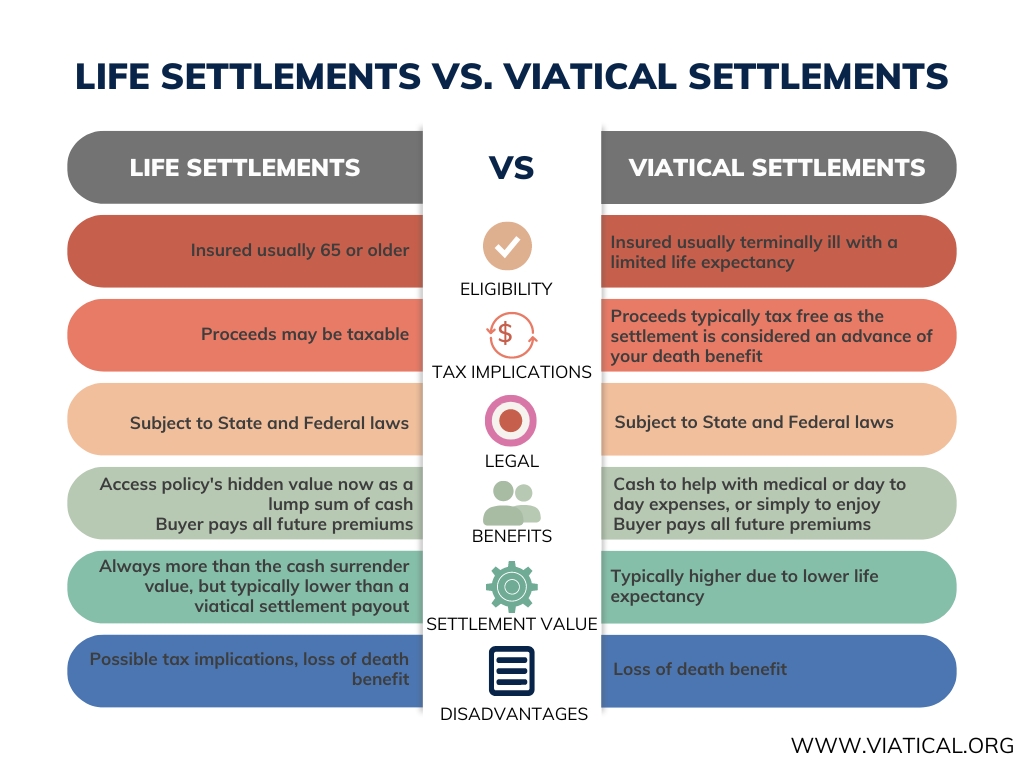
It is essential to distinguish a viatical settlement from a general life settlement, as regulatory frameworks and tax implications differ significantly between the two.
- Viatical Settlement: Involves an insured individual who is terminally or chronically ill (typically with a life expectancy of 24 months or less, depending on state statutes). Because of the medical condition, the payout is often tax-free under federal law.
- Life Settlement: Involves an older healthy or chronically ill senior (usually age 65 or older) who sells a life insurance policy for reasons unrelated to a terminal diagnosis, such as retiring, eliminating expensive premium payments, or restructuring an estate. Life settlement payouts are generally subject to capital gains taxes.
Eligibility Requirements and Qualifying Conditions
Not every life insurance policy or policyowner qualifies for a viatical settlement. Providers and regulatory bodies enforce strict eligibility criteria to ensure consumer protection and to manage the actuarial risk assumed by the purchasing entity.
Medical Criteria
The foundational prerequisite for a viatical settlement is the health status of the insured. Generally, the insured must be diagnosed with a terminal or chronic illness.
- Terminal Illness: A condition that is reasonably expected to result in death within 24 months, as certified by a licensed attending physician.
- Chronic Illness: A condition that creates an inability to perform certain activities of daily living (ADLs)—such as bathing, eating, dressing, or continence—without substantial assistance.
Policy Criteria
Beyond the health of the insured, the life insurance policy itself must meet specific structural requirements:
- Policy Type: Universal life, whole life, and convertible term life insurance policies are typically eligible. Pure non-convertible term policies generally do not qualify unless they can be converted into permanent insurance.
- Policy Age: Most policies must have been active for a specific contestability period, commonly at least two years, to prevent fraudulent acquisitions.
- Face Value: Providers often have minimum policy face value requirements—frequently starting at $100,000—because administrative and legal costs make smaller policies economically unviable.
- Carrier Stability: The insurance company issuing the underlying policy must be financially stable and licensed to operate within the jurisdiction.
The Financial Mechanics: How Offers Are Calculated
The cash payout received by a policyowner in a viatical settlement is rarely equal to the face value of the policy, nor is it equal to the cash surrender value offered by the insurance company. Instead, it falls somewhere in between, usually representing a percentage of the death benefit.
| Factor | Description | Impact on Payout |
|---|---|---|
| Life Expectancy | Estimated time the insured has left to live, determined by medical underwriting. | Shorter life expectancy increases the offer; longer life expectancy decreases the offer. |
| Face Value | The total death benefit payout specified in the policy contract. | Higher face values generally yield higher absolute cash offers. |
| Future Premiums | The ongoing cost to keep the policy active until the insured's mortality. | Higher ongoing premium costs reduce the net present value and lower the settlement offer. |
| Discount Rate | The internal rate of return expected by the viatical settlement provider. | Higher discount rates reduce the cash payout offered to the policyowner. |
Because viatical settlement providers must continue paying premiums for an indeterminate period while waiting for the death benefit to pay out, their calculations account for the time value of money, administrative overhead, and mortality risk. Consequently, policyowners should solicit multiple competing bids through a licensed broker to ensure competitive pricing.
The Step-by-Step Viatical Settlement Process
Entering into a viatical settlement is a formal, heavily regulated transaction designed to protect the policyowner from coercion, fraud, or undervaluation. The process generally follows a standardized sequence of steps.
- Initial Consultation and Assessment: The policyowner or their legal representative consults with a licensed viatical settlement broker or provider to review the policy details, current cash value, and the insured’s medical prognosis.
- Medical and Policy Underwriting: The provider requests medical records and contacts the insurance carrier to verify policy ownership, face value, contestability status, and premium schedules. An independent medical evaluation may be conducted.
- Offer and Negotiation: Based on underwriting data, the provider issues a formal purchase offer. If working with a broker, competing offers from multiple buyers can be compared and negotiated.
- Disclosure and Legal Review: The provider supplies comprehensive written disclosures detailing the exact financial terms, tax implications, alternative options, and the policyowner's statutory rescission rights. Independent legal and financial counsel is strongly recommended at this stage.
- Contract Execution: If the offer is accepted, formal legal contracts are signed by the policyowner, the insured (if different), and the provider.
- Escrow and Funds Transfer: The purchase funds are placed into an independent escrow account. Once the insurance carrier officially acknowledges the ownership and beneficiary change, the escrow agent releases the funds to the policyowner.
Regulatory Protections and Consumer Safeguards
Viatical settlements are strictly regulated at the state level in the United States. The vast majority of states have enacted legislation based on the National Association of Insurance Commissioners (NAIC) Viatical Settlements Model Act.
Key Regulatory Safeguards
- Licensing Requirements: Viatical settlement providers, brokers, and representatives must be licensed by the state insurance commissioner or department of insurance in the state where the policyowner resides.
- Rescission Period: State laws mandate a mandatory cooling-off period (typically 15 to 30 days after the contract is executed, or 15 days from receipt of settlement proceeds) during which the policyowner can cancel the agreement without penalty by returning the funds.
- Privacy Protections: Strict medical and financial privacy rules govern how providers handle the insured's private health information, preventing unauthorized disclosure.
- Disclosure Mandates: Providers must explicitly disclose all fees, commissions, alternative options (such as accelerated death benefits), and potential tax consequences before a contract can be signed.
Tax Implications of Viatical Settlements
For individuals facing serious health challenges, tax consequences are a critical consideration. Under the Health Insurance Portability and Accountability Act (HIPAA) of 1996, proceeds received from a viatical settlement are generally excluded from gross income and are entirely tax-free at the federal level, provided specific statutory conditions are met.
Conditions for Tax-Exempt Status
- Terminal Illness: The insured must be certified by a physician as having an illness or physical condition that can reasonably be expected to result in death within 24 months.
- Chronic Illness: If the insured is chronically ill rather than terminally ill, tax-free treatment applies only if the funds are used directly for costs incurred for qualified long-term care services or if the settlement meets specific statutory accumulation limits.
- Licensed Provider: The settlement must be executed through a viatical settlement provider licensed by the state.
Disclaimer: Tax laws are complex and subject to change based on federal and state jurisdictions. Policyowners should consult a qualified certified public accountant or tax attorney before finalizing a viatical settlement.
Alternatives to Viatical Settlements
Before entering into a viatical settlement contract, policyowners should evaluate alternative financial mechanisms that may preserve the death benefit for beneficiaries while still addressing immediate financial needs.
- Accelerated Death Benefits (ADBs): Many life insurance policies include an accelerated death benefit rider at no additional cost or for a minimal fee. This rider allows the policyowner to withdraw a portion of the death benefit early (often 50% to 80%) directly from the insurance carrier tax-free upon a terminal diagnosis, without selling the policy to a third party.
- Policy Loans: Policyowners with permanent life insurance policies (whole life or universal life) can borrow against the accumulated cash value of the policy. While interest accrues on the loan, the policy remains active as long as sufficient cash value exists to cover premiums and loan interest.
- Surrendering the Policy: The policyowner can surrender the policy directly back to the insurance carrier for its established cash surrender value. While simpler than a viatical settlement, cash surrender values are typically lower than viatical settlement offers.
- Policy Vmo/Reductions: Reducing the face value of the policy can lower ongoing premium requirements, making it easier to maintain coverage without liquidating the asset entirely.
Common Pitfalls and Mistakes to Avoid
Navigating the secondary life insurance market requires vigilance. Policyowners and their families should avoid several common mistakes:
- Failing to Shop Around: Accepting the first offer from a single provider can leave substantial money on the table. Utilizing a licensed broker to solicit competing bids ensures market-rate valuation.
- Working with Unlicensed Entities: Engaging with unregistered buyers or unauthorized brokers strips away statutory consumer protections, exposing the policyowner to fraudulent practices.
- Overlooking Tax Consequences: Assuming all settlements are tax-free without verifying whether the diagnosis meets strict federal definitions for terminal or chronic illness can lead to unexpected tax liabilities.
- Ignoring the Impact on Public Assistance: Liquidating an asset for a large lump sum can alter a policyowner’s eligibility for means-tested government assistance programs, such as Medicaid or Supplemental Security Income (SSI).
Conclusion and Next Actions
A viatical settlement is a contract between a life insurance policyowner and a third-party purchaser that converts a future death benefit into immediate, necessary liquidity for individuals facing severe medical challenges. While it provides a valuable financial lifeline when traditional resources fall short, it requires careful evaluation of medical prognoses, policy terms, alternative options, and regulatory safeguards.
If you or a loved one are considering a viatical settlement, your next steps should include:
- Reviewing your original life insurance policy documents to identify available riders, such as accelerated death benefits.
- Consulting with your attending physician to verify medical qualification and life expectancy documentation.
- Contacting your state’s department of insurance to verify the licensing status of any provider or broker you intend to work with.
- Engaging independent financial, legal, and tax professionals to evaluate the long-term impact of the transaction on your estate and financial well-being.