Tax-free bonds are a strong investment for high-income earners seeking predictable, low-risk income. By exempting interest from federal and sometimes state taxes, they often provide higher effective yields than taxable alternatives for those in the 32% tax bracket or higher, particularly during periods of fiscal policy shifts and economic transition.
The question of whether tax-free bonds—primarily municipal bonds in the United States—constitute a "good" investment depends heavily on an investor's marginal tax rate, their need for capital preservation, and the current interest rate environment of 2026. While they offer lower nominal yields than corporate bonds, their "after-tax" return can be significantly more attractive for those in higher income tiers.
Understanding the Mechanics of Tax-Free Interest
Tax-free bonds are debt securities issued by state and local governments, or their agencies, to fund public projects such as schools, highways, hospitals, and water systems. The primary appeal of these instruments is the federal tax exemption on the interest paid to bondholders. In many cases, if the investor resides in the state where the bond was issued, the interest may also be exempt from state and local income taxes, creating a "double" or even "triple" tax-exempt status.
In the financial landscape of 2026, these bonds remain a cornerstone of conservative portfolio construction. Following the expiration of several tax provisions at the end of 2025, many investors are finding themselves in higher effective tax brackets, which has naturally increased the demand for tax-advantaged income streams.
The Role of the Issuer
The safety and yield of a tax-free bond are tied directly to the issuer's ability to generate revenue or levy taxes.
- General Obligation (GO) Bonds: These are backed by the "full faith and credit" of the issuing municipality, which has the power to tax residents to pay bondholders. They are generally considered the safest form of municipal debt.
- Revenue Bonds: These are backed by the income generated by a specific project, such as a toll bridge or a municipal stadium. While often offering higher yields, they carry the risk that the project may not generate sufficient revenue to meet debt obligations.
The Critical Metric: Tax-Equivalent Yield (TEY)
To determine if a tax-free bond is a superior choice compared to a taxable corporate bond or Treasury note, investors must calculate the Tax-Equivalent Yield (TEY). This formula reveals what a taxable bond would need to pay to equal the yield of a tax-exempt bond after taxes are accounted for.
The standard formula for TEY is: TEY = Tax-Free Yield / (1 – Marginal Tax Rate)
For example, in 2026, if an investor is in the 37% federal tax bracket and is looking at a municipal bond yielding 3.5%, the calculation would be: 0.035 / (1 – 0.37) = 0.0555, or 5.55%.
In this scenario, a taxable corporate bond would need to yield more than 5.55% to be a better financial decision than the 3.5% tax-free bond. For individuals in lower tax brackets (e.g., 12% or 22%), the TEY is often lower than what can be earned in high-quality corporate debt, making tax-free bonds less suitable for their portfolios.
Comparing Tax-Free vs. Taxable Investments in 2026
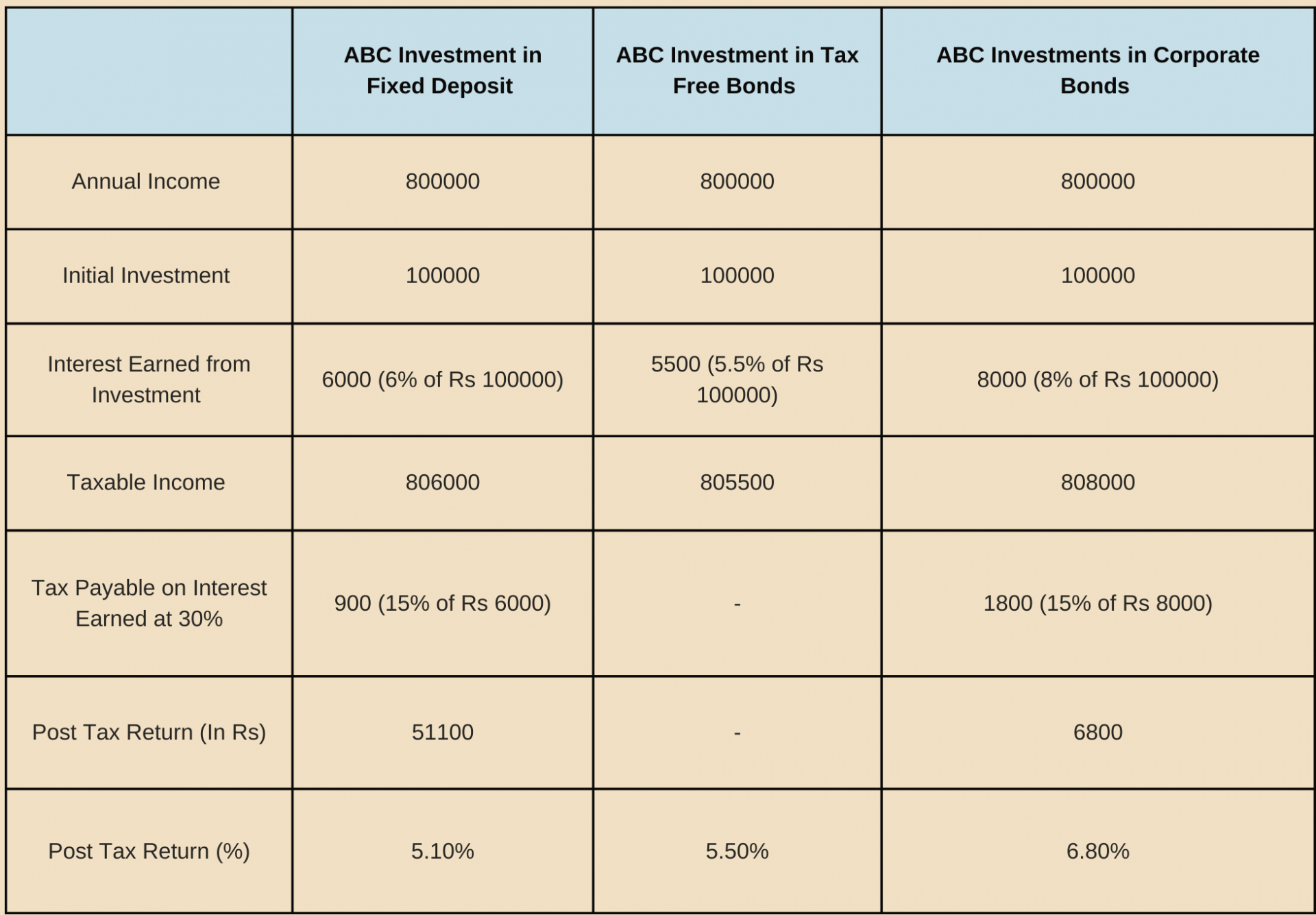
The following table compares the effective yields of tax-free bonds against taxable alternatives across different tax brackets, assuming a hypothetical 4% yield on a municipal bond.
| Investor Tax Bracket | Tax-Free Bond Yield | Tax-Equivalent Yield (TEY) | Minimum Taxable Yield Needed |
|---|---|---|---|
| 12% | 4.00% | 4.54% | > 4.54% |
| 24% | 4.00% | 5.26% | > 5.26% |
| 32% | 4.00% | 5.88% | > 5.88% |
| 35% | 4.00% | 6.15% | > 6.15% |
| 37% | 4.00% | 6.35% | > 6.35% |
Note: These figures assume federal tax rates only. State tax exemptions would further increase the TEY for residents.
Key Advantages of Tax-Free Bonds
1. Superior After-Tax Returns for High Earners
As demonstrated by the TEY calculation, the primary advantage is the retention of more interest income. For a wealthy investor, a tax-free bond yielding 4% can be functionally equivalent to a high-yield corporate bond or a dividend-paying stock, but with significantly lower volatility.
2. Historical Stability and Low Default Rates
Municipal bonds have historically exhibited much lower default rates than corporate bonds of similar credit ratings. According to long-term data from organizations like Moody’s Investors Service, the five-year cumulative default rate for investment-grade municipal bonds is a fraction of a percent. This makes them an ideal "ballast" for a portfolio, providing stability when the equity markets are volatile.
3. Portfolio Diversification
Tax-free bonds often move differently than stocks. In 2026, as investors navigate a post-inflationary environment, the fixed-income sector provides a hedge against market downturns. Because they are driven by different factors (local tax receipts vs. corporate earnings), they offer genuine diversification.
4. Funding Public Good
Beyond financial gain, many investors appreciate that their capital is being used to build essential infrastructure. Whether it is a new regional hospital or a sustainable water treatment plant, tax-free bonds allow for "impact investing" within the fixed-income space.
Potential Risks and Disadvantages
No investment is without risk, and tax-free bonds carry specific nuances that can impact total return if not carefully managed.
Interest Rate Risk
Like all fixed-income securities, bond prices move inversely to interest rates. If market interest rates rise in 2026, the market value of existing bonds with lower coupons will fall. This is particularly relevant for long-term bonds (10–30 years), which have higher "duration" and are more sensitive to rate changes.
Credit Risk
While defaults are rare, they are not impossible. Economic downturns can squeeze municipal budgets, leading to credit downgrades. A downgrade in a bond's credit rating (e.g., from AA to A) will typically cause its market price to drop, even if the issuer continues to make payments.
Inflation Risk
Tax-free bonds pay a fixed rate of interest. If inflation rises significantly, the purchasing power of that fixed interest income declines. In the economic climate of 2026, where cost-of-living adjustments are a major focus, investors must ensure their bond yields stay ahead of the Consumer Price Index (CPI).
The Alternative Minimum Tax (AMT)
Some "private activity" municipal bonds—such as those for airports or industrial development—may be subject to the Alternative Minimum Tax (AMT). For investors subject to the AMT, the tax-free status of these specific bonds is effectively nullified. It is vital to check the "AMT-free" status of a bond or fund before purchasing.
Investment Vehicles: Direct Ownership vs. Funds
Investors have several ways to access the tax-free bond market, each with its own set of pros and cons.
Individual Bonds
Buying individual bonds allows the investor to tailor their portfolio to specific maturities and locations (e.g., buying only bonds from their home state to maximize tax benefits). This strategy eliminates the management fees associated with funds and allows the investor to hold the bond to maturity, ensuring the return of principal regardless of market price fluctuations. However, it requires a significant capital outlay—often $5,000 to $25,000 minimum per bond—and significant research.
Municipal Bond Mutual Funds and ETFs
For most individual investors, mutual funds or Exchange-Traded Funds (ETFs) are the most practical route.
- Diversification: A single fund can hold hundreds of different municipal issues, spreading out credit risk.
- Liquidity: ETFs can be bought and sold throughout the trading day, whereas individual bonds may be difficult to sell quickly in the secondary market.
- Professional Management: Fund managers actively monitor credit quality and interest rate trends.
- Cost: Management fees (expense ratios) are generally low, particularly for passive ETFs.
How to Evaluate a Tax-Free Bond in 2026
When considering an investment, follow these steps to ensure it aligns with your 2026 financial goals:
- Verify Your Tax Status: If you are in the 12% or 22% federal tax bracket, you are likely better off with taxable Treasuries or high-quality corporate bonds. Tax-free bonds become "good" investments primarily when your marginal rate exceeds 24%.
- Check Credit Ratings: Look for ratings from S&P Global or Fitch Ratings. Stick to "Investment Grade" (BBB- or higher) unless you have a high risk tolerance for "High Yield" (junk) municipal debt.
- Assess State Tax Benefits: If you live in a high-tax state like California or New York, the state tax exemption on in-state bonds can add another 50–100 basis points to your tax-equivalent yield.
- Analyze Duration: Ensure the bond's maturity matches your time horizon. If you need the money in five years, do not buy a 20-year bond, as you may be forced to sell at a loss if rates have risen.
- Utilize the EMMA Portal: The Electronic Municipal Market Access (EMMA) system, provided by the Municipal Securities Rulemaking Board (MSRB), offers free access to official statements, trade prices, and credit disclosures for virtually all municipal bonds.
FAQs
Are tax-free bonds really 100% tax-free?
Not necessarily. While the interest is typically exempt from federal income tax, it may still be subject to state and local taxes if you buy bonds issued by a state other than the one in which you reside. Additionally, if you sell a tax-free bond for more than you paid for it, the profit is considered a capital gain and is subject to standard capital gains taxes.
Can the federal government start taxing these bonds in the future?
While there have been occasional legislative proposals to cap the tax preference for municipal interest, the tax-exempt status of municipal bonds is deeply rooted in the principle of reciprocal immunity between federal and state governments. Any change would likely only apply to newly issued bonds, not those already held by investors.
What is the difference between a "Tax-Free" bond and a "Tax-Deferred" account?
A tax-free bond provides income that is never taxed at the federal level. A tax-deferred account, like a traditional 401(k) or IRA, allows you to contribute pre-tax money and grow it without taxes, but the entire withdrawal is taxed as ordinary income later. It is generally not recommended to hold tax-free bonds inside a tax-deferred account, as you are wasting the bond's primary benefit.
How do rising interest rates affect my tax-free bond fund?
When interest rates rise, the net asset value (NAV) of a bond fund typically falls. However, the fund manager can eventually reinvest the proceeds from maturing bonds into new bonds with higher yields, eventually raising the fund's monthly payout.
Is there a risk of the municipality going bankrupt?
While municipal bankruptcies (Chapter 9) do occur—such as the high-profile cases of Detroit or Puerto Rico in previous decades—they are extremely rare compared to corporate bankruptcies. Most municipal issuers have strong incentives and legal requirements to balance their budgets and prioritize debt service.
Final Recommendation
For the 2026 investor, tax-free bonds are an excellent investment if you fall into a high income-tax bracket and prioritize wealth preservation over aggressive growth. They serve as a vital defensive component of a balanced portfolio, offering a level of tax-efficient income that is difficult to replicate elsewhere.
To maximize your results, focus on in-state municipal bond funds to capture the full spectrum of tax exemptions. Monitor your marginal tax rate annually; if your income drops or tax laws change significantly, the relative value of these bonds may shift, necessitating a portfolio rebalance. Always consult with a qualified tax professional to ensure that specific bond issues do not trigger the Alternative Minimum Tax (AMT) for your specific financial situation.