The government of the People’s Republic of China (PRC) is defined as a socialist state under the people's democratic dictatorship, led by the Communist Party of China (CPC). It operates through a unique "dual-track" system where the Party provides ideological and strategic direction while the state apparatus handles administrative execution, all governed by the principle of democratic centralism.
The Constitutional Framework and the "Dual-Track" System
To understand the Chinese type of government in 2026, one must first grasp the foundational constitutional framework that distinguishes it from Western liberal democracies. The Constitution of the People’s Republic of China explicitly states that the leadership of the Communist Party of China is the defining feature of socialism with Chinese characteristics. This is not a system of "checks and balances" between equal branches, but rather a hierarchy where the Party sits atop all other institutions.
The "dual-track" system refers to the parallel existence of Party organs and state organs. For almost every government office, there is a corresponding Party committee or department. While the State Council manages the day-to-day affairs of the country—such as the economy, education, and foreign policy—the Party’s Central Committee and its Politburo set the high-level agenda. In recent years, and continuing into 2026, these two tracks have become increasingly integrated. Many high-ranking officials hold "dual roles," serving as both a government minister and the Party secretary for that same ministry. This ensures that the state's administrative power is always aligned with the Party's political objectives.
This integration is designed to eliminate friction between policy-making and policy execution. By having the Party lead the state, the government can mobilize resources rapidly for long-term projects, such as the "Belt and Road Initiative" or national carbon neutrality targets. However, this also means that the distinction between political will and legal procedure is often blurred, as the law is seen as a tool for governance rather than a constraint on the ruling party’s power.
Democratic Centralism: The Core Operational Logic
The operational backbone of the Chinese government is the principle of "democratic centralism." While often misunderstood by outside observers, this concept is the key to how decisions are made and enforced across the world's most populous nation. Democratic centralism consists of two distinct phases: consultation and execution.
In the "democratic" phase, the Party and state engage in extensive internal consultation. Before a major policy is enacted—such as a new Five-Year Plan—input is gathered from various levels of government, state-owned enterprises, think tanks, and even the "United Front" (a group of eight minor, non-opposition political parties and professional organizations). This stage is intended to ensure that the policy is technically feasible and addresses the concerns of different regions and sectors.
However, once a decision is reached by the central leadership, the "centralism" phase takes over. At this point, all debate must cease, and every level of the government is required to implement the decision without deviation. Subordinates must obey superiors, and the local must obey the central. This "top-down" enforcement is what allows the Chinese government to execute massive infrastructure projects or public health mandates with a speed that few other systems can match. In the 2026 context, this mechanism is being heavily utilized to drive "high-quality development" and technological self-reliance.
The Communist Party of China (CPC) Hierarchy
The CPC is the ultimate source of power in China. As of 2026, its structure remains a rigid hierarchy that filters talent from the grassroots level up to the very top. The organization is vast, with nearly 100 million members, but the actual decision-making power is concentrated in a few key bodies.
- The General Secretary: The highest-ranking official in the Party and the most powerful individual in the country. The General Secretary typically also serves as the President of the PRC (a state role) and the Chairman of the Central Military Commission.
- The Politburo Standing Committee (PSC): Usually consisting of 7 to 9 members, the PSC is the inner sanctum of power. It meets frequently to discuss the most sensitive and urgent national issues.
- The Politburo: A larger group (historically around 25 members) that represents the broader leadership of the Party, including heads of major provinces and key central departments.
- The Central Committee: Consisting of several hundred members, this body meets in "Plenary Sessions" (Plenums) to ratify major shifts in policy and ideology.
The Party's control over the government is exercised through the "Nomenklatura" system. The Party’s Organization Department has the authority to appoint, promote, or dismiss officials in almost every important institution in the country, including universities, state-owned banks, and the courts. This ensures that every person in a position of authority is ultimately accountable to the Party leadership.
The State Council: The Executive Branch
While the CPC sets the direction, the State Council is the "Central People’s Government" and the highest organ of state administration. Led by the Premier, the State Council is responsible for the implementation of laws and the management of the national economy.
The State Council oversees a vast network of ministries and commissions. Key bodies include the National Development and Reform Commission (NDRC), which acts as the "macro-manager" of the economy, and the Ministry of Finance. In 2026, the State Council’s role is increasingly focused on navigating complex global economic shifts and managing the transition to a digital, green economy.
The Premier is traditionally the second- or third-ranking member of the Politburo Standing Committee. While the General Secretary handles ideology and national security, the Premier focuses on the nuts and bolts of administration. However, under the current governance model, the State Council has seen some of its traditional autonomy shifted toward Party-led "Central Leading Groups" or commissions, which are chaired by the General Secretary to ensure direct Party oversight of technical policy areas like finance and cybersecurity.
The National People's Congress (NPC) and Legislative Function
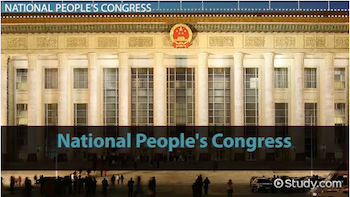
The National People's Congress is technically the "highest organ of state power" under the Constitution. It is a unicameral legislature with nearly 3,000 delegates who meet annually in Beijing for about two weeks in March (the "Two Sessions").
Critics often label the NPC as a "rubber stamp" because it has never rejected a major piece of legislation or a high-level appointment proposed by the Party. However, this view overlooks the NPC's functional role in the Chinese system. The NPC’s Standing Committee (NPCSC) works year-round to draft and refine laws. During this process, there is significant negotiation and technical adjustment. The NPC serves as a forum for local delegates to voice regional grievances and for the government to signal its priorities to the public and the international community.
Legislation in China is generally not the result of partisan competition but of bureaucratic consensus-building. Laws are often drafted in broad terms, giving the State Council and provincial governments significant leeway to issue "implementing regulations" that adapt the law to local conditions.
Comparison of Party and State Functions
To clarify the distinction between the two tracks of Chinese governance, the following table outlines the roles of the primary Party and State entities as of 2026.
| Feature | Communist Party of China (CPC) | State Apparatus (PRC Government) |
|---|---|---|
| Primary Body | Central Committee / Politburo | State Council |
| Top Leader | General Secretary | Premier |
| Primary Mission | Ideology, Strategy, and Personnel | Administration, Economy, and Implementation |
| Authority Source | Party Constitution / Historical Mandate | PRC Constitution / NPC Legislation |
| Military Control | Direct (Party controls the military) | Ceremonial (State CMC) |
| Local Presence | Party Committees (Secretary) | Local Governments (Governor/Mayor) |
| Key Instrument | Discipline Inspection / Nomenklatura | Laws, Regulations, and Budgets |
The Judiciary and the National Supervisory Commission
The Chinese legal system is classified as a civil law system, but it operates without judicial independence as understood in the West. The courts, known as People's Courts, are required to uphold the leadership of the Party. The Supreme People's Court (SPC) is the highest judicial body, responsible for interpreting laws and overseeing the lower courts.
In 2018, a significant change occurred with the creation of the National Supervisory Commission (NSC). This body sits alongside the executive, legislative, and judicial branches and is tasked with anti-corruption and ethics oversight for all public employees—not just Party members. The NSC is closely linked with the Party’s own Central Commission for Discipline Inspection (CCDI). This "dual-office, one-team" approach allows the Party to use the state’s legal machinery to enforce internal discipline, ensuring that corruption does not threaten the Party’s legitimacy.
By 2026, this supervisory system has become a permanent and pervasive feature of Chinese governance. It serves as both a tool for cleaning up the bureaucracy and a mechanism for ensuring absolute political loyalty among civil servants.
The Military: The Party Controls the Gun
A fundamental tenet of the Chinese government type is that the military—the People’s Liberation Army (PLA)—is the armed wing of the Communist Party, not the state. This is encapsulated in the famous phrase: "The Party commands the gun, and the gun must never be allowed to command the Party."
The Central Military Commission (CMC) is the highest authority for all military affairs. While there is both a Party CMC and a State CMC, their memberships are identical, and they function as a single entity. The General Secretary of the CPC serves as the Chairman of the CMC, providing him with direct control over the armed forces. This arrangement prevents the military from becoming an independent political force and ensures that the PLA is fully committed to defending the Party’s rule.
Local Governance and Decentralized Execution
Although the Chinese government is highly centralized in terms of policy and personnel, it is surprisingly decentralized in terms of fiscal expenditure and service delivery. China is divided into provinces, prefectures, counties, and townships.
Local governments are responsible for the vast majority of public spending, including education, healthcare, and infrastructure. This creates a competitive environment where local officials are incentivized to promote economic growth to earn promotions within the Party hierarchy. However, this decentralization also creates challenges, such as the accumulation of "hidden" local government debt and occasional resistance to central environmental mandates. In 2026, the central government is increasingly using digital monitoring and "big data" governance to keep a closer eye on local officials and ensure that national policies are being implemented correctly at the grassroots level.
FAQ
Who is the head of the Chinese government?
The "head of state" is the President, but the most powerful position is the General Secretary of the Communist Party of China. The head of the administrative government (the executive branch) is the Premier of the State Council.
Are there elections in China?
China holds direct elections only at the lowest levels—specifically for Village Committees and Local People's Congresses. Higher-level officials are elected indirectly by the congresses below them. However, all candidates are typically vetted or approved by the Communist Party.
Is the Chinese government a "communist" system?
While the ruling party is the Communist Party and it maintains the ultimate goal of achieving communism, the actual economic and governance model is "Socialism with Chinese Characteristics." This involves a mix of state-controlled strategic sectors and a highly competitive market economy.
How are laws passed in China?
Laws are typically drafted by the State Council or the NPC Standing Committee, often following a "red-headed document" (an internal Party directive). After periods of internal and sometimes public consultation, the law is formally voted on and passed by the National People’s Congress or its Standing Committee.
Can other political parties exist in China?
There are eight "minor" political parties in China, but they are not opposition parties. They exist as part of the "United Front" under the leadership of the CPC and serve an advisory role through the Chinese People’s Political Consultative Conference (CPPCC).
Recommendations for Further Action
For those seeking to engage with or analyze the Chinese government in 2026, it is essential to look beyond formal state titles and identify the Party hierarchies behind them. To stay updated on official policy shifts, one should monitor the outcomes of the CPC Central Committee Plenums and the annual "Two Sessions" of the NPC and CPPCC.
When reviewing Chinese legislation, pay close attention to the "Implementing Regulations" issued by ministries, as these often contain the specific technical details and requirements that affect businesses and individuals. For official English-language updates, the English portal of the State Council of the PRC remains the primary source for administrative announcements and government white papers.