An Approved Scanning Vendor (ASV) is an organization certified by the Payment Card Industry Security Standards Council (PCI SSC) to perform external vulnerability scans. These scans are a mandatory requirement for businesses that store, process, or transmit cardholder data, ensuring that their internet-facing systems are resilient against external cyber threats and meet PCI DSS compliance standards.
In 2026, the landscape of payment security is more complex than ever, driven by the widespread adoption of PCI DSS v4.0.1 and the continued evolution of cloud-native environments. Understanding ASV security is no longer just a checkbox for compliance; it is a critical component of a proactive defense strategy. This guide provides an in-depth exploration of what ASVs are, how the scanning process works, and how organizations can maintain a secure and compliant external perimeter.
What is an Approved Scanning Vendor (ASV)?
An Approved Scanning Vendor is a service provider that has been rigorously vetted and authorized by the PCI SSC to validate the security of an organization’s external-facing infrastructure. To become an ASV, a firm must undergo an annual qualification process, which includes testing their scanning tools for accuracy and ensuring their staff possesses the technical expertise to interpret complex vulnerability data.
The primary role of an ASV is to conduct quarterly external vulnerability scans of an entity’s "external-facing" systems. These include any point of entry from the internet that could potentially provide a path to the Cardholder Data Environment (CDE). In the current 2026 security environment, this definition has expanded to include not only traditional web servers and firewalls but also cloud APIs, serverless functions, and third-party gateways.
The PCI SSC maintains a list of currently qualified ASVs. It is essential for merchants and service providers to select a vendor from this official list, as scans performed by non-approved entities do not satisfy PCI DSS Requirement 11.3.2.
The Regulatory Framework: PCI DSS v4.0 and ASV Requirements
The requirement for ASV scans is codified in the Payment Card Industry Data Security Standard (PCI DSS). As of 2026, the industry has fully transitioned to the version 4.0 series of the standard, which emphasizes outcome-based security and continuous monitoring over "point-in-time" compliance.
Requirement 11.3.2
Under PCI DSS v4.0, Requirement 11.3.2 (which succeeded Requirement 11.2.2 in older versions) mandates that external vulnerability scans must be performed at least once every three months (quarterly) and after any "significant change" to the environment. These scans must be conducted by a PCI SSC Approved Scanning Vendor.
A "significant change" might include:
- Installing new network equipment or servers.
- Modifying firewall rules or network topology.
- Updating major software versions or operating systems.
- Migrating workloads between cloud regions or providers.
The Objective of the ASV Scan
The overarching goal is to identify vulnerabilities that could be exploited by an external attacker to gain unauthorized access to the network or cardholder data. Unlike internal scans, which look for lateral movement risks within the network, ASV scans focus on the "perimeter"—the digital front door of the organization.
The ASV Scanning Process: A Step-by-Step Breakdown
The ASV scanning process is a structured workflow designed to ensure that no critical asset is overlooked. While the specific interface of an ASV tool may vary, the methodology remains standardized according to the PCI SSC's ASV Program Guide.
1. Scoping the Environment
The most critical—and often most difficult—phase is scoping. The merchant or service provider is responsible for providing the ASV with a complete list of all internet-facing IP addresses and domains that are "in scope." This includes any component that provides a path to the CDE or could impact the security of the CDE if compromised.
In 2026, scoping must account for:
- Static and Dynamic IPs: Ensuring that load-balanced environments and auto-scaling cloud groups are fully captured.
- Third-Party Services: Determining if subdomains hosted by third parties are relevant to the organization’s security posture.
- Ephemeral Assets: Identifying containers or temporary staging environments that might be exposed to the internet.
2. The Scanning Phase
Once the scope is defined, the ASV uses its proprietary scanning engine to probe the targets. The scan looks for open ports, identifies running services, and checks for known vulnerabilities, misconfigurations, and outdated software versions. ASV scans are generally "non-disruptive," meaning they are designed not to crash services or cause downtime, though they do generate significant network traffic.
3. Analysis and Reporting
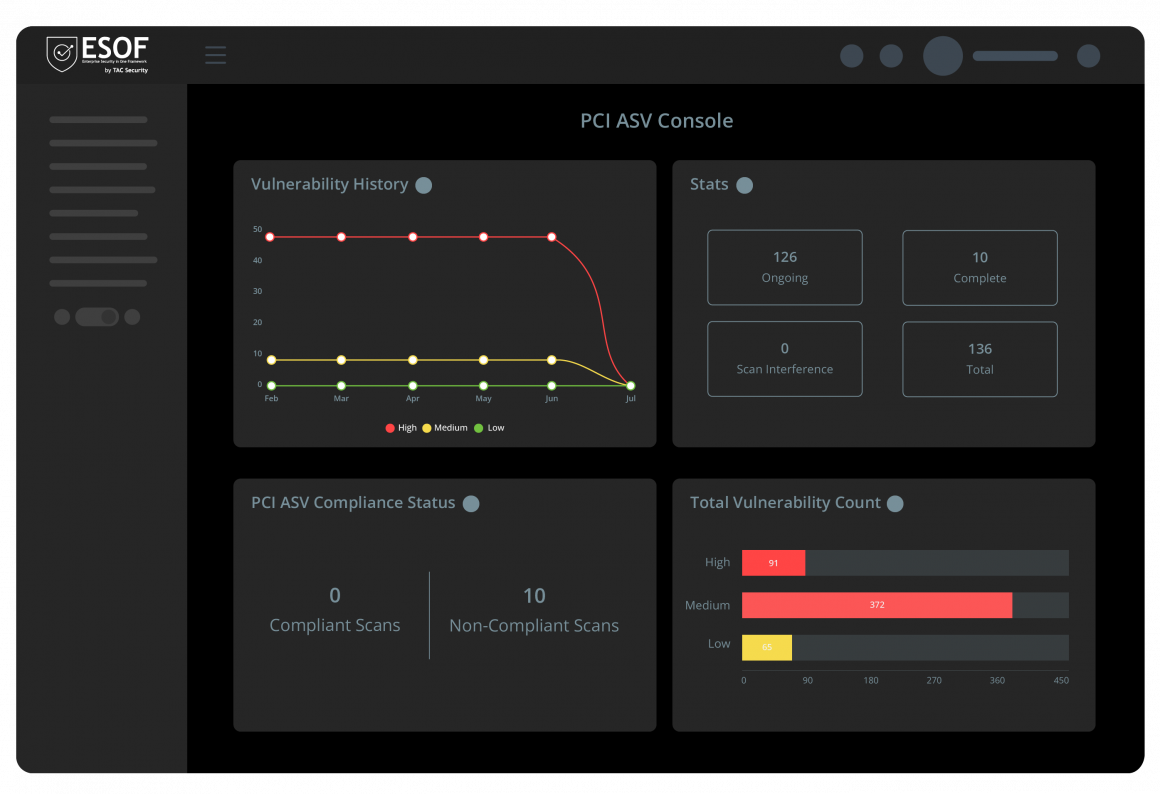
After the raw data is collected, the ASV tool analyzes the findings against the Common Vulnerability Scoring System (CVSS) and the PCI SSC's specific "Pass/Fail" criteria. The results are compiled into a draft report. This report classifies vulnerabilities based on their severity and provides guidance on remediation.
4. Dispute Resolution and Remediation
If the scan identifies vulnerabilities that result in a "Fail," the organization must address them. This can happen in two ways:
- Remediation: The organization fixes the flaw (e.g., patches a server or updates a TLS configuration) and the ASV performs a rescan.
- Dispute: The organization provides evidence that the vulnerability is a "false positive" or that a compensating control is in place that mitigates the risk. The ASV must review and formally accept these disputes.
5. Final Attestation
Once all "Fail" items are resolved or successfully disputed, the ASV issues an Attestation of Scan Compliance (ASOC). This document, signed by both the ASV and the scanned entity, serves as the official proof of compliance for banks, acquirers, and PCI auditors.
Understanding ASV Scan Results: Pass vs. Fail Criteria
A "clean" scan result is not necessarily one with zero vulnerabilities; rather, it is a result that contains no "High" or "Critical" vulnerabilities as defined by the PCI SSC. In 2026, the thresholds for passing an ASV scan are strictly enforced.
| Vulnerability Type | CVSS Score Threshold | PCI Status |
|---|---|---|
| High/Critical Risk | 4.0 and Above | Fail |
| Low/Medium Risk | Below 4.0 | Pass (but remediation recommended) |
| Automatic Fail Items | Any Score | Fail (e.g., use of Telnet, expired SSL) |
| Information Disclosure | Variable | Fail (if sensitive data is leaked) |
Automatic Failures Regardless of Score
Certain configurations are considered so inherently risky that they result in an automatic failure, even if the individual CVSS score for the underlying software is low. These include:
- Insecure Protocols: Use of deprecated protocols like SSL v2/v3, TLS 1.0, or TLS 1.1.
- Default Credentials: Discovery of default passwords on administrative interfaces.
- SQL Injection: Any evidence of SQLi or other high-impact web application flaws.
- Unsupported Software: Operating systems or web servers that have reached "End of Life" (EOL) and no longer receive security updates.
ASV vs. Internal Vulnerability Scans: Key Differences
It is a common misconception that an ASV scan can replace an internal vulnerability scan, or vice versa. PCI DSS v4.0 requires both, as they serve different purposes within a defense-in-depth strategy.
External ASV scans are performed from outside the network, simulating the perspective of an external hacker. They are restricted to public-facing IPs. Internal scans, required under PCI DSS 11.3.1, are performed from within the network perimeter and focus on vulnerabilities that could be exploited by a malicious insider or an attacker who has already breached the perimeter.
Furthermore, while internal scans can be performed by qualified internal staff using commercial tools, ASV scans must be performed by an external, PCI-approved third party to ensure objectivity and standardized reporting.
Selecting the Right Approved Scanning Vendor in 2026
With many vendors on the PCI SSC approved list, organizations must choose a partner that aligns with their technical infrastructure. When evaluating an ASV, consider the following factors:
- Cloud Native Support: Does the vendor’s tool integrate with AWS, Azure, or Google Cloud APIs for automated discovery of assets? This is vital in 2026 to prevent "shadow IT" from remaining unscanned.
- False Positive Rates: Some scanning engines are more prone to false positives than others. A vendor with a high-quality engine and an efficient dispute resolution process will save the security team significant time.
- Integration Capabilities: Can the ASV results be pushed directly into your Vulnerability Management (VM) platform or SIEM?
- Pricing Structure: Some vendors charge per IP address, while others offer "unlimited" scanning for a flat annual fee. For companies with dynamic cloud environments, a flat-fee model is often more predictable.
Common Challenges and Troubleshooting ASV Compliance
Achieving a passing ASV scan is often a journey of trial and error. Several common roadblocks can prevent a successful attestation.
Scoping Oversights
The most frequent cause of audit failure is an incomplete scope. If an auditor or an acquiring bank discovers an internet-facing IP belonging to the organization that was not included in the ASV scan, the entire compliance status may be invalidated. Organizations should use automated discovery tools to maintain an accurate inventory of their external attack surface.
Load Balancers and WAFs
Web Application Firewalls (WAFs) and load balancers can sometimes interfere with ASV scans. If a WAF blocks the ASV's scanning IP, the scan might return "clean" results because the scanner couldn't see the underlying vulnerabilities. The PCI SSC requires that ASV scans be performed in a way that allows the scanner to see the actual state of the target—this often requires "whitelisting" the ASV's IP addresses at the WAF level.
Persistent Low-Level Findings
While a CVSS score of 3.5 is technically a "Pass," allowing low-level vulnerabilities to accumulate can lead to "vulnerability chaining," where an attacker combines multiple minor flaws to achieve a major breach. Leading organizations in 2026 treat the ASV report as a minimum baseline and strive to remediate all findings, regardless of score.
The Cost of ASV Security in 2026
The cost of ASV scanning has stabilized in recent years but remains a notable budget item for small to mid-sized enterprises (SMEs). For a small merchant with a single static IP, an annual ASV subscription might cost between $200 and $500. For large enterprises with thousands of IP addresses across global data centers, the cost can reach tens of thousands of dollars.
However, these costs are negligible compared to the potential fines and costs of a data breach. In 2026, non-compliance fines from card brands (Visa, Mastercard, etc.) for failing to provide quarterly ASV reports can exceed $5,000 per month, increasing over time.
Next Actions for Organizations
To ensure continuous compliance and robust security, organizations should follow these steps:
- Verify the Current Vendor: Check the PCI SSC official list to ensure your current vendor is still qualified for 2026.
- Automate Scoping: Implement an attack surface management tool to automatically update the ASV scope whenever a new cloud resource is provisioned.
- Schedule Early: Do not wait until the end of the quarter to run a scan. Perform the initial scan in the first month of the quarter to allow ample time for remediation and rescan if a "Fail" occurs.
- Integrate with DevOps: Ensure that any "significant change" in the CI/CD pipeline triggers an automated request for an ad-hoc ASV scan.
By treating ASV security as a continuous process rather than a quarterly chore, organizations can protect their customers' data and maintain their standing in the global payment ecosystem.
Frequently Asked Questions
Do I need an ASV scan if I don't store cardholder data?
Yes, if you process or transmit cardholder data, you are likely required to perform ASV scans. Even if you use a third-party payment gateway and "redirect" customers to their site, your web server is still in scope because it could be compromised to redirect customers to a malicious site (a "Magecart" style attack). This is explicitly covered under PCI DSS Self-Assessment Questionnaires (SAQs) such as SAQ A-EP.
How long is an ASV scan report valid?
A passing ASV scan report is valid for three months (one quarter). To maintain compliance, you must have four passing quarterly scans for each 12-month period. Additionally, any significant change to your network requires a new scan, even if the previous one was performed recently.
What happens if I fail an ASV scan?
If your scan identifies a vulnerability with a CVSS score of 4.0 or higher, you will receive a "Failing" report. You must remediate the vulnerability and perform a rescan until you receive a "Passing" result. You cannot submit a failing report to your acquirer as proof of compliance.
Can I dispute a vulnerability as a false positive?
Yes. If you believe the ASV tool has incorrectly identified a vulnerability, you can submit a dispute. You must provide technical evidence (such as configuration files or screenshots) proving that the vulnerability does not exist or is mitigated by other controls. The ASV has the final authority to accept or reject the dispute based on PCI SSC guidelines.
Is an ASV scan the same as a penetration test?
No. An ASV scan is an automated, high-level vulnerability scan that identifies known flaws. A penetration test (required by PCI DSS Requirement 11.4) is a manual, in-depth exercise where a security professional attempts to actively exploit vulnerabilities to gain access to the environment. An ASV scan is a prerequisite for a healthy security posture, but it does not replace the need for a deep-dive penetration test.