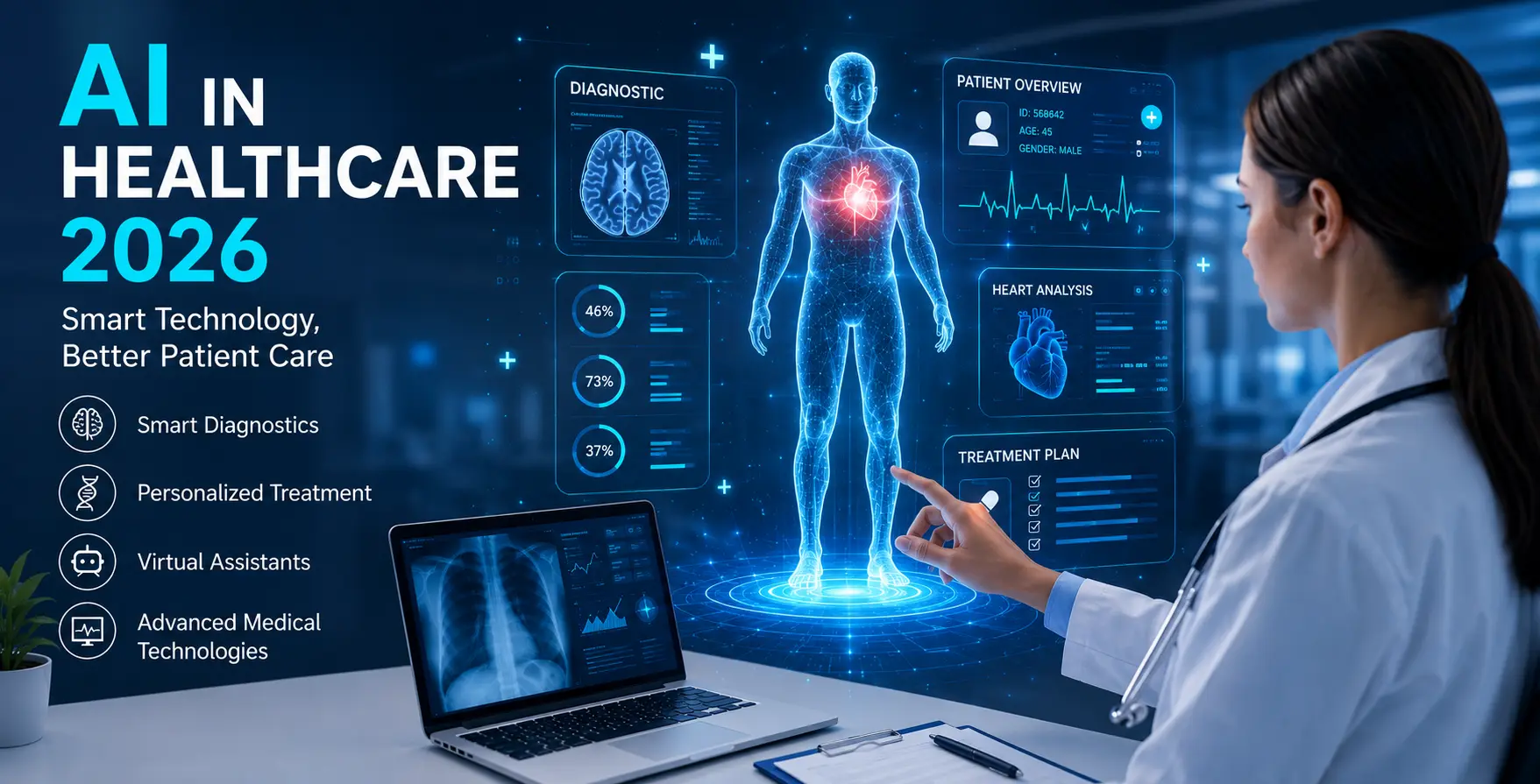
Artificial Intelligence in healthcare refers to the application of complex algorithms and software to emulate human cognition in the analysis, interpretation, and comprehension of medical and clinical data. In 2026, these innovations focus on enhancing diagnostic accuracy, automating administrative burdens, and personalizing treatment plans through predictive analytics, fundamentally shifting how practitioners deliver patient care.
The Landscape of Artificial Intelligence in Modern Medicine
Artificial Intelligence (AI) has transitioned from an experimental technology to an integrated component of clinical infrastructure. By 2026, the primary objective of AI in healthcare is not to replace human decision-making but to augment the capabilities of clinicians by processing vast quantities of unstructured data—such as medical imaging, genomic sequences, and electronic health records (EHR)—at speeds impossible for human cognition alone.
The integration of AI typically occurs across three distinct pillars: clinical decision support, operational efficiency, and patient engagement. Clinical decision support utilizes machine learning models to identify anomalies in radiology or pathology, flagging potential issues for physician review. Operational efficiency involves the use of natural language processing (NLP) to transcribe patient encounters, automate billing coding, and manage scheduling. Patient engagement utilizes remote monitoring tools and AI-driven chatbots to manage chronic conditions outside the hospital environment.
Diagnostic Accuracy and Medical Imaging
One of the most mature applications of AI is in medical imaging, specifically radiology and pathology. Algorithms trained on millions of annotated images can detect patterns that are often imperceptible to the human eye, such as early-stage microcalcifications in mammography or subtle changes in lung tissue suggestive of malignancy.
In 2026, the workflow for a radiologist involves a "human-in-the-loop" verification system. The AI scans the imaging study first, prioritizing the worklist to surface critical cases—such as intracranial hemorrhages or pneumothorax—for immediate attention. This prioritization, known as "triage AI," drastically reduces the time between image acquisition and life-saving intervention.
However, the efficacy of these tools depends entirely on the quality of the training data. A common challenge remains the "black box" nature of deep learning models, where the decision-making path of the algorithm is not transparent. To address this, regulatory bodies like the U.S. Food and Drug Administration (FDA) have implemented stringent requirements for algorithmic transparency and validation, ensuring that these tools remain secondary to the physician's diagnostic judgment.
Operational Efficiency and Reducing Clinician Burnout
Healthcare systems globally face a crisis of administrative burden. According to industry reports from 2025 and 2026, practitioners spend nearly one-third of their time on documentation. AI-powered ambient clinical intelligence is actively mitigating this by utilizing high-fidelity microphones and advanced speech-to-text models to document the physician-patient conversation in real-time.
This technology automatically extracts relevant clinical data, creates structured clinical notes, and suggests ICD-10/11 medical codes for billing. By removing the need for manual data entry, these systems allow providers to focus on direct patient interaction, theoretically improving both the quality of care and the patient experience.
Predictive Analytics and Patient Risk Stratification
Predictive analytics uses historical patient data to forecast future health events. By analyzing trends in vital signs, laboratory results, and demographic data, AI can predict the onset of sepsis, cardiac arrest, or readmission risk.
These models are integrated directly into the EHR, alerting the clinical team to changing patient status before physiological decline becomes clinically obvious. For example, a patient in a medical-surgical unit may trigger an alert if their trajectory of oxygen saturation and heart rate deviates from established norms. This shift from reactive to proactive care is a hallmark of modern hospital medicine, significantly reducing mortality rates in intensive care settings.
Table: Comparison of AI Applications in Healthcare
| Application Area | Primary Technology | Key Benefit | Typical User |
|---|---|---|---|
| Medical Imaging | Computer Vision (CNN) | Enhanced diagnostic precision | Radiologists |
| Documentation | Natural Language Processing | Reduced administrative time | All Clinicians |
| Predictive Care | Machine Learning (RNN) | Early intervention/Sepsis alert | ICU Teams |
| Genomics | Pattern Recognition | Precision medicine mapping | Geneticists |
| Virtual Triage | Chatbots/NLP | 24/7 patient accessibility | Primary Care |
Precision Medicine and Genomics
AI innovations have accelerated the field of precision medicine, which tailors treatments to the individual characteristics of each patient. Instead of a "one-size-fits-all" approach, AI models analyze a patient’s genomic profile alongside clinical trial data and molecular studies to determine the most effective therapy.
In oncology, this is particularly transformative. AI algorithms can identify specific mutations within a tumor and match them with targeted therapies or immunotherapies that have shown success in clinical trials. This reduces the time spent on "trial-and-error" prescribing, where patients might receive ineffective chemotherapy drugs that cause significant side effects. By 2026, the integration of multi-omics data—incorporating genomics, proteomics, and metabolomics—represents the next frontier for AI-driven oncology protocols.
Regulatory Oversight and Data Privacy
The deployment of AI in healthcare is subject to rigorous oversight. In 2026, the ethical and legal frameworks governing AI emphasize data privacy, security, and algorithmic bias. Regulations like the Health Insurance Portability and Accountability Act (HIPAA) in the United States and the General Data Protection Regulation (GDPR) in Europe mandate that data used for training AI must be de-identified and handled with the highest levels of cybersecurity.
Algorithmic bias is a critical area of concern. If an AI is trained on a dataset that does not represent the demographic diversity of the population it serves, its predictive power may be skewed, leading to disparate outcomes. Developers are now required to perform "bias audits," testing models against various ethnicities, socioeconomic backgrounds, and age groups to ensure equitable performance.
Practical Implementation: What Providers Need to Know
For healthcare organizations looking to adopt AI solutions, the process involves more than simply installing software. It requires a robust digital infrastructure.
- Requirement Assessment: Before implementation, organizations must define the specific clinical pain point. AI is most effective when it solves a discrete, data-heavy problem.
- Infrastructure Readiness: The facility must have a cloud-capable EHR system capable of handling the high-bandwidth requirements of AI processing.
- Governance: A multidisciplinary team including clinicians, IT specialists, and legal counsel must be established to oversee the ethical use and performance of the AI tool.
- Continuous Monitoring: AI models can suffer from "data drift," where their performance degrades as clinical practices or patient demographics change over time. Ongoing validation against ground-truth data is essential.
Frequently Asked Questions (FAQ)
1. Does AI replace the need for human diagnosis? No. In 2026, AI is classified as a decision-support tool. It provides data-driven suggestions, but the final diagnostic and treatment decisions remain the responsibility of the licensed medical professional.
2. How is patient data protected during AI training? AI vendors typically use federated learning or de-identified datasets that comply with HIPAA and GDPR. These methods allow algorithms to "learn" from patterns without accessing or exposing personally identifiable information (PII).
3. What is the biggest hurdle to AI adoption in hospitals? The primary hurdle is often the lack of interoperability between different EHR systems. If an AI tool cannot seamlessly exchange data with the hospital's existing software, its utility is significantly diminished.
4. Can AI help in resource-constrained or rural clinics? Yes. AI-powered diagnostic tools, such as mobile-based skin cancer screening or automated retinal exams for diabetic retinopathy, allow providers in underserved areas to perform screenings that would otherwise require a specialist referral.
5. How do I verify if an AI product is safe? Look for regulatory clearance, such as the FDA’s 510(k) clearance or PMA (Premarket Approval) for medical devices in the U.S., or CE marking in Europe. Always review the product's clinical validation studies published in peer-reviewed journals.
Next Steps for Implementation
If you are a healthcare administrator or practitioner, your first action should be to conduct an internal audit of your current data workflows. Identify the most time-consuming administrative task or the diagnostic area with the highest variability. Once identified, look for vendors that provide validated, peer-reviewed AI solutions with established, transparent regulatory documentation. Start with a pilot program in a single department to measure the impact on clinical outcomes and provider efficiency before scaling across the organization.