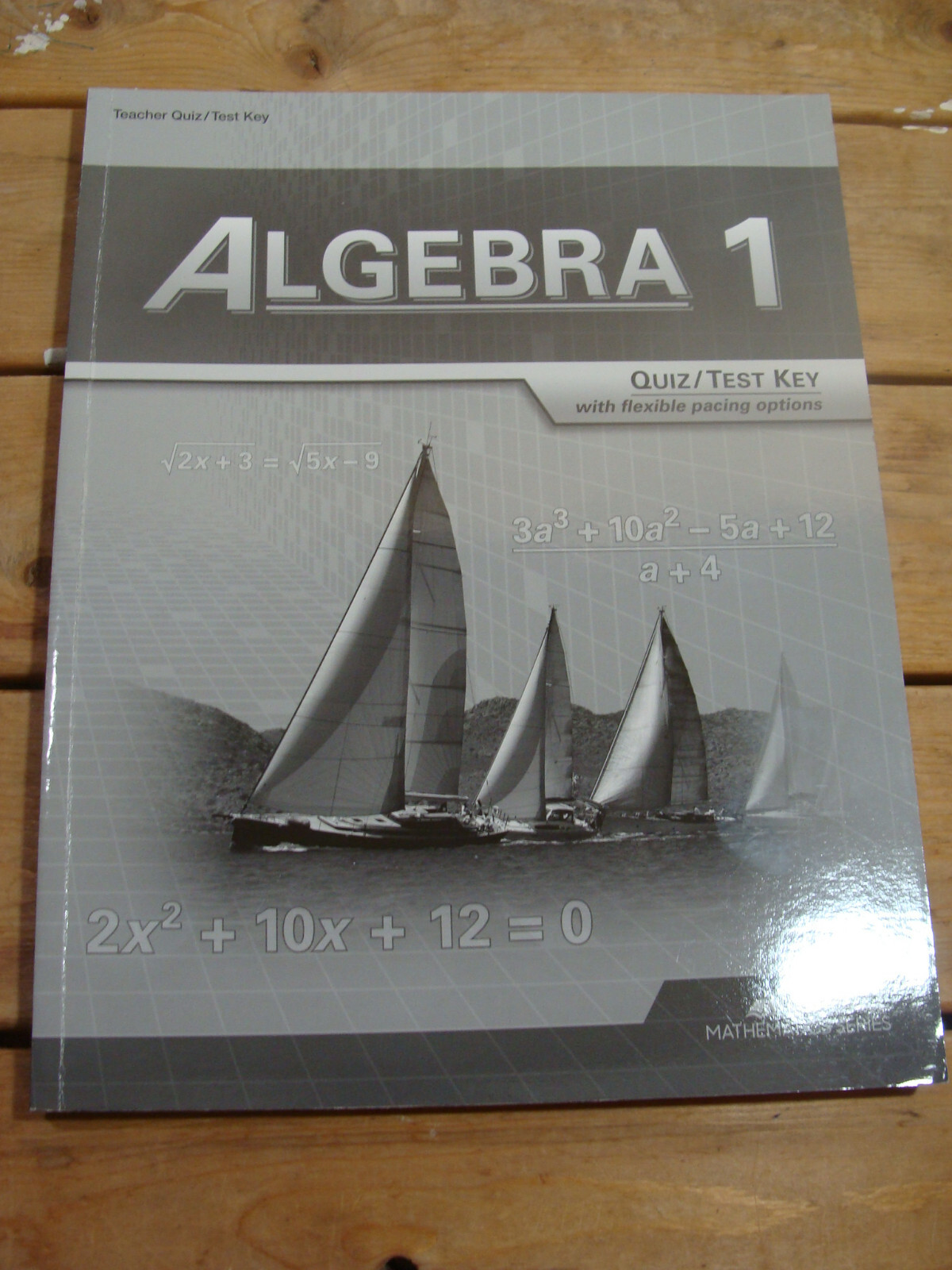
Abeka Algebra 1 provides a rigorous, traditional foundation in mathematical logic and problem-solving essential for secondary education. Achieving high school success with this curriculum requires consistent daily practice, a strong grasp of pre-algebraic concepts, and the strategic use of Abeka’s teacher-led resources to navigate its fast-paced, spiral approach to mathematical learning.
The Foundation of Abeka Algebra 1: Methodology and Philosophy
To understand how to succeed with Abeka Algebra 1, one must first understand the pedagogical philosophy that drives it. Abeka uses a traditional, teacher-directed approach rooted in the "spiral" method of learning. Unlike mastery-based programs that focus on one concept until it is fully conquered before moving on, the spiral method introduces a concept, provides practice, moves to a new topic, and then circles back to the original concept repeatedly throughout the year.
For high school students, this means that Algebra 1 is not just about learning new functions; it is about constant reinforcement. Success in this environment depends on the student’s ability to handle frequent transitions between different types of mathematical operations. The 2026 academic landscape continues to see Abeka as a premier choice for families seeking a structured, disciplined curriculum that emphasizes absolute truths in mathematics. The curriculum views math as a tool to understand the orderly universe, which translates into a highly organized textbook structure that rewards students who follow systematic steps.
The rigor of Abeka Algebra 1 is often cited as its defining characteristic. It covers a vast array of topics, including radical expressions, quadratic equations, and statistics, often introducing them earlier or in more depth than standard public school curricula. This depth ensures that a student who completes the course successfully is exceptionally well-prepared for Geometry and Algebra 2.
Prerequisites for Algebra 1 Success
Before a student opens the Abeka Algebra 1 textbook, certain foundational skills must be solidified. High school success is often determined not by the student's ability to learn new algebra, but by their proficiency in the arithmetic that supports it.
Mastery of Pre-Algebraic Concepts
A student should have a firm command of "Pre-Algebra" topics, specifically those covered in Abeka’s Grade 8 program. This includes a deep understanding of integers, fractions, decimals, and percentages. If a student struggles to add or subtract negative numbers or find a least common multiple, the fast-paced nature of Algebra 1 will quickly become overwhelming.
Logical Reasoning and Discipline
Algebra is the first time many students encounter abstract reasoning where "x" represents an unknown. This requires a shift from concrete arithmetic to symbolic logic. Successful students are those who are willing to show their work step-by-step. Abeka’s grading rubrics heavily favor the process over the final answer, meaning a student who is disciplined enough to write down every line of an equation is more likely to identify their own errors and achieve higher scores.
Essential Components of the Abeka Algebra 1 Program
To maximize success, it is vital to use the correct materials. Using the textbook in isolation is a common mistake that leads to frustration. In 2026, the comprehensive suite of Abeka materials remains the gold standard for full implementation.
- The Student Textbook: This is the primary source of instruction and practice. It contains clear explanations, worked-out examples, and tiered practice sets (usually categorized by difficulty).
- The Teacher Edition: This is indispensable for parents or tutors. It includes lesson plans, teaching tips, and the "Daily Lesson" outlines that keep the student on track to finish the course within a standard 170–180 day school year.
- The Solution Key: Distinct from the Answer Key, the Solution Key provides the step-by-step breakdown of how to solve every problem in the textbook. This is a critical tool for troubleshooting when a student reaches an incorrect conclusion.
- Tests and Quizzes: Abeka’s assessment schedule is rigorous. Frequent quizzes ensure that gaps in knowledge are identified before they become major hurdles during a unit test.
The Role of Abeka Academy (Video Streaming)
For many families, the "Abeka Academy" video streaming service is the key to high school success. These recorded lessons feature master teachers who explain complex concepts with clarity and enthusiasm. For a subject as technical as Algebra 1, having a professional instructor model the problem-solving process can bridge the gap for students who find the textbook explanations too dense.
Strategies for Daily Success and Retention
Success in Abeka Algebra 1 is built in the daily margins. Because the curriculum is "spiral," missing a single day can make the next three days more difficult.
Implementing the "Review, New, Practice" Cycle
Every Abeka lesson follows a specific rhythm. The first ten to fifteen minutes are typically dedicated to review. Students should never skip this. The review sessions are designed to keep older concepts (like factoring polynomials) fresh while the student is learning newer concepts (like radical equations).
When encountering "New Material," students should actively take notes. Writing down the example problems as the teacher or textbook explains them creates a kinesthetic link to the material. Finally, the "Practice" section should be completed in a quiet environment. If a student finds the practice problems too easy, they should move to the "Sharpening Your Skills" or "Advanced" sections to ensure they are being sufficiently challenged.
Handling Word Problems and Real-World Application
Abeka places a significant emphasis on "Problem Solving," which often takes the form of word problems. These are frequently the most difficult aspect of the course for high schoolers. To succeed, students should adopt a "Translate and Solve" strategy:
- Identify the unknown and assign a variable.
- Translate "is" to an equals sign (=).
- Translate phrases like "more than" or "less than" into addition or subtraction.
- Draw a diagram whenever possible, especially for distance/rate/time problems.
Comparing Abeka Algebra 1 to Other Curricula
Choosing the right curriculum involves understanding how Abeka stacks up against competitors. This table highlights the differences between Abeka and other popular high school math options available in 2026.
| Feature | Abeka Algebra 1 | Saxon Algebra 1 | Math-U-See (Algebra 1) |
|---|---|---|---|
| Primary Method | Spiral / Traditional | Incremental / Spiral | Mastery / Conceptual |
| Instructional Tone | Teacher-Directed / Rigorous | Self-Directed / Repetitive | Video-Led / Visual |
| Difficulty Level | High | Moderate to High | Moderate |
| Religious Integration | Strong (Biblical Worldview) | Neutral | Neutral (usually) |
| Parental Involvement | High (without video) | Low to Moderate | Low to Moderate |
| Assessment Frequency | High (Daily/Weekly) | Moderate (Weekly) | Flexible |
As the table illustrates, Abeka is best suited for students who thrive in a structured environment and need the constant reinforcement of a spiral approach. It is generally more demanding than Math-U-See but provides a more traditional classroom-style experience than Saxon.
Overcoming Common Obstacles in Algebra 1
Even the most diligent students will hit "the wall" at some point in Algebra 1. Common friction points include systems of equations, quadratic formulas, and functions.
Identifying "Gaps" Early
If a student begins failing quizzes, it is usually a sign of a "gap" in foundational knowledge rather than a lack of effort. In 2026, many educators recommend going back two or three chapters to see where the logic broke down. For example, if a student cannot solve a system of equations, the problem may actually be their inability to isolate a variable—a skill taught weeks earlier.
Using Supplemental Resources
While Abeka is comprehensive, some students benefit from seeing a concept explained in a different way. Using resources like Khan Academy or specialized math tutoring can provide the "lightbulb moment" needed to move past a difficult chapter. However, these should be used as supplements, not replacements, to stay aligned with Abeka’s specific terminology and sequence.
Managing Math Anxiety
High school success is as much about confidence as it is about competence. Because Abeka is rigorous, it can occasionally lead to burnout. Parents and educators should emphasize that Algebra 1 is a marathon, not a sprint. Breaking down assignments into smaller chunks—solving five problems, taking a five-minute break—can help maintain focus and reduce the feeling of being overwhelmed.
Long-Term Benefits of Completing Abeka Algebra 1
The ultimate goal of Algebra 1 is not just to pass a test, but to build a mental framework for all future STEM (Science, Technology, Engineering, and Math) courses. A student who masters Abeka Algebra 1 will find that:
- Chemistry and Physics become significantly easier because the student can manipulate formulas with ease.
- Standardized Testing (SAT/ACT) scores tend to be higher because Abeka’s word problems mirror the logic required for these exams.
- Logical Prowess is developed, enabling the student to think through complex problems outside of the math classroom.
By the time a student reaches the end of the Abeka Algebra 1 curriculum, they have covered a range of topics that many other programs save for Algebra 2. This "head start" is a major factor in high school success, allowing the student to approach higher-level mathematics with a sense of familiarity and confidence.
Frequently Asked Questions
Is Abeka Algebra 1 accredited for high school credit?
Yes, Abeka is a widely recognized curriculum. If you are enrolled in the Abeka Academy "Accredited" program, they provide official transcripts and report cards. If you are using the "Independent Study" version, the curriculum meets standard high school requirements for one full credit of Algebra 1, though parents are responsible for maintaining their own records and verifying local state requirements.
Can a student switch to Abeka Algebra 1 from a different 8th-grade curriculum?
Yes, but a placement test is highly recommended. Because Abeka is rigorous and follows a specific sequence, a student coming from a slower-paced mastery program might find they are missing certain prerequisites. Abeka offers free placement tests on their website to ensure the student starts at the correct level.
How much time should a student spend on Abeka Algebra 1 daily?
On average, a high school student should expect to spend 60 to 90 minutes per day on Algebra 1. This includes roughly 20–30 minutes of instruction (either reading the text or watching a video) and 40–60 minutes of practice and review. Consistency is more important than total hours; doing math five days a week is far more effective than "cramming" for several hours on a weekend.
What should I do if my student is struggling with the speed of the course?
The beauty of homeschooling or private instruction is flexibility. If the "spiral" is moving too fast, it is perfectly acceptable to spend two days on a single lesson. However, do not skip the review sections in an attempt to "catch up," as this will only lead to more difficulty later when those concepts reappear in a more complex form.
Does Abeka Algebra 1 include geometry?
Abeka Algebra 1 focuses primarily on algebraic concepts, but it does include foundational geometric principles, especially as they relate to coordinate graphing and area/volume formulas. However, Abeka has a separate, dedicated Geometry course that is intended to be taken after Algebra 1.
Final Recommendation for Students and Parents
To ensure high school success with Abeka Algebra 1, the most critical action is to prioritize the Solution Key and the Video Lessons. Do not treat the course as a self-study program. Algebra is a language, and like any language, it is best learned through hearing it spoken and seeing it written by those who are already fluent. Ensure the student completes every quiz and test on schedule, and use the results to immediately address any areas of weakness. With the structured support of the Abeka system, students can build a formidable mathematical foundation that will serve them throughout their academic careers and beyond.