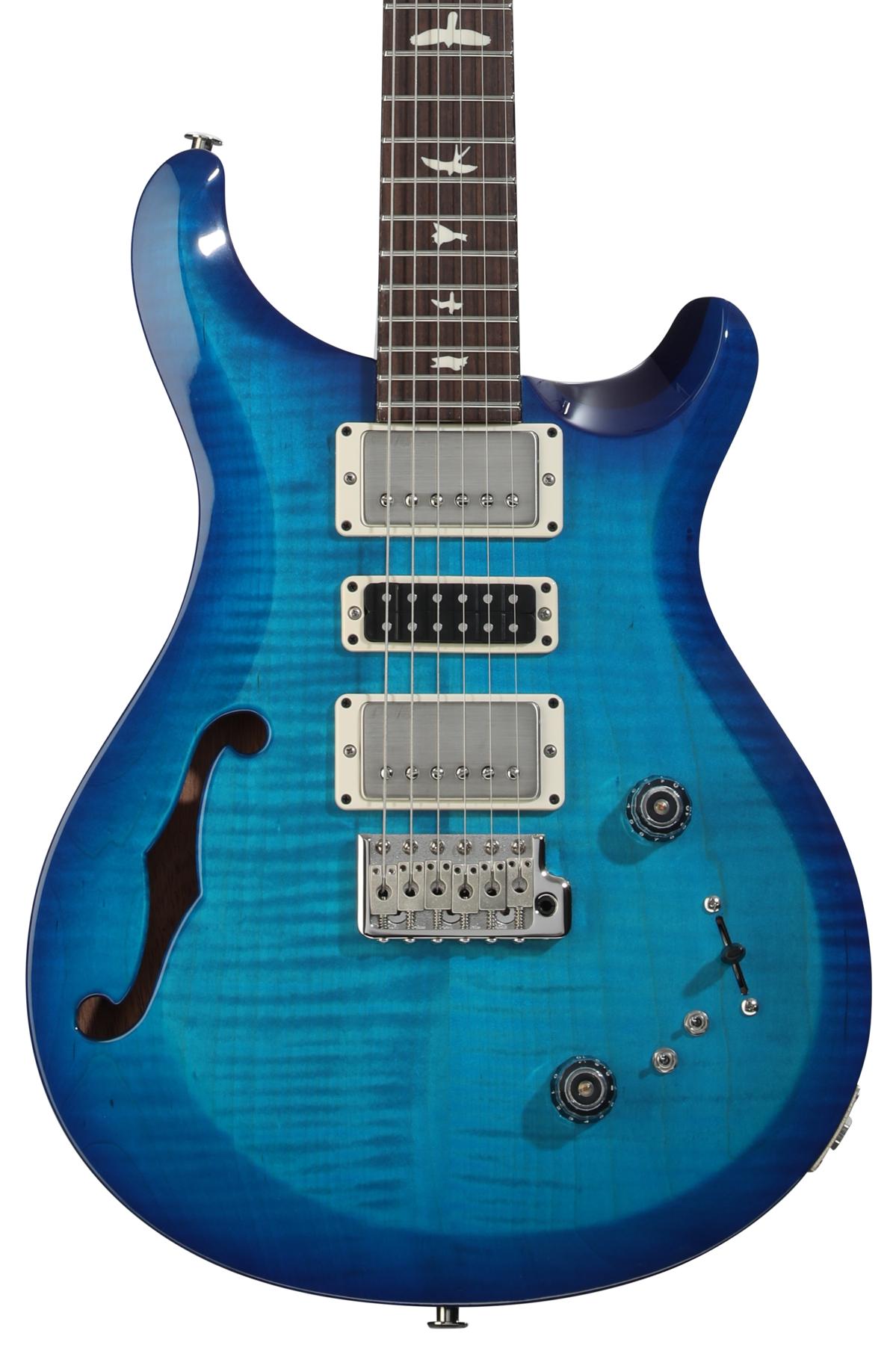
The PRS McCarty 594 is a premium electric guitar designed to bridge the gap between vintage 1950s character and modern manufacturing precision. Its centerpiece is a unique 24.594-inch scale length, which provides a specific string tension and harmonic "bloom" that distinguishes it from both traditional short-scale and long-scale instruments. Featuring TCI-tuned 58/15 LT pickups and a chunky "Pattern Vintage" neck, it serves as the ultimate tool for players seeking classic humbucking tones with contemporary reliability.
1. The Defining Characteristic: The 24.594-Inch Scale Length
The nomenclature of the PRS 594 is not a random sequence of numbers; it refers specifically to the scale length of the instrument: 24.594 inches. To understand why this matters in 2026, one must look at the standard landscape of electric guitars. For decades, the industry was split largely between the 24.75-inch scale of traditional single-cutaway designs and the 25.5-inch scale of bolt-on double-cutaway models. Paul Reed Smith’s standard scale was 25 inches.
The 24.594-inch scale was derived from Paul Reed Smith’s meticulous measurements of vintage "Golden Era" instruments from the late 1950s. While many vintage guitars were marketed as having a 24.75-inch scale, actual production variations often resulted in this slightly shorter measurement.
The physical impact of this scale length is twofold:
- String Tension: The shorter scale reduces the tension required to bring strings to pitch. This makes the guitar feel "slinky," allowing for easier vibrato and deeper bends without the physical resistance found on longer-scale necks.
- Harmonic Content: A shorter scale length shifts the harmonic nodes of the string. The 594 is noted for a certain "bloom" in the notes—a characteristic where the fundamental note is followed by a rich swell of overtones.
In practical play, this makes the 594 feel immediately familiar to those who grew up on vintage single-cuts, yet it retains the precise intonation that PRS is known for.
2. Neck Profile and Ergonomics: The Pattern Vintage
The PRS 594 features the "Pattern Vintage" neck carve. This is one of the most substantial profiles in the PRS lineup, designed specifically to satisfy players who prefer a "hand-filling" feel. It is important to distinguish this from the "Pattern Regular" or "Pattern Thin" profiles found on the Custom 24 series.
The Pattern Vintage neck is an asymmetrical carve. It is slightly thicker on the bass side and thinner on the treble side. This design acknowledges the ergonomics of the human hand; when a player wraps their hand around the neck, the palm requires more mass near the thumb, while the fingers need more clearance on the underside for complex lead work.
Specifications of the Pattern Vintage Neck:
- Depth at the Nut: Approximately 7/8”.
- Width at the Nut: 1 11/16”.
- Width at the Body: 2 1/4”.
While the neck is beefy, it does not feel cumbersome. The transition from the nut to the heel is seamless, a hallmark of PRS construction. By 2026, the use of the Nitro over Cellulose (CAB) finish has become standard on these models, providing a feel that is smooth and never "sticky," even during long performances. This finish also allows the wood to resonate more freely compared to thicker polyester finishes used in the past.
3. Electronics: 58/15 LT Pickups and TCI Tuning
The "heart" of the 594 lies in its 58/15 LT pickups. The "LT" stands for "Low Turn," referring to the number of times the copper wire is wound around the bobbins. In the world of humbuckers, more winds usually equate to higher output and more midrange "growl," but this often comes at the expense of high-end clarity and note separation.
The 58/15 LT pickups are designed to mimic the unpotted, lower-output pickups of the late 1950s. They provide a clear, bell-like top end and a warm, controlled low end. In 2020, PRS introduced TCI (Tuned Capacitance and Inductance) tuning to these pickups. TCI is a proprietary process that fine-tunes the pickups to ensure they react perfectly with the specific components of the guitar.
Sonic Performance of the 58/15 LT:
- Clean Tones: They offer a hi-fi quality, capturing the acoustic resonance of the mahogany body.
- Overdriven Tones: Because the output is lower, they do not "choke" the amplifier. Instead, they allow the player to control the gain through pick attack and the guitar's volume knobs.
- Note Separation: Even with high-gain distortion, complex chords remain articulate rather than turning into a "muddy" wash of sound.
4. Hardware and Bridge System: The Two-Piece Philosophy
Unlike the integrated tremolo systems found on most PRS guitars, the 594 utilizes a two-piece bridge system. This consists of a zinc/brass bridge and a separate tailpiece. This design is a nod to traditional construction but features several modern engineering upgrades.
The bridge features brass saddles and studs, which are critical for energy transfer. Brass is a highly resonant material that helps sustain the vibration of the string into the mahogany body. Furthermore, the bridge is designed with more mass than vintage counterparts, which aids in stability and prevents the "leaning" often seen in older bridge designs.
Another crucial hardware detail is the use of "Vintage Style" non-locking tuners. While PRS is famous for its Phase III locking tuners, the 594 often ships with non-locking versions to maintain a specific weight balance and aesthetic. These tuners use a closed-back design that prevents dust entry while providing a high gear ratio for precise tuning. The nut is made of a proprietary synthetic material infused with bronze powder, ensuring the strings do not bind during heavy bending.
5. Construction and Tonewoods: The Foundation of Tone
The construction of the PRS 594 follows a time-tested formula: a thick mahogany back paired with a carved figured maple top. This combination is the industry standard for "thick" guitar tones, where the mahogany provides the warmth and sustain, and the maple adds "snap" and definition to the attack.
Material Breakdown:
- Body: Solid Mahogany. The 594 body is slightly thicker than a standard Custom 24, contributing to its increased sustain and "weighty" tonal character.
- Top: Flame or Quilt Maple (often "10-Top" grade for premium aesthetics).
- Fretboard: Rosewood, often with faux-bone binding. The binding adds a layer of comfort, as the player's hand does not come into direct contact with the fret ends.
- Inlays: Traditional PRS Birds, typically made of paua or mother of pearl.
The 594 is available in several configurations, including the standard Doublecut, the Singlecut (which offers even more mahogany mass), and the Semi-Hollow versions. The Semi-Hollow 594 is particularly favored in 2026 for its "airier" tone and reduced weight, making it a popular choice for session musicians who spend hours standing.
6. Versatility: The Four-Knob Layout and Coil-Splitting
The 594 is the first PRS model to feature a four-knob control layout (two volume, two tone) combined with a 3-way toggle switch located on the upper bout. This layout is intuitive for players moving from other traditional single-cut guitars.
The true versatility, however, comes from the push-pull pots on the tone knobs. Each pickup can be independently "split" into a single-coil mode. PRS uses a specific resistor-based coil-tapping method rather than a hard split. This means that when you pull the knob, the pickup doesn't lose all of its volume—a common complaint with traditional coil splits. Instead, it retains a "muscular" single-coil sound that mimics a vintage P90 or a beefy Stratocaster-style pickup.
This allows for eight distinct pickup combinations:
- Bridge Humbucker
- Neck Humbucker
- Both Humbuckers
- Bridge Single-coil
- Neck Single-coil
- Both Single-coils
- Bridge Humbucker + Neck Single-coil
- Bridge Single-coil + Neck Humbucker
7. Playability and Build Consistency
PRS has maintained a reputation for the highest level of build consistency in the industry. Whether you are purchasing a Core 594, an S2 594, or an SE 594, the fundamental geometry remains identical. The frets are leveled and polished to a mirror shine, ensuring there are no "dead spots" or buzzing even with low action.
The 594 is designed to be a "workhorse" instrument. It is robust enough for touring but refined enough for high-end studio work. The inclusion of the "Tweakable" truss rod allows for minute adjustments to the neck relief, ensuring the guitar can be set up to any player’s specific preference.
| Feature | PRS McCarty 594 (Core) | Gibson Les Paul Standard (50s) | PRS Custom 24 |
|---|---|---|---|
| Scale Length | 24.594" | 24.75" | 25" |
| Neck Profile | Pattern Vintage (Asymmetrical) | Vintage 50s (C-Shape) | Pattern Thin/Regular |
| Bridge Type | Two-Piece (Zinc/Brass) | Tune-O-Matic / Stopbar | PRS Patented Tremolo |
| Pickups | 58/15 LT (Low Turn) | Burstbucker 1 & 2 | 85/15 |
| Controls | 2 Vol, 2 Tone (Push-Pull), 3-way | 2 Vol, 2 Tone, 3-way | 1 Vol, 1 Tone, 5-way Blade |
| Nut Material | Synthetic Bone w/ Bronze | GraphTech/Bone | Synthetic Bone |
| Finish | Nitro over Cellulose | Nitrocellulose | Nitro over Cellulose |
Frequently Asked Questions
Does the PRS 594 sound exactly like a vintage Les Paul?
While the PRS 594 is heavily inspired by vintage single-cut guitars, it has its own voice. The 58/15 LT pickups provide more clarity and "air" than many modern Gibson pickups. It captures the spirit and warmth of a vintage instrument but with better intonation and a slightly more "refined" upper-midrange.
Is the Pattern Vintage neck too thick for players with small hands?
Thickness is subjective, but the Pattern Vintage neck is designed with an asymmetrical carve that makes it feel smaller than it actually is. Because it is thinner on the treble side, reaching for high notes is surprisingly easy. However, players who prefer the "shredder" style necks of the 1980s may find it substantial.
What is the difference between the Core 594 and the S2 594?
The Core 594 is made in Maryland with premium woods, a carved violin top, and US-made 58/15 LT pickups. The S2 594 uses a simplified "asymmetric bevel" top (less carving), a different finish process, and S2-specific pickups. While the S2 is an excellent professional instrument, the Core model offers the full suite of TCI-tuned electronics and high-grade aesthetics.
Why is the 3-way toggle switch on the upper bout?
This placement was a deliberate choice to accommodate players who are used to traditional four-knob guitar layouts. It also separates the switching from the volume/tone controls, preventing accidental knocks during aggressive strumming.
How does the 24.594 scale affect string gauge choice?
Because of the slightly lower tension of the 24.594-inch scale, some players find they can move up one string gauge (e.g., from .010s to .011s) without the guitar feeling "stiff." This can result in a thicker tone and more sustain. Conversely, using standard .010s makes the guitar feel incredibly easy to play.
Is the PRS 594 suitable for heavy metal?
While it is primarily marketed as a vintage-voiced instrument for blues, jazz, and rock, the 594 can certainly handle high gain. The 58/15 LT pickups are exceptionally clear, which helps prevent low-tuned riffs from sounding muddy. However, players seeking ultra-high output "active" pickup sounds may need to swap the pickups or use a dedicated high-gain preamp.
Final Recommendation
The PRS McCarty 594 stands as a masterclass in guitar design. It is recommended for the serious enthusiast or professional musician who requires the soul of a vintage instrument but cannot tolerate the mechanical inconsistencies of 70-year-old hardware. If you value a "thick" neck, exceptional note clarity, and a versatile switching system that offers convincing single-coil tones, the 594 is arguably the best "evolutionary" single-cut design available in 2026. For those undecided between a classic single-cut and a modern PRS, the 594 provides the most harmonious middle ground.