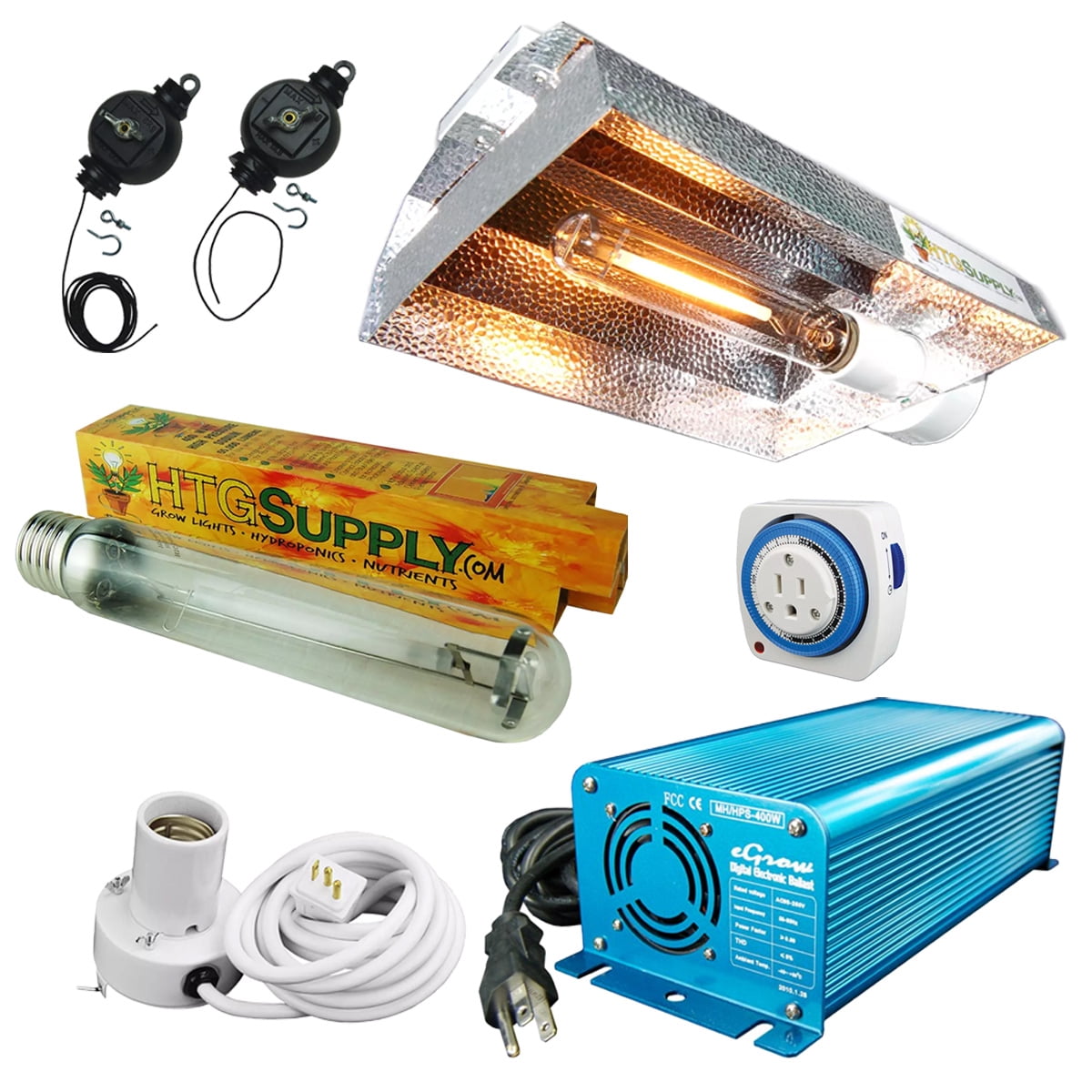
A 400W High-Pressure Sodium (HPS) grow light provides a high-intensity output of approximately 50,000 to 55,000 lumens, making it the ideal choice for a 3' x 3' (1m x 1m) flowering area. It balances power by offering superior canopy penetration compared to smaller HID units, while maintaining higher electrical efficiency and lower heat output than industrial 1000W systems.
The Role of 400W HPS Systems in 2026
Despite the continued dominance of high-efficiency LED arrays in 2026, High-Pressure Sodium (HPS) technology remains a staple for many indoor horticulturalists. The 400W HPS system, in particular, occupies a unique "sweet spot" in the market. It serves as the bridge between entry-level hobbyist setups and professional-grade industrial cultivation.
The primary appeal of the 400W HPS lies in its ability to deliver a specific spectrum dominated by red and orange wavelengths, which are essential for the flowering and fruiting stages of plant development. While LEDs have made strides in spectral customization, the raw intensity and radiant heat produced by HPS bulbs continue to offer advantages in specific environmental conditions, such as cold-climate grow rooms where supplemental heating would otherwise be required.
Understanding the balance between power (light intensity) and efficiency (micromoles per joule) is critical for any grower looking to maximize their yield without skyrocketing their utility bills. The 400W HPS represents a calculated compromise, offering enough photon flux to drive heavy photosynthesis without the extreme thermal management challenges of larger 600W or 1000W fixtures.
Technical Specifications and Spectral Output
To understand why a 400W HPS is effective, one must look at its technical composition. These lights operate by igniting a mixture of gases—primarily sodium, mercury, and xenon—inside a narrow translucent tube made of aluminum oxide.
The Flowering Spectrum
The spectral output of a standard HPS bulb typically peaks in the 580nm to 610nm range. This yellow-orange-red light mimics the shifting angle of the sun during late summer and autumn. For plants, this is a biological signal to cease vegetative expansion and begin the reproductive phase. The 400W HPS provides a high Photosynthetic Photon Flux (PPF), often ranging between 600 and 750 μmol/s depending on the bulb quality and ballast efficiency.
Lumens vs. PAR
While many older resources focus on lumens (a measure of brightness as perceived by the human eye), modern growers in 2026 focus on PAR (Photosynthetically Active Radiation). A 400W HPS produces roughly 125 to 140 lumens per watt. However, its efficiency is best measured by its ability to deliver photons within the 400nm to 700nm range. Because HPS lights concentrate so much energy in the "red" part of this range, they are exceptionally "efficient" at inducing a strong flowering response, even if their total energy conversion into light is lower than that of top-tier LEDs.
Anatomy of a 400W HPS System
A complete 400W HPS setup is not just a bulb; it is a system of three major components that must work in harmony to ensure safety and performance.
1. The Ballast: Magnetic vs. Digital
The ballast is the engine of the system, regulating the voltage required to start the lamp and maintain a steady current.
- Magnetic Ballasts: These are the older, heavier traditional units. While incredibly durable, they are less efficient, run hotter, and can produce a noticeable hum.
- Digital (Electronic) Ballasts: In 2026, these are the standard. They are smaller, silent, and far more efficient. High-end digital ballasts often feature "dimmable" settings, allowing a 400W bulb to be run at 250W during the early stages of growth, though this can sometimes shift the color spectrum of the bulb.
2. The Reflector (Hood)
Because an HPS bulb emits light in 360 degrees, a reflector is mandatory to redirect the upward-bound photons back down toward the plant canopy.
- Wing Reflectors: Simple and inexpensive, but they offer no heat management.
- Cool Tubes: A cylindrical glass housing that allows an exhaust fan to pull air directly across the bulb. This is essential for 400W systems in small tents to prevent heat stress.
- Air-Cooled Hoods: Large, rectangular enclosures with glass bottoms. These provide the best light distribution (footprint) while allowing for integrated cooling.
3. The Bulb
The 400W bulb itself has a limited lifespan. While it may continue to "light up" for years, its spectral output degrades significantly after 8,000 to 10,000 hours of use. Professional growers typically replace HPS bulbs every 9–12 months to ensure they are still getting the maximum PAR output for their electricity spend.
Footprint and Canopy Management
The efficiency of a light is largely determined by how well its "footprint" matches the growing area. For a 400W HPS, the optimal coverage is as follows:
- Vegetative Stage: 4' x 4' (1.2m x 1.2m). Since plants require less intensity during the leafy growth stage, the light can be hung higher, covering a larger area.
- Flowering Stage: 3' x 3' (0.9m x 0.9m). To achieve the density required for high-quality fruits and flowers, the light must be concentrated.
Hanging Height and the Inverse Square Law
The 400W HPS generates significant radiant heat. Unlike LEDs, which are "cool" to the touch, HPS bulbs emit infrared radiation that can burn plant tissue. The standard hanging height for a 400W HPS is between 12 and 18 inches (30–45 cm) from the canopy.
Growers must respect the Inverse Square Law, which states that the intensity of light radiating from a point source is inversely proportional to the square of the distance from the source. Moving a light from 12 inches to 24 inches doesn't just halve the light; it reduces it to one-quarter of the original intensity. The 400W HPS balances this by having enough "punch" to penetrate several layers of the canopy, a feat that lower-wattage lights cannot achieve.
Comparative Analysis: 400W HPS vs. Alternatives
To understand the value proposition of the 400W HPS in 2026, we must compare it against its closest rivals in the 3' x 3' grow space category.
| Feature | 400W HPS (High-Pressure Sodium) | 400W MH (Metal Halide) | 400W LED (Mid-Range) |
|---|---|---|---|
| Primary Use | Flowering / Fruiting | Vegetative Growth | Full Cycle |
| Spectral Bias | Red / Orange (2000K-2100K) | Blue / White (5000K-6500K) | Full Spectrum (Variable) |
| Heat Output | High (Radiant) | High (Radiant) | Low to Moderate |
| Initial Cost | Low ($150 - $250) | Low ($150 - $250) | Moderate to High ($350 - $600) |
| Bulb Life | 10,000 Hours | 10,000 Hours | 50,000+ Hours |
| Canopy Penetration | Excellent | Good | Moderate to Excellent |
| Operational Efficiency | ~1.7 μmol/j | ~1.5 μmol/j | 2.3 - 3.0 μmol/j |
Thermal Management and Environmental Control
The biggest hurdle to efficiency with a 400W HPS is heat. A 400W bulb is essentially a 400-watt space heater that happens to emit light. If this heat is not managed, the plant's metabolic processes will slow down or stop entirely as they enter a state of heat stress.
Vapor Pressure Deficit (VPD)
In 2026, advanced growers use VPD to manage their environments. Because HPS lights increase leaf surface temperature more than LEDs do, the humidity in the room must be adjusted upward to maintain a healthy transpiration rate. A 400W HPS system usually requires a robust exhaust system—typically a 4-inch or 6-inch inline fan rated for at least 200 CFM (Cubic Feet per Minute)—to exchange the air in a standard tent every 1 to 3 minutes.
Winter Benefits
In temperate or cold climates, the heat from a 400W HPS is a dual-purpose asset. By using the light to maintain grow room temperatures between 75°F and 82°F (24°C–28°C), growers can avoid the electrical cost of running separate heaters. In this specific context, the "efficiency" of the HPS system increases because it is performing two jobs at once.
Safety Protocols for HID Lighting
Operating a 400W High-Intensity Discharge (HID) system requires more safety awareness than simple plug-and-play LED strips.
- Circuit Loading: A 400W HPS draws approximately 3.5 to 4 amps on a standard 120V circuit. While this is well within the limits of a 15A household circuit, adding multiple fans, pumps, and other lights can quickly lead to a tripped breaker.
- Bulb Handling: Never touch the glass of an HPS bulb with bare hands. Skin oils can create "hot spots" on the quartz glass, leading to the bulb shattering when it reaches operating temperature. Use a clean cloth or gloves.
- Eye Protection: The intense yellow light of an HPS can cause long-term eye strain and make it difficult to spot plant pests or nutrient deficiencies (which often appear as subtle leaf discolorations). Use HPS-specific grow room glasses that neutralize the yellow spectrum.
- Fire Safety: Ensure ballasts are kept off the floor and away from water. Digital ballasts should be mounted on a wall or a non-flammable surface to allow for proper heat dissipation.
Troubleshooting Common 400W HPS Issues
Despite their reliability, HPS systems can encounter technical hurdles.
- Failure to Strike: If the bulb flickers but won't stay on, it is often a sign of "cycling." This happens when the bulb is reaching the end of its life and requires more voltage to maintain the arc than the ballast can provide.
- RF Interference: Poorly shielded digital ballasts can sometimes interfere with Wi-Fi or radio signals. Choosing a high-quality, shielded ballast from a reputable horticultural brand is essential.
- Dimming Issues: While some 400W ballasts allow for dimming to 250W, doing so for extended periods can cause "blackening" of the arc tube and a shift in the light spectrum, potentially harming plant quality.
Economic Efficiency: The Bottom Line
When assessing the "balance" of a 400W HPS, one must consider the Total Cost of Ownership (TCO).
Initial Capital Expenditure (CapEx): You can often purchase a complete 400W HPS kit (ballast, bulb, and reflector) for less than half the price of a high-quality 400W LED. This makes it the preferred choice for new growers or those expanding their garden on a strict budget.
Operating Expenditure (OpEx): Over a two-year period, the LED will usually win on electricity savings and the lack of bulb replacement costs. However, the HPS provides a faster return on investment (ROI) for growers who only run one or two cycles per year or those who need the supplemental heat.
Frequently Asked Questions
Can I use a 400W HPS bulb in a 600W ballast?
No. You should always match the wattage of the bulb to the wattage of the ballast. Using a 400W bulb in a 600W ballast can cause the bulb to explode or fail instantly. Some digital ballasts have a "selectable" wattage; you may use a 400W bulb only if the ballast is specifically set to the 400W mode.
Is 400W HPS enough for four plants?
Yes, a 400W HPS is perfectly suited for four medium-sized plants in 3-gallon or 5-gallon pots. This assumes the plants are arranged in a square pattern within the 3' x 3' primary light footprint.
Do I need a special timer for an HPS light?
HPS ballasts have a high "inrush current" when they first turn on. While standard household timers might work for a while, it is highly recommended to use a heavy-duty mechanical timer or a dedicated grow light controller to prevent the timer contacts from welding shut.
How do I know when to replace my 400W HPS bulb?
If you notice a decrease in yield, or if the light appears more "pink" than "orange," it is time for a change. Most professional growers use a PAR meter to check output; when the PPFD (Photosynthetic Photon Flux Density) drops by 15-20% compared to its first use, the bulb should be replaced.
Can I grow from seed to harvest with a 400W HPS?
While possible, HPS light is not ideal for the vegetative stage because the lack of blue light can cause plants to become "leggy" or stretched. For best results, use a 400W Metal Halide (MH) bulb for the vegetative stage and switch to the HPS bulb for flowering. Most modern 400W digital ballasts are "dual-spectrum" or "switchable," meaning they can run both MH and HPS bulbs.
Final Recommendation
The 400W HPS grow light remains a formidable tool in 2026 for the discerning indoor gardener. To achieve the best balance of power and efficiency, pair a high-quality digital ballast with an air-cooled hood. This configuration mitigates the primary drawback of HPS technology—heat—while leveraging its greatest strength: deep, flowering-optimized light penetration. For growers operating in smaller tents or those who require a cost-effective entry point into high-intensity gardening, the 400W HPS is a proven, reliable, and powerful solution.