To accurately code for "other acute postprocedural pain" in 2026, healthcare professionals must assign the ICD-10-CM code G89.18. This code is utilized when pain following a procedure is the primary reason for a healthcare encounter or requires specific management beyond routine postoperative care, provided it is not documented as a complication.
The landscape of medical coding in 2026 demands high precision, particularly regarding the documentation of pain. As value-based care models continue to evolve, the specificity with which we capture patient encounters—especially regarding postoperative recovery and pain management—directly impacts clinical data integrity and reimbursement. Code G89.18, "Other acute postprocedural pain," serves a unique role within the ICD-10-CM hierarchy, sitting at the intersection of symptomatic reporting and procedural follow-up.
Understanding G89.18: Definition and Clinical Context
Code G89.18 is nested within Chapter 6 of the ICD-10-CM, which covers Diseases of the Nervous System. Specifically, it falls under the G89 category: "Pain, not elsewhere classified (NEC)." This category is reserved for pain that cannot be more specifically described by site-specific codes or when the pain itself is the focus of the clinical encounter.
"Other acute postprocedural pain" is defined by two primary characteristics:
- Temporal Relationship: The pain must occur in the immediate aftermath of a medical or surgical procedure (the acute phase).
- Clinical Significance: In a 2026 clinical environment, "routine" or "expected" pain that is managed with standard postoperative protocols is generally not coded separately. G89.18 is reserved for instances where the pain is the reason for an admission, an outpatient visit, or requires a distinct treatment plan that deviates from standard postoperative expectations.
It is essential to distinguish between "postprocedural pain" and "postoperative pain." While often used interchangeably in casual clinical discourse, ICD-10-CM uses "postprocedural" to encompass all types of medical interventions, including minimally invasive radiology, catheterizations, and traditional surgeries.
ICD-10-CM Official Guidelines for Postprocedural Pain
The ICD-10-CM Official Guidelines for Coding and Reporting provide specific instructions for the G89 category. Understanding these rules is the first step in avoiding claim denials and ensuring accurate patient records.
Routine vs. Non-Routine Pain
Coding guidelines stipulate that postprocedural pain that is "expected" or "routine" immediately following surgery should not be coded. For instance, if a patient undergoes a total knee arthroplasty and experiences standard surgical site pain managed by the standard hospital pathway, a G89 code is typically unnecessary.
However, G89.18 should be assigned when:
- The patient is seen specifically for pain control.
- The pain is described as "acute" and is not better categorized by another specific code.
- The provider documents the pain as "postprocedural" or "postoperative."
Sequencing Rules
The sequencing of G89.18 depends entirely on the circumstances of the encounter.
- Pain Management Encounters: If a patient is admitted or seen primarily for the management of acute postprocedural pain, G89.18 is sequenced as the principal or first-listed diagnosis. The underlying condition or the procedure that caused the pain may be listed as a secondary diagnosis.
- Other Encounters: If the patient is seen for a different reason (such as a follow-up for the surgical site) and the pain is managed during that visit, G89.18 is listed as a secondary diagnosis.
Distinguishing Acute from Chronic Postprocedural Pain
In 2026, the clinical distinction between acute and chronic pain is more strictly enforced in auditing processes.
- Acute Postprocedural Pain (G89.18): This is pain that is expected to resolve within the normal healing time for the specific procedure. There is no hard "day count" in the ICD-10-CM manual, but clinical standards usually suggest a window of less than three to six months.
- Chronic Postprocedural Pain (G89.28): This code is used when pain persists beyond the expected healing time or is specifically documented by the provider as "chronic."
If a provider does not specify whether the postprocedural pain is acute or chronic, the default code in the G89 category depends on the sub-indexing; however, G89.18 specifically requires the "acute" designation in documentation to be used with high confidence.
The Boundary Between Pain and Complications
One of the most complex areas of navigating G89.18 is its relationship with complication codes. Codes from the T81 series (Complications of procedures, not elsewhere classified) often include pain as a symptom.
According to the Official Guidelines, if the pain is due to a specific complication, such as a displaced prosthetic or a postoperative infection, the complication code should be sequenced first.
- Example: A patient has acute pain due to a surgical site infection. You would code the infection first (e.g., T81.4-), followed by G89.18 only if the pain is the specific reason for the encounter or requires intensive management.
- Postprocedural Pain as a Complication: If the provider explicitly documents "postoperative pain" as a complication (e.g., "Postoperative pain syndrome"), the coder should look toward the complication codes in the T80-T88 range first. G89.18 is used when the pain is not categorized as a complication of the surgery but rather a symptom requiring management.
Site-Specific Coding and "Code Also" Instructions
Code G89.18 does not identify the location of the pain. To provide a complete clinical picture, the ICD-10-CM instructions frequently advise to "code also" the site of the pain if known.
For example, if a patient has acute postprocedural pain in the abdominal region following a laparoscopy, the coding string might look like this:
- G89.18 (Other acute postprocedural pain)
- R10.9 (Abdominal pain, unspecified)
This dual-coding approach ensures that both the nature of the pain (acute and postprocedural) and the location of the pain are captured in the data. In 2026, electronic health record (EHR) systems often prompt for this secondary code to satisfy internal quality metrics and payer requirements.
Practical Scenarios and Case Examples
The following scenarios illustrate the application of G89.18 in common 2026 clinical settings.
Scenario 1: Pain Management Admission
A patient who underwent a thoracotomy three days ago is readmitted to the hospital because their outpatient pain regimen is failing. The physician's diagnostic statement reads: "Admission for management of acute postoperative pain."
- Principal Diagnosis: G89.18 (Other acute postprocedural pain)
- Secondary Diagnosis: Z98.890 (Other specified postprocedural states) or a code for the original condition (e.g., lung cancer).
- Logic: Since the reason for admission is the pain, G89.18 takes the lead.
Scenario 2: Postoperative Visit with Exceptional Pain
A patient returns for a two-week follow-up after a hernia repair (K40.90). The surgical site is healing well, with no signs of infection or dehiscence, but the patient reports severe, acute pain that requires a new prescription for nerve blocks or specialty analgesics.
- Principal Diagnosis: K40.90 (Unilateral inguinal hernia, without obstruction or gangrene, not specified as recurrent)
- Secondary Diagnosis: G89.18 (Other acute postprocedural pain)
- Logic: The encounter is for a routine follow-up (the hernia repair), but the acute postprocedural pain is a significant additional finding that was addressed.
Scenario 3: Pain as a Complication
A physician documents that a patient has acute pain due to a misplaced internal fixation device in the femur.
- Principal Diagnosis: T84.294A (Other mechanical complication of internal fixation device of left femur, initial encounter)
- Secondary Diagnosis: G89.18 (Other acute postprocedural pain)
- Logic: The complication code must be primary because the pain is a direct result of the device failure.
Comparison of Common Postprocedural Pain Codes
| ICD-10 Code | Description | Clinical Application |
|---|---|---|
| G89.18 | Other acute postprocedural pain | Used for acute pain after surgery that is the focus of care and not a complication. |
| G89.28 | Other chronic postprocedural pain | Used for pain persisting past the healing phase (usually 3+ months) or documented as chronic. |
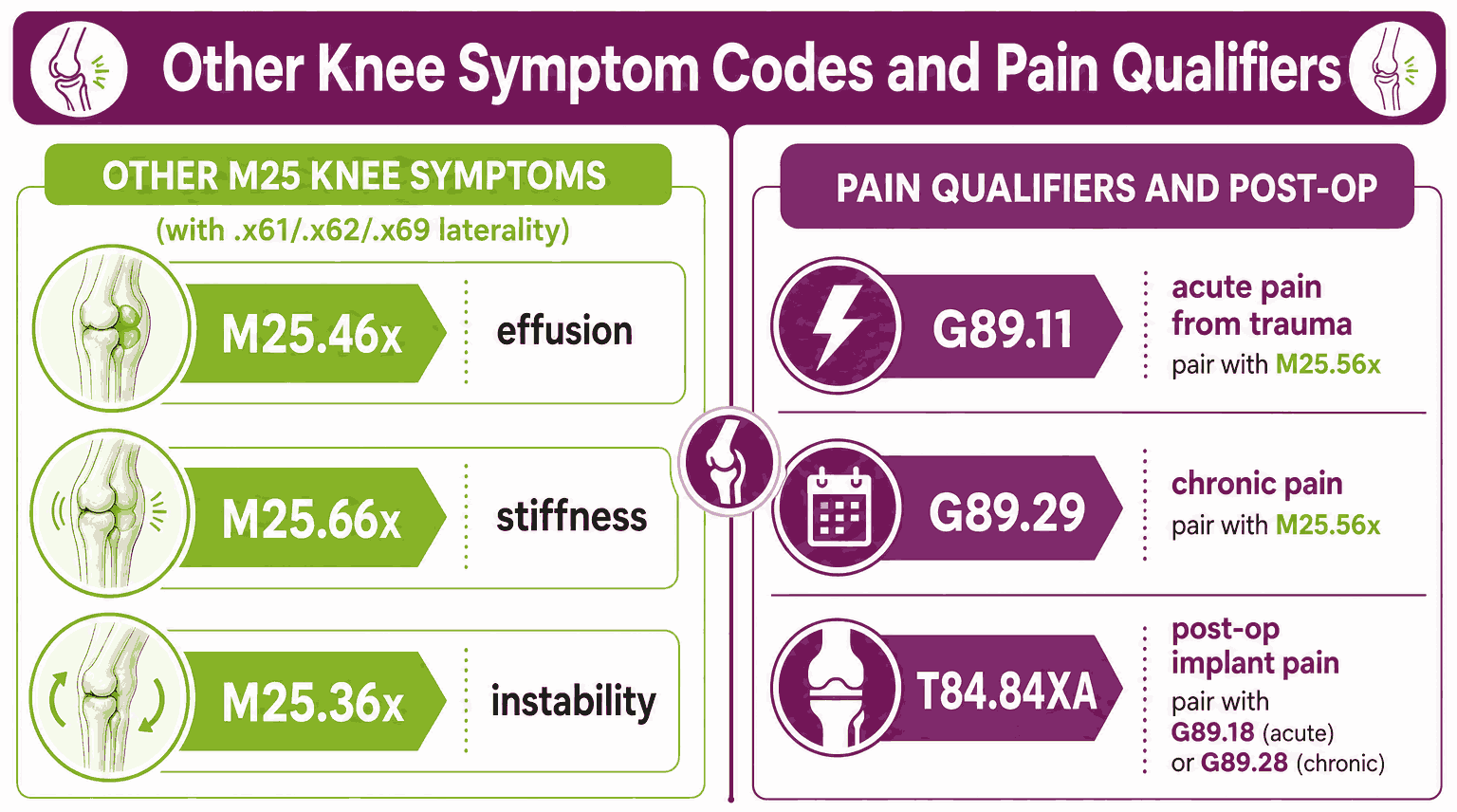
| G89.11 | Acute pain due to trauma | Used when the pain is the result of an injury rather than a medical procedure. |
| T81.89XA | Other complications of procedures, NEC | Used when the pain is officially documented as a surgical complication. |
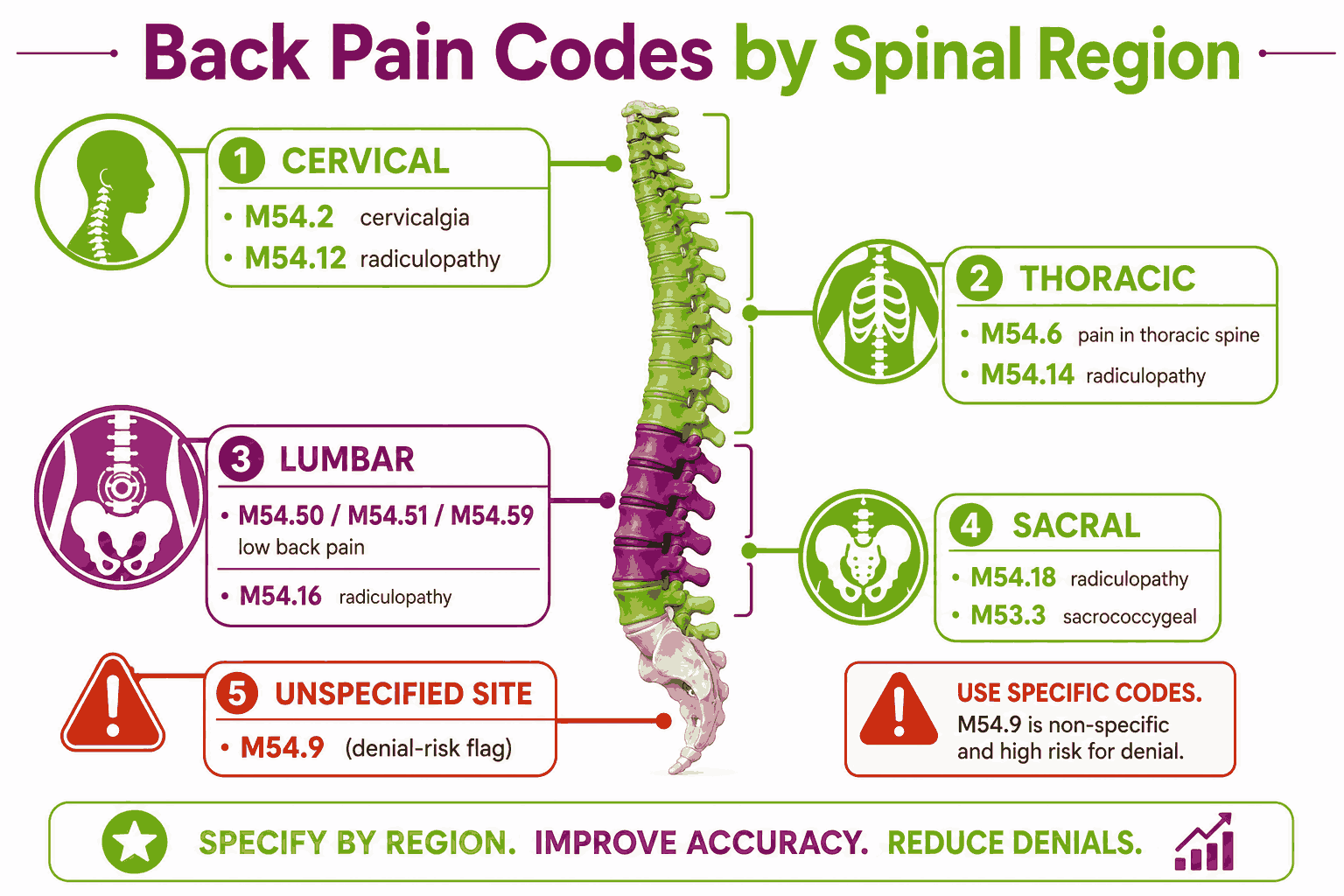
| M54.50 | Low back pain, unspecified | Site-specific code often used in conjunction with G89.18 for spinal procedures. |
Documentation Requirements for 2026 Compliance
To support the use of G89.18, clinicians must ensure the medical record contains specific details. Coders cannot "assume" pain is postprocedural or acute based solely on the timing of a visit.
- Specificity of Timing: The provider should use the word "acute." While 2026 EHRs often have "acute" as a default toggle, the narrative note should ideally reflect the onset and expected duration.
- Linkage: The documentation must clearly link the pain to the procedure. Using phrases like "pain following [procedure]" or "post-op pain" is sufficient for G89.18.
- Severity and Management: To justify coding pain that might otherwise be considered "routine," the record should reflect the intensity of the pain and the specific interventions taken (e.g., adjustment of medications, referral to a pain specialist, or diagnostic imaging to rule out complications).
- Exclusion of Complications: If the provider believes the pain is part of a complication (like a hematoma or infection), they must document that specific condition. If they explicitly state the pain is not due to a complication, it reinforces the use of G89.18.
Common Mistakes and How to Avoid Them
The most frequent error in postprocedural pain coding is over-coding routine pain. In many audits, G89.18 is flagged if the documentation shows the patient is experiencing a "normal" recovery path. To avoid this, only code G89.18 when the pain management itself requires significant clinical effort or is the primary reason the patient sought care.
Another common mistake is failing to update the code to G89.28 (chronic) when the patient continues to seek treatment for the same pain months later. In 2026, many payers use automated "look-back" periods. If G89.18 (acute) is used for a patient who has had the same pain for six months, it may trigger a medical necessity review.
Finally, ensure the Excludes1 and Excludes2 notes are respected. Category G89 has an Excludes1 note for "localized pain, unspecified site," which means if the site is known and the pain isn't "not elsewhere classified," you must be careful about which code is primary. However, G89.18 is specifically designed to be used with site codes to provide the full context of postprocedural status.
Frequently Asked Questions
Can G89.18 be used for pain after a diagnostic procedure like a biopsy?
Yes. ICD-10-CM defines "postprocedural" broadly. If a patient experiences acute, non-routine pain following a needle biopsy or an endoscopic procedure, G89.18 is applicable, provided the pain is the focus of the clinical encounter and documented as such.
Should I code G89.18 if the patient is already taking pain medication for a pre-existing condition?
Only if the postprocedural pain is a new, distinct acute issue. If the patient has chronic back pain and undergoes surgery, G89.18 would only be used if there is an acute exacerbation or a new type of pain specifically resulting from the surgery that requires its own management strategy.
Is G89.18 a "complication code"?
No. G89.18 is a symptom code within the "Pain, not elsewhere classified" category. While it describes a negative outcome (pain), it is not technically classified under the "Complications of Surgical and Medical Care" (T80-T88) chapter. If the pain is a complication, a T-code is generally required first.
Does the "3-month rule" for chronic pain apply to G89.18?
While the ICD-10-CM manual does not strictly define "acute" vs. "chronic" by a specific number of days, the 2026 clinical consensus generally treats pain as chronic after 3 to 6 months. For coding purposes, you should follow the provider’s literal documentation of "acute" or "chronic."
Can G89.18 be a principal diagnosis for an outpatient claim?
Yes. If the "reason for visit" on the encounter form or the first-listed diagnosis in the clinical note is the management of acute postprocedural pain, G89.18 should be the primary code on the CMS-1500 or UB-04 form.
Recommendations for Accurate Coding
To maintain compliance and ensure optimal reimbursement in 2026, organizations should implement a regular review of G89.18 usage. Clinical Documentation Improvement (CDI) specialists should encourage providers to explicitly state when pain is "postprocedural" and "acute," especially when that pain is the primary driver of a patient encounter.
Furthermore, always verify the sequencing. Remember: if the encounter is for pain management, the pain code (G89.18) comes first. If the encounter is for something else, the pain code is secondary. By adhering to these guidelines and maintaining a clear distinction between routine postoperative discomfort and clinically significant acute postprocedural pain, healthcare organizations can ensure both data accuracy and financial integrity.