The first Superman comic book, published as Action Comics #1 in April 1938 by Detective Comics (the precursor to DC Comics), is widely recognized as the most important single issue in the history of the medium. It marked the debut of Superman, the archetype for the modern superhero, effectively launching the Golden Age of comic books and creating a multi-billion-dollar global cultural icon.
The Origins of a Cultural Phenomenon
To understand the 1938 debut of Superman, one must look at the creative partnership between Jerry Siegel and Joe Shuster. Both were young science-fiction enthusiasts living in Cleveland, Ohio, who spent years refining the concept of a powerful, costumed hero. After numerous rejections from newspaper syndicates, the duo finally found a home for their creation at National Allied Publications.
Editor Vin Sullivan was looking for fresh content for a new anthology title, Action Comics. While the original plan was for the debut to be an ordinary anthology feature, the impact of the cover—depicting a man in a cape lifting a green car above his head—was immediate. The character was not just a science-fiction trope; he was a moral force, a champion of the oppressed, and a physical marvel who stood in stark contrast to the gritty pulp detectives and adventure heroes of the era.
Anatomy of Action Comics #1
Action Comics #1 was a standard 64-page anthology publication. While Superman took the cover and the lead story, the issue also contained several other features, including "Zatara the Master Magician," "Tex Thompson," and various sports and adventure shorts.
The story inside was relatively brief, written by Siegel and drawn by Shuster in a style that was heavily influenced by the contemporary newspaper strips of the day. It introduced key elements that remain foundational to the character: Clark Kent, Lois Lane, and the transformation of a visitor from another planet into a hero for humanity. By today’s standards, the narrative is sparse, moving rapidly through his origin—the destruction of his home planet and his arrival on Earth—to his first displays of power against human corruption and social injustice.
Why This Specific Issue Holds Unmatched Value
In the world of rare collectibles, Action Comics #1 is the "Holy Grail." Its value is driven by its historical scarcity and its status as the catalyst for the entire comic book industry. Before 1938, the comic book format was largely used to reprint newspaper strips. The success of this issue proved that original, character-driven material could sustain a publication.
As of 2026, the market for this specific issue remains the most robust segment of comic book investing. Collectors evaluate the copies based on two primary factors: the condition of the paper (which was notoriously low-quality newsprint) and the integrity of the original cover. Because the issue was meant to be read and discarded, the number of surviving "high-grade" copies is incredibly small, which drives the astronomical prices seen at public auctions.
Technical and Physical Characteristics of the 1938 Edition
For collectors and historians, identifying a genuine 1938 copy of Action Comics #1 requires a deep understanding of its physical production. Unlike modern editions, these books were printed on acidic, low-grade paper that is prone to yellowing, brittleness, and "foxing" (brown spotting).
The following table summarizes the key metrics for identifying and understanding the historical context of the publication.
| Feature | Specification | Impact on Value |
|---|---|---|
| Cover Date | June 1938 (on-sale April 18, 1938) | Essential for identification |
| Cover Price | 10 cents | Defines the historical price point |
| Publisher | National Allied Publications | Founding entity of DC Comics |
| Lead Character | Superman (created by Siegel & Shuster) | Defines the "Superhero" archetype |
| Page Count | 64 pages | Standard anthology format |
| Production | Newsprint on standard pulp stock | High fragility; leads to rarity |
Authentication and Professional Grading
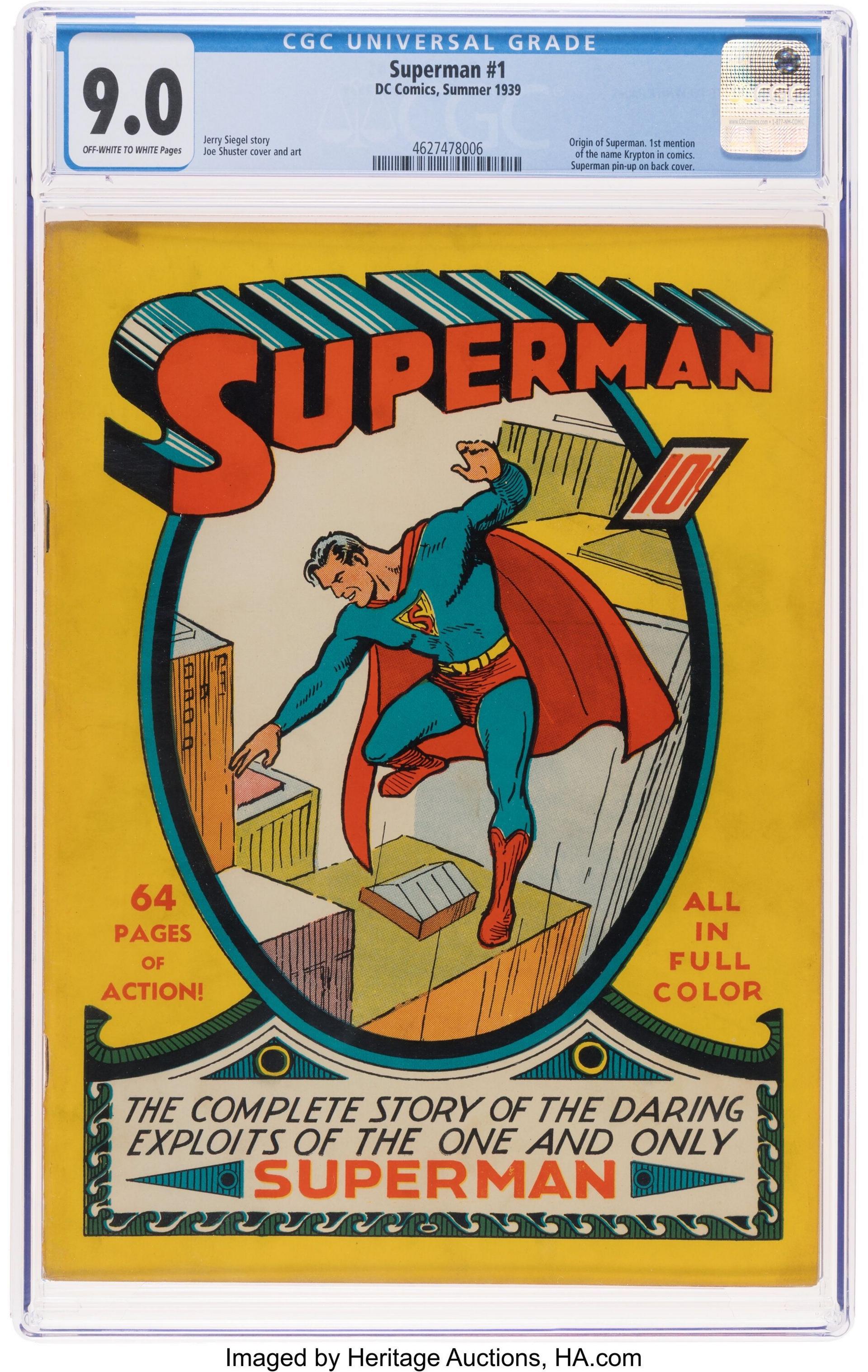
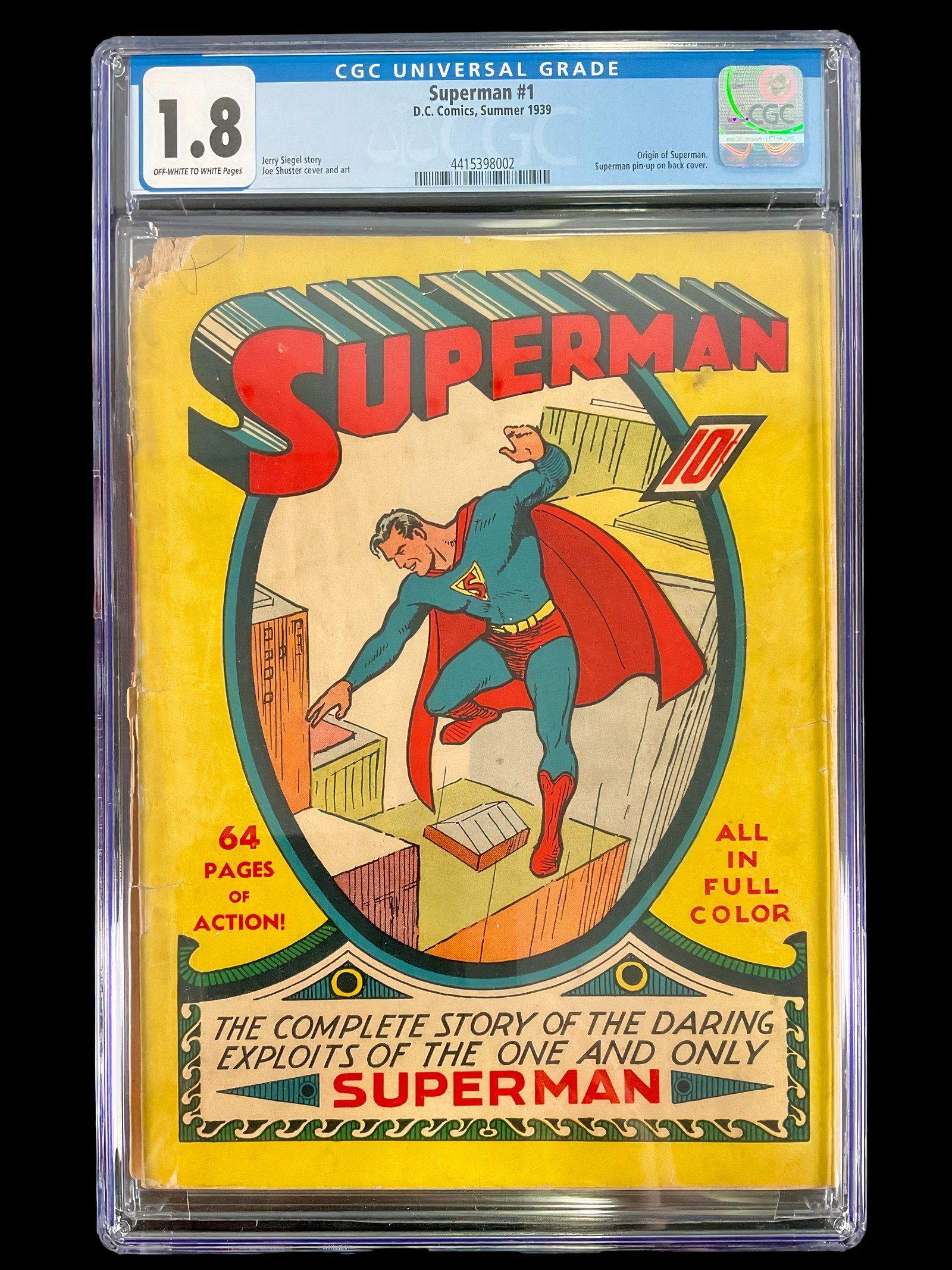
Because of the massive financial stakes involved, any copy of Action Comics #1 must undergo rigorous authentication. Third-party grading services, such as the Certified Guaranty Company (CGC), use a universal 1-to-10 scale to judge the physical state of the book. Factors such as staple rust, spine stress, cover color fading, and page acidity are measured with high-precision equipment.
A "CGC Universal" grade is generally the industry standard for verifying that the comic has not been restored. "Restoration" (such as color touching, piece replacement, or spine repair) can significantly decrease the value of such a rare item. For those looking to verify a copy, consulting the census data provided by these professional grading firms is the only way to determine the known population of existing copies in a specific grade.
Common Misconceptions About the 1938 Debut
A frequent error in public discourse is the assumption that Superman was an instant, overnight success. While the character caught on quickly, the comic book industry at the time was volatile. Action Comics was a test, and its sustained popularity led to the creation of the Superman solo title in 1939.
Another misconception involves the cover price. While 10 cents seems trivial in 2026, in 1938, it represented a small but significant purchase for a child or young adult. This price point helped make the comic accessible, ensuring that Superman reached a massive, diverse audience during the Great Depression, which partially explains the character's early focus on social crusading against corrupt landlords, crooked politicians, and wife-beaters.
The Evolution of the Superhero Genre
The 1938 issue provided the blueprint for the "Golden Age" of comics. Following the massive sales success of Action Comics #1, other publishers scrambled to produce their own caped crusaders, leading to the creation of Batman (1939), Wonder Woman (1941), and Captain America (1941).
Without the specific success of this 1938 edition, the entire superhero landscape—including the films, television shows, and merchandise that dominate global entertainment in 2026—would likely not exist in its current form. The issue served as the "Big Bang" of the superhero universe, establishing the dual-identity trope (Clark Kent vs. Superman) and the concept of the super-powered defender of the weak.
Preservation and Handling Best Practices
For those lucky enough to possess any artifact from the 1938 printing, preservation is the primary concern. Newsprint is inherently unstable due to the lignin content in the wood pulp, which causes rapid oxidation. To maintain the condition of such a valuable item:
- Environment Control: Keep the item in a temperature-controlled environment, ideally between 65 and 70 degrees Fahrenheit, with a relative humidity of 40-50%.
- Light Protection: Prolonged exposure to ultraviolet (UV) light will fade the vibrant primary colors of the cover instantly. Storage in a dark, secure location is mandatory.
- Archival Materials: Use acid-free, buffered backing boards and Mylar sleeves. Mylar is chemically inert and offers superior protection against physical damage compared to standard polyethylene or polypropylene bags.
- Professional Handling: Use cotton gloves or ensure hands are cleaned of oils before handling. Avoid flipping pages unnecessarily, as the paper fibers become extremely brittle over time.
Frequently Asked Questions
Is a copy of Action Comics #1 worth millions of dollars? Yes, high-grade copies of Action Comics #1 have frequently sold at auction for millions of dollars. The final price is entirely dependent on the CGC numerical grade, the color quality, and the lack of restoration.
Why is it labeled "June" 1938 if it was released in April? It was standard industry practice in the 1930s for magazines and comic books to use "cover dates" that were two months ahead of the actual on-sale date. This informed newsstand dealers how long the issue should remain on display before being removed.
Are there any reprints of the 1938 Superman comic available? Yes, DC Comics has released numerous facsimile editions and trade paperbacks that reprint the contents of Action Comics #1. These are widely available and are intended for reading, as they preserve the original art and story while ensuring the historical artifact remains undisturbed.
Does the 1938 comic contain the entire origin story? It contains the foundational elements: the destruction of the planet and his arrival as a child. However, the specific details—such as the name "Krypton" or the identity of his parents as Jor-El and Lara—were fleshed out in subsequent newspaper strips and radio dramas shortly thereafter.
What is the "CGC Census" and why does it matter? The CGC Census is a database of every comic book that has been submitted to that specific company for grading. It allows you to see how many copies of Action Comics #1 exist in a particular grade, which is essential for determining rarity and market value.
Recommendation for Collectors and Enthusiasts
If you are interested in the historical significance of the 1938 Superman debut, the best course of action is to acquire a high-quality facsimile or a digital archive version from an official source like the DC Universe service or a reputable library collection. These provide the full experience of the original 1938 content without the risks associated with handling the fragile, multi-million dollar original. If you are a collector looking to invest, ensure that any physical copy you encounter is accompanied by a modern, verifiable certification from an established grading body to avoid potential counterfeits that have appeared on the market over the decades.