Benjamin Franklin’s daily routine centered on a structured schedule known as his "Scheme of Order." Waking at 5:00 AM, he prioritized moral reflection, focused work, and civic engagement. His 24-hour cycle balanced intensive labor with self-improvement and social leisure, anchored by his morning and evening self-examination questions.
As of 2026, the fascination with "biohacking" and extreme productivity remains high, yet few modern systems are as enduring or psychologically grounded as the one Benjamin Franklin designed for himself in the mid-18th century. Franklin, one of the most prolific polymaths in history, was not naturally organized. In his Autobiography, he admits that the precept of "Order"—requiring that every part of his business should have its allotted time—gave him the most trouble. However, the system he developed to combat his natural "fidgety" disposition became the engine for his success as a printer, scientist, diplomat, and founding father.
To understand a day in the life of Benjamin Franklin is to understand the deliberate construction of a human life toward the goal of "moral perfection." By analyzing his 24-hour schedule, we can extract timeless principles of time management that remain relevant even in our hyper-connected 2026 environment.
The Foundation: The Thirteen Virtues and the Precept of Order
Before examining the clock, one must understand the "why" behind Franklin’s schedule. Franklin did not track his time merely for efficiency; he tracked it for character. In his twenties, he conceived the "bold and arduous project of arriving at moral perfection." He identified thirteen virtues—Temperance, Silence, Order, Resolution, Frugality, Industry, Sincerity, Justice, Moderation, Cleanliness, Tranquility, Chastity, and Humility—and dedicated a page in a small book to each.
The virtue of Order was the most structurally significant for his daily life. Franklin believed that a clear schedule allowed the mind to focus on the task at hand without the anxiety of forgotten obligations. He famously wrote, "Let all your things have their places; let each part of your business have its time." This was not just a suggestion but a requirement for his mental clarity. In an era without digital notifications or calendar apps, Franklin relied on the rhythmic repetition of his "Scheme" to maintain his output.
The Morning Block: 5:00 AM to 8:00 AM
Franklin’s day began at 5:00 AM. His first three hours were dedicated to preparation—both physical and spiritual. This block was titled "Rise, wash, and address Powerful Goodness!"
The "Air Bath" and Personal Hygiene
While Franklin’s schedule mentions "wash," his hygiene habits were revolutionary and somewhat eccentric for the time. He was a proponent of the "air bath." He would wake up, strip naked, and sit in his room with the windows open for thirty to sixty minutes, reading or writing. In a letter to a friend, he explained that he found cold air much more refreshing and healthful than the "shock" of cold water. In the context of 1700s medicine, where many believed "miasmas" or bad air caused disease, Franklin’s insistence on fresh air was a precursor to modern understandings of ventilation and respiratory health.
Spiritual and Moral Alignment
The "address to Powerful Goodness" was Franklin’s version of prayer or meditation. He was a Deist, believing in a creator but skeptical of organized religious dogma. His morning "prayer" was a petition for help in maintaining his virtues throughout the day. Following this, he would engage in what he called "prosecuting the present study"—usually reading or working on a scientific experiment.
The Morning Question
The most famous element of Franklin’s morning was his self-interrogation: "What good shall I do this day?" This was not a vague philosophical inquiry but a prompt for specific action. Whether it was planning a new civic improvement like the Library Company of Philadelphia or simply resolving to help a neighbor, this question framed his entire day around utility and service.
The Work Blocks: 8:00 AM to 5:00 PM
Franklin divided his primary working hours into two four-hour blocks, separated by a substantial mid-day break.
Morning Work (8:00 AM – 12:00 PM)
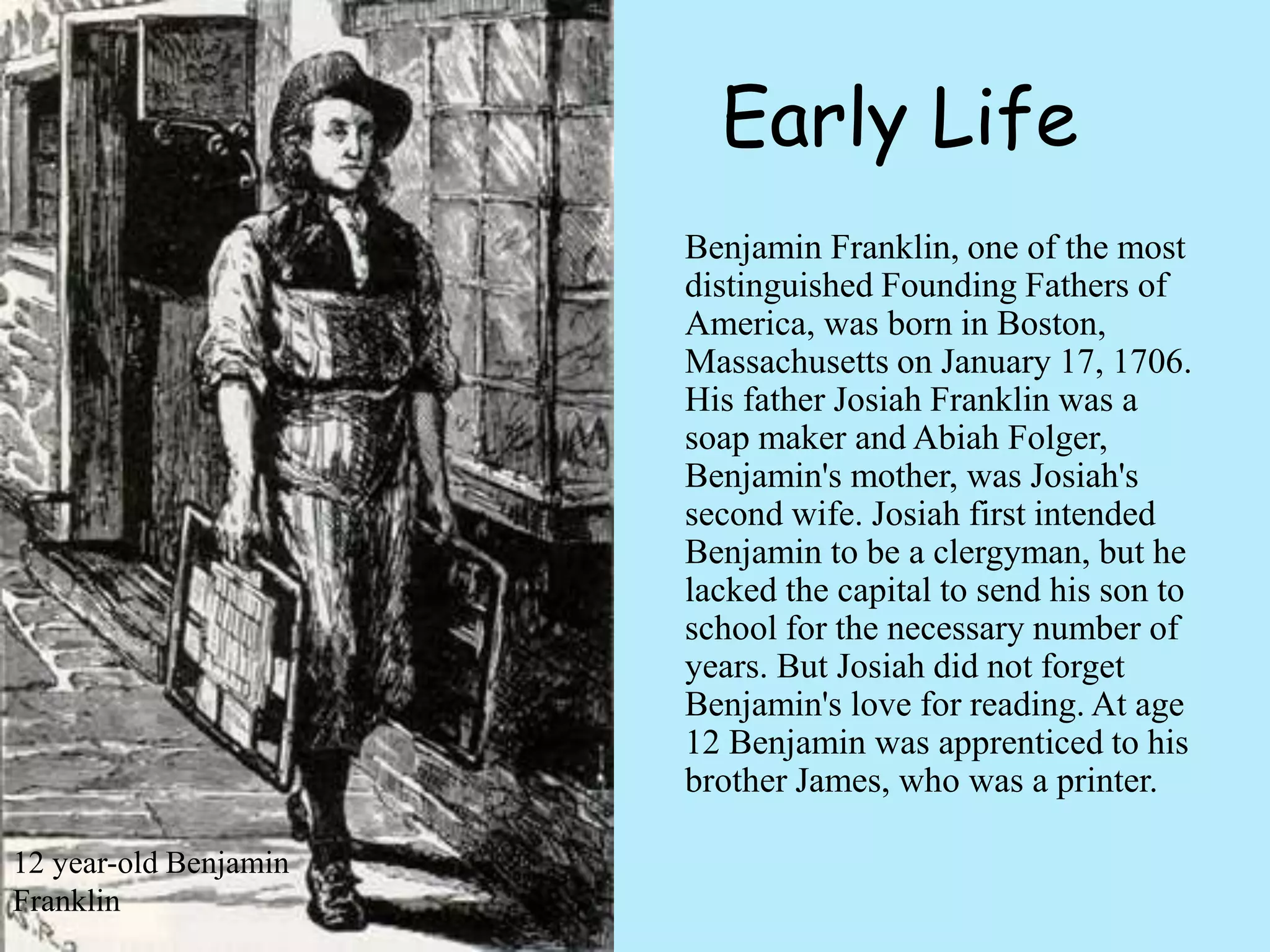
During his years as a printer, this time was physically demanding. Operating a manual printing press required significant strength and endurance. Franklin was known for his "industry," often staying later or arriving earlier than his competitors to prove his reliability to the Philadelphia business community. Even after he retired from active printing at age 42, these hours were spent on intense intellectual labor, such as his electrical experiments or drafting political pamphlets.
The Mid-Day Break (12:00 PM – 2:00 PM)
Franklin’s two-hour break was titled "Read, or overlook my accounts, and dine." It is important to note that "dining" in the 18th century was the day's main meal.
- Dietary Habits: During his apprenticeship, Franklin famously became a vegetarian to save money for books. Though he later returned to eating fish and meat, he maintained a lifelong interest in temperance. He avoided the heavy midday drinking common among London printers, preferring water, which earned him the nickname "the Water-American."
- Financial Oversight: "Overlooking accounts" was a critical habit. Franklin was a meticulous record-keeper, believing that financial transparency was a prerequisite for personal freedom.
Afternoon Work (2:00 PM – 6:00 PM)
The second block of work often involved more collaborative or civic-oriented tasks. As he moved into public life, this time might be spent at the Pennsylvania Assembly or managing the colonial postal system. Franklin was a master of "deep work" before the term existed, but he also understood the importance of networking and social capital in the "Junto," his club for mutual improvement.
The Evening Block: 6:00 PM to 10:00 PM
As the sun set, Franklin shifted from industry to "recreation" and "reflection." This period was essential for preventing burnout—a concept Franklin understood intuitively.
Supper and Diversion
Franklin’s evenings were filled with music, conversation, and "diversion." He was an accomplished musician, playing the harp, guitar, and violin, and he even invented the glass armonica. He believed that the mind needed to be "unbent" after a day of labor. Socializing was not just for fun; it was how he tested ideas. The Philadelphia elite frequently gathered at his home, where conversations ranged from lightning rods to the nuances of British common law.
Putting Things in Their Places
True to his virtue of Order, Franklin spent time each evening tidying his workspace and home. He believed that physical clutter led to mental clutter. By "putting things in their places," he ensured that the following morning’s work could begin without the friction of searching for tools or papers.
The Evening Question
Before retiring, Franklin asked himself the inverse of his morning question: "What good have I done today?" This was his moment of accountability. He would take out his little book of virtues and mark a black spot next to any virtue he had violated that day. This daily audit allowed him to track his progress over time, turning character development into a measurable metric.
Sleep: 10:00 PM to 5:00 AM
Franklin was a firm believer in the seven-hour sleep cycle. His famous maxim, "Early to bed and early to rise, makes a man healthy, wealthy, and wise," was not just a catchy proverb but his lived reality. He understood that late-night "revelry" or working by candlelight was inefficient and damaging to the next day’s performance.
| Time Block | Franklin's Activity | Modern Productivity Equivalent |
|---|---|---|
| 5:00 AM - 8:00 AM | Rise, wash, address Powerful Goodness, study, breakfast. | Morning routine: Exercise, meditation, deep work/study. |
| 8:00 AM - 12:00 PM | Work. | First Deep Work Sprint: High-priority tasks. |
| 12:00 PM - 2:00 PM | Read, overlook accounts, dine. | Lunch, administrative tasks, "shallow" work. |
| 2:00 PM - 6:00 PM | Work. | Second Deep Work Sprint or Meetings/Collaboration. |
| 6:00 PM - 10:00 PM | Supper, music/diversion, examination of the day. | Evening wind-down: Socializing, hobbies, daily review. |
| 10:00 PM - 5:00 AM | Sleep. | Consistent sleep hygiene and recovery. |
The Challenges of the Routine
It is a common misconception that Franklin followed this schedule perfectly every day. In his Autobiography, he confesses that his business as a printer often required him to be "at the beck and call" of others, which frequently disrupted his "Scheme of Order." Furthermore, his travels to London and Paris as a diplomat made it nearly impossible to maintain a rigid Philadelphia schedule.
However, the value of the routine was not in its perfection, but in its function as a "north star." When life became chaotic, Franklin had a structured framework to return to. He noted that even though he never arrived at the "perfection" he originally desired, he was "by the endeavour, a better and a happier man than I otherwise should have been if I had not attempted it."
Applying Franklin’s Routine in 2026
In our current era, characterized by the "attention economy," Franklin’s routine offers several tactical advantages for those seeking to reclaim their time:
- The Power of the Bookends: Franklin focused heavily on the first and last hours of the day. By controlling the morning (intention) and the evening (reflection), he could tolerate the unpredictability of the middle of the day.
- The Virtue of Silence: One of Franklin’s virtues was Silence ("Speak not but what may benefit others or yourself; avoid trifling conversation"). In 2026, this translates to digital silence—turning off non-essential notifications and avoiding the "trifling conversation" of social media feeds.
- Physical Environment: Franklin’s insistence on "Order" (everything in its place) is a precursor to modern ergonomic and "minimalist" workspace design. A clean desk reduces the cognitive load required to start a task.
- Moral Accountability: Most modern productivity systems focus only on output. Franklin’s system focused on outcome and ethics. Asking "What good shall I do?" forces a prioritization of tasks based on value rather than just urgency.
Frequently Asked Questions
Did Benjamin Franklin really take "air baths"?
Yes, Benjamin Franklin was a firm believer in "tonic" effects of cold air. He would sit in his room without clothes for up to an hour while reading or writing. He believed that the skin needed to breathe and that this practice helped prevent illnesses, contrary to the contemporary belief that cold air caused the common cold. This habit is well-documented in his correspondence, including a 1768 letter to Dr. Jacques Barbeu-Dubourg.
How did Franklin manage his schedule while traveling?
Franklin found it extremely difficult to maintain his "Scheme of Order" while serving as a diplomat in France and England. The social demands of the French court and the erratic nature of 18th-century travel meant he often had to abandon his strict 5:00 AM wake-up time. However, even in Paris, he maintained his habit of evening reflection and kept his "little book" to track his virtues, proving that the mental framework was more important than the specific clock times.
What was the purpose of Franklin's morning and evening questions?
The morning question ("What good shall I do this day?") served as a cognitive prime, forcing him to look for opportunities to be productive and helpful. The evening question ("What good have I done today?") served as a feedback loop. This practice of daily self-reflection is now recognized by psychologists as a powerful tool for behavior change and "metacognition"—the ability to think about one's own thinking and actions.
Why did Franklin choose 13 virtues specifically?
Franklin chose 13 virtues because the number allowed him to cycle through the entire list exactly four times in a year. He would focus intensely on one virtue per week, placing a dot in his book for every lapse. By focusing on only one virtue at a time, he avoided feeling overwhelmed, applying a "sequential" approach to self-improvement that is still recommended by habit-formation experts today.
Was Franklin's routine considered "normal" for the 1700s?
Franklin’s routine was more structured than that of the average colonial citizen, but it was influenced by the agrarian and industrial realities of the time. Without electricity, most people’s lives were dictated by daylight. However, Franklin’s specific "Scheme of Order" was a personal invention designed to combat his own perceived lack of discipline. His emphasis on "industry" and "frugality" helped define what became known as the "Protestant Work Ethic" in America.
Practical Recommendation: Implementing the "Scheme"
To adopt Benjamin Franklin’s routine in 2026, do not attempt to replicate his exact hours immediately. Instead, start with his bookend questions. For one week, write "What good shall I do today?" on a sticky note or in a digital planner each morning. At night, answer the question, "What good have I done today?" This simple act of reflection provides the same psychological benefit that Franklin sought: a life lived with intention rather than by accident. Once this habit is established, you can begin to apply his "Precept of Order" by assigning specific time blocks to your most demanding work, ensuring that "each part of your business has its time."