The Trojan War was a legendary decade-long conflict between the Achaean (Greek) forces and the city of Troy. Triggered by the Trojan prince Paris’s abduction of Helen, the Queen of Sparta, the war culminated in the famous ruse of the Trojan Horse and the total destruction of Troy, blending historical archaeology with timeless Greek mythology.
The narrative of the Trojan War is one of the foundational pillars of Western literature. While primarily known through Homer’s Iliad and Odyssey, the story encompasses a vast cycle of myths involving gods, heroes, and the complex interplay of fate and human agency. In the context of 2026, our understanding of this event continues to bridge the gap between poetic legend and the archaeological realities discovered at the site of Hisarlik in modern-day Turkey.
The Mythological Origins: The Apple of Discord
The seeds of the Trojan War were not sown on a battlefield, but at a wedding. When Peleus (a mortal king) and Thetis (a sea-nymph) married, they invited all the gods except Eris, the goddess of strife. Insulted, Eris gatecrashed the ceremony and tossed a golden apple inscribed with the words "To the Fairest" into the crowd.
This sparked a heated dispute between three powerful goddesses: Hera, the queen of the gods; Athena, the goddess of wisdom and war; and Aphrodite, the goddess of love. Unable to decide amongst themselves, Zeus appointed Paris, a young prince of Troy who was living as a shepherd at the time, to act as the judge. This event, known as the Judgment of Paris, forced the young man to choose between three bribes:
- Hera offered him political power and dominion over Europe and Asia.
- Athena offered him supreme wisdom and skill in battle.
- Aphrodite offered him the love of the most beautiful woman in the world.
Paris chose Aphrodite. The "most beautiful woman" was Helen, the daughter of Zeus and Leda, and the wife of King Menelaus of Sparta. Under the protection of Aphrodite, Paris traveled to Sparta, seduced (or abducted, depending on the source) Helen, and carried her back to the fortified city of Troy.
The Gathering of the Greek Host
The abduction of Helen was more than a personal insult to Menelaus; it was a violation of the sacred laws of hospitality (xenia). Years earlier, when Helen’s father, Tyndareus, was choosing a husband for her, he feared that the rejected suitors would turn to violence. On the advice of Odysseus, he made all the suitors swear an oath—the Oath of Tyndareus—to defend the chosen husband if any wrong was done to him regarding Helen.
When Menelaus discovered his wife was gone, he called upon his brother, Agamemnon, the powerful King of Mycenae, to lead an expedition to retrieve her. Because of the oath, the greatest heroes of Greece were bound to join the cause. This coalition included:
- Achilles: The greatest warrior of his age, nearly invincible except for his heel.
- Odysseus: The King of Ithaca, renowned for his cunning and strategic mind.
- Ajax the Greater: A towering warrior of immense strength.
- Diomedes: A bold commander who eventually wounded two gods in battle.
The Greek fleet, famously described as "a thousand ships," assembled at the port of Aulis. However, the expedition was delayed when Agamemnon offended the goddess Artemis. To appease her and secure favorable winds for the voyage, Agamemnon was forced to sacrifice his own daughter, Iphigenia—a grim prelude to the tragedies that would follow.
The Ten-Year Siege and the Role of the Gods
Upon arriving at the shores of Troy, the Greeks realized the city would not fall easily. Troy was protected by massive walls, said to have been built by the gods Poseidon and Apollo themselves. The conflict settled into a protracted siege that lasted ten years. During this decade, the Greeks raided surrounding Trojan allies and countryside to sustain their supplies, while the Trojans remained largely behind their fortifications.
The war was not merely a human struggle; it was a divine proxy war. The Olympian gods were deeply divided, often intervening directly on the battlefield:
- Supporting the Greeks: Hera and Athena (still bitter over the Judgment of Paris), Poseidon, and Hermes.
- Supporting the Trojans: Aphrodite (protecting Paris), Apollo (the city's patron), Artemis, and Ares.
- Neutral/Arbitrator: Zeus, who attempted to maintain the balance of fate, though he often leaned toward the Trojans to honor a request from Achilles’ mother, Thetis.
Divine intervention took many forms, from shielding heroes with magical mists to inspiring them with "aristeia"—a state of heightened battle-frenzy where a mortal could perform supernatural feats.
The Wrath of Achilles: The Turning Point
The Iliad, the most famous account of the war, focuses exclusively on a few weeks during the tenth year. It begins with the "Wrath of Achilles." Agamemnon, the Greek commander, insulted Achilles by seizing a captive woman, Briseis, whom Achilles had claimed as a war prize. Furious and dishonored, Achilles withdrew from the fighting, taking his elite Myrmidon soldiers with him.
Without their champion, the Greeks suffered devastating losses. The Trojans, led by the noble Prince Hector, pushed the Greeks back to their very ships. Desperate to save his comrades, Achilles’ closest companion, Patroclus, donned Achilles' armor to frighten the Trojans. Patroclus fought bravely but was eventually slain by Hector.
Grief-stricken and consumed by a desire for vengeance, Achilles returned to the war. In a climactic duel outside the gates of Troy, Achilles killed Hector. In an act of extreme hubris and cruelty, he dragged Hector’s body behind his chariot around the city. The poem ends on a somber note when King Priam of Troy secretly enters the Greek camp to beg for his son’s body, leading to a temporary truce for Hector’s funeral.
The Fall of Troy and the Trojan Horse
The death of Hector did not end the war. Troy received new allies, including the Amazons led by Queen Penthesilea and the Ethiopians led by King Memnon, both of whom were defeated by Achilles. However, Achilles’ own fate soon caught up with him. Paris, guided by the god Apollo, fired an arrow that struck Achilles in his one vulnerable spot—his heel—killing the greatest of the Greek heroes.
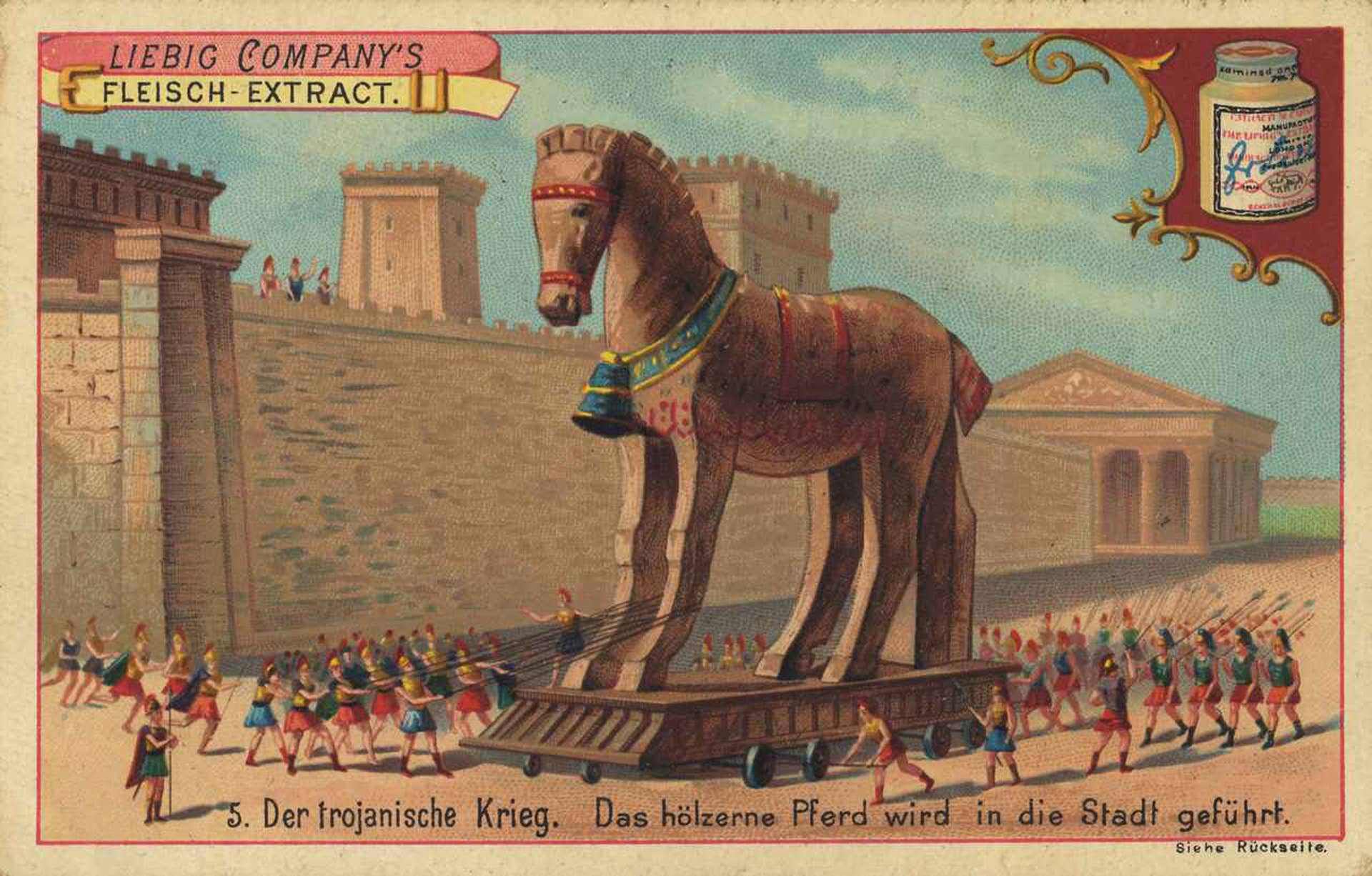
Despite the loss of Achilles, the Greeks realized that Troy could not be taken by force alone. Odysseus devised a brilliant and deceptive plan. The Greeks constructed a massive, hollow wooden horse and left it outside the city gates. The rest of the Greek fleet burned their camp and sailed away, hiding behind the nearby island of Tenedos.
Thinking the Greeks had surrendered and left the horse as an offering to Athena, the Trojans debated what to do. Despite the warnings of the prophetess Cassandra and the priest Laocoön, the Trojans pulled the horse into the city and began a night of celebration.
Once the city was asleep and intoxicated, the Greek soldiers hidden inside the horse—including Odysseus and Menelaus—emerged and signaled the waiting fleet to return. The Greeks entered the open gates and systematically slaughtered the inhabitants. King Priam was killed at the altar of Zeus, and the city was burned to the ground. Helen was recovered by Menelaus, and the surviving Trojan women, including Queen Hecuba and Andromache, were taken into slavery.
Key Figures and Their Fates
The following table summarizes the primary actors in the Trojan War and the outcomes of their stories according to the broader epic cycle.
| Name | Side | Role | Fate |
|---|---|---|---|
| Agamemnon | Greek | High King / Commander | Survived the war, but was murdered by his wife Clytemnestra upon his return. |
| Achilles | Greek | Champion Warrior | Killed by Paris (with Apollo's help) before the fall of Troy. |
| Odysseus | Greek | Strategist / King | Survived; took ten years to return home (the subject of the Odyssey). |
| Hector | Trojan | Prince / Lead General | Killed by Achilles in single combat outside the walls of Troy. |
| Paris | Trojan | Prince / Abductor | Killed by Philoctetes using the bow of Hercules late in the war. |
| Helen | Trojan/Greek | Queen of Sparta | Returned to Sparta with Menelaus and lived out her days as Queen. |
| Priam | Trojan | King of Troy | Killed by Neoptolemus (Achilles' son) during the sack of Troy. |
| Aeneas | Trojan | Prince / Hero | Survived; fled the burning city to eventually found the Roman lineage (in the Aeneid). |
Historical Reality vs. Mythological Legend
For centuries, the Trojan War was considered purely a work of fiction. However, in the late 19th century, archaeologist Heinrich Schliemann began excavations at Hisarlik in modern-day Turkey. He discovered a series of cities built on top of one another, dating back to the Bronze Age.
Archaeological findings and Hittite diplomatic texts (which refer to a city called "Wilusa," likely the Hittite name for Ilion/Troy) suggest that a conflict did indeed occur around 1200 BCE. Most modern historians believe that the "Trojan War" was likely a series of conflicts over trade routes and resources in the Aegean, rather than a romantic quest for a single woman. The city identified as Troy VIIa shows evidence of destruction by fire and warfare, which aligns closely with the traditional dating of the fall of Troy.
As of 2026, remote sensing and advanced stratigraphic analysis have revealed that the city was much larger than previously thought, with a significant "lower city" that could have supported a population capable of resisting a long siege. While the gods and individual duels remain in the realm of myth, the geopolitical tension between the rising Mycenaean Greeks and the established Luwian-speaking Trojans is a documented historical reality.
The Enduring Legacy of the War
The Trojan War persists in the modern imagination because it explores universal themes: the futility of war, the nature of heroism, the inevitability of fate, and the destructive power of pride. Homer’s Iliad is not a pro-war poem; it is a meditation on "the sorrow of war" and the shared humanity of enemies.
The story also birthed the concept of the "Trojan Horse" in modern technology and strategy—a term used for anything that appears harmless but carries a hidden threat. Furthermore, the "Achilles' heel" remains a standard metaphor for a single, fatal weakness in an otherwise strong entity.
Frequently Asked Questions
Did the Trojan Horse actually exist?
While the wooden horse is the most famous part of the legend, there is no direct archaeological evidence for it. Some historians suggest the "horse" may have been a metaphor for a siege engine (like a battering ram) covered in wet horse hides to prevent fire, or it could represent an earthquake—symbolized by Poseidon, whose animal was the horse—that breached the city walls.
How long did the Trojan War last?
According to mythological tradition, the war lasted 10 years. The first nine years consisted of the Greeks raiding Trojan allies and the surrounding countryside to weaken Troy's economy and food supply, while the final year contained the most significant battles described in the Iliad.
Who won the Trojan War?
The Greeks (Achaeans) technically won the war by destroying the city of Troy. However, it was a "Pyrrhic victory" for many. Most of the Greek heroes died during or shortly after the war, and those who survived, like Odysseus and Agamemnon, faced years of hardship or death upon returning home.
Where was Troy located?
The ruins of Troy are located at Hisarlik in northwest Turkey, near the entrance to the Dardanelles. This strategic location allowed the city to control trade between the Mediterranean and the Black Sea, making it a wealthy and frequent target for invasions.
Is the movie "Troy" (2004) accurate?
The film is a loose adaptation that removes the gods entirely and shortens the ten-year war into a few weeks. It also changes the fates of major characters (for example, Agamemnon and Menelaus die in the film but survive the war in the original myths). For a clear summary, one should rely on the Epic Cycle rather than cinematic interpretations.
Next Steps for Learning
To gain a deeper understanding of the Trojan War, the best course of action is to read the primary sources. Start with Homer's Iliad for the conflict's peak, followed by Virgil's Aeneid (Book II) for the most detailed description of the Trojan Horse and the city's fall. For those interested in the archaeological side, the UNESCO World Heritage site records for the Archaeological Site of Troy provide the most current scientific data on the excavations.