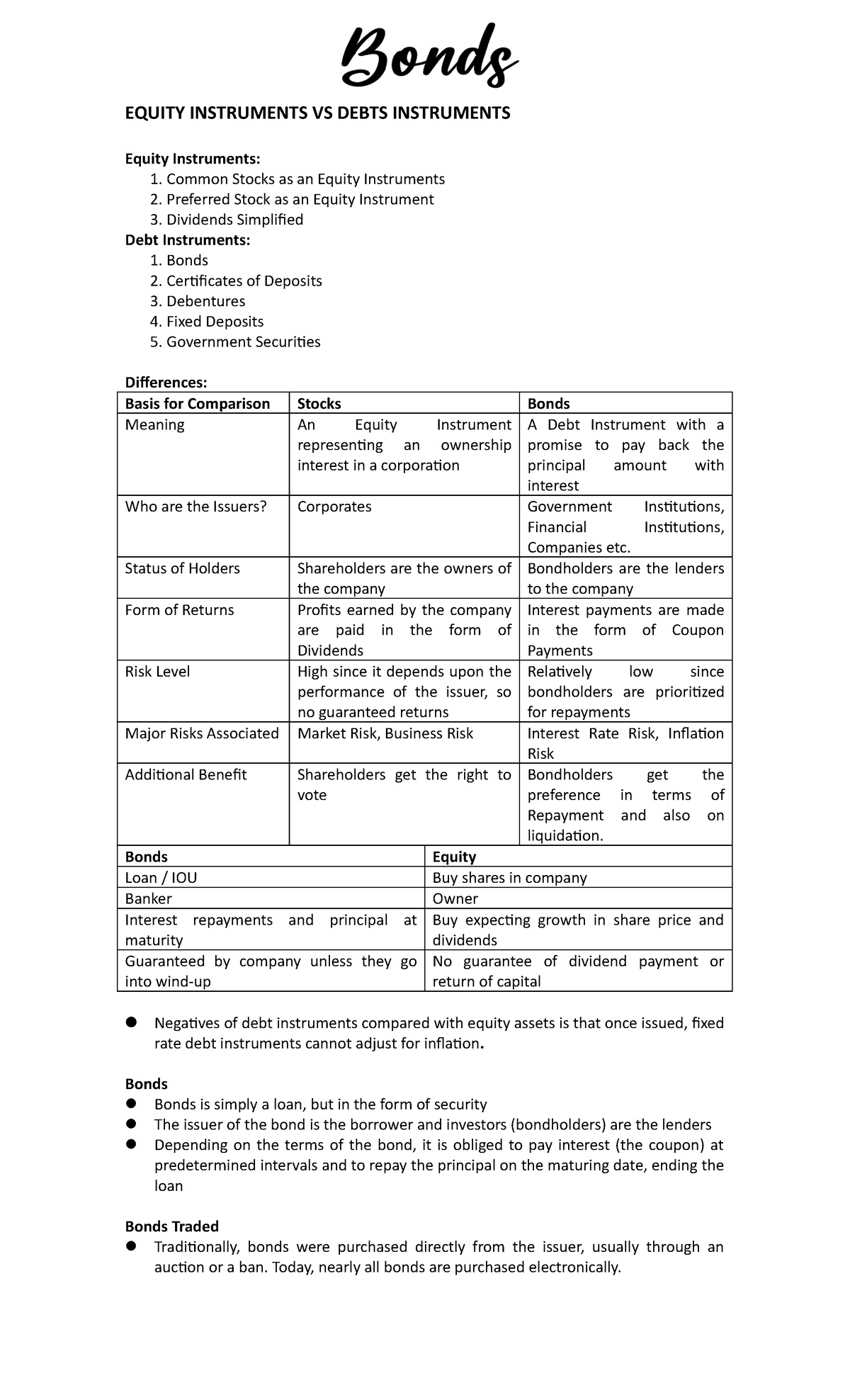
The fundamental distinction between a bond and an equity lies in the nature of the relationship with the issuer. A bond is a debt instrument where the investor acts as a lender, entitled to interest and principal repayment. Equity represents ownership in a company, granting a residual claim on profits without guaranteed returns or repayment.
In the financial landscape of 2026, where digital assets and fractionalized interests have blurred some traditional boundaries, the legal and economic distinction between debt and ownership remains the most critical concept for any investor to grasp. To say "a bond is not an equity" is more than a simple classification; it is an acknowledgement of two entirely different risk-reward profiles, legal protections, and roles within a corporate capital structure.
The Contractual Nature of Bonds
When you purchase a bond, you are entering into a formal lending agreement. Whether the issuer is a sovereign government, a municipality, or a private corporation, the bond acts as a "promissory note." As a bondholder, you do not own a piece of the entity; rather, you are a creditor.
The Issuer’s Obligation
The core of a bond is the indenture, a legal contract that specifies the terms of the loan. This includes the "par value" (the amount to be repaid at the end), the "coupon rate" (the interest rate paid to the lender), and the "maturity date" (when the loan concludes). In 2026, these contracts are increasingly executed via smart contracts on distributed ledgers, but the underlying legal obligation remains identical to traditional paper bonds: the issuer must pay you back.
Fixed Income and Predictability
Bonds are often referred to as "fixed-income" securities because the cash flows are generally predetermined. Unless the bond has a floating rate, you know exactly how much interest you will receive and when. This predictability makes bonds the cornerstone of wealth preservation and income-generation strategies. If a company generates record profits, bondholders do not receive a bonus; they receive exactly what was promised. Conversely, if the company’s profits dip, the company is still legally required to pay the bondholders before it can consider rewarding its owners.
The Participatory Nature of Equities
Equity, commonly referred to as "stock" or "shares," represents a slice of ownership in a business. Unlike bondholders, equity investors are not lenders; they are partners. When you buy equity, you are betting on the future success of the enterprise and its ability to generate value over time.
Residual Claimants
The most significant technical aspect of equity is that shareholders are "residual claimants." This means that in the hierarchy of corporate cash flows, equity holders are last in line. A company must pay its employees, its suppliers, its taxes, and—most importantly—its bondholders before a single cent can be distributed to shareholders as dividends.
Because shareholders take the most risk by standing last in line, they also enjoy the most significant potential for reward. There is no "ceiling" on how much a stock price can rise. If a company doubles its valuation, the equity holders capture that growth, while the bondholders continue to receive only their fixed interest payments.
Voting Rights and Governance
Owning equity typically confers governance rights. Shareholders often have the power to vote on the board of directors and major corporate actions, such as mergers or acquisitions. Bondholders, as creditors, generally have no say in how a company is run, provided the company continues to meet its debt obligations. Their influence only arises if the company violates a "covenant" (a protective rule in the bond agreement) or enters bankruptcy.
Key Differences: A Comparative Analysis
To understand why a bond is not an equity, one must look at how they behave under different economic conditions and legal scenarios. The following table highlights the primary divergent characteristics.
| Feature | Bond (Debt) | Equity (Ownership) |
|---|---|---|
| Relationship | Creditor/Lender | Owner/Shareholder |
| Primary Return | Interest (Coupons) | Capital Gains & Dividends |
| Maturity | Fixed Date | Perpetual (None) |
| Risk Profile | Lower (Generally) | Higher (Generally) |
| Legal Claim | Senior (Paid First) | Junior (Residual/Last) |
| Upside Potential | Capped at Interest/Par | Theoretically Unlimited |
| Governance | None (Usually) | Voting Rights |
| Tax Treatment | Interest is Tax-Deductible for Issuer | Dividends are not Deductible |
The Capital Stack and Liquidation Preference
One of the most practical ways to see that a bond is not an equity is to examine the "capital stack." This is the hierarchy of who gets paid when a company’s assets are distributed, particularly in a liquidation or bankruptcy scenario.
Seniority of Debt
In the eyes of the law, debt must be satisfied before equity. Within the category of bonds, there are further subdivisions:
- Secured Debt: Backed by specific collateral (like a building or equipment).
- Unsecured Debt (Debentures): Backed by the general credit of the company.
- Subordinated Debt: Paid only after senior bondholders are made whole.
Even the most junior bondholder is technically "senior" to a common shareholder. In 2026, even with faster digital liquidation processes, this "absolute priority rule" remains the standard. If a company fails, equity holders frequently see their investment go to zero, while bondholders may recover 40, 60, or 80 cents on the dollar, depending on the available assets.
The Risk of the "Equity Cushion"
From a corporate finance perspective, equity serves as the "cushion" for bondholders. Because bondholders must be paid first, the equity value must be entirely wiped out before the company technically defaults on its bonds. This is why bonds are perceived as safer; the company’s value would have to drop significantly before the bondholders' principal is at risk.
Economic Sensitivities: Interest Rates and Inflation
Bonds and equities react differently to the macroeconomic environment, particularly regarding interest rates and inflation, which remain central themes in the 2026 economy.
Bonds and Interest Rate Risk
Bonds have an inverse relationship with interest rates. When market interest rates rise, existing bonds with lower coupon rates become less attractive, causing their market price to fall. This is known as duration risk. For a bondholder intending to hold until maturity, this price fluctuation may not matter, but for those needing liquidity, it is a primary concern.
Equities and Growth Dynamics
Equities are also affected by interest rates, but the relationship is more complex. Higher rates increase the "discount rate" used to value future earnings, which can depress stock prices, especially for growth companies. However, equities often act as a better hedge against inflation than bonds. Because companies can raise prices for their goods and services as inflation climbs, their nominal earnings (and thus their stock price) can rise, whereas a bond’s fixed interest payments lose purchasing power.
Hybrid Securities: When the Line Blurs
While a bond is fundamentally not an equity, the financial industry has created "hybrid" instruments that share characteristics of both. Understanding these is essential for sophisticated investors in 2026.
- Convertible Bonds: These are bonds that can be "converted" into a predetermined number of equity shares. They offer the safety of a bond (interest payments and seniority) with the upside potential of equity if the stock price performs well.
- Preferred Stock: Despite the name, preferred stock behaves a lot like a bond. It usually pays a fixed dividend and has a higher claim on assets than common stock, but it technically represents ownership and does not have a maturity date.
- Mezzanine Financing: This is often a blend of debt and equity used in private equity and real estate, sitting between senior debt and pure equity in the capital stack.
Even in these cases, the legal "trigger" for when a security behaves like debt versus when it behaves like equity is clearly defined in the offering documents.
Why Investors Need Both
The reason professional portfolios almost always contain both bonds and equities is that they serve different purposes.
- Diversification: Because they often react differently to market shocks, holding both can reduce overall portfolio volatility. When the "equity risk premium" disappears during a market crash, the "flight to safety" often drives up the price of high-quality government bonds.
- Income vs. Growth: Bonds provide the "ballast" and steady cash flow needed for retirees or those with near-term expenses. Equities provide the "engine" for long-term wealth accumulation and inflation protection.
- Liability Matching: For institutional investors like pension funds, bonds are used to match specific future cash outflows (liabilities). Equities are used to grow the total pool of assets over decades.
Common Pitfalls and Misconceptions
It is a mistake to assume that all bonds are safer than all equities. In the current 2026 market, "High Yield" or "Junk" bonds—those issued by companies with poor credit ratings—can be significantly riskier than "Blue Chip" equities. If a company's probability of default is high, the bond's "guaranteed" return is only as good as the company's ability to stay solvent.
Another misconception is that dividends are the same as interest. They are not. A board of directors can choose to cut or eliminate a dividend at any time without legal penalty. Failing to pay bond interest, however, is an act of default that can lead to immediate legal action and bankruptcy.
Summary of the "Bond vs. Equity" Decision
Choosing between a bond and an equity investment requires an assessment of your "risk tolerance" and "time horizon."
- Choose Bonds if your primary goal is capital preservation, predictable income, and you have a shorter timeframe (e.g., 1–5 years).
- Choose Equities if you are looking for long-term growth, can tolerate price swings, and have a decade or more to allow the power of compounding and corporate growth to take effect.
Frequently Asked Questions
1. Can a bond ever turn into an equity? Yes, but only through specific mechanisms. A convertible bond allows the holder to exchange the debt for shares. Additionally, in some corporate restructurings or bankruptcies, bondholders may be forced to accept equity in the "new" reorganized company as a settlement for the debt they are owed. This is often referred to as a "debt-for-equity swap."
2. Why do bonds have lower returns than equities over the long term? This is known as the Equity Risk Premium. Because equity holders take on more risk (they are last in line for payment) and have no guarantee of return, the market requires a higher expected return to entice people to buy stocks. If bonds returned as much as equities, no one would take the risk of owning the equity.
3. Is "Preferred Stock" a bond or an equity? Legally, it is equity. However, it is often called a "hybrid" because it pays a fixed dividend (like a bond coupon) and usually does not have voting rights. In the capital stack, it sits above common equity but below all forms of debt.
4. What happens to bonds and equities during high inflation? Generally, high inflation is bad for existing bonds because it erodes the purchasing power of their fixed interest payments. Equities can be a mixed bag; while inflation can increase costs and hurt valuations, many companies can pass those costs to consumers, allowing their earnings (and stock price) to keep pace with or exceed inflation over time.
5. Which is better for a retirement account in 2026? Most advisors recommend a blend. In 2026, with a more volatile global economy, a "60/40" or "70/30" split between equities and bonds remains a standard starting point, adjusted based on how close you are to needing the money. The equity portion provides growth to combat inflation, while the bond portion provides stability and income.
Practical Recommendation
If you are just starting your investment journey in 2026, begin by identifying your objective. If you are saving for a house down payment in three years, focus on high-quality bonds or "bond-like" instruments (CDs, Treasuries) to ensure the money is there when you need it. If you are saving for a retirement that is twenty years away, the majority of your capital should likely be in equities to capture the long-term growth of the economy. Always verify the credit rating of any bond issuer and the "dividend safety" of any equity before committing significant capital.
Disclaimer: This article provides general financial information and does not constitute professional investment, legal, or tax advice. Financial markets involve risk; consult with a certified financial planner or advisor regarding your specific situation.