When a life insurance policy pays out a death benefit, beneficiaries often face the decision of whether to invest those funds into an annuity. Generally, the death benefit itself is received income-tax-free by the beneficiary. However, once those proceeds are used to purchase an annuity, the subsequent growth and distributions from that annuity are subject to specific tax rules dictated by the Internal Revenue Code. The tax status of the annuity depends on whether the contract is qualified or non-qualified and how the interest is structured within the account.
Understanding the Tax Nature of Life Insurance Death Benefits
To determine how an annuity purchase is taxed, one must first distinguish between the source of the funds and the nature of the investment vehicle. Under Section 101(a) of the Internal Revenue Code, life insurance death benefits paid to a beneficiary are typically excluded from gross income. This means that if you receive a $500,000 payout from a policy, that initial sum is yours to keep without triggering an income tax liability.
When you take that tax-free cash and use it to purchase a single-premium immediate annuity (SPIA) or a deferred annuity, you are essentially transitioning from a non-taxable asset to an investment vehicle that generates taxable income. The IRS does not view the "purchase" of the annuity as a taxable event; rather, it views the annuity as a new financial contract. The tax consequences begin to accrue only when the annuity starts to pay out interest or distributions.
How Annuity Taxation Works After Purchase
Annuities are tax-deferred investment vehicles. This means you do not pay taxes on the interest earned by the annuity until you begin taking withdrawals. Once you transition to the withdrawal phase—whether through periodic payments or lump-sum surrenders—the IRS applies the "exclusion ratio" to non-qualified annuities.
The Exclusion Ratio Explained
The exclusion ratio is a technical calculation used to determine what portion of each annuity payment is considered a return of your original investment (your principal) and what portion is considered taxable earnings.
- Excludable Amount: This represents the portion of the annuity payment that is considered a tax-free return of your original principal.
- Taxable Amount: This represents the interest earned on the principal. This portion is taxed as ordinary income at your current marginal tax rate.
If you purchase an annuity with the death benefit proceeds, your "investment in the contract" is the amount you paid for the annuity. The IRS assumes you will receive your original principal back over your life expectancy or the term of the annuity. The remaining balance of the payments is then treated as profit and taxed accordingly.
Qualified vs. Non-Qualified Annuity Distinctions
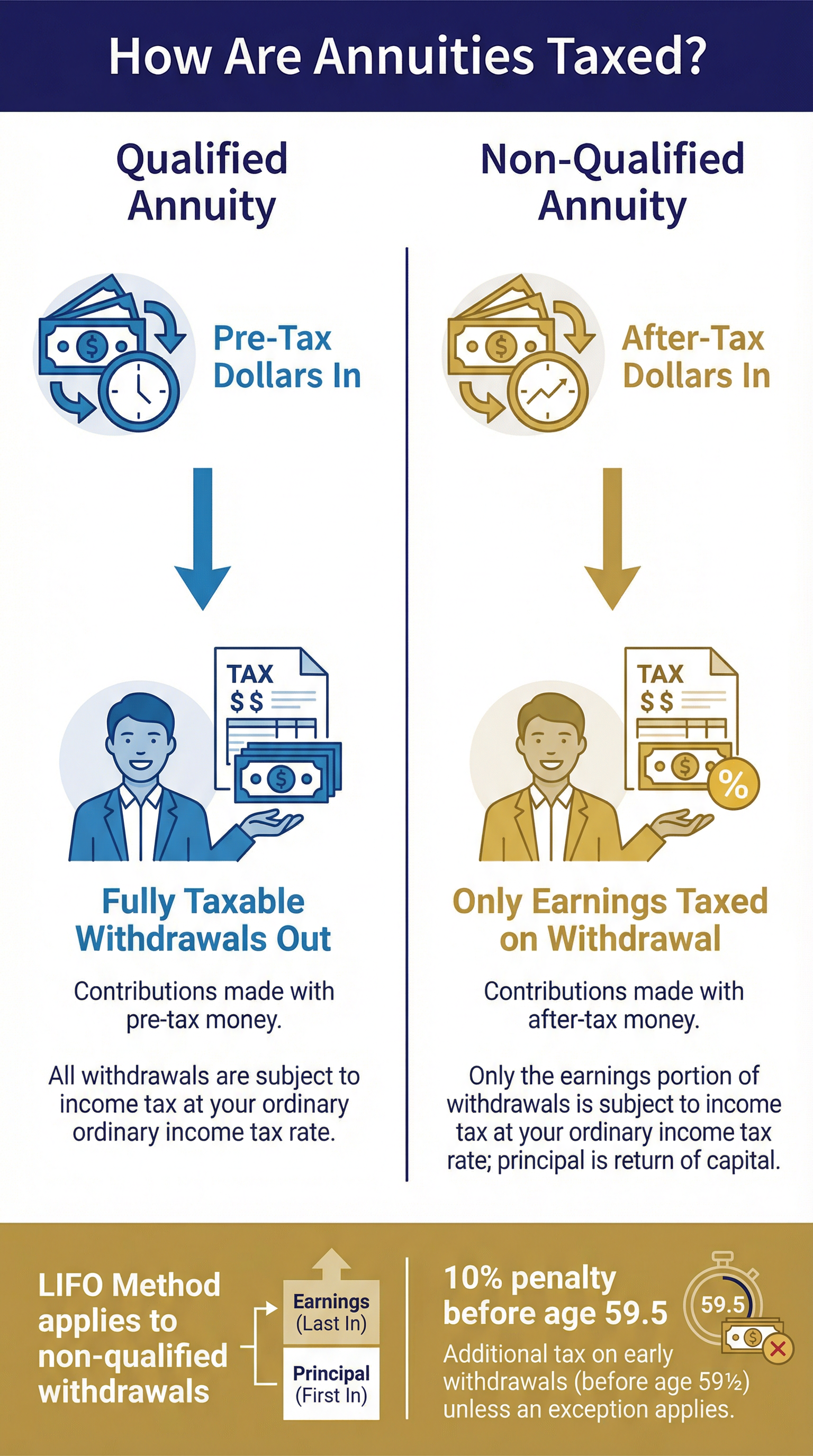
The tax treatment is heavily influenced by the "qualified" status of the annuity. A qualified annuity is funded with pre-tax dollars, often rolled over from a 401(k) or traditional IRA. If you use life insurance death benefits to purchase an annuity, the annuity will be "non-qualified" because the money used to buy it (the death benefit) was already received tax-free and was not held in a tax-advantaged retirement account.
Tax Treatment of Non-Qualified Annuities
Because the annuity is non-qualified, the tax treatment is relatively straightforward compared to retirement accounts:
- Cost Basis: Your cost basis is the amount you paid for the annuity.
- LIFO Accounting: Unlike some investments that use FIFO (First-In, First-Out), annuities typically follow LIFO (Last-In, First-Out) for withdrawals. This means any withdrawals are considered to come from the earnings (taxable) first, rather than your principal (non-taxable).
- Penalty Tax: If you withdraw funds from a deferred annuity before age 59½, the IRS generally imposes a 10% penalty on the taxable portion of the withdrawal, in addition to regular income tax.
Comparison of Tax Treatments for Annuity Funding Sources
| Funding Source | Tax Status of Principal | Taxability of Growth | Penalty Risk |
|---|---|---|---|
| Life Insurance Death Benefit | Tax-Free | Tax-Deferred | Yes (if < 59½) |
| Traditional IRA Rollover | Pre-Tax | Tax-Deferred | Yes (if < 59½) |
| After-Tax Savings/Cash | Already Taxed | Tax-Deferred | Yes (if < 59½) |
The Impact of Settlement Options
Some life insurance policies offer an "annuitization" option directly through the insurer. If you choose to leave the death benefit with the insurance company to be paid out as a series of installments rather than a lump sum, the tax treatment changes.
Under these circumstances, the insurer often treats the payout as a settlement option. A portion of each payment may be excluded from income under the rules of Section 101(d), which allows the beneficiary to exclude the principal amount and sometimes a portion of the interest (up to $1,000 per year) if the beneficiary is a surviving spouse. If you take the lump sum and purchase a separate annuity, you generally lose this specific $1,000 interest exclusion, as the contract is treated as a new, independent investment.
Potential Pitfalls and Strategic Considerations
Purchasing an annuity with life insurance proceeds is a significant financial commitment. Because annuities are designed for long-term income, liquidity can be a major challenge.
Liquidity Constraints
Once you move the death benefit into a deferred annuity, the funds are no longer liquid. While most annuities offer a "free withdrawal" provision (typically 10% per year), accessing the bulk of your capital before the contract term ends may trigger high surrender charges. These charges can erode the principal you just transferred from the insurance policy.
The Impact of Inflation
While an annuity provides a guaranteed stream of income, it is essential to consider the impact of inflation over the years. If you purchase a fixed annuity in 2026, the purchasing power of those monthly payments will likely decrease over time. Some investors opt for "inflation-protected" riders, but these typically come at the cost of a lower initial payout, which affects the tax-free exclusion ratio calculations.
Estate Tax Considerations
While life insurance death benefits are generally free from income tax, they are still considered part of the decedent’s gross estate for federal estate tax purposes if the decedent owned the policy. However, once the proceeds are received by the beneficiary and placed into an annuity, those assets are now part of the beneficiary's estate. If the beneficiary passes away with the annuity still in force, the remaining value of the annuity may be subject to estate taxes depending on the beneficiary's total net worth and current federal tax exemptions.
Frequently Asked Questions
Is the entire annuity payment taxable if I use life insurance money?
No. Only the interest portion of the payment is taxable. The portion of each payment that represents a return of your original principal—the money you used to buy the annuity—is considered a non-taxable return of capital and is excluded from your income.
Do I pay taxes on the death benefit when I receive it?
Generally, no. Life insurance death benefits paid to a beneficiary are excluded from gross income under federal law. However, if the policy was transferred to you for "valuable consideration," different tax rules may apply, potentially making the death benefit subject to income tax.
Can I avoid the 10% penalty on annuity withdrawals?
The 10% IRS penalty generally applies to taxable withdrawals made before age 59½. If you are younger than 59½, you might consider choosing an immediate annuity (SPIA), which provides a series of payments. Because these are structured as a return of principal, the earnings portion is often minimal or spread out, though the age-based penalty can still be a factor in specific contract structures.
Is it better to take the lump sum or the annuity from the insurance company?
This depends on your need for cash versus your need for guaranteed lifetime income. A lump sum provides total flexibility but shifts the burden of investment management onto you. An annuity provides security and longevity but locks your capital away. You should consult with a tax professional to calculate which option results in the most favorable after-tax outcome based on your specific age and tax bracket.
Does the insurance company report this income to the IRS?
Yes. Insurance companies issue Form 1099-R to both the policyholder and the IRS. This form outlines the total distribution, the taxable portion, and the tax-free portion (the exclusion ratio). You must report this information on your annual tax return.
Professional Guidance and Next Steps
Before converting a life insurance death benefit into an annuity, assess your immediate financial needs. If the death benefit is intended to cover immediate liabilities such as mortgages, medical bills, or estate taxes, an annuity is likely inappropriate due to the lack of liquidity and potential surrender charges.
If you have sufficient emergency reserves and are seeking a predictable income stream, contact a fee-only financial planner or a tax advisor. Ask them to run a "break-even" analysis comparing the after-tax yield of the annuity against other conservative investment vehicles like high-yield bonds or CDs. Ensure you understand the surrender charge schedule of any annuity you are considering and verify whether the insurance company offers any "death benefit riders" that might return the remaining principal to your heirs should you pass away shortly after purchasing the contract.