Ancient Egyptian civilization flourished along the lower reaches of the Nile River in North Africa for over 3,000 years, from roughly 3100 BCE to 30 BCE. Defined by monument building, divine kingship, complex funerary traditions, and remarkable administrative stability, its legacy laid foundational principles for architecture, mathematics, medicine, and governance across the Mediterranean world.
Geographic Foundations: The Gift of the Nile
Ancient Egyptian civilization owed its longevity and distinct cultural identity to the physical geography of the Nile River basin. Often repeating the observation of the ancient Greek historian Herodotus that Egypt was "the gift of the Nile," historians emphasize that the river provided predictable resource abundance in the middle of an otherwise unforgiving desert ecosystem.
- MEDITERRANEAN SEA
- Lower Egypt (Delta)
- Memphis (Capital)
- Upper Egypt (Nile Valley)
- First Cataract (Aswan)
- Nubia
The civilization was geographically organized into two primary regions: Upper Egypt (the narrow river valley in the south) and Lower Egypt (the broad, fertile delta in the north). The annual flooding of the Nile—known as the Akhet or Inundation—occurred between July and October. Driven by summer monsoon rains in the Ethiopian highlands, the floodwaters deposited nutrient-rich black silt across the floodplain. The Egyptians called this fertile soil Kemet ("the Black Land"), contrasting it sharping with Deshret ("the Red Land"), the barren desert regions shielding the valley on both eastern and western flanks.
These surrounding deserts and natural barriers provided dual benefits:
- Agricultural Surplus: The reliable flood cycle enabled high-yield grain farming (primarily emmer wheat and barley) using basin irrigation, creating economic security and supporting non-agricultural specialists like priests, artisans, and administrators.
- Geographic Isolation: Surrounding deserts, the Mediterranean Sea to the north, the Red Sea to the east, and dangerous river rapids (cataracts) to the south insulated Egypt from constant foreign invasion, permitting long stretches of internal cultural development.
Chronological Timeline of Dynastic Egypt
Egyptologists divide the 3,000-year history of dynastic Egypt into distinct kingdoms characterized by strong central governance, interspersed with "intermediate periods" marked by political fragmentation, civil strife, or foreign rule.
- [3100 BCE] Unification under Narmer
- Early Dynastic Period (3100–2686 BCE): State foundations, Memphis capital
- Old Kingdom (2686–2181 BCE): Pyramid Age, centralized state
- First Intermediate Period (2181–2055 BCE): Drought, regional power shifts
- Middle Kingdom (2055–1650 BCE): Classical renaissance, literary bloom
- Second Intermediate Period (1650–1550 BCE): Hyksos rule in Delta
- New Kingdom (1550–1069 BCE): Imperial expansion, Valley of Kings
- Third Intermediate Period (1069–664 BCE): Libyans, Nubian 25th Dynasty
- Late Period (664–332 BCE): Persian rule, brief restorations
- [30 BCE] Conquest by Rome (End of Ptolemaic Era)
Predynastic and Early Dynastic Periods (c. 6000–2686 BCE)
Before 3100 BCE, autonomous Neolithic communities farmed along the Nile. Unification occurred around 3100 BCE when King Narmer (often identified with Menes) united Upper and Lower Egypt under a single crown. This event, commemorated on the famous Narmer Palette, established the First Dynasty and introduced the dual crown (Pschent), symbolizing cosmic harmony and royal dominance over both regions. The capital was established at Memphis, near the apex of the Nile Delta.
The Old Kingdom: The Age of the Pyramids (c. 2686–2181 BCE)
The Old Kingdom (Dynasties 4–6) represented an era of extreme political centralization and unprecedented architectural engineering. Pharaohs ruled as absolute divine monarchs. King Djoser’s architect, Imhotep, constructed the first major stone monument—the Step Pyramid at Saqqara—during the Third Dynasty.
By the Fourth Dynasty, construction techniques peaked with the monument complex at Giza, built for Kings Khufu, Khafre, and Menkaure. Building these massive stone edifices required an advanced administrative apparatus capable of mobilizing tens of thousands of conscripted laborers, managing logistics, and redistributing agricultural rations on a national scale. The Old Kingdom collapsed due to a combination of severe severe droughts, fiscal exhaustion from monument construction, and the rising political autonomy of provincial governors (nomarchs).
The First Intermediate Period (c. 2181–2055 BCE)
Following the collapse of the Sixth Dynasty, Egypt fractured into competing regional centers. Dynasties 7 through 10 ruled from Herakleopolis in the north, while Dynasty 11 asserted control from Thebes in the south. Literature from this period reflects civil turmoil, food shortages, and the disruption of traditional social structures.
The Middle Kingdom: The Classical Age (c. 2055–1650 BCE)
Mentuhotep II of Thebes reunified Egypt, inaugurating the Middle Kingdom. Centered around Thebes and later Itjtawy, this era prioritized administrative restructuring, public works, and territorial protection. Pharaohs like Senusret III professionalized the military, built fortresses along the southern border in Nubia, and managed large-scale reclamation projects in the Faiyum Oasis.
The Middle Kingdom is celebrated as the peak of Egyptian classical literature and visual art. Works such as The Tale of Sinuhe and The Eloquent Peasant explored human emotion, morality, and loyalty to the crown.
The Second Intermediate Period (c. 1650–1550 BCE)
Central authority collapsed again when West Semitic immigrants known as the Hyksos ("rulers of foreign lands") gained control over Lower Egypt, setting up their capital at Avaris. The Hyksos introduced transformative military technologies to Egypt, including the horse-drawn war chariot, composite bows, superior bronze metallurgy, and new fortification designs. The native Egyptian rulers in Thebes maintained control over Upper Egypt, eventually waging a war of liberation led by Seqenenre Tao, Kamose, and Ahmose I.
The New Kingdom: The Egyptian Empire (c. 1550–1069 BCE)
Ahmose I expelled the Hyksos and established the 18th Dynasty, initiating the imperial era of the New Kingdom. To prevent future foreign incursions, Egypt pursued aggressive expansionism, creating an empire extending south into Nubia (down to the Fourth Cataract) and northeast across the Levant to the Euphrates River.
Notable rulers of this era redefined governance and ideology:
- Hatshepsut: One of Egypt's most successful female pharaohs, who promoted massive trade expeditions (such as the expedition to the Land of Punt) and undertook extensive building projects, including her mortuary temple at Deir el-Bahari.
- Thutmose III: Known as the "Napoleon of Egypt," who conducted 17 military campaigns, consolidating Egyptian power across Syro-Palestine.
- Akhenaten (Amenhotep IV): Instituted a radical religious revolution, abandoning the traditional pantheon to establish near-monotheistic worship of the sun disk, the Aten. He moved the capital to Amarna and initiated a dramatic shift in artistic conventions.
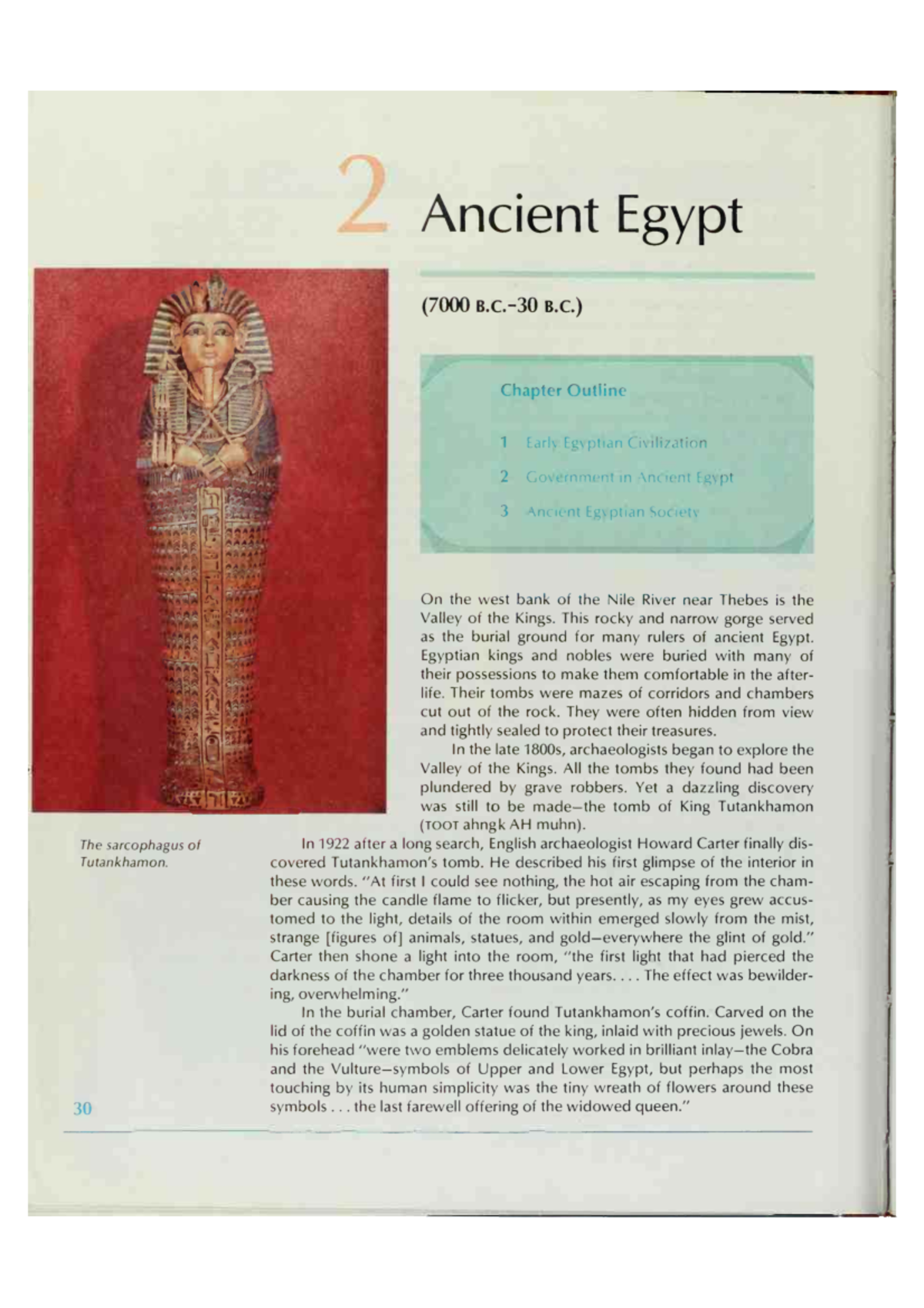
- Tutankhamun: Restored traditional polytheistic worship and returned the capital to Memphis; his intact tomb, discovered by Howard Carter in 1922, provided rare archaeological insight into royal burial practices.
- Ramesses II (The Great): Ruled for 66 years, fought the Hittites at the Battle of Kadesh (c. 1274 BCE, yielding the world's earliest known surviving international peace treaty), and commissioned colossal architectural works such as Abu Simbel and the Hypostyle Hall at Karnak.
The Third Intermediate, Late, and Greco-Roman Periods (c. 1069 BCE – 30 BCE)
Following the death of Ramesses XI, internal economic strain and loss of foreign territories led to fragmentation. Egypt was governed by Libyan military leaders, followed by the Nubian pharaohs of the 25th Dynasty, who restored classical Egyptian arts and religious customs.
Subsequent invasions by the Neo-Assyrian Empire and the Achaemenid Persian Empire reduced Egyptian independence. In 332 BCE, Alexander the Great conquered Egypt, founding Alexandria. Following his death, his general Ptolemy I Soter established the Ptolemaic Dynasty, initiating a Hellenistic era that blended Greek and Egyptian traditions. The dynastic period concluded with the death of Cleopatra VII in 30 BCE, after which Emperor Augustus annexed Egypt as a province of the Roman Empire.
Governance, Social Hierarchy, and State Administration
Ancient Egypt was governed as a centralized teocratic monarchy. The social structure formed an unyielding pyramid, with absolute authority vested at the top.
- PHARAOH: Divine Ruler & High Priest
- VIZIERS & NOBLES: Provincial Administration
- PRIESTS & SCRIBES: Religious & Administrative Keepers
- MILITARY OFFICERS & ARTISANS: Skilled Craftsmen & Soldiers
- FARMERS & LABORERS: Agricultural Majority & Conscripts
The Divine Authority of the Pharaoh
The Pharaoh was not merely a political executive; he was considered a living god on Earth. Regarded as the physical incarnation of Horus during life and associated with Osiris in death, the pharaoh was tasked with maintaining Ma'at—the fundamental cosmic principle of order, truth, justice, and harmony. If the king failed to maintain ritual purity or protect the borders, the gods might withhold the annual Nile floods or allow foreign invaders to disrupt societal balance.
Administrative Bureaucracy
The administrative apparatus was led by the Vizier (Tjaty), who acted as chief minister, overseeing the treasury, public works, judicial system, and state archives.
To manage regional affairs, Egypt was divided into roughly 42 administrative districts called nomes, each governed by a nomarch appointed by the crown. When central royal power was strong, nomarchs functioned as loyal civil servants; during periods of royal weakness, nomarch positions often became hereditary, leading to decentralization.
Literacy and Scriptoriums
The foundation of state efficiency was the class of scribes. Literacy was rare, estimated at less than 2% of the population. Scribes trained for years in specialized schools (Houses of Life) to master hieroglyphic and hieratic scripts. They recorded crop yields, assessed taxation levels based on water levels measured by nilometers, oversaw census records, calculated construction logistics, and drafted legal contracts.
Religious Beliefs, Cosmological Order, and Afterlife Practices
Religion saturated every aspect of ancient Egyptian life. It provided a framework for understanding natural phenomena, statecraft, human mortality, and social morality.
The Egyptian Afterlife Journey
- Deceased Dies
- Mummification (70-Day Process)
- Opening of the Mouth Ceremony
- Hall of Two Truths (Osiris)
- Weighing of the Heart (vs Ma'at)
- Entry into Field of Reeds
The Concept of Ma'at and the Pantheon
The governing ideology of Egyptian religion was Ma'at, represented as a goddess wearing an ostrich feather. Ma'at symbolized the divine structure of the universe established at creation.
The Egyptian pantheon included hundreds of deities representing natural forces, local attributes, and cosmic concepts:
- Amun-Ra: King of the gods, combining the Theban wind deity Amun with the ancient sun god Ra.
- Osiris: God of the underworld, agriculture, and resurrection; central figure of afterlife mythology.
- Isis: Devoted wife of Osiris and mother of Horus; protector goddess associated with magic and healing.
- Horus: Falcon-headed sky god associated with kingship and victory over chaos.
- Anubis: Jackal-headed deity responsible for mummification and guiding souls through the underworld.
- Seth: God of storms, chaos, violence, and the desert, contrasting with the order represented by Osiris and Horus.
Human Soul Elements and Afterlife Preparation
The Egyptians believed human existence comprised physical and spiritual components that had to be preserved for eternal life:
- The Physical Body: Must remain recognizable to anchor the spirit.
- The Ka: The spiritual double or life-force received at birth, requiring physical nourishment via food offerings.
- The Ba: The unique personality or soul, depicted as a human-headed bird capable of traveling between the tomb and the afterlife.
- The Ren: The person's secret name; preserving a written name guaranteed continued existence.
- The Shadow (Sheut): A component of identity that accompanied the individual throughout life.
Funerary Practices and Tomb Architecture
To ensure survival in the afterlife, Egyptians perfected mummification—a complex 70-day process that involved removing moisture from the body using natron (a naturally occurring salt compound), removing internal organs to be stored in canopic jars, and wrapping the body in linen bandages with protective amulets.
Tomb styles evolved dramatically over centuries:
- Mastabas: Flat-roofed, rectangular mud-brick structures used during the Early Dynastic Period.
- Pyramids: Monumental stone superstructures used in the Old and Middle Kingdoms to safeguard royal bodies and signal divine elevation to the sun god.
- Rock-Cut Tombs: Subterranean chambers carved directly into cliff faces, such as those in the Valley of the Kings near Luxor, designed to deter grave robbers during the New Kingdom.
During the burial process, priests performed rituals like the Opening of the Mouth ceremony to restore the deceased's senses. Funerary texts, including the Pyramid Texts, Coffin Texts, and eventually the Book of the Dead (written on papyrus scrolls), provided magical spells and instructions to guide the deceased through the underworld trials, culminating in the Weighing of the Heart against the feather of Ma'at before Osiris.
Technological, Scientific, and Cultural Achievements
Ancient Egyptian contributions to science, technology, and art resulted from practical necessity and administrative demands rather than theoretical abstract inquiry.
| Innovation | Practical Application |
|---|---|
| Papyrus Paper | Administration, literature, record-keeping, trade contracts. |
| Solar Calendar | Predicting Nile floods; 365-day year divided into 12 months. |
| Mathematical Geometry | Boundary surveying after floods, stone cutting, ramp physics. |
| Medical Diagnostics | Bone setting, wound treatment, pharmacological remedies. |
| Monumental Masonry | Construction of durable stone temples, obelisks, pyramids. |
Writing Systems and Literate Culture
Egyptians developed three distinct writing scripts over their history:
- Hieroglyphics: Formal, pictorial script used primarily for monumental inscriptions, religious texts, and royal decrees carved into stone or painted on plaster.
- Hieratic: A cursive, simplified script used by scribes for daily administrative records, legal deeds, and literary compositions on papyrus.
- Demotic: A highly stylized, rapid cursive script that replaced Hieratic for legal and commercial purposes around 660 BCE.
Decipherment of Egyptian writing occurred in 1822 when French scholar Jean-François Champollion used the Rosetta Stone—a trilingual stele featuring the same decree written in Hieroglyphic, Demotic, and Ancient Greek—to crack the phonetic code of hieroglyphs.
Mathematics, Engineering, and Surveying
Egyptian mathematics employed a base-10 non-positional system. Mathematical texts, such as the Rhind Mathematical Papyrus (c. 1550 BCE), reveal sophisticated knowledge of practical arithmetic, fractions, geometry, and early algebra.
Engineering applications included:
- Using right-angled triangles to construct precise 90-degree corners.
- Calculating areas of circles, rectangles, and trapezoids to recalculate farm boundaries after annual floods washed away property lines.
- Building inclined earth ramps and lever systems to move massive granite blocks weighing up to 50 tons into place during monument construction.
Medicine and Anatomy
Through the practice of mummification, Egyptian physicians gained an advanced empirical understanding of human anatomy, though they viewed organ functions through a magical and theological lens. The Edwin Smith Papyrus (c. 1600 BCE) is one of the oldest known surgical treatises, outlining diagnostic procedures, physical examinations, trauma management, and prognosis for head and spinal injuries. Egyptian doctors used honey as an antimicrobial dressing, set fractured bones with wooden splints, and used an array of herbal compounds.
Economic Systems and Trade Networks
The ancient Egyptian economy was a non-monetized, state-directed redistribution system driven by intensive agricultural production.
Agriculture and Grain Storage
Agricultural success depended on irrigation systems using canals, dykes, and human-powered water-lifting devices like the shaduf (introduced during the New Kingdom). The primary crops included emmer wheat (for bread), barley (for beer), flax (for linen textiles), papyrus (for paper, boats, and mats), and various vegetables and fruits.
Grains served as both the primary food source and the chief medium of exchange. Harvested grain was collected by state officials and stored in massive royal and temple granaries. These reserves were redistributed to feed state workers, craftsmen, priests, and the general population during poor harvest years.
Currency Standards and Trade Dynamics
Coinage was not introduced to Egypt until the Late Period through contacts with the Greek world. Transaction values were calculated using weight standards called the deben (roughly 91 grams of copper, silver, or gold). Goods were exchanged via bartering based on their equivalent value in deben weights of raw metals.
Egypt developed active international trade routes across the ancient Near East and Africa:
- Nubia (South): Imported gold, ivory, ebony, incense, exotic animal skins, and mercenaries.
- Punt (Red Sea Region): Sourced high-value luxury goods including myrrh, frankincense, gold, and baboons.
- Levant (Northeast): Imported cedar wood from Byblos (essential for ship construction and sarcophagi), olive oil, and wine.
- Aegean / Eastern Mediterranean: Traded fine linen, papyrus, and grain for silver, lapis lazuli, and finished ceramics.
Comparison of Dynastic Eras
The table below summarizes the key political shifts, capital cities, primary rulers, and cultural landmarks across Egypt's main historical eras.
| Historical Era | Approximate Dates | Capital City | Key Rulers | Primary Achievements & Innovations |
|---|---|---|---|---|
| Early Dynastic | 3100 – 2686 BCE | Thinis, Memphis | Narmer, Hor-Aha, Djer | Unification of Upper/Lower Egypt, creation of hieroglyphic script, mastaba tomb architecture. |
| Old Kingdom | 2686 – 2181 BCE | Memphis | Djoser, Sneferu, Khufu, Khafre | Construction of Step Pyramid at Saqqara and Great Pyramids at Giza; strong centralized bureaucracy. |
| Middle Kingdom | 2055 – 1650 BCE | Thebes, Itjtawy | Mentuhotep II, Senusret III, Amenemhat III | Classical age of Egyptian literature; irrigation projects in Faiyum; military expansion into Nubia. |
| New Kingdom | 1550 – 1069 BCE | Thebes, Akhetaten, Pi-Ramesses | Hatshepsut, Thutmose III, Akhenaten, Tutankhamun, Ramesses II | Imperial territorial expansion; construction of Valley of the Kings and Karnak Temple; international diplomacy. |
| Late Period | 664 – 332 BCE | Sais, Memphis | Psamtik I, Amasis II, Nectanebo II | Revival of traditional arts; foreign invasions by Assyrians and Persians; adoption of Demotic script. |
| Ptolemaic Period | 332 – 30 BCE | Alexandria | Ptolemy I, Ptolemy III, Cleopatra VII | Hellenistic fusion; creation of Library and Lighthouse of Alexandria; construction of Edfu and Philae temples. |
Decline, Fall, and Enduring Historical Legacy
The decline of dynastic Egypt was a slow process caused by structural economic instability, internal dynastic rivalries, and external military pressures.
Structural Decline and Foreign Subjugation
Toward the end of the New Kingdom (c. 1100 BCE), long-term military campaigns exhausted royal coffers, while weak pharaohs lost political control to the High Priests of Amun at Thebes. Simultaneously, drought cycles across the Mediterranean disrupted regional trade networks and triggered migrations of foreign groups, including the Sea Peoples.
As native central control collapsed, foreign empires invaded and ruled Egypt:
- Libyan and Nubian Control: Libyans established localized power in the Delta, while Nubian rulers of the 25th Dynasty briefly restored central power in the 8th century BCE.
- Assyrian and Persian Rule: The Neo-Assyrian Empire sacked Thebes in 663 BCE. Later, the Achaemenid Empire incorporated Egypt into the Persian Empire twice (525–404 BCE and 343–332 BCE).
- Hellenistic and Roman Imperial Integration: Alexander the Great's arrival in 332 BCE ended native Egyptian rule permanently, placing control in the hands of the Greek Ptolemaic elite. Following Cleopatra VII's death in 30 BCE, Egypt became the personal property of Roman emperors, serving as the primary grain supplier for Rome.
Cultural Legacy
Though ancient Egyptian statehood dissolved, its cultural contributions left a permanent mark on human history:
- Architecture: The mastery of stone columns, hypostyle halls, and structural geometry directly influenced archaic Greek architectural styles.
- Science and Calendars: The Egyptian 365-day solar calendar—divided into 12 months of 30 days plus five extra intercalation days—formed the structural basis for the Julian calendar introduced by Julius Caesar, which evolved into today's Gregorian calendar.
- Paper and Record-Keeping: Papyrus remained the primary writing material across the Mediterranean basin throughout Classical antiquity until parchment and paper processing replaced it centuries later.
Frequently Asked Questions
What caused the collapse of the Old Kingdom and the building of pyramids?
The collapse of the Old Kingdom resulted from a combination of severe environmental stress and internal political decentralization. Prolonged droughts reduced Nile flooding, cutting agricultural output and grain reserves. At the same time, regional governors (nomarchs) gained political autonomy and financial independence, withholding local taxes from the central crown. The massive expenditure of state resources on royal pyramid complexes also drained the central treasury, leaving the government unable to respond to widespread famine.
How were the Egyptian pyramids constructed without modern technology?
Pyramids were built using manual labor, sophisticated geometric surveying, and straightforward physical mechanics. Workers quarried limestone and granite blocks using copper chisels, wooden wedges, and stone hammers. Blocks were transported along the Nile on specialized barges during the flood season and dragged to construction sites on wooden sledges over wetted sand to reduce friction. Massive earth-and-brick ramps were constructed around the growing pyramid core, allowing teams of laborers to haul blocks into place using ropes and levers.
What is the historical significance of the Rosetta Stone?
The Rosetta Stone, discovered in 1799 during Napoleon’s expedition to Egypt, provided the key to deciphering ancient Egyptian hieroglyphic writing. It contains a royal decree issued at Memphis in 196 BCE by Ptolemy V, inscribed in three distinct scripts: Egyptian Hieroglyphic, Egyptian Demotic, and Ancient Greek. Because scholars could read Ancient Greek, Jean-François Champollion and Thomas Young used the text as a comparative key, establishing that hieroglyphs were not merely symbolic ideograms, but a complete writing system containing phonetic sounds, alphabetic characters, and determinatives.
What role did women play in ancient Egyptian society?
Compared to other ancient civilizations, women in ancient Egypt enjoyed significant legal rights and economic autonomy. They could own, inherit, buy, sell, and lease real estate and personal property independently of male guardians. Women could initiate divorce, sign legal contracts, serve as witnesses in court, and operate independent commercial businesses (such as textile production and perfumery). While primary roles centered on domestic management, women could serve as priestesses, scribes, and even supreme political sovereigns, as demonstrated by hatshepsut, Sobekneferu, and Cleopatra VII.
Why was mummification so central to ancient Egyptian religion?
Mummification was essential because ancient Egyptians believed that the afterlife required preserving the physical body as a anchor for the soul's components—the Ka (life force) and the Ba (personality). If a body decayed or was destroyed, these spiritual elements could not recognize their physical vessel, preventing the individual from surviving trials in the underworld or entering the Field of Reeds (paradise). Preserving the body ensured the continuous spiritual existence of the individual in the afterlife.
Recommended Next Steps for Research and Study
To build a deeper understanding of ancient Egyptian history and archaeological developments, consult the following academic resources and museum collections:
- Primary Source Collections: Examine online digital archives of the Rhind Mathematical Papyrus (British Museum) and the Edwin Smith Surgical Papyrus (New York Academy of Medicine) to review ancient Egyptian scientific literature.
- Archaeological Databases: Explore open-access catalog resources provided by the Oriental Institute at the University of Chicago and the Egypt Exploration Society (EES) for field excavation reports and translation updates.
- Museum Collections: Review virtual exhibits and artifact catalogs hosted by the Grand Egyptian Museum (GEM) in Giza, the British Museum in London, and the Metropolitan Museum of Art in New York.