Alteryx provides enterprise analytics with an integrated, automated platform that bridges the gap between raw data engineering and actionable business intelligence. By utilizing a low-code/no-code interface, Alteryx accelerates data preparation, democratizes advanced machine learning through AI-driven automation, and ensures robust governance and security across complex, multi-cloud environments for large-scale organizations.
In the 2026 analytics landscape, the pressure on enterprise data teams has shifted from merely collecting data to generating instantaneous, governed insights. Organizations are no longer satisfied with static reports; they require dynamic, predictive capabilities that can be deployed by business users and data scientists alike. Alteryx has evolved into a cornerstone of this transition, offering a unified environment that handles everything from basic ETL (Extract, Transform, Load) to generative AI-powered predictive modeling.
The Evolution of Alteryx in the Enterprise Ecosystem
Historically known for its "Designer" desktop application, Alteryx has matured into a comprehensive Alteryx Analytics Cloud Platform (AACP). For the enterprise, this means the software is no longer a siloed tool used by a few "power users." Instead, it is a centralized engine that connects to modern data warehouses like Snowflake, Databricks, and Google BigQuery, allowing data to be processed where it lives.
The primary benefit for the enterprise is the reduction of the "insight gap"—the time it takes to move from a business question to a data-driven answer. By abstracting the complexity of SQL, Python, and R into visual workflows, Alteryx allows domain experts (such as financial controllers or supply chain managers) to perform their own sophisticated analysis without waiting for a centralized IT or data science team to clear a backlog.
1. Accelerated Data Engineering and Automated ETL
One of the most significant Alteryx benefits for enterprise analytics is the radical simplification of data engineering. In a typical large organization, data is scattered across legacy on-premises databases, cloud storage (S3, Azure Blob), and various SaaS applications (Salesforce, Workday, SAP).
Streamlined Data Blending
Alteryx Designer and its cloud counterparts allow users to "blend" these disparate sources without writing a single line of code. The visual interface uses "tools" (icons representing specific functions like Join, Filter, or Formula) that are connected to create a repeatable workflow. This transparency is vital for enterprise audits; unlike a 500-line SQL script, an Alteryx workflow is self-documenting, making it easy for a new team member to understand the logic behind a data transformation.
In-Database (In-DB) Processing
For enterprises dealing with petabytes of data, moving data out of a warehouse for processing is inefficient and costly. Alteryx utilizes In-Database processing, which allows the platform to send the transformation logic directly to the database. This leverages the compute power of platforms like Snowflake or Amazon Redshift, ensuring that the "heavy lifting" happens within the secure cloud perimeter while the user maintains the ease of the Alteryx visual interface.
2. Democratization of Advanced Analytics and Machine Learning
In 2026, the shortage of specialized data scientists remains a bottleneck for many corporations. Alteryx addresses this by democratizing access to predictive and prescriptive analytics through Alteryx Machine Learning and Alteryx Auto Insights.
Citizen Data Science
The platform enables "Citizen Data Scientists"—business professionals who understand the data but lack formal coding training—to build high-quality machine learning models. Alteryx provides automated feature engineering and algorithm selection, guiding users through the process of building, validating, and deploying models. This scales the organization's analytical capacity far beyond what a small team of PhDs could achieve alone.
Generative AI Integration (Alteryx AiDIN)
A key feature of the modern Alteryx suite is AiDIN, the platform’s AI engine. It integrates generative AI to help users build workflows faster. For instance, a user can describe a business problem in natural language, and AiDIN can suggest the necessary tools or even draft the initial workflow. This significantly lowers the barrier to entry for complex enterprise analytics tasks, such as sentiment analysis or demand forecasting.
3. Robust Governance, Security, and Scalability
For an enterprise, a tool is only as good as its governance framework. "Shadow IT"—where employees use unapproved tools to process sensitive data—is a major risk. Alteryx mitigates this through Alteryx Server and the Alteryx Management Console.
Centralized Control and Versioning
Alteryx Server provides a secure, private gallery where workflows can be published, shared, and scheduled. It offers:
- Role-Based Access Control (RBAC): Ensuring only authorized personnel can view or execute specific data workflows.
- Version Control: Tracking changes over time, allowing teams to roll back to previous versions of a report if errors are discovered.
- Lineage Tracking: Providing a clear "map" of where data came from and what happened to it, which is essential for compliance with regulations like GDPR or CCPA.
Scalable Architecture
The enterprise benefits from Alteryx’s ability to scale horizontally. As the demand for analytics grows, organizations can add more "nodes" to their Alteryx Server environment to handle increased processing loads. Furthermore, the shift to a cloud-native architecture means that Alteryx can scale elastically, using only the resources needed at any given time, which optimizes cloud spend.
4. Operational Efficiency and Tangible ROI
The financial justification for Alteryx in the enterprise usually centers on two pillars: time savings and error reduction.
Reducing Manual "Data Grunt Work"
Many finance and HR departments still rely on manual Excel-based processes. These are not only slow but highly prone to human error. Alteryx automates these "manual joins" and "vlookups." A process that takes a team three days every month can often be reduced to a three-minute automated Alteryx workflow. Over a large organization, these saved hours translate into millions of dollars in reclaimed productivity.
Cost Optimization of the Data Stack
By acting as an orchestration layer, Alteryx helps enterprises maximize their investment in other technologies. Instead of hiring expensive consultants to build custom integrations between a CRM and a BI tool (like Tableau or Power BI), internal teams can use Alteryx to build the pipe themselves.
Comparison of Analytics Approaches in the Enterprise
The following table compares Alteryx against traditional manual methods and pure-code environments to illustrate why enterprises prioritize it for large-scale analytics.
| Feature | Manual (Excel/Legacy) | Pure Code (Python/SQL) | Alteryx Platform (2026) |
|---|---|---|---|
| Speed of Development | Slow & Repetitive | Moderate (High Dev Time) | Very Fast (Visual) |
| Skill Requirement | Low | High (Coding Required) | Medium (Business Logic) |
| Auditability | Poor (Hidden Formulas) | Moderate (Code Review) | High (Visual Lineage) |
| Governance | None (File-based) | High (Git/DevOps) | High (Server/Cloud Console) |
| AI/ML Integration | Manual/None | Complex Integration | Built-in (AiDIN/Auto ML) |
| Scalability | Non-existent | High (Containerized) | High (Elastic Cloud) |
5. Seamless Integration with the Modern Data Stack
Alteryx does not exist in a vacuum. Its value in an enterprise setting is amplified by its deep integration with the existing technology stack.
- BI Tool Connectivity: Alteryx has "native connectors" for Power BI, Tableau, and Qlik. This means data can be cleaned and prepared in Alteryx and pushed directly into a dashboard, ensuring the visualization layer is always based on "clean" data.
- Cloud Data Warehouses: As mentioned, the partnership with Snowflake and Databricks is central. Alteryx allows users to leverage the data lakehouse architecture without needing to master Spark or complex SQL.
- API Capabilities: Enterprises can use Alteryx to trigger actions in other systems via APIs. For example, a credit risk workflow in Alteryx could automatically trigger an email in an ERP system to hold an order if a customer's credit score drops.
6. Real-World Enterprise Use Cases
To understand the benefits, it is helpful to look at how different departments utilize the platform:
Finance: Automated Tax Reporting
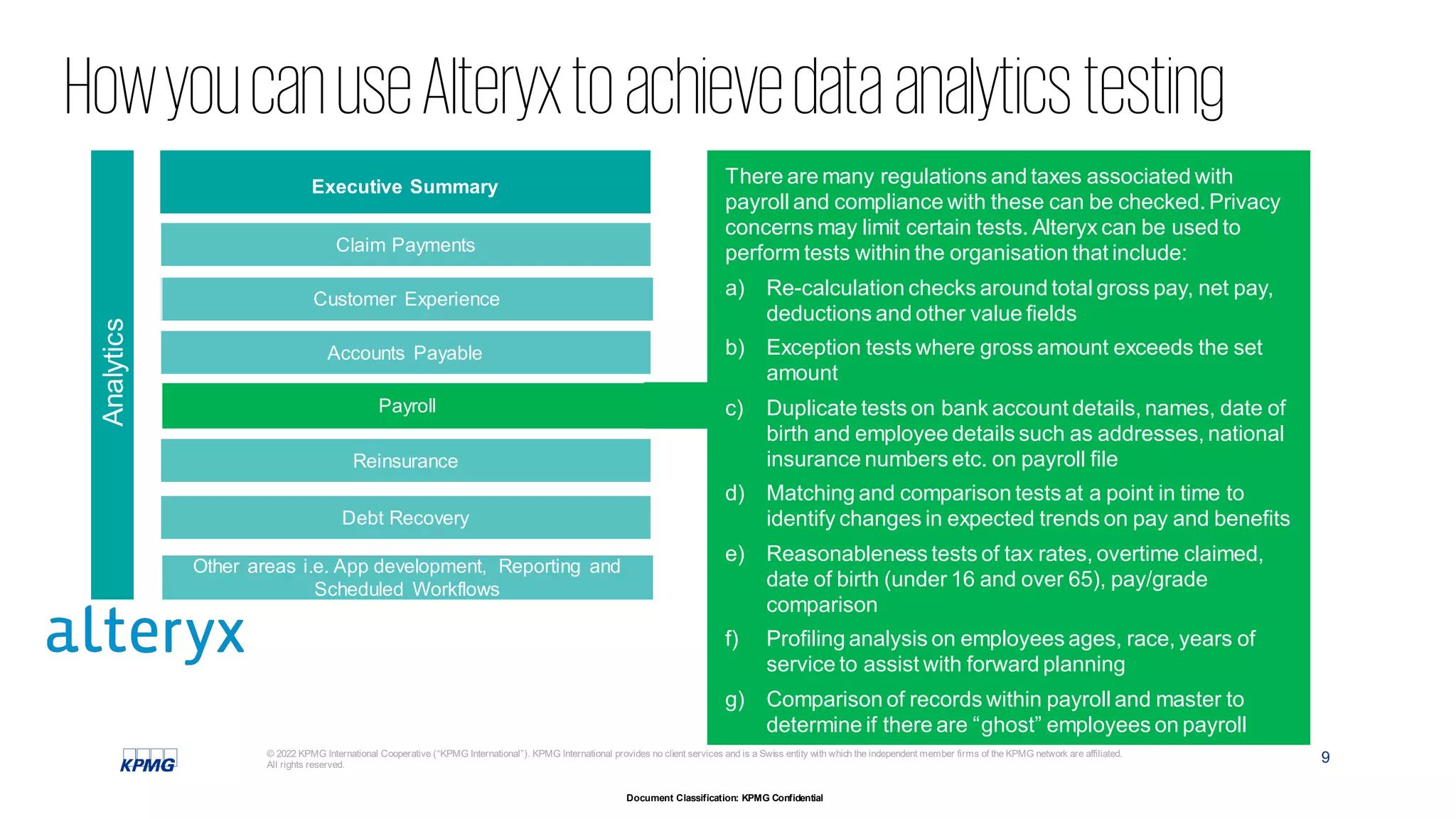
A multinational corporation must reconcile thousands of transactions across different tax jurisdictions. Alteryx can ingest data from 20 different ERP systems, apply complex tax logic, and output a formatted report for regulators, reducing a weeks-long process to hours.
Supply Chain: Predictive Inventory Management
By combining historical sales data with external weather and shipping delay data, an enterprise can use Alteryx Machine Learning to predict stock-outs before they happen. This "prescriptive" approach allows the company to move inventory proactively, saving on expedited shipping costs.
Marketing: Customer 360 Degree View
Marketing teams use Alteryx to blend social media sentiment, website clickstream data, and in-store purchase history. This creates a "Golden Record" for each customer, allowing for hyper-personalized marketing campaigns that significantly increase conversion rates.
Challenges and Considerations for Enterprise Deployment
While the benefits are extensive, an enterprise rollout of Alteryx requires careful planning. The most common pitfall is treating Alteryx as a "desktop-only" tool. Without an Alteryx Server or Cloud environment, the organization cannot achieve the governance and automation benefits described above.
Additionally, while the tool is "no-code," it still requires a strong understanding of data logic. Enterprises should invest in a "Center of Excellence" (CoE) to provide training and establish best practices for workflow design. This ensures that the workflows created by business users are efficient and do not place unnecessary load on the organization's data infrastructure.
Frequently Asked Questions
Is Alteryx a replacement for a Data Warehouse?
No. Alteryx is an analytics and automation platform that sits on top of a data warehouse. It is used to transform and analyze data, while the warehouse (like Snowflake or BigQuery) is used for storage and large-scale compute. Alteryx complements these tools by providing an accessible interface for interacting with the data stored within them.
How does Alteryx ensure data security in a cloud environment?
Alteryx employs multiple layers of security, including encryption at rest and in transit, Multi-Factor Authentication (MFA), and integration with enterprise identity providers via SAML or OAuth. In 2026, the Alteryx Cloud also adheres to major global standards such as SOC2, HIPAA, and ISO 27001, ensuring it meets the rigorous security requirements of highly regulated industries.
Can Alteryx handle real-time data streaming?
While Alteryx is primarily optimized for batch and micro-batch processing, it can be integrated with streaming platforms like Kafka or Amazon Kinesis via APIs and custom connectors. For most enterprise analytics use cases—such as hourly reporting or daily forecasting—Alteryx’s scheduling capabilities provide the necessary "near real-time" responsiveness.
What is the learning curve for an average business user?
A business user familiar with advanced Excel (Pivot tables, VLOOKUPs) can typically become productive in Alteryx Designer within 2 to 4 days of training. Mastering advanced predictive modeling or complex API integrations may take several weeks, but the "low-code" nature of the platform significantly reduces the learning curve compared to learning a programming language like Python.
How does Alteryx justify its cost compared to free tools like Python?
The cost is justified through "Time-to-Value." While Python is free, the time required for a professional to write, test, and maintain code for complex data pipelines is expensive. Alteryx allows those same pipelines to be built 5-10x faster and maintained by non-coders, drastically reducing the Total Cost of Ownership (TCO) for the organization’s analytics projects.
Strategic Recommendation for 2026
For enterprises looking to modernize their analytics stack in 2026, the focus should be on hybrid-cloud deployment. Organizations should utilize Alteryx Designer for complex workflow creation, while leveraging the Alteryx Analytics Cloud for broader distribution and accessibility.
To maximize ROI, enterprises should prioritize the automation of high-frequency, high-error manual processes first. By establishing a "Center of Excellence" to govern the deployment, a large organization can transition from a "data-heavy" environment to a "data-driven" one, where insights are accessible to every department, not just those with technical expertise.