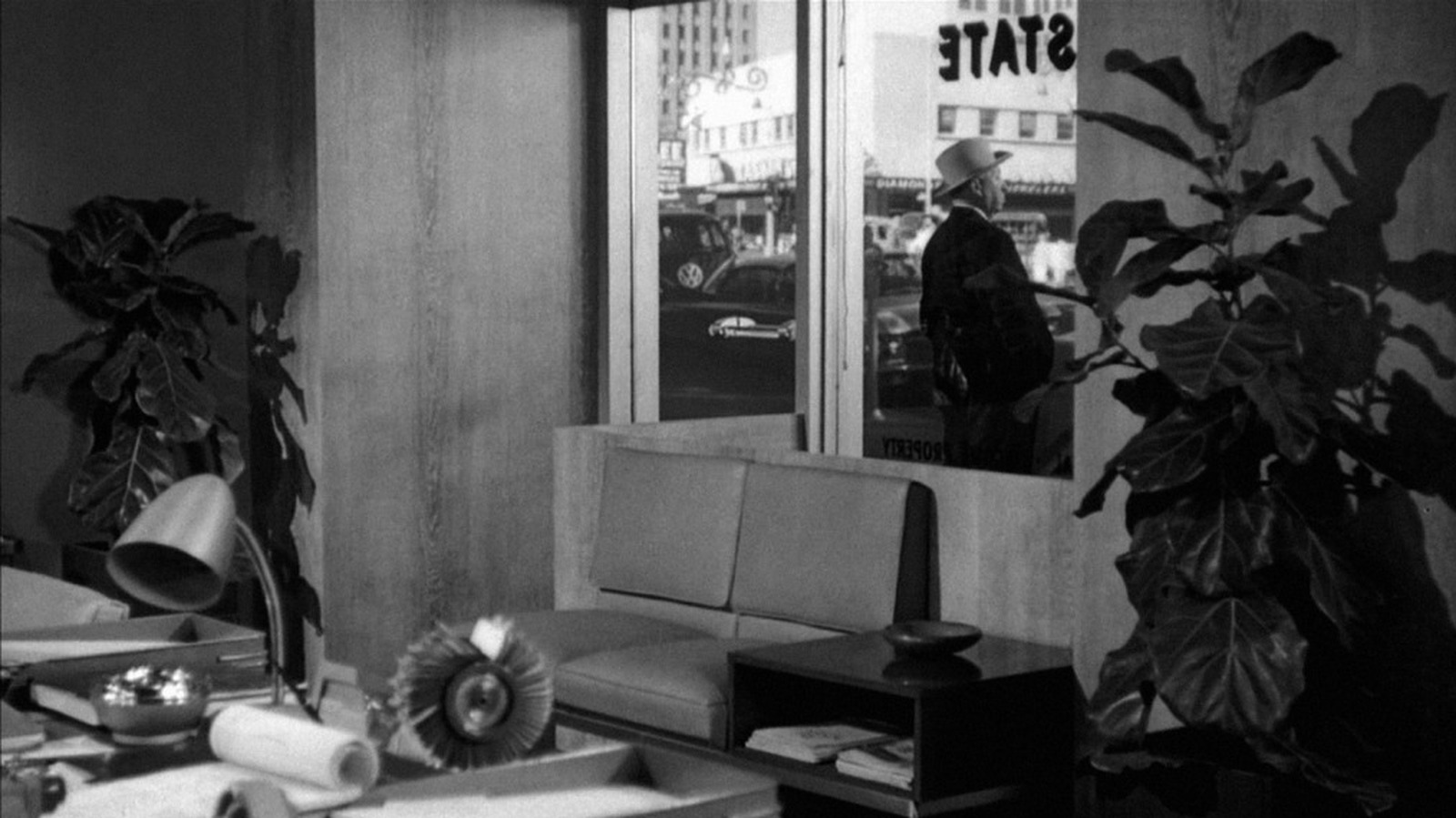
In Alfred Hitchcock's 1960 psychological horror masterpiece Psycho, the director appears at roughly the 06:25 mark, standing on the sidewalk outside Marion Crane's workplace wearing a light-colored Stetson cowboy hat. This brief, four-second glimpse served Hitchcock's deliberate rule of appearing early to prevent viewers from becoming distracted while hunting for his signature signature.
Hitchcock's walk-on appearances remain among the most recognizable recurring motifs in film history. While they began out of necessity during the silent era, by 1960 they had evolved into a high-profile calling card. The cameo in Psycho is particularly noteworthy because it arrives almost immediately, contrasts sharply with the film's bleak tone, and subtly sets up the themes of voyeurism and guilt that dominate the narrative.
Pinpointing the Cameo: Timestamp, Setting, and Visual Cues
Locating the director in Psycho does not require extensive searching, provided you know where to look during the opening act. The scene takes place immediately after the prologue between Marion Crane (Janet Leigh) and Sam Loomis (John Gavin) in a cheap downtown Phoenix hotel room.
As Marion returns to her job at the Lowery Real Estate office on a blazing hot Friday afternoon, the camera frames the street exterior. Hitchcock stands stationary on the sidewalk just outside the office window. He wears a light-colored Western Stetson hat and a dark suit, his silhouette turned three-quarters toward the street. Marion walks past him into the building, and Hitchcock turns slightly as she passes. The entire shot lasts roughly four seconds before the camera cuts inside to Marion's interaction with her co-worker Caroline (Patricia Hitchcock, the director's daughter) and client Tom Cassidy (Frank Albertson).
Precise Scene Breakdown
- Timestamp: 06:20–06:25 (varies by home video master, theatrical timing, and streaming frame rates; always within the first seven minutes).
- Location: Exterior of the Lowery Real Estate office, 417 N. Central Avenue, Phoenix, Arizona (recreated on the Universal/Revue backlot).
- Wardrobe: Tan Stetson hat, classic dark business suit, dark tie.
- Action: Standing near the curb, turned away from the office door, turning his head slightly as Marion enters.
- Screen Time: Approximately 4 seconds.
Why Alfred Hitchcock Appeared So Early in Psycho
The timing of Hitchcock's cameo in Psycho was not an accident; it followed a strict practical rule he instituted after noticing an unintended audience habit during the late 1940s and 1950s.
When Hitchcock first introduced walk-ons in silent films like The Lodger: A Story of the London Fog (1927), he needed extra bodies to fill the frame and save on background actor budgets. As his celebrity grew—amplified enormously in the 1950s by his weekly television series Alfred Hitchcock Presents—audiences began actively scanning the screen to find him.
Hitchcock realized that if he placed his cameo mid-film or near the climax, audience members would lose focus on the plot while waiting for his face to pop up. He explained this dilemma in his famous 1962 interviews with French filmmaker François Truffaut. To neutralize the distraction, Hitchcock made a conscious editorial decision: get the cameo out of the way within the first five to ten minutes of runtime.
Once viewers saw him standing outside Lowery Real Estate in Psycho, they could mentally check off the cameo and dedicate their undivided attention to Marion's illicit theft of $40,000, her flight out of Phoenix, and the impending terror at the Bates Motel.
Thematic Resonance: The Cowboy Hat and the Voyeur
While Hitchcock often treated his cameos with playful irony, film scholars have noted that his placement in Psycho aligns neatly with the underlying psychological architecture of the movie.
The Contrast of the Stetson Hat
The visual oddity of Alfred Hitchcock—a portly, English-born director known for formal London tailoring—wearing a wide-brimmed cowboy hat on a Phoenix street is subtly comical. Yet, Phoenix in 1960 was an expanding Southwestern hub where Western attire coexisted with corporate suits. By donning the Stetson, Hitchcock blends into the Arizona milieu while signaling an eccentric presence.
Moments after this exterior shot, Marion enters the office, where Tom Cassidy boasts about buying a home for his daughter as a wedding gift with $40,000 in cash. Cassidy also wears a cowboy hat, loud clothing, and exhibits Texas-style swagger. Hitchcock’s hat serves as a miniature visual prelude to Cassidy's arrival, linking the exterior world of Phoenix to the predatory financial temptation that triggers Marion's downfall.
The Observer Motif
Psycho is fundamentally a film about looking:
- Sam and Marion are watched through a window in the opening shot.
- Marion is scrutinized by a highway patrolman behind mirrored sunglasses.
- Norman Bates watches Marion undress through a peep-hole in his parlor wall.
- The audience is forced into complicity as voyeurs to a brutal murder.
By stationing himself directly outside Marion’s workplace, Hitchcock positions himself as the ultimate prime observer. He is the architect of the tragedy, watching his doomed protagonist walk into the office where she will seal her fate.
Comparing Hitchcock's Psycho Cameo Across His Filmography
To appreciate the efficiency of the Psycho appearance, it helps to compare it with how Hitchcock staged his appearances across different eras of his career.
| Film Title | Release Year | Timestamp / Segment | Description of Appearance | Dramatic Purpose / Style |
|---|---|---|---|---|
| The Lodger | 1927 | ~03:00 / Opening | Sitting at a newsroom desk with his back turned; later in a crowd. | Practical extra / filler. |
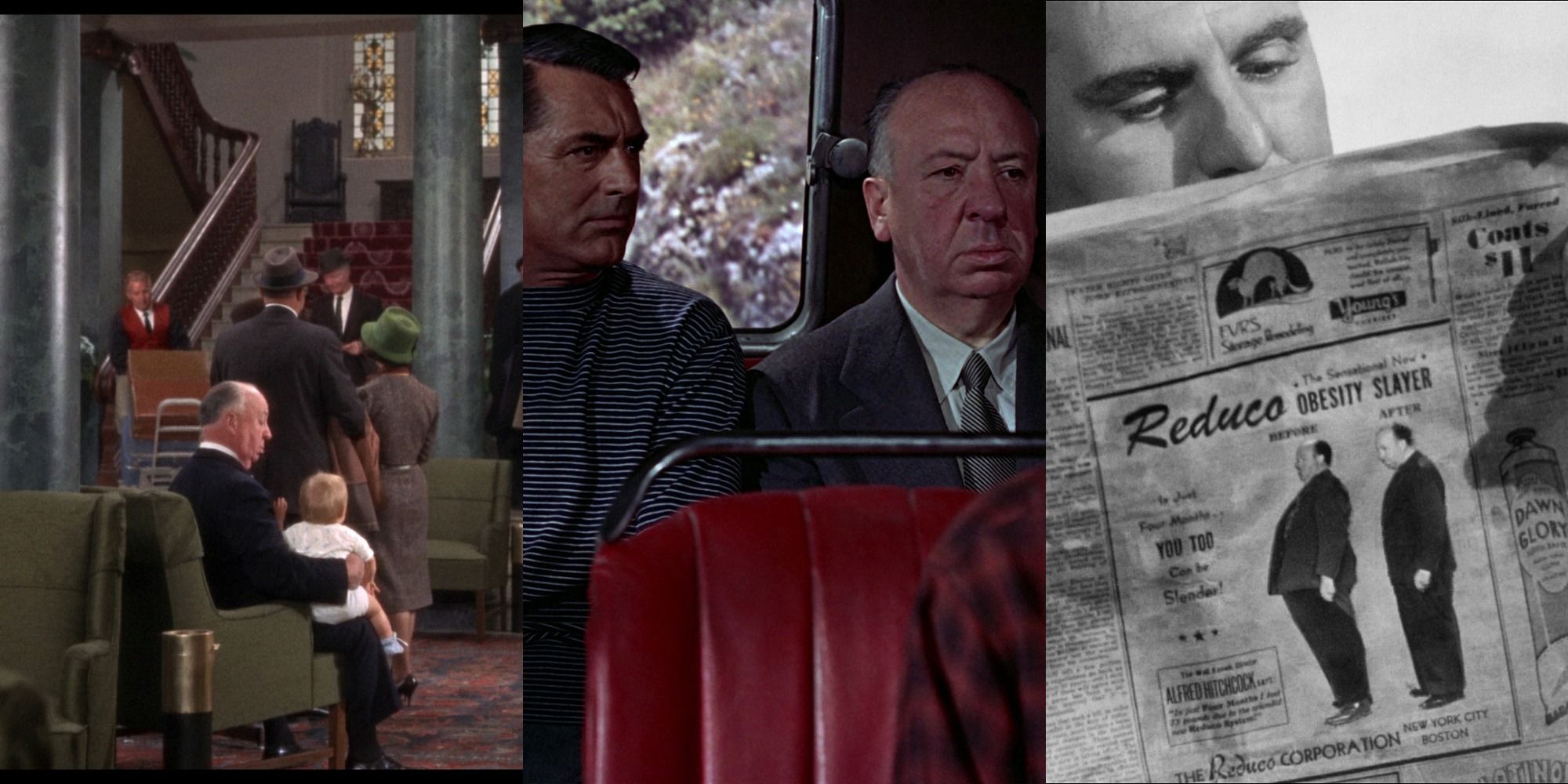
| Lifeboat | 1944 | ~52:00 / Mid-film | "Before and After" photos in a printed newspaper diet advertisement. | Technical challenge solved creatively within an isolated set. |
| Rope | 1948 | ~55:00 / Mid-film | Neon sign in the Manhattan skyline depicting his caricature profile. | Seamless visual insertion inside a continuous-shot conceit. |
| Strangers on a Train | 1951 | ~10:00 / Early | Boarding a train carrying a bulky double bass fiddle. | Comic relief; visual contrast with his stature. |
| Rear Window | 1954 | ~26:00 / Early-mid | Winding a clock in the songwriter's apartment across the courtyard. | Reinforces the voyeuristic theme of observing neighbors. |
| Vertigo | 1958 | ~11:00 / Early | Walking past Gavin Elster's shipyard office carrying a trumpet case. | Low-key passerby; early exit to maintain suspense. |
| North by Northwest | 1959 | ~02:00 / Credits | Misses a bus as the doors slam directly in his face. | Classic physical comedy establishing a playful tone. |
| Psycho | 1960 | ~06:25 / Early | Standing on the sidewalk in a Stetson hat outside Lowery Real Estate. | Early removal to avoid distracting the audience from the tension. |
| The Birds | 1963 | ~04:00 / Early | Leaving a pet shop with two white Sealyham Terriers. | Whimsical contrast with the forthcoming avian horror. |
Technical and Production Context of the Cameo
Filmed in late 1959 and early 1960, Psycho was an experimental project for Hitchcock. Financing the picture himself after Paramount refused to back a gruesome pulp novel adaptation, he kept costs minimal by employing his crew from Alfred Hitchcock Presents and shooting in black-and-white.
Studio Set vs. Phoenix Location
Although the establishing shots of Phoenix were captured by a second-unit crew under Hitchcock's directions in late 1959, the street scene outside the real estate office was filmed on the Universal Studios lot in Universal City, California. The art department dressed the storefront to match the Arizona streetscape.
Hitchcock did not travel to Phoenix to film his cameo. Instead, he stepped onto the lot's soundstage street exterior on a scheduled production day, shot the quick sequence with Leigh, and transitioned immediately to the interior office scenes.
Family Presence on Set
The scene where the cameo occurs also holds personal significance for Hitchcock's family. As Marion enters the building, she meets Caroline, played by Pat Hitchcock. Pat had appeared in earlier Hitchcock classics such as Stage Fright (1950) and Strangers on a Train (1951). Thus, within the span of thirty seconds, Hitchcock places his own visual signature on screen and transitions directly to his daughter delivering dialogue, emphasizing the intimate, small-crew nature of the Psycho shoot.
How to Spot the Psycho Cameo: Step-by-Step Guide for Viewers
If you are watching Psycho on Blu-ray, 4K UHD, or a digital streaming platform, follow these steps to spot Hitchcock without missing the dialogue:
- Start the film and let the title sequence conclude: Saul Bass's famous kinetic title cards accompanied by Bernard Herrmann’s screeching score run for roughly two minutes.
- Watch the opening pan across Phoenix: The film displays textual overlays indicating the date and time: Phoenix, Arizona / Friday, December the Eleventh / Two Forty-Three P.M.
- Wait through the hotel room scene: Marion Crane and Sam Loomis discuss their financial inability to marry inside a downtown hotel room. This scene concludes as Marion dresses and prepares to leave.
- Prepare for the cut to the street: At roughly 06:15 to 06:20, the camera cuts to an exterior shot of a city sidewalk.
- Look to the center-right of the frame: Before Marion enters the doorway of the Lowery Real Estate office, locate the large man standing motionless by the window edge. He wears a prominent light-colored cowboy hat. Marion sweeps past him, he turns his head slightly, and the camera cuts indoors at approximately 06:25.
Frequently Asked Questions
Did Alfred Hitchcock speak any dialogue in his Psycho cameo?
No. Hitchcock never spoke lines in any of his feature film cameos. His appearances were strictly non-speaking visual walk-ons or background placements designed not to disrupt the narrative rhythm.
Why is Hitchcock wearing a cowboy hat in Psycho?
The hat fits the geographic context of Phoenix, Arizona, and mirrors the Western attire worn by Tom Cassidy, the client who brings the $40,000 cash into the office moments later. It also allowed Hitchcock's recognizable profile to blend into the Southwestern setting while remaining identifiable to observant fans.
Does Alfred Hitchcock appear anywhere else in Psycho?
No. Hitchcock appears only once in Psycho, at the 06:25 mark outside the real estate office. Any claims of secondary cameos, such as silhouettes in the Bates house windows, depict the character of Norman Bates or body doubles for "Mother," not Hitchcock himself.
Was this cameo meant as a joke or a serious cinematic device?
It served both purposes. By 1960, the cameo was an established audience expectation and a piece of self-promotional showmanship that Hitchcock enjoyed. However, placing it early was a serious editorial device engineered to prevent the audience's cameo search from breaking the suspense of the main plot.
What was Hitchcock's final cameo before his death?
Hitchcock’s final official cameo was in his 1976 film Family Plot. In that film, his silhouette appears through the frosted glass door of the Registrar of Births and Deaths, forty-nine years after his first cameo in The Lodger.
Next Steps for Film Enthusiasts
To fully appreciate the craft behind Hitchcock's visual trademarks, consider these viewing and research recommendations:
- Watch the 1960 original alongside the 1998 shot-for-shot remake: Director Gus Van Sant honored Hitchcock’s cameo tradition in the 1998 version of Psycho. At the exact same timestamp, Van Sant appears outside the real estate office talking to a Hitchcock lookalike dressed in the director's classic attire.
- Read Hitchcock/Truffaut: François Truffaut's extended interview book offers direct commentary from Hitchcock regarding his cameo philosophy, production constraints on Psycho, and how he managed audience focus through early screen appearances.